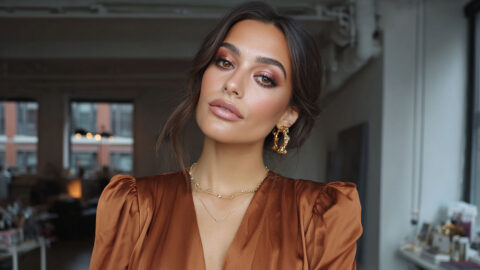
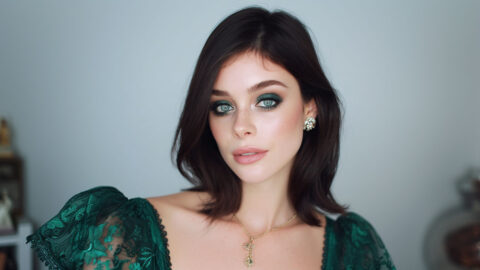
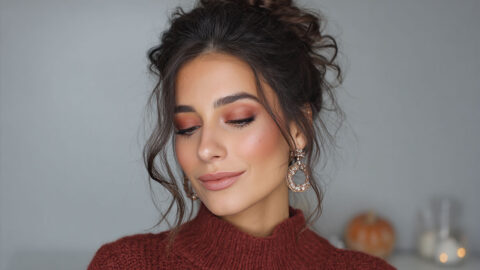
Cream and liquid blush now drive the blush category. Circana data reported by Glossy in 2024 shows US prestige blush sales through May more than tripled against the same period in 2021, driven mainly by liquid formulas.
That flush is the signature of soft glam makeup looks. The rest of the face is a radiant medium-coverage base, blended warm neutral eyeshadow and satin or glossy lips, with no hard lines anywhere.
Softness comes from diffusion, not from using fewer products. That’s why the style works at weddings, prom and evening events as well as in daylight.
What Makes a Makeup Look Soft Glam?

It lands between a bare-skin routine and full glam. The face gets a radiant, medium-coverage base and blended warm neutral eyeshadow, then satin or glossy lips to finish.
Editors tend to define it by what’s missing. Marie Claire Australia calls it an aesthetic free of harsh lines, and Woman & Home quotes makeup artist Gia Mills describing a hybrid that lifts the features without turning heavy.
Natural makeup keeps the base light, with little or no shadow and tinted lips and cheeks. Full glam goes the other way, with full coverage, heavy contour, dramatic lashes and high-pigment color. Soft glam uses a medium base, shaped eyes with a shimmer lid, a diffused sculpt and satin or glossy lips.
The quickest test is the edges. If you can see exactly where the shadow stops or the contour starts, the look has moved toward full glam makeup.
Soft doesn’t mean invisible, though. Marie Claire Australia points to a lash-heavy celebrity look that still counts as soft because it skips liner, and a plain natural makeup look misses the shimmer lid and sculpt that make soft glam read as polished.
Soft Glam Makeup Steps in Order, With the Tools Each Step Needs
Order matters more than any product list. Creams go on before powders, the eyes get done before the final set, and lips come last.
- Prep the skin with moisturizer, then sunscreen, then primer only where makeup tends to slide. Clean fingers are enough.
- Press on a medium-coverage foundation or skin tint with a damp sponge or a dense brush.
- Tap concealer at the inner corners of the eyes and over blemishes with the sponge tip or a small brush.
- Add cream blush and cream contour with fingers or a small dense brush, then soften the edges with the sponge.
- Shape the eyes. Use a fluffy brush for a matte transition shade in the crease, then a flat brush or fingertip for shimmer on the lid and inner corner.
- Smudge a soft brown liner close to the lash line, curl the lashes and add mascara.
- Brush the brows up and set them with brow gel using a spoolie.
- Dust translucent powder over the T-zone and under the eyes only, using a fluffy brush or puff.
- Line the lips, then press in a satin color or gloss.
- Add highlighter to the high points of the face and finish with setting spray.
Cream before powder is the rule people break most often. Laura Mercier’s directions for its Translucent Loose Setting Powder say to apply it after any creamy formula, cream blush included, and a guide to layering makeup covers the same logic for the rest of the routine.
Beautyblender’s directions say to wet the sponge until it nearly doubles in size, squeeze it damp and bounce it on, since swiping only moves product around. The brand also recommends replacing it every 3 months.
A fluffy blending brush diffuses the transition shade and softens every edge. Fingers are better for warming cream blush, contour and lip color into the skin.
Some artists do the eyes before the base so fallout wipes away clean. The downside is that concealer can drag across finished shadow.
A longer walkthrough of doing soft glam makeup from start to finish shows the same sequence on a face.
Base and Skin Finish: How Much Coverage Soft Glam Needs
Aim for medium coverage built in thin layers, with a satin or radiant finish. Matte full coverage drifts toward full glam, and a sheer wet-look finish drifts toward natural makeup.
Prep and primer

Sunscreen goes first, according to Cleveland Clinic guidance. Apply SPF 30 or higher after washing and moisturizing, then give it a few minutes to dry before any makeup.
From there, prepping your skin before makeup depends on skin type. Dry skin gets a richer moisturizer, and primer stays on the areas where foundation tends to slide.
Skip primer on dry patches. It only sits on top of them.
Foundation, concealer and setting

One thin layer of foundation or skin tint is enough, built up only where the skin needs it. Concealer goes in small amounts at the inner corners of the eyes and over blemishes, tapped in with the sponge tip.
Powder is a thin dusting on the T-zone and under the eyes. Laura Mercier’s directions apply its loose powder with a velour puff in a press-and-roll motion rather than sweeping it on.
Concealer is where creasing starts, so the fix for creasing under the eyes is a thin layer and a light set.
Setting spray goes on at the very end and decides how long the finish holds. Urban Decay reports that 78% of 50 participants in a 7-day study said All Nighter kept their makeup in place for 16 hours (brand listing, as of October 2026).
That is a brand-run study with a small sample, so treat 16 hours as a ceiling. Urban Decay’s directions call for misting from 8 to 10 inches away in an X and T pattern.
Which Eyeshadow Shades and Placement Work for Soft Glam Eyes?

Warm neutrals do most of the work. Taupe and soft brown give depth, champagne and peach add lift, and a matte transition shade sits in the crease with shimmer on the lid and inner corner. Harsh lines are the thing to avoid, so every edge gets blended.
Shade and finish choices
Anastasia Beverly Hills built its Soft Glam palette from 14 shades, 9 ultra-matte and 5 metallic (brand product copy, as of October 2026).
The ratio shows how the eye is built. The brand’s directions use warm matte neutrals to define and contour, and keep the metallics as accents.
Its own example is short. Rustic goes through the crease and Bronze gets pressed onto the lid.
Peach or rose adds warmth if the browns feel flat. Urban Decay’s Naked3 applies the same matte-plus-shimmer logic in rose-hued neutrals, a softer route if brown reads too heavy on you.
Placement and blending

Blending decides whether the eye reads soft.
The brush does most of it. ABH’s included brush uses the flat end to pack color onto the lid and the fluffy end to diffuse it, which is the right split for any brush set.
The classic setup puts the transition shade in the crease and shimmer across the lid. A halo eye puts shimmer in the center of the lid and a deeper shade at the inner and outer corners, blended toward the middle.
A small spot of shimmer at the inner corner finishes either option, and the steps for placing an inner corner highlight cover where it should sit.
Shimmer needs something to grip, so a thin layer of eyeshadow primer goes on the lid first.
Liner stays soft too. A smudged brown line along the lashes is enough, and a wing, if you want one, stays short and blended.
Blush, Sculpting, and Highlight Placement
Cream or liquid blush goes on the apples of the cheeks and gets blended up toward the temples. Keep the sculpt warm and soft, and let highlighter touch only the high points. No layer should leave a visible edge.
Rare Beauty’s directions describe Soft Pinch Liquid Blush as concentrated and say a little goes a long way. According to the brand, it layers over liquid or powder makeup without disturbing it. Start with one small dot per cheek, pat it in with fingertips and build from there, the same technique used for applying liquid blush in general.
For the sculpt, use a cream or powder contour a shade or two deeper than the skin. Keep it warm and apply it under the cheekbone only. Blend until the edge disappears, and check the method for using a cream contour if the formula drags.
A diffused liquid or cream highlighter goes on the cheekbone, brow bone and inner corner. ABH’s palette directions suggest its Glistening, Bronze and Fairy shades for the high points of the face and the brow bone, so one palette can double as a highlighter.
Woman & Home names two mistakes that ruin the sculpt, glittery cheekbones and gray, ghostly hollows. Both come from a heavy hand. Build in thin layers and stop earlier than feels necessary.
Lip Color, Brows, and Lashes
Lips lean rose, mauve, nude-pink or nude-brown, in satin or gloss. Brows are brushed up and set, not drawn. Lashes can be anything from a single coat of mascara to wispy clusters.
Lip shade and finish
Charlotte Tilbury sells Pillow Talk Original as a nude-pink Matte Revolution lipstick rated for up to 10 hours of wear (brand product page, as of October 2026).
That formula is matte, so the shade does the soft glam work and the finish needs adjusting. Press it on with a fingertip, then add gloss to the center of the lips.
The brand’s directions trace the liner just outside the natural lip line. For soft glam, stay on the natural edge and smudge the liner inward, because the technique behind applying lip liner is a light trace, not a hard outline.
Fenty Beauty describes Gloss Bomb as a non-sticky gloss with shea butter that works alone or over lipstick. It covers the glossy end of the finish range.
Brows
Brush them up and that’s most of it.
A clear or lightly tinted brow gel holds the hairs in place, and a light pencil fills only the sparse spots.
Sharp, drawn-on tails read as hard edges and push the look toward full glam.
Lashes
Mascara alone is the lightest option, with the lashes curled first and one or two coats on top. For evening, wispy strips that run longer at the outer corner work well, and individual clusters do the same job when you only want extra volume in certain spots.
Maybelline lists Lash Sensational Sky High in True Brown next to its blacks, and sells washable and waterproof versions. Brown softens the line at the lash base, and the waterproof version is built to resist smudging, which helps at weddings.
Which Soft Glam Look Fits Day, Evening, Weddings, and Prom?
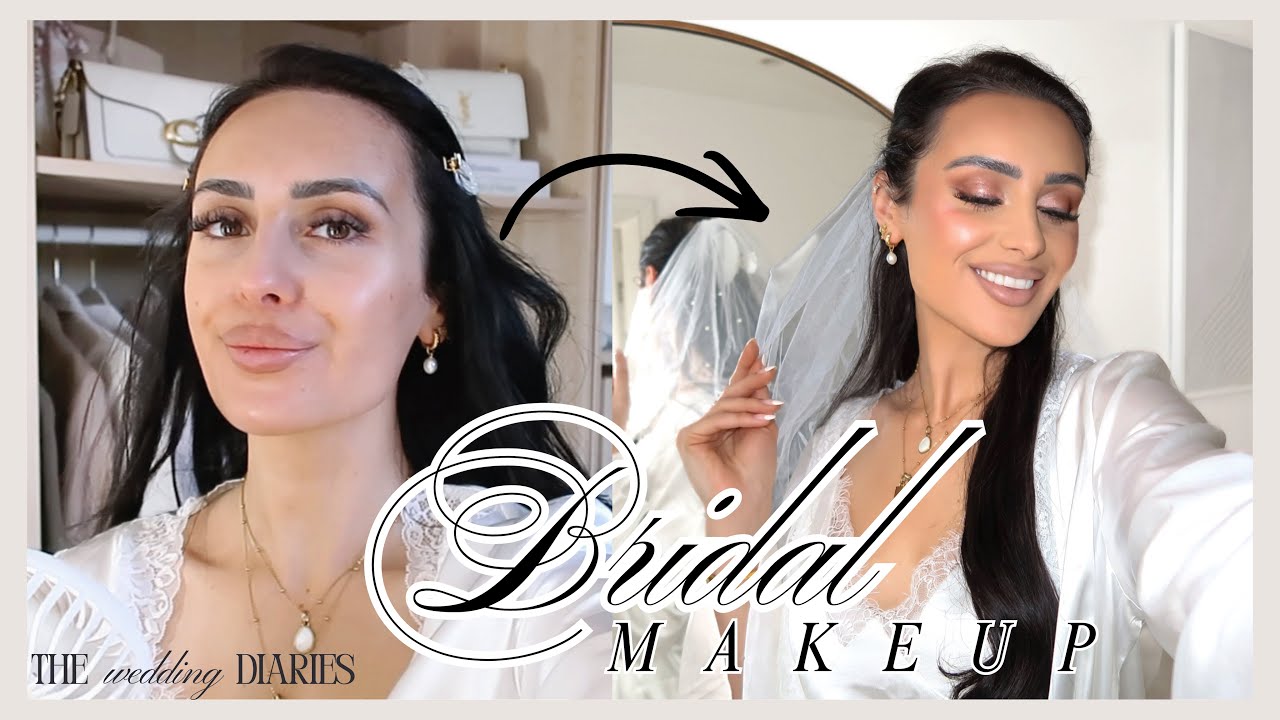
Daytime sits closest to natural makeup, and evening adds a metallic lid. Weddings and prom land in the middle. What decides it is how much shimmer and lash the event can carry, and how glossy the lip should be.
| Look | Eyes | Cheeks and lips | Glam level |
|---|---|---|---|
| Daytime | One matte brown wash, light shimmer | Cream blush, tinted gloss | Low |
| Evening | Matte crease, metallic lid, soft liner | Rosy blush, satin lip | Medium |
| Wedding guest | Champagne or peach lid, brown mascara | Peach or rose blush, rose lip | Medium-low |
| Bridal | Neutral lid, soft shimmer, optional lashes | Cream blush, nude-pink lip | Medium |
| Prom | Metallic lid, wispy lashes | Defined sculpt, glossy lip | Medium-high |
Tarte’s soft glam guide points to mellow looks for events such as summer weddings and graduation season. It keeps the full smoky eye for formal black tie and photoshoots.
Brides who want a wider range can compare this against other wedding makeup looks before booking a trial. Both bridal and prom get photographed heavily, so check shimmer and powder choices under a phone flash ahead of the day.
Prom sits at the top of the soft glam range because of the photos and the dancing. Add lashes and a defined sculpt, keep the lip glossy, and browse prom makeup looks to see where louder styles begin.
How to Adapt Soft Glam to Oily Skin, Hooded Eyes, Deep Skin Tones, and Mature Skin
The look itself stays the same. Formulas change with skin type, and shadow placement and shade depth change with eye shape and skin tone.
Oily skin
Oil breaks down cream products first, so the swaps start there.
Go lighter on the base and set it only where shine appears. Switch to powder blush if cream slides. On the eyes, put primer on the lid and use matte shades in the crease. Shimmer stays on the lid, where the primer sits underneath.
Hooded eyes
Bustle and MasterClass agree on the core rule, which is to apply shadow with your eyes open and put the crease shade above the natural fold. KING 5’s makeup artist Kelby Blosser reaches the same placement from another angle, marking the spot where the shadow stays visible.
Use a matte crease shade a few shades deeper than your skin tone, blended slightly above the fold. Shimmer goes on the center of the lid and the inner corner only.
The full routine for makeup for hooded eyes adds liner and lash tips on top of this placement.
Skip the brow bone highlight or shrink it to a small dab. MasterClass notes that highlighting the whole brow bone can overwhelm hooded eyes.
Deep and fair skin tones

On deeper tones, push the transition shade toward chocolate, cinnamon or deep bronze, and keep the contour warm so it never turns gray. Fairer tones do well with taupe, rose and soft peach on the eyes, and the sculpt stays a shade or two deeper than skin so it does not look muddy.
Matching depth beats matching names. A matte shade a few shades deeper than the skin scales to any tone, and a guide on how to match makeup to your skin tone covers the undertone side.
Mature skin

Advice splits on one point. Makeup artist Laura Geller (via Prevention Australia) says too much powder settles into fine lines and recommends creamier, more hydrating products.
Makeup artists quoted by Parade warn about the opposite risk. Heavy cream formulas move, crease and sink into lines through the day, so they favor light textures of either type.
Where they overlap is thin layers, a hydrating prep step and a primer, so product sits on the skin instead of in the lines.
Geller also points to baked formulas, which start as creams and finish as light powders.
Why Soft Glam Creases, Fades, or Turns Heavy (and When It Is the Wrong Choice)

Soft glam tends to go wrong in familiar ways. It creases, fades, turns heavy and cakey, or flashes back under a camera flash. Each one has a main cause and a short fix.
| Problem | Main cause | Fix |
|---|---|---|
| Creasing | Thick concealer or shadow on unprimed skin | Thin layers, primer, light set |
| Fading | Oil, friction and no setting step | Blot, set shiny spots, mist spray |
| Heavy or cakey | Too many layers and textures | Fewer products, lighter formulas |
| Flashback | Light-reflecting minerals or powders under flash | Test a flash photo, swap the powder |
Flashback: where sources disagree
Sources disagree on the main cause of flashback. L’Oreal Paris blames zinc oxide and titanium dioxide in SPF products.
Huda Beauty names silica powders as the worst offender. Lab Muffin Beauty Science says SPF minerals cause a white cast only sometimes, and that most SPF products do not.
Huda Beauty’s practical answer is a quick flash test before leaving the house.
Wear time and touch-ups
Soft glam lasts as long as its weakest layer, and that is usually the lip. Lipstick and gloss wear off with eating and drinking, so the lip color goes in the bag.
Eyes and base hold longer when primed and set, and a guide on how to make makeup last all day covers the rest.
Touch-ups are where the look turns heavy. Blot oil with a tissue and dab powder on shiny spots only, because re-layering base is what pushes makeup toward a cakey finish.
When soft glam is the wrong choice
Skip it if you want full coverage of acne, texture or pigmentation, since soft glam trades coverage for glow. Direct flash is risky when you can’t test heavy shimmer or silica powders first, and a long event with no touch-up window is a problem too.
In those cases, use a fuller-coverage base under the same eye and lip choices.
Drugstore or Prestige: Where to Spend on Soft Glam Products

Spend on the base and cheek color, and save on liners, mascara and brow products. Makeup artists interviewed by Daily Vanity say high-end lines tend to win on ingredients, pigment payoff and tools, while drugstore eye makeup has caught up.
Where drugstore holds up
NYX Professional Makeup’s current product copy lists its Slim Lip Pencil in 31 shades, and NYX cites L’Oreal calculations on NielsenIQ data ranking it the top US lip liner brand for the 52 weeks ending November 30, 2024.
A pencil is the right place to save, because the line gets blended under gloss or lipstick anyway. A guide on choosing a lip liner covers shade matching.
Drugstore lines cost less, come in wide shade ranges and have strong eye and liner options. The weak spot is brushes and applicators, according to the Daily Vanity panel.
Where prestige earns its price
The base is where prestige pays off, and the obvious pick is the wrong one.
Tarte’s Shape Tape concealer is a best-seller, listed as full coverage with a natural matte finish and 16-hour wear, which is the opposite of a thin, glowing soft glam base. Tarte also sells a radiant medium-coverage version in the same line, and that suits the look better.
A rundown on choosing a concealer shows how to match coverage to the job.
The Daily Vanity panel credits prestige with stronger pigment payoff and better tools, and you also get more formula choices, such as coverage levels. Richer textures may not suit every skin type, though, and a higher price does not guarantee a better fit.
Soft Glam Makeup Looks FAQ
Which eyeshadow colors suit blue, green, and brown eyes?
Warm browns and copper work well on blue eyes. Green eyes stand out against plum, mauve and bronze, while brown eyes take almost any warm neutral. A champagne or rose shimmer adds lift.
Can a beginner do this look with only a few products?
Yes. Five products cover it. A skin tint, cream blush, one neutral eyeshadow palette, mascara and a lip gloss.
Brow gel and a damp sponge are worth adding once the basics feel easy.
Can a skin tint replace foundation?
Yes, when the skin needs little coverage. Makeup artist Huda Kattan told Refinery29 Australia that a lightweight skin tint suits the look better than full-coverage foundation, because it enhances skin instead of covering it.
Add concealer only where it is needed.
How can I do soft glam faster?
Cut it to five steps: base, cream blush, one shadow shade on the lid, brow gel and lip gloss.
Fingers and a damp sponge move faster than brushes. Liner, lashes and highlighter are the first steps to drop.
Who made the style popular?
S Magazine’s interview with makeup artist Mario Dedivanovic credits him with first giving Kim Kardashian the look.
Refinery29 Australia also turned to Huda Kattan for a tutorial on it.
Which Soft Glam Look to Practice First
Start with the daytime soft glam look. It uses the fewest layers and forgives uneven blending.
Practice order differs from application order, and repair cost sets it. Start with cream blush and base, then move to one matte shade plus a lid shimmer. Liner, lashes and a defined sculpt come last.
Cheeks come first because a smudge there wipes off and blends again in seconds, while eye blending takes the most repetitions.
The trade-off is a flatter result in photos, since daytime skips the metallic lid and defined sculpt that evening and prom looks add.
This order, verified in October 2026, changes when a dated event with flash photography is booked. Practice that look instead, and test it under a phone flash.
Once the daytime routine runs smoothly, more everyday makeup looks show how to rotate shades without rebuilding it.

She started writing on the site after fielding the same questions from clients and friends often enough to just write the answers down: which red won't turn orange on a warm undertone, how to keep lipstick from feathering into fine lines, why a "12-hour" formula rarely survives dinner.
Every review on the site follows the same rule she uses with paying clients: wear it first, then decide if it's worth recommending.
- How to Make Eyeliner Last Longer Without Smudging - August 31, 2026
- How to Make Eyeshadow Last Longer All Day - August 29, 2026
- How to Find Your Undertone in 5 Easy Steps - August 27, 2026