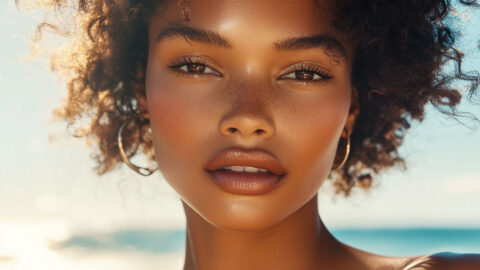
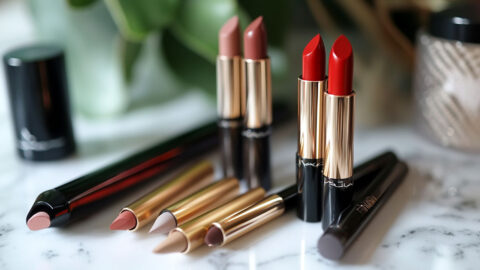
Most advice on lipstick for dark skin comes down to pigment and contrast. The shade has to be saturated enough to register against your natural lip and the skin around it, and the base has to suit your undertone. Rich reds, brown nudes, berries and plums, plus saturated corals, oranges and fuchsias, usually clear that bar.
People forget the lip itself is part of this. Oral mucosa runs from pink in pale-skinned people to brown or black in deeper-skinned people, depending on factors that include melanocyte activity (European Journal of Dentistry, 2022).
So the same lipstick lands on a different natural color from one person to the next. Undertone, shade depth and how opaque the formula is will matter more than the name on the tube.
Which lipstick colors look best on dark skin?
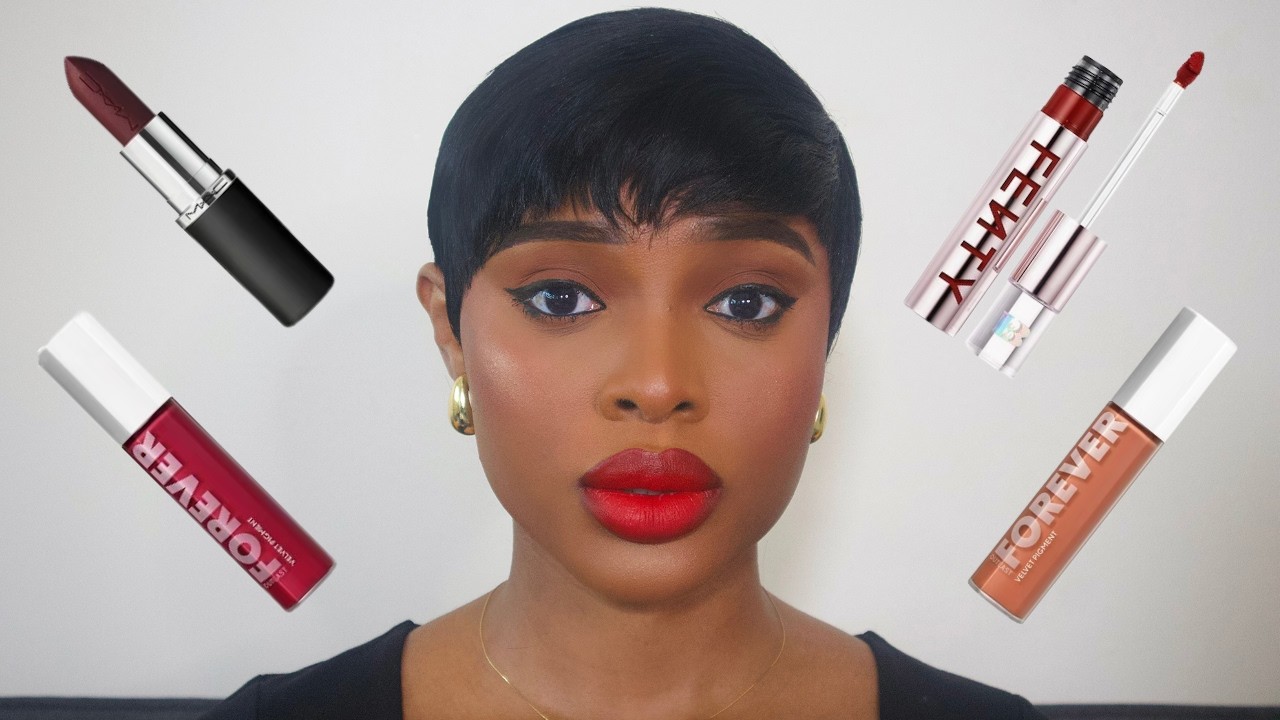
Rich reds, brown nudes, berries and plums, and saturated corals, oranges and fuchsias look best. Each has enough pigment to read as color instead of sinking into the lip.
Contrast does most of the work, more than the shade name.
Pale pinks and light beige nudes turn ashy because they sit lighter than the skin around them. Charlotte Tilbury’s shade guide flags the problem and answers it with a darker liner.
| Shade family | Undertone fit | Example shades | Watch for |
|---|---|---|---|
| Red | Blue-based for cool, orange-based for warm | Fenty Stunna Uncensored, Maybelline SuperStay Matte Ink Innovator | Wrong base turns dull |
| Brown nude | Warm and neutral | MAC Whirl, Fenty Stunna Unveil | Pale versions go ashy |
| Berry, plum, burgundy | Cool and neutral | MAC Diva | Dark edges blur |
| Coral and orange | Warm | Giorgio Armani Lip Maestro The Tibetan Orange | Needs high pigment |
| Pink and fuchsia | Cool | NARS Audacious Claudia, Black Radiance Perfect Tone Purple Passion | Pastels lose contrast |
Undertone narrows the shade family. After that it’s mostly contrast (the gap between the lipstick, your natural lip and your skin), how opaque the formula is in one or two passes, and whether the finish is matte, satin, cream or gloss.
The same logic applies when picking a lipstick color for any complexion. On deeper skin, the contrast bar simply sits higher.
How does undertone decide the right shade?
Undertone picks the shade family. Cool undertones suit blue-based reds and mauve pinks, along with berries, while warm and neutral undertones suit orange-based corals and bricks, according to makeup artist Gene in Marie Claire.
Skin tone shifts with sun exposure, but undertone does not (Mented Cosmetics).
Blue in the pigment base is what cool undertones favor, and it’s the logic behind lipstick shades for cool undertones in general. Warm undertones go the other way, toward orange and brown bases, which the wider set of lipstick shades for warm undertones also builds on.
How to find your undertone

Do these bare-faced, in daylight.
- Hold gold and silver jewelry against your skin. Gold looking better points warm, silver points cool.
- Compare a white cloth and an off-white cloth under your chin (Maybelline’s undertone guide lists both tests).
- Look at the veins on your inner wrist. Green leans warm, blue leans cool, a mix leans neutral.
- Note how your skin pulls in the sun, golden or rosy.
- Swipe a blue-based red and an orange-based red on the lip. Keep the one that looks cleaner.
Deeper skin often hides wrist veins, and the vein and jewelry checks blur near neutral. When two checks disagree, call it neutral and let the lip swatch settle it. Honestly, the swatch is the only one of these I’d fully trust.
Does skin depth change the shade?
Sort of, though mostly as contrast and not through either of the big skin scales.
Google’s Monk Skin Tone Scale (2022), built with Harvard sociologist Dr. Ellis Monk, has 10 shades. The Fitzpatrick scale it was positioned against has six types.
Fitzpatrick was built to predict how skin reacts to UV light, and its first version covered only types I to IV, with V and VI added later (Healthline). It describes sun response, not lip contrast. Types V and VI cover skin that rarely burns or never burns, while the Monk scale splits things into ten tones, so the deep end gets finer steps.
Neither scale is a lipstick chart, so depth works better as a contrast dial. Charlotte Tilbury splits its advice across tan, deep and dark skin and ties lighter shades to a darker liner, while Mented notes that melanin concentration varies across dark skin itself.
Which red lipstick works on dark skin?

Match the base to your undertone. Blue-based reds suit cool undertones and orange-based reds suit warm ones. When the undertone is unclear, a neutral true red is the safer pick.
A wrong base makes red look dull instead of rich. The split between cool and warm reds comes down to pigment base, not brightness.
For cool undertones, L’Oreal Paris Colour Riche Intense Volume Matte in Le Rouge Avant-Garde is a ruby red with bluish undertones (Makeup.com). Blue-leaning burgundy reds fit here too.
On the warm side, Giorgio Armani Lip Maestro Velvet Liquid in The Tibetan Orange is a warm orange-red (Makeup.com). Maybelline SuperStay Matte Ink in Innovator is a poppy orange-red that The Zoe Report names as the closest match to the discontinued shade makeup artist Spickard favors for deep skin. Brick reds belong in this camp as well.
The sources disagree on how far a single red can stretch. The Zoe Report quotes artist Jonet Williamson saying shades of red and plum are generally good for all complexions, and it calls the blue undertones of MAC Ruby Woo flattering on every skin tone, while Marie Claire’s artist assigns blue-based reds to cool undertones and orange-based reds to warm ones.
I think both hold up. A blue-based red is the low-risk default, and matching the base is the upgrade on top of it.
Fenty Beauty launched Stunna Lip Paint in 2017 with one shade, the matte red Uncensored, pitched as a universal red with a 12-hour hold (Cosmetics Business, 2017).
How do you wear nude and brown lipstick without it looking ashy?

Go for a nude with brown or rose in the base (taupe works too), keep it at or below the depth of your natural lip, and add a darker liner when the shade runs light. Beige and pale pink nudes are the ones that go gray.
The wider method for choosing a nude lipstick still applies, with the depth shifted for deep skin.
Why nude lipstick turns ashy
Fair shades such as pale pink and light beige can look ashy on dark skin, according to Charlotte Tilbury’s guide.
The fix is either a rosy brown or brown nude with real pigment, or a pencil darker than the lipstick. A shade that is too light never recovers on its own.
Brown nudes that hold their color
MAC Whirl, a dirty-rose matte that sits at the pink-brown end of nudes (MAC Cosmetics), and Fenty Stunna Unveil, a chocolate brown released in 2018 in the Stunna line, cover the two ends of the range.
Mented Cosmetics is a different case. It launched in 2017 built around nude lipsticks for darker skin tones.
Spickard calls dark brown with warm undertones a pick for almost all medium to deep skin (The Zoe Report). If brown is new to you, a primer on wearing brown lipstick shows how to fit it into daily makeup.
Sources split on whether nudes belong to warm undertones only. Spickard names one warm-leaning brown as a broad pick. Maybelline UK goes further and maps separate nudes to warm, cool and neutral undertones.
Are berry, plum and purple lipsticks the safest choice for dark skin?
They rank among the most reliable families, with one condition. The base has to match the undertone, or the plum loses the contrast that made it a good pick.
Sources split here too. Some pages call berry universally flattering on deep skin, while Marie Claire’s artist and Maybelline UK tie plum and mauve to cool undertones. Depth makes berry safe, and undertone decides which berry.
MAC Diva is a reddish burgundy that MAC’s Terry Barber counts among the original MAC lip shades. Maybelline UK files its wine-like deep purple under cool undertones, and L’Oreal Paris names purple and dark chocolate brown for deep skin.
Purple sits at the far end of this family, and a guide to wearing purple lipstick covers how to balance it with the rest of the face.
Dark shades blur at the edge when applied freehand. The basics of wearing dark lipstick start with prepped lips and a liner to define the edge, as in L’Oreal Paris’s guide.
MAC’s own Diva styling begins with a deep wine pencil in Plum, then the lipstick on top.
Do pink, coral, orange and fuchsia lipsticks work on dark skin?
Yes, as long as the shade is saturated and the formula is opaque. Opacity decides whether a bright registers on deep skin, and undertone decides whether it looks clean.
Most pinks lean cool, which is why the family sits on the cool side, but warm-leaning pinks exist. NARS Audacious in Claudia is a cool pink with blue undertones, while Anita is a medium-dark pink with warm undertones. Both are opaque satins (Brown Girl Magazine).
That split matters most when wearing pink lipstick on deeper skin, where a warm pink and a cool pink read very differently.
Coral and orange suit warm undertones. NARS Powermatte runs from peachy nudes through bright oranges, which gives a warm undertone several steps to try (Cult Beauty).
Burnt orange is the easier entry point, since it sits between a warm red and a brown. Anyone wearing orange lipstick for the first time should start there and move brighter.
With fuchsia, saturation does the contrast work. Black Radiance Perfect Tone Lip Color in Purple Passion is a vivid fuchsia with full coverage and satin shine, per the Walmart listing.
Check opacity in one swipe before buying. If the natural lip shows through, the formula is wrong, not the color.
Which lipstick finish and formula show up best on dark skin?
Every finish works on dark skin, so the choice comes down to wear, comfort and lip size. Maybelline UK treats matte versus glossy as personal preference, while Maybelline India notes that matte can make lips look smaller and gloss adds volume.
Matte, satin, cream or gloss
| Finish | Pros | Cons |
|---|---|---|
| Matte | Bold flat color, transfer-resistant (NARS Powermatte) | Can shrink the lip look, bled while eating in one Black Radiance review |
| Creamy matte | Satin comfort with a matte look (Maybelline India) | Velvet finish, not a full dry-down |
| Satin | Hydrating, opaque (NARS Audacious) | Shorter wear in one Audacious review |
| Gloss | Adds volume, layers over any lipstick | Softens bold shades (Fenty Beauty) |
The dryness that comes with matte is manageable, and there are ways to keep lips moisturized under matte lipstick.
The quickest way to soften a matte is applying lip gloss over lipstick. Fenty Beauty sells Gloss Bomb on exactly that use, and Ulta’s listing recommends it over a favorite lip color for extra dimension.
How much pigment payoff is enough
NARS Powermatte is built around bold, budge-proof color in a single pass (Cult Beauty). Pat McGrath Labs’ LuxeTrance application notes go the other way and build opacity in layers, pressing the color on with a finger (Selfridges).
The late Sharon Chuter, founder of Uoma, argued in a 2019 Dazed interview that a lipstick should err toward super-pigmented.
For a quick test, make one pass on the lip and look. If the natural lip shows through, add a layer or pick another formula.
How do dark or uneven natural lips change the shade, and which liner fixes it?
Natural lip color shows through light or sheer shades and shifts the final result, so neutralize the lip first, then line it. Two-toned lips are common on deeper skin, according to Pound Cake founder Camille Bell (Marie Claire).
Bell describes a light pink top lip over a dark brown bottom lip, or the reverse.
With a darker or two-toned lip and a light or sheer shade, neutralize first, then line. An even lip with an opaque shade can skip the neutralizer, and the liner is only there for edge definition. For an ombre look, pick a liner two to three shades darker than the lipstick.
Neutralizing darker lips
A thin layer of foundation or concealer on the lip gives the lipstick a blank base, so it shows its tube color. The Beauty Department’s makeup-artist tutorial uses foundation on a sponge, and Pat McGrath Labs’ LuxeTrance instructions at Selfridges call for exfoliating, then a touch of concealer.
In that tutorial, clients with darker skin tones tend to have darker lips or a dark line around the lip perimeter.
It is not a daily step. A clear gloss on natural lips works fine on days off.
Order matters when applying lipstick on dark lips: neutralize, line, then color.
Choosing a lip liner shade
Who What Wear’s tester picks a liner one shade darker than the lip or lipstick for a natural look, and two to three shades darker for ombre. A liner that matches the lipstick exactly tends to look flat.
The real constraint is range. The same writer found that few lines offer enough shades to avoid leaving dark lips looking gray or ashy.
Morphe Signature Lip Pencil is the affordable pick at GBP 8, and Victoria Beckham Beauty Lip Definer is the luxury one at GBP 31. A black liner gives a sharp edge that stands out cleanly on dark skin.
The general method for choosing a lip liner still applies. The shade range is what changes on deeper skin.
Which brands carry the widest shade ranges, and how do you test a shade before buying?
Brands built for deeper skin (Uoma Beauty, Mented Cosmetics, Black Radiance) and mainstream lines with broad ranges (MAC, NARS, Pat McGrath Labs, Fenty Beauty) all carry shades for deep skin. They split across drugstore, founder-built and prestige tiers.
| Brand | Sold at | Lip line to check |
|---|---|---|
| Uoma Beauty | Ulta, Nordstrom, Morphe (as of its 2021 Morphe launch) | Badass Icon matte lipsticks |
| Mented Cosmetics | Target, Ulta, HSN | Lipsticks and nude glosses |
| Black Radiance | CVS, Walmart | Perfect Tone Lip Color |
| NARS | Cult Beauty, MECCA | Powermatte (matte), Audacious (satin) |
| Pat McGrath Labs | Sephora, Selfridges | LuxeTrance (cream, opaque) |
Drugstore, prestige and founder-built lines

Black Radiance Perfect Tone Lip Color lists at $1.97 on Walmart as of October 2026. Maybelline’s Color Sensational range includes nude, pink, red and plum shades, per Maybelline India.
The savings show up in wear time. A 2016 swatch review of Black Radiance’s matte shades on dark skin found good pigment but short wear and bleeding while eating (The Style and Beauty Doctor).
A cheap lipstick is still the lowest-risk way to test a shade family before paying for a formula you love.
Uoma, started by Sharon Chuter in 2019, offers dozens of lipstick shades for all skin tones (Entrepreneur) and added Morphe in 2021 after Ulta and Nordstrom (Glossy). Chuter stepped down as CEO in 2023 and died in August 2025, and the brand has since changed owners, so check current availability before you shop.
On the prestige end, NARS separates satin Audacious from matte Powermatte, and Pat McGrath’s LuxeTrance is a creamy, opaque, full-coverage formula (The Beauty Look Book).
Testing a shade before you buy
- Shortlist with a retailer tool. Sephora’s Virtual Artist launched in 2016 with more than 3,000 lipstick and lip gloss colors and skin-tone filtering through Pantone Color IQ (Global Cosmetic Industry), MAC’s try-on page advertises 800+ shades, and Ulta’s app offers GLAMlab.
- Look at swatches on deep skin, not product photos.
- Swatch the real shade on the lip in daylight.
- Compare it with the virtual image before checkout.
That last step matters because members of Sephora’s Deeper Shades community report that the app’s try-on adds warmth the real shade lacks.
Testers pass between shoppers, so use a disposable applicator and follow the steps for sanitizing a lipstick before swatching.
Lipstick Colors for Dark Skin FAQ
Which lipstick color suits everyday wear, a wedding or an evening look?
Brown nudes and soft berries are easy for everyday wear. A red suits a wedding, and plum or burgundy tends to suit the evening.
Move up in saturation as the occasion gets more formal, and keep the base matched to your undertone.
Can dark skin wear green, black or other unusual lipstick colors?

Yes. Deep skin has the contrast to carry saturated dark colors such as black and deep green, even violet.
Pick a shade with a visible hue, since near-black can read as plain black on the lip. If you go that way, the styling rules for wearing black lipstick apply.
How long should lipstick last on dark skin, and what extends wear?
The formula decides wear time, not the skin. Transfer-resistant liquid mattes outlast satin bullets.
A coordinating liner beneath the lipstick adds staying power, according to Pat McGrath Labs’ LuxeTrance instructions at Selfridges. Other ways to make lipstick last longer work on any skin tone.
Do lipstick shades look different in daylight and indoor light?

Yes. Store lighting and indoor bulbs change how a shade reads, and so does camera flash, so judge it in daylight first.
Mented applies the same rule to foundation: let the shade sit about five minutes, then check it in natural light.
Building a Starter Set for Dark Skin
A brown nude, a red matched to your undertone and a berry or plum cover most situations. The order you buy them in decides how many mistakes you avoid.
Start with the red, since it settles whether you’re blue-based or orange-based. The brown nude comes second, bought with a liner. The berry or plum goes last, in the base you’ve now confirmed.
What this set leaves out is range. Pink, coral, orange and fuchsia each lean to one side of the undertone split and can wait.
These picks reflect brand listings checked in October 2026. Reformulated or discontinued shades change the match, so swatch again before repurchasing.
With the lip shades chosen, the rest of the face is the next step in doing makeup for dark skin.

She started writing on the site after fielding the same questions from clients and friends often enough to just write the answers down: which red won't turn orange on a warm undertone, how to keep lipstick from feathering into fine lines, why a "12-hour" formula rarely survives dinner.
Every review on the site follows the same rule she uses with paying clients: wear it first, then decide if it's worth recommending.
- How to Make Eyeliner Last Longer Without Smudging - August 31, 2026
- How to Make Eyeshadow Last Longer All Day - August 29, 2026
- How to Find Your Undertone in 5 Easy Steps - August 27, 2026