Under-eye darkness rarely has a single cause. In a clinical analysis of 65 patients, 78% of dark circles were mixed types combining two or more of pigment, visible vessels and shadow, and only 5% were pigment alone (Huang et al., International Journal of Dermatology, 2014).
That’s why one shade rarely cancels the area on its own.
Concealer carries more pigment than foundation, so it covers dark circles, blemishes and redness that foundation leaves visible. The same pigment is what makes it look heavy when it’s misused.
Which Concealer Formula and Coverage Level Fits the Job?
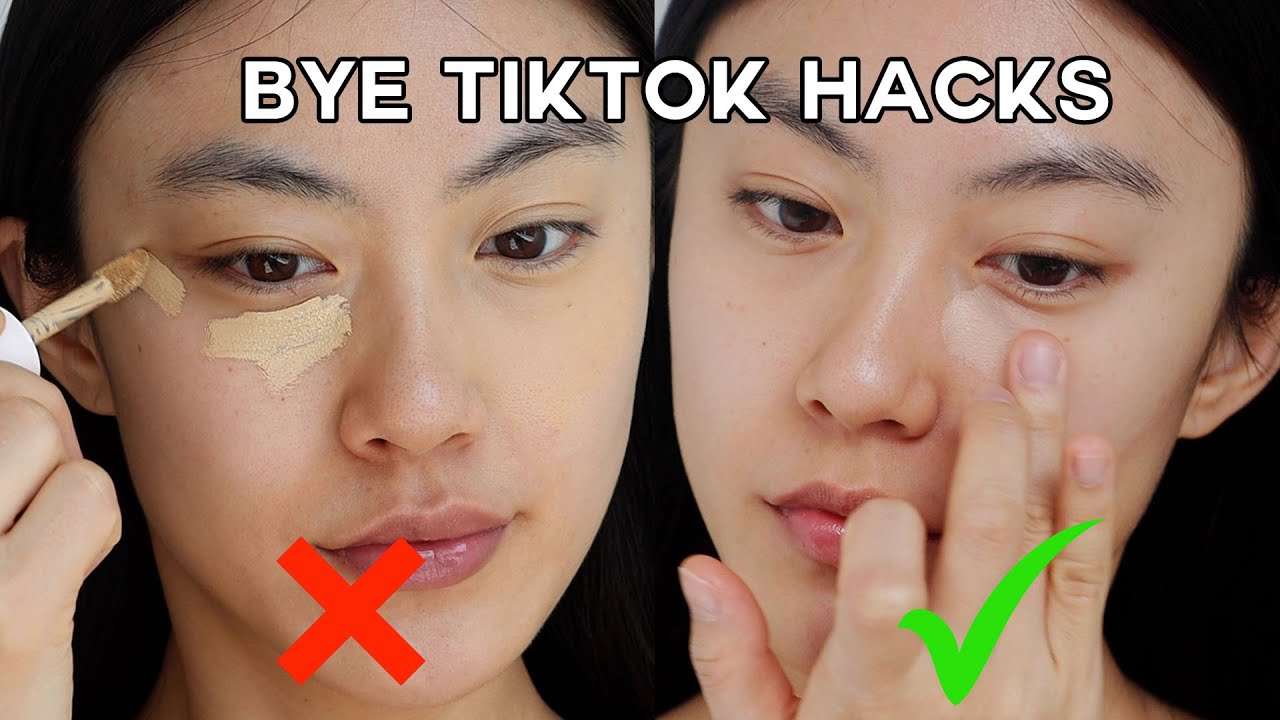
Under the eyes, a thin liquid or light cream works best. Blemishes and scars can handle a denser cream or a stick.
Coverage should stay sheer to medium wherever skin creases. Full coverage only makes sense where the discoloration shows through a lighter layer.
| Formula | Typical coverage | Best for | Watch out for |
|---|---|---|---|
| Liquid | Sheer to full, buildable | Under eyes, all-over spot work | Needs setting to stay put |
| Cream | Medium to full | Blemishes, scars, deep dark circles | Thick layers settle into lines |
| Stick | Medium to full | Quick spot cover, touch-ups | Drags on dry skin |
| Pencil | Medium to full | Single blemishes, sharp edges | Too stiff for the eye area |
| Powder | Sheer to medium | Oily zones, midday touch-ups | Sits on dry patches |
Full coverage costs something. Revlon’s guide says those formulas feel thicker and take more blending. Clarins puts most creasing down to using too much product.
Coverage also changes by version within a single brand. Tarte’s own comparison chart lists Shape Tape as full coverage in the original and ultra creamy versions, and as medium coverage in the Radiant version.
Product pages from Fenty Beauty, NARS and Tarte (as of October 2026) put Fenty Beauty Pro Filt’r Instant Retouch at medium to full, a liquid that builds in layers. NARS Radiant Creamy Concealer lands at medium with a luminous finish. Tarte’s original Shape Tape is the full-coverage one, and it’s matte.
Applicator format matters too. A twist-up sponge tip, like the one on Maybelline’s Instant Age Rewind Eraser, packs product and blending tool into one tube.
Still weighing formulas? A separate guide to picking the right concealer goes deeper on the decision.
How to Match Concealer Shade and Undertone
Blemishes need an exact match. Go lighter only when the goal is brightening under the eyes. Undertone decides whether the result reads as skin or as a patch.
Fenty Beauty’s product page (as of October 2026) says to use the foundation shade for spot concealing and a shade two lighter than the foundation for under-eye brightening.
Revlon’s guide sets a lower bar, a concealer only slightly brighter than foundation. I’d start one shade lighter and take a second step only if the area still reads dark after blending.
Cool undertones lean pink, red or blue. Warm ones lean toward yellow, peach or gold, and neutral falls between the two. Undertone has nothing to do with depth, and Paula’s Choice, in a guide credited to board-certified dermatologist Hartman MD, states that very light and very deep skin can each be cool, warm or neutral.
The same guide cautions that a foundation labeled strictly cool or warm may not be the most flattering choice, and that a warm shade should carry only a very subtle yellow or golden tone. A neutral shade with only a slight lean tends to look most natural, and concealer follows the same logic.
Wrist veins are the usual first check. Blue or purple points to cool and green points to warm. Some people hold gold and silver jewelry against bare skin instead, and a swatch along the jawline shows how a shade looks once it dries down.
The jewelry test comes with a warning. Mented Cosmetics’ guide calls it extremely subjective. NARS says to let a shade dry down on skin before confirming the match, and adds that shades vary slightly across its formulas by coverage and finish, so a shade from one formula may not carry over exactly to another.
Fenty Beauty says its concealer shades are made to complement its foundation, not match it, so treat the foundation shade number as a starting point and adjust from there. Range helps, and Fenty lists 50 concealer shades while NARS lists 30 (as of October 2026).
For the rest of the face, a walkthrough on matching makeup to your skin tone applies the same undertone logic to base products.
Color Correctors Under Concealer: What Each Shade Cancels
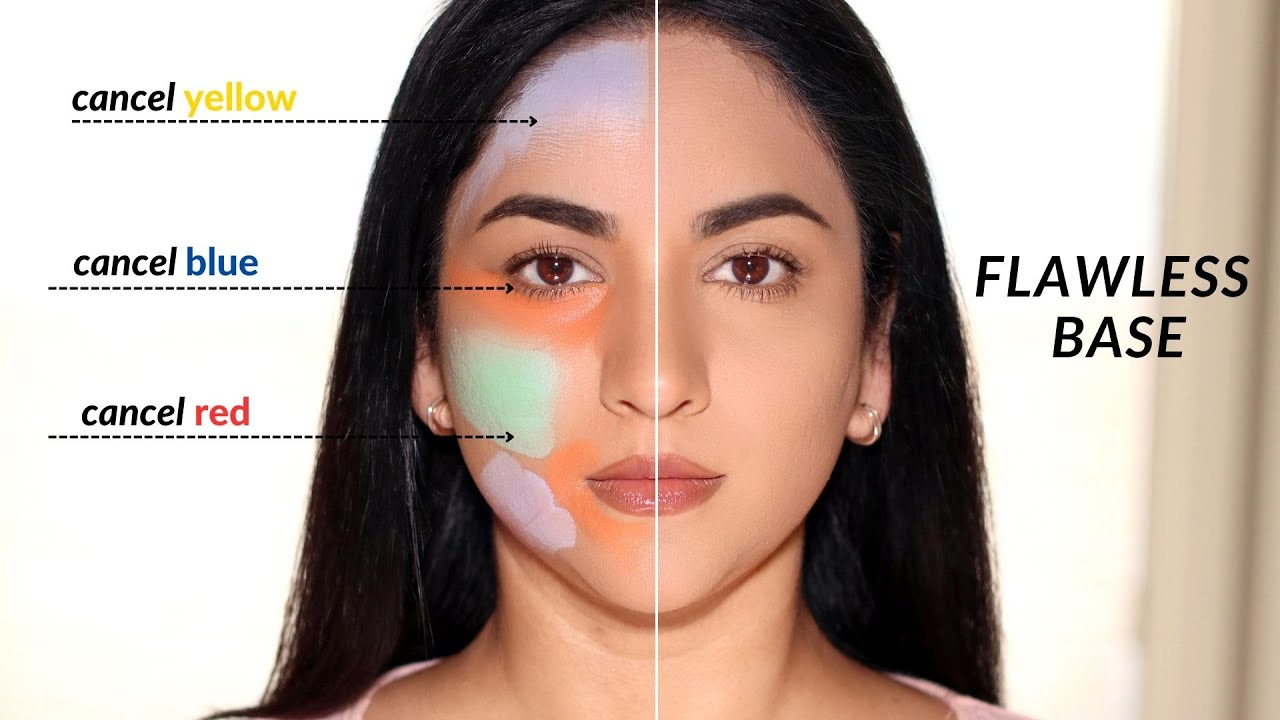
Pastel-tinted correctors cancel a discoloration by sitting opposite it on the color wheel. Green cancels red, and peach or orange cancels blue and purple. Yellow also cancels purple, and lavender goes against yellow.
| Concern | Corrector | Placement |
|---|---|---|
| Redness (breakouts, rosacea, broken capillaries) | Green | Over the red area only |
| Blue or purple dark circles | Peach on light skin, orange on deep skin | Inner corner and darkest hollow |
| Dark spots | Yellow or orange | Directly on the spot |
| Sallow or dull patches | Lavender | Thin layer over the yellow-gray areas |
Because color correctors cancel color instead of covering it, one thin layer does the work. NYX Cosmetics’ guide pairs green with redness, peach or orange with dark circles, and yellow or orange with dark spots.
Sources split on shade depth.
For dark circles, Reader’s Digest steps through pink for light skin, peach for medium and orange for dark. A camouflage-makeup guide on The Hospitalist’s community site gives peach or salmon for Fitzpatrick types I to III and orange for types IV to VI. On redness, that same guide recommends green for types I to III but a yellow-based corrector for types IV to VI, while consumer guides, NYX Cosmetics included, name green without a skin-depth limit.
Deeper skin generally needs a warmer, more saturated corrector than light skin. Test the shade at the jawline before committing it to the face.
Maybelline’s usage directions for the Instant Age Rewind Eraser include a Neutralizer shade for extreme dark circles, applied under the regular concealer shade. That layering works with any corrector, tint first and concealer on top.
Dab the corrector on and let it settle before the concealer goes over it. The full routine is in this guide to applying color corrector.
Should Concealer Go On Before or After Foundation?

After foundation for most full-coverage looks, before foundation for sheer bases and for color correctors. Working artists split on this, and each side has a reason that holds up.
MAC senior artist Nicole Thompson applies a sheer foundation layer to primed skin and then stipples concealer on top, because foundation worked over concealer wipes the coverage away. Bobbi Brown goes the other way for people who dislike a full face of foundation, since the concealed areas may need little or no foundation afterward.
A makeup artist writing for Beaut.ie puts concealer after foundation nine times out of ten. Foundation shows which marks still need coverage, so concealer goes only where it is needed, while green, violet and peach correctors go under foundation.
Concealer first has a documented weak point. Makeup artist Lucas White, reported by Jordan News, says a creamy or oily foundation over concealer thins its coverage, with high-coverage camouflage products as the exception.
Texture adds a second rule. L’Oreal Paris UK’s guide says to pair liquid with liquid and to put liquids on before powders.
In practice it works out like this:
- With a full-coverage foundation, apply foundation first and put concealer on whatever still shows.
- With a sheer base or none at all, concealer goes first and foundation only where needed.
- Corrector always goes first.
- When textures are mixed, liquids go before creams and creams before powders.
The same sequencing logic extends past these two products, and a guide on how to layer makeup covers the full order.
How to Apply Concealer on the Under-Eyes, Blemishes and Redness
Concealer goes on the discoloration itself, in thin dots, and gets blended outward until the edge disappears. A wider patch or a second layer just adds product the skin has to carry.
Under the eyes
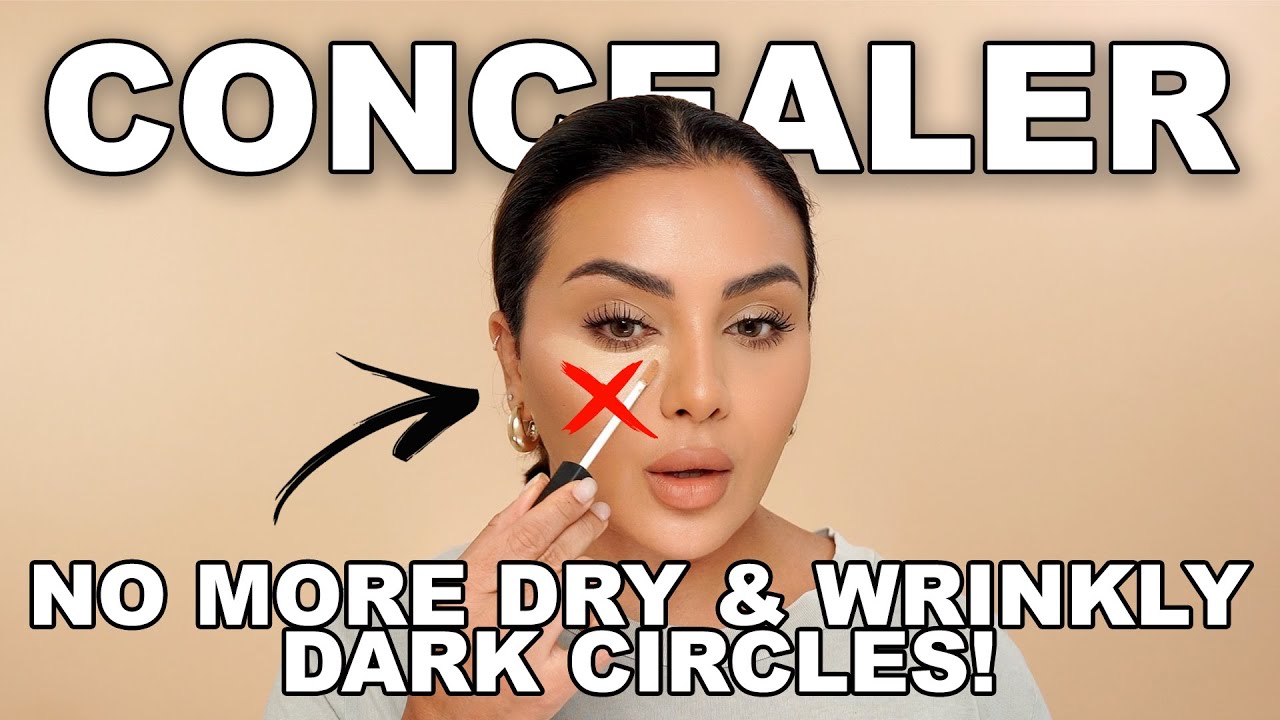
The under-eye routine goes in this order:
- Apply a light eye cream and let it absorb fully
- Stop foundation short of the under-eye area
- Dot concealer on the darkest zone, starting at the inner corner
- Add a little below the outer corner, away from the lower lash line
- Work the flat areas first and the fine lines last
- Tap outward with a ring finger, damp sponge or small brush
Ulta’s education guide lists too much eye cream right before makeup as a creasing habit, which is why the first step includes the wait. Makeup artist Melissa Murdick, quoted by OK Beauty Box, starts foundation beneath the orbital bone because foundation brought up under the eyes can make concealer crease.
Katie Jane Hughes, reported by Stylist, loads the brush and starts on the flat areas because the first spot takes most of the product. Lancome’s guide picks the ring finger for the lightest touch and says to dab, not rub.
Faces Canada ties placement too close to the lower lash line to immediate creasing. Huda Beauty adds that it makes the eyes look smaller.
Shape is where the sources disagree. Oriflame’s baking guide starts with a thick triangle of concealer under each eye. Huda Beauty says oversized triangles elongate the face, and Murdick warns against heavy stripes of concealer under the eye, picking up only a tiny amount.
I’d follow the shape of the shadow instead of committing to a triangle.
Makeup artist Lisa Potter-Dixon, quoted by SheerLuxe, also touches concealer onto the eyelids and blends it up toward the brow, since dark circles read from the brows down to the cheeks.
Blemishes and dark spots
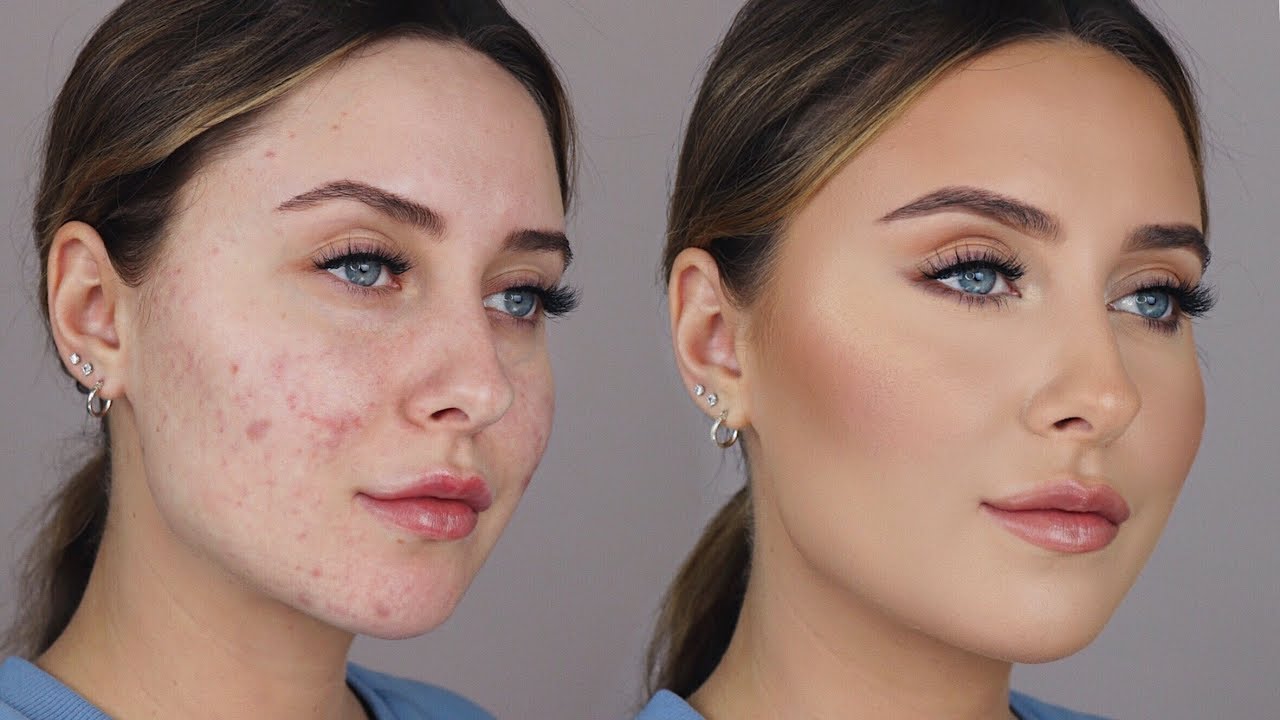
The American Academy of Dermatology says foundations and concealers can worsen acne or cause new breakouts. It recommends products labeled non-comedogenic, oil-free or won’t clog pores.
The AAD also advises applying makeup with applicators such as brushes, and warns against sharing tools, because bacteria and oil from other skin cling to them. Covering active breakouts has its own sequence, laid out in this guide to covering acne with makeup.
Faces Canada’s guide says to use a small flat brush, loaded lightly, and to aim for the raised part of the blemish and not the skin around it. Patting and pressing beats swiping, which matches how M.A.C describes its 195 brush, built to layer thin coats by patting or pressing product onto skin.
Flat dark spots and scars take the same dot, with a closer shade match. Deeper pigmentation is a separate job, handled in this walkthrough on hiding hyperpigmentation with makeup.
Redness around the nose and chin

Faces Canada’s guide uses gentle patting motions for redness around the nose or chin. A tiny amount over a corrector is enough, and the edges should vanish before the patting stops.
Fingers, Sponge or Brush: Which Tool Blends Concealer Best?

A ring finger suits light cream under the eyes, and a small brush is better where a blemish needs precision. A damp sponge presses product in. No single tool wins everywhere.
Body heat softens cream formulas on the fingers, and the ring finger applies the least pressure near the eyes. A damp sponge pushes product into skin and leaves a sheer, skin-like layer. Brushes put product exactly where it’s needed and build coverage in thin layers.
Makeup artist Alex Reader, quoted by SheerLuxe, applies Hourglass Vanish Airbrush Concealer with a finger or a Beautyblender to push the formula into skin for a smoother blend. M.A.C describes its 195 Synthetic Concealer Brush as a flat paddle with a slight pointed tip, built for patting or pressing concealer on in thin layers.
Beautyblender’s own guide says to wet the sponge, squeeze it out and bounce, and that swiping only moves product around. Its guide points the pointed side at hard-to-reach spots, including under the eyes.
The full sponge routine, foundation included, sits in this guide to applying makeup with a sponge.
Brands disagree on damp versus dry.
Beautyblender says the sponge is meant to be used wet. Real Techniques says its Miracle Complexion Sponge gives a dewy glow damp and full coverage dry, yet its Complexion Sponge + Concealer Sponge Duo copy calls for damp use and promises light to medium coverage.
For concealer, damp is the safer default. Go dry only when a spot needs more pigment than a brush delivers.
Beautyblender recommends replacing the sponge every 3 to 6 months. Between replacements, a dirty sponge is worth cleaning properly, and this guide shows how to clean makeup sponges.
How to Set Concealer and Stop It From Creasing

Set only the area that creases, with the lightest method that holds. Each method trades finish against wear, and none of them fixes a layer that is too thick.
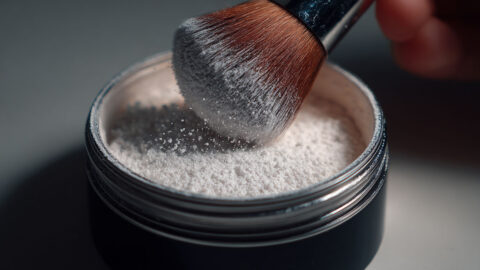
Translucent powder gets pressed on with a damp sponge or tapped on with a fluffy brush, which gives a soft-focus finish. Baking means leaving a thick layer of powder to sit and then dusting it off, and the under-eye comes out matte. Setting spray goes over the finished face and adds wear without adding powder.
Laura Mercier’s own guide (June 2025) skips baking and presses a light dusting of powder under the eyes with a brush, tapping off the excess first. It warns that overdoing it looks dry. Where baking is used, wait times differ. Salt Lake Magazine’s walkthrough waits 10 to 15 minutes, while most other guides wait 5 to 10, so start at the short end.
Powder technique has its own detail, covered in this guide to applying translucent powder.
Urban Decay’s directions for All Nighter call for 2 to 4 mists in an X and T pattern from 8 to 10 inches away, with eyes closed. The brand claims up to 16 hours of wear, and 78% of the 50 participants in its own 7-day study agreed, which makes it a self-reported brand figure rather than independent testing.
Whether to set at all is another point of disagreement. Huda Beauty calls setting one of the most important steps against creasing, while OK Beauty Box, relaying Murdick, says to skip it when shine isn’t a problem because powder can dry the skin.
Hughes, per Stylist, warns that sweeping powder across the whole under-eye makes fine lines more obvious. Ulta’s guide lands in the middle and says to target the setting to where concealer creases.
| Symptom | Likely cause | Fix |
|---|---|---|
| Product collects in fine lines | Too much concealer | Thin dots, tapped only where it collects |
| Concealer slides off by midday | Foundation under the eyes, or wet skincare | Stop foundation short, wait for eye cream |
| Dry, patchy under-eyes | Heavy baking on dry skin | Moisturize, set only the center, skip baking |
| Cakey texture | Thick layer plus coarse powder | Use less concealer, finely milled powder |
| Fading within hours | No setting step | Spot-set with powder or a light mist |
Salt Lake Magazine says baking looks poor on very dry or mature skin. A longer fix list sits in this guide on preventing creasing under the eyes.
Concealer also stops short of puffiness. Essence’s guide says puffiness is hard to cover because the swelling is skin, and that brightening a puffy area makes it look more prominent, so a concealer matched to the exact skin tone works better there.
Concealer FAQ
How is concealer different from foundation?

Mostly pigment and placement. Concealer carries more of it and goes on small zones, while foundation evens tone across the whole face.
That density is why concealer hides blemishes and dark circles, and why it looks heavy when spread over large areas.
Which concealer works best for dry, oily or mature skin?
Dry skin does better with a creamy, hydrating formula at light to medium coverage, while oily zones suit a thin liquid set with powder.
Mature skin needs nothing thick or heavy, since dense layers settle into lines, and heavy baking is best skipped on very dry or mature skin.
Can concealer hide under-eye puffiness?
Not fully. Puffiness is swollen skin, not discoloration, and Essence’s guide warns that brightening a puffy area makes it look more prominent.
A concealer matched to the exact skin tone camouflages it better than a lighter shade.
Can I wear concealer without foundation?
Yes, when the shade matches skin exactly. Dot it only on discolored areas and blend the edges.
The result is a lighter finish than a full base.
Can concealer be used to highlight and contour?

Yes. Makeup.com’s guide places concealer two shades lighter than skin on the high points to highlight, and two shades darker to contour.
Blend the edges so no line shows.
How do I use concealer on brows?
Place a small touch below the brow arch, as Revlon’s guide suggests, and blend the lower edge.
The line should read as a clean border, not a stripe of product.
How long does concealer last, and when should it be touched up?
Wear time depends on the formula, the skin type and whether the concealer was set. Brand claims such as 16 hours are self-reported.
Essence’s guide says to touch up through the day when needed. Tap a small amount onto the faded spot instead of layering over a crease.
Building a Starter Concealer Kit
A beginner can start with one medium-coverage liquid or cream in the exact foundation shade and a single blending tool, either a damp sponge or a small brush.
The rest can wait until the need shows up, because each product solves a problem that only appears once the one before it is in place. Translucent powder comes next, and only for spots that crease. Color corrector comes last, and only if discoloration still shows through.
An exact-match shade covers blemishes but won’t lift the under-eye area, so a second, lighter shade belongs in the kit later, along with a denser product for stubborn scars.
The foundation worn beside the concealer gets its own walkthrough in this guide to applying foundation.

She started writing on the site after fielding the same questions from clients and friends often enough to just write the answers down: which red won't turn orange on a warm undertone, how to keep lipstick from feathering into fine lines, why a "12-hour" formula rarely survives dinner.
Every review on the site follows the same rule she uses with paying clients: wear it first, then decide if it's worth recommending.
- How to Make Eyeliner Last Longer Without Smudging - August 31, 2026
- How to Make Eyeshadow Last Longer All Day - August 29, 2026
- How to Find Your Undertone in 5 Easy Steps - August 27, 2026