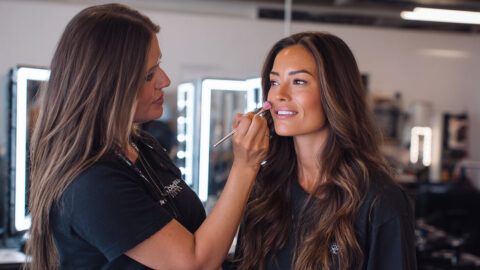
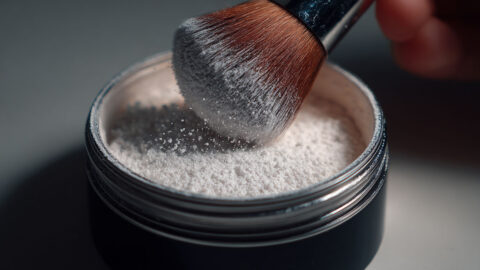
Setting spray is the last thing that touches the face. Everything else goes on first, powder included, and then you mist from 6 to 10 inches away in an X and a T, the range most brands print.
After that you wait. Laura Mercier (2026) puts the drying time of most sprays at 30 to 60 seconds, so hands stay off the face until then.
How long the result lasts is less settled. Who What Wear’s editors (updated September 2025) logged 5 to 10 hours of wear across the 12 sprays they tested. Morphe (2026), going by a 31-subject consumer study, claims 16 hours.
How to Apply Setting Spray Step by Step

- Complete the base, cheek, eye and lip products, powder included.
- Shake the bottle. On a pump, fire one quick spritz into the air to prime it (Morphe’s instruction).
- Close your eyes and mouth.
- Hold the bottle at the distance printed on its label.
- Mist in an X across the face, then a T down the forehead, nose and chin.
- Let the film air-dry. Add a second light coat only after the first has dried.
Primer isn’t part of the spray step, though getting primer right under the base still counts for a lot, and e.l.f. recommends pairing the two for every skin type.
Shield your brows and lashes with a hand when you mist near the hairline. That’s Laura Mercier’s advice in its February 2026 guide.
How Far Away to Hold Setting Spray and Which Pattern to Use
Brands don’t agree on distance. Some print 6-8 inches, others 8-10, and none of them explains the gap.
Nozzles and formulas differ from bottle to bottle, so the number printed on yours wins over any article, this one included.
Distance by brand
These figures come from each brand’s published instructions as of October 2026.
| Source | Distance | Pattern | Dry guidance |
|---|---|---|---|
| Maybelline (2025) | 6-8 inches | X, then T | Dry naturally |
| Laura Mercier (2026) | 8-10 inches | Circular, X and T, or five-point | Air-dry 30-60 seconds |
| e.l.f. Cosmetics | 6-8 inches | Even mist, no pattern named | Dry before touching or adding products |
| Morphe | 8-10 inches | Even mist, no pattern named | Let dry |
| Colorescience (2018) | 6-8 inches | X and T | Air-dry, no blow dryer |
Maybelline, e.l.f. and Colorescience print 6-8 inches. Laura Mercier and Morphe go with 8-10. Eight inches is the only distance both ranges accept.
Laura Mercier ties its 8-10 inch range to a light mist that still covers evenly. Spray too close and you get wet spots and an uneven set.
Spray patterns compared
Maybelline and Colorescience both use an X and then a T, two fixed routes that cover the forehead, cheeks, nose and chin. Laura Mercier’s step list goes circular for even distribution, and it also lists a five-point pattern next to X and T as a way to prevent drips.
No brand tests one pattern against another. Laura Mercier blames running and patchiness on prolonged spraying, not on the shape.
X and T is the easier default. It gives you a fixed route, so you cover each zone once and move on.
Does Setting Spray Go On Before or After Powder?

After powder is the default. Brand guidance splits only on whether to add a mist earlier in the routine too.
Powder first, then spray

Laura Mercier’s 2026 guide and NYX both put the mist after powder. Morphe’s September 2025 article gives its reasons. Powder needs time to absorb oil, and spraying too soon can turn it cakey or patchy. The layering order is foundation, then powder as the smoother surface, then spray as the sealant. Powder also goes only where oil control is needed, while the mist covers everything evenly.
Dust off the excess after applying setting powder and give it a few seconds to settle before you mist.
The cost is the wait, and a rushed mist can undo the powder.
Between layers
makeup.com treats the last-step mist as standard but allows one after each base step (foundation, concealer, blush, contour, bronzer, powder) for extra hold. It adds that the spray makes powders look more natural.
Charlotte Tilbury’s own instructions for using its setting spray start with a mist to prime and end with one to set, with optional mists between steps.
You get more hold per layer, and powders sit more naturally on the skin. The price is time. Each layer has to dry before the next product goes on (Laura Mercier), the routine slows down, and oversaturating can dissolve layers or leave streaks (Laura Mercier).
Spray before powder
Morphe describes a light mist after foundation and concealer, before setting powder, as a trend from the past year or so. A trend, not a rule.
No brand publishes results for this order. Morphe’s advice is to test it on your hand or arm first, and it adds that oily skin might do better with powder first while dry skin might prefer spray first.
My default would be one mist after powder. Add a mid-routine mist when you wear several powder products or need extra hold, let each layer dry, and try spray before powder only after a patch test on your forearm.
How Much Setting Spray to Use and How Long It Takes to Dry
One light pass is the baseline, and Laura Mercier puts the drying time of most sprays at 30 to 60 seconds.
How many sprays or coats
Brand guides publish no spray count. They describe coverage instead, though a few product listings do give a number. Retailer listings for Laura Mercier’s Setting Spray say 1 to 3 sprays, and Target’s listing for Maybelline’s Lasting Fix says 4 to 6.
An X and then a T counts as one pass and covers the face (Maybelline, 2025). A second coat is fine once the first has dried, as long as each pass stays light (Laura Mercier, 2026). If you overdo it, pat the excess off with a clean beauty sponge (Morphe’s product instructions).
Oversaturating dissolves layers or leaves streaks, according to Laura Mercier. Its fix for a patchy or spotted finish is a longer distance and fewer passes.
How long setting spray takes to dry
Laura Mercier says most sprays set in 30 to 60 seconds, and a handheld fan can speed that up.
That is one brand’s claim, not a tested standard. None of the other brands in the distance table publishes a figure, though L’Oreal claims its Infallible 3-Second Setting Mist dries in 3 seconds.
Skip the blow dryer. Colorescience says to let the spray air-dry so it does not irritate skin, and nobody should touch or rub the face until it is dry.
Hold off on more makeup too. e.l.f. says to let the spray dry before touching the face or applying other products.
If the face still looks wet past that window, too much product is a likelier cause than a slow formula, so blot with a sponge.
Matching a Setting Spray Formula to Your Skin Type
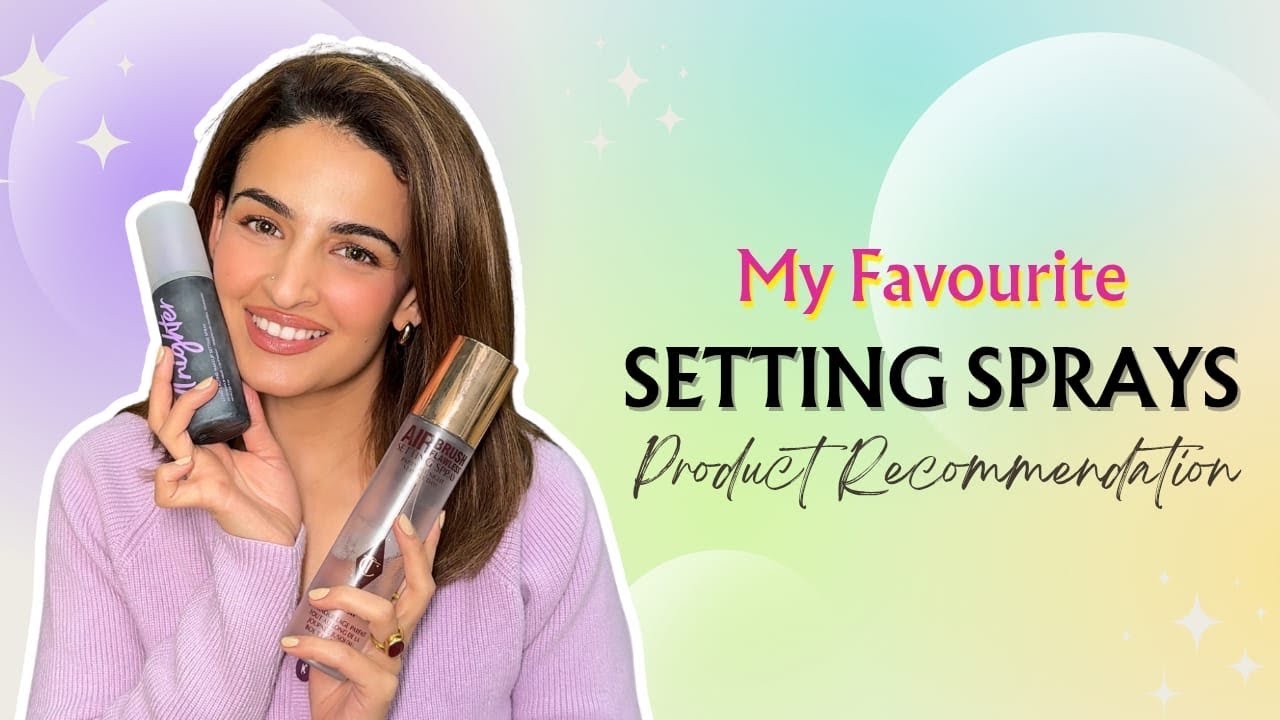
Oily skin takes a mattifying formula and dry or mature skin does better with a hydrating or dewy one. Combination skin follows whichever zones run oilier.
That split comes from Laura Mercier’s 2026 guide. Who What Wear’s editors (updated September 2025) tested on the same logic, pairing NYX Matte Finish with oily skin and Milk Makeup Hydro Grip with dry.
Matte, dewy and hydrating formulas
| Formula | Best for | Watch for |
|---|---|---|
| Matte or oil-control | Oily or combination skin, humid days | Can emphasize texture on very dry skin |
| Hydrating or ultra-blur | Dry, dehydrated or mature skin | Not built to control shine |
| Dewy or radiance | Normal-to-dry skin, flat-looking base | Tacky feel, shine over oily zones |
| Shielding or longwear | Long days, events, under masks | Label claims outrun tested hours |
The finish categories follow Laura Mercier’s list. The watch-for column draws on that guide and on Who What Wear’s tests.
What the ingredient list tells you
Alcohol denat. dries fast and mattifies. Milani’s Make It Last lists it second, with glycerin and niacinamide to offset the dryness (NBC Select, 2021).
PVP is a film former and hair fixative, per BASF’s Luviskol K 30 documentation, and the film is what holds makeup down. Glycerin is a humectant that keeps that film comfortable, and Laura Mercier names it among the ingredients that refresh makeup midday.
Colorescience’s 2018 guide tells dry skin to avoid alcohol. The Cosmetic Ingredient Review Expert Panel’s final report found denatured alcohol safe as used in cosmetics, which answers a safety question, not a comfort one.
Alcohol-free options exist. Morphe’s Lifeproof (2026) pairs film formers with ectoin, and Clinique’s Set The Day uses 5% aloe water.
No source retrieved here compares hold between alcohol-free and alcohol-based sprays head to head.
How to read wear-time claims

Brand claims run from 16 to 36 hours, and the panels behind them are small.
As of October 2026, Morphe’s Lifeproof claims 16 hours based on a 31-subject consumer study (Morphe, 2026). Dior’s Backstage Airflash Mist claims 24 hours from an instrumental test on 30 women wearing their usual foundation. L’Oreal Paris’s Infallible 3-Second Setting Mist goes furthest at 36 hours, with 91% of 105 women reporting it lasted that long.
Those are panel results, not hours logged by one wearer. Who What Wear’s editors recorded 5 to 10 hours across their tested sprays, though one of them noted that 9 hours was simply the longest she had worn hers.
Plan around a workday and treat the label as a ceiling. The rest of the routine matters as much, and this guide to making makeup last all day covers it.
Using a Sponge, Brush or Midday Touch-Up Instead of a Full Mist

Mist the tool, not the face. A sprayed sponge or brush puts the setting spray only where makeup needs it.
e.l.f. says wetting the sponge with spray while you blend extends wear, and Colorescience (2018) swaps water for spray for the same reason. Makeup artist Mia Jones goes the other direction and lightly presses the spray in with a sponge after the mist (NBC Select, 2021).
Brushes work too. Lucas Bowman sprays the bristles of a foundation brush and passes it lightly over the skin. For eyes, mist the bristles before picking up shadow, and Nydia Figueroa turns powder shadow into liner this way with a thin brush.
The blending technique doesn’t change when spray is the dampener, so the basics of applying makeup with a sponge carry over.
Press, never rub. Colorescience warns against blending the spray around the face, while Laura Mercier’s 2026 guide presses it in with a puff or sponge. The two agree once you read them closely.
For a midday refresh, Laura Mercier says to mist once onto a clean sponge or your palms and press over dry or dull patches, leaving the rest of the face alone. Figueroa also mists through the day to refresh makeup and bring back a natural glow. Laura Mercier specifies a clean sponge, so wash your makeup sponges between uses.
Colorescience suggests dabbing a little spray onto eyelids with a Q-tip or finger, and says it can help lipstick resist smudging. Keep the mist itself away from the eyes.
Why Setting Spray Looks Cakey, Patchy or Sticky (and When It Cannot Help)
Most bad results trace back to timing or formula. Nozzle quality accounts for the rest.
Problems and fixes
| Symptom | Likely cause | Fix |
|---|---|---|
| Cakey or patchy base | Mist hit powder that had not settled, or passes were heavy | Let powder settle, then use light passes from farther back |
| Tight, flat or textured finish | Very matte formula on very dry skin | Switch to a hydrating, soft-blur formula |
| Shine breaking through the T-zone | Dewy formula over oily zones, or no powder there | Mist a sponge and press it only onto the shine |
| Tacky or sticky feel | Some formulas dry tacky by design | Blot with a clean sponge, or change formula |
| Wet spots or coarse droplets | Nozzle delivers an uneven mist | Hold at the printed distance or try a micro-fine mist |
The table draws on Laura Mercier’s 2026 troubleshooting list and Who What Wear’s editor tests (updated September 2025). Two of those editors described tacky finishes on the sprays they tested.
A base that has already gone patchy needs fixing patchy makeup before any more spray goes on.
Nozzles matter more than people expect. Who What Wear’s editors flagged uneven nozzles on NYX Matte Finish and Too Faced Makeup Insurance, and praised the fine aerosol mist of Morphe’s Continuous Setting Mist.
The five brands in the distance table sit between 6 and 10 inches, though Laura Mercier’s own setting-products FAQ says 10-12 inches. Clinique’s pump spray says 10-12 inches and Dior’s Airflash Mist says 35 to 40 cm (about 14 to 16 inches), so the printed distance on your bottle outranks any single range.
When setting spray does not apply
Setting spray finishes a base. It does not repair one.
It’s also optional. Makeup artist Jamie Greenberg calls it not required, though beneficial (Who What Wear, 2025). Eyeliner can still transfer, and the editors found Rare Beauty’s Always an Optimist mist did not stop it. Heat and sweat win some nights too, since the editor who rated One/Size’s On ‘Til Dawn best overall saw it budge on one hot, sweaty evening out.
One Who What Wear editor hydrates her skin and uses a gripping primer before any spray goes on. That is why prepping skin before makeup belongs ahead of any decision about spray.
Setting Spray FAQ
What does setting spray do?

It leaves a thin protective film over finished makeup after going on as a fine liquid mist. Dermatologist Nava Greenfield describes that film as a physical barrier that stops cosmetics from rubbing off (NBC Select, 2021).
Is finishing spray the same as setting spray?
Yes, mostly. NBC Select (2021) lists finishing spray as another name, and Colorescience (2018) adds fixing spray.
A hydrating face mist is a different product. Who What Wear’s editors call Tatcha’s Luminous Dewy Skin Mist a spray-on moisturizer that extends wear but is not technically a setting spray.
Can setting spray replace setting powder or primer?
No, because each product has its own job. Primer works under the base, and powder absorbs oil and keeps foundation from creasing (Morphe, 2025). The spray just seals the finished face.
e.l.f. recommends pairing primer with spray for every skin type. If powder is the new part of your routine, start with what setting powder actually does.
Can you use setting spray on bare skin?
Yes, with formulas labeled for prep. e.l.f. suggests misting a clean face before and after makeup, and NYX says certain formulas can prime skin before foundation.
Check the label first. A spray made only for the final step has no prep claim behind it.
Does setting spray replace sunscreen?
No. Sources disagree on how far SPF sprays go. Colorescience (2018) markets SPF 50 setting sprays for reapplication, while dermatologist Marisa Garshick says they do not replace face sunscreen (NBC Select, 2021).
For topping up protection over a finished face, see this guide to reapplying sunscreen over makeup.
Is setting spray safe for contact lens wearers?
Some are labeled that way. Clinique’s Set The Day and Morphe’s mattifying setting spray are both listed as ophthalmologist tested and safe for contact lens wearers.
Keep your eyes and mouth closed while spraying, as Clinique’s instructions say.
Can setting spray cause breakouts?
The formula decides. Garshick advises an oil-free, non-comedogenic spray for acne-prone skin (NBC Select, 2021), and Colorescience (2018) gives the same advice for oily skin.
No source retrieved here links setting spray itself to breakouts.
Does setting spray expire?
Not on a legally required date. FDA says US law does not require cosmetics to carry expiration dates, and it treats shelf life as the manufacturer’s responsibility.
Check the bottle for a manufacturer’s date. FDA adds that how long a cosmetic stays usable also depends on how you handle and store it.
Testing a Setting Spray Against Your Own Day
Test a setting spray by misting one half of the face and leaving the other half bare for a full workday. A split result beats any label claim.
Get the skin prep and base right first, since the spray only finishes what sits beneath it. Then pick one formula and run it for one day on one half of the face. Layered mists come in only if wear fails.
Layering carries a cost. Six mists across a full base, each with its drying wait, add 3 to 6 minutes to the routine.
As of October 2026, no independent lab comparison of setting spray hold has been located, and a published head-to-head test would change this advice.
Once the half-face test shows a gain, layering makeup in the right order is the next place to look.

She started writing on the site after fielding the same questions from clients and friends often enough to just write the answers down: which red won't turn orange on a warm undertone, how to keep lipstick from feathering into fine lines, why a "12-hour" formula rarely survives dinner.
Every review on the site follows the same rule she uses with paying clients: wear it first, then decide if it's worth recommending.
- How to Make Eyeliner Last Longer Without Smudging - August 31, 2026
- How to Make Eyeshadow Last Longer All Day - August 29, 2026
- How to Find Your Undertone in 5 Easy Steps - August 27, 2026