Patchy makeup almost always comes down to skin that’s drier than the foundation can handle, a primer that doesn’t match what’s underneath it, or blending that got rushed. Working out which one is actually happening is most of the fix. What’s left is a straightforward foundation problem. Bare patches or rough texture pushing through where the coverage should sit as one smooth layer.
It’s most common on skin that’s already dry, textured, or dehydrated. Foundation grabs onto raised or flaky patches before it ever touches the smoother skin nearby. There’s a whole industry built around patching this exact issue. The global face primer market, most of it selling some version of a texture fix, was worth an estimated $1.39 billion in 2025, and forecasts have it nearly doubling, to roughly $2.64 billion, by 2034 (Data Insights Reports, 2025).
What Is Patchy Makeup?

People throw the word “patchy” around loosely, but it actually describes something specific: foundation that leaves visible bare spots, blotches, or rough texture showing through instead of sitting as one even layer.
It’s not the same as cakey makeup, which just means too much product stacked on the skin everywhere. Oxidation is a different problem too, and it’s more about color shifting as oil reacts with the formula over the course of a day, evenly, across the whole face, rather than showing up in isolated spots.
At its core, this is a coverage problem, not a color one. Foundation is built to sit on top of skin, so it only goes on evenly when the surface underneath is even to begin with.
IT Cosmetics built an entire product category around this exact problem. CC creams exist mostly to solve unevenness like this.
| Problem | What it looks like | Usual trigger |
|---|---|---|
| Patchy makeup | Bare spots or rough breakthrough in specific areas | Uneven skin texture or dry patches |
| Cakey makeup | Thick, flat coverage everywhere | Too much product or no hydration underneath |
| Oxidized foundation | Color shifts darker or more orange across the whole face | Skin oil reacting with the formula over hours |
Cheeks, the sides of the nose, the jawline, and the hairline along the forehead tend to be where it shows up first.
- Cheeks, where dryness and product settle into fine texture
- Nose bridge and sides, where oil and dry skin often sit side by side
- Jawline, where blending tends to stop short
- Forehead, especially near the hairline
There’s one clear way to tell. If two patches of skin sitting right next to each other look different under the exact same foundation, that’s patchiness, not a shade mismatch.
What Causes Patchy Makeup?

Dry or uneven texture is usually part of it. So is product that doesn’t match what the skin needs that particular day, or technique that leaves gaps in the coverage without anyone noticing until the mirror check at lunch. Most of the time it’s not just one of these on its own. It’s two of them stacking on top of each other.
Dry, dehydrated, or flaky skin causes more of this than anything else. Foundation can’t spread evenly over rough or flaking texture. It clings in some spots and slides right off others.
- 53% of older adults show measurable dry skin, or xerosis, according to a 2023 systematic review and meta-analysis published in Geriatric Nursing
- 7.3% of US adults report a diagnosed case of eczema, per 2021 National Health Interview Survey data released by the CDC in 2023
- 8% to 15% of people with eczema are allergic to fragrance, a common ingredient in primers and foundations, according to the National Eczema Association
Dry Skin and Texture
Dry patches sit higher than the surrounding skin, so foundation grabs onto that raised, flaky texture before it ever reaches the smoother skin around it.
Texture drives this more than tone does. Two patches of skin can be the exact same shade and still take foundation completely differently if one of them is drier than the other.
What you end up with is a foundation layer that looks thin and even in some spots, thick or missing entirely in others. That’s a different issue than applying makeup on dry skin in general, which tends to affect the whole face rather than showing up in isolated patches.
Product and Technique Mistakes
Using a mattifying, oil-absorbing primer on skin that’s already dry strips away the last bit of moisture the foundation needed in order to glide. It’s an easy mistake to make, since mattifying primers tend to get marketed as the default choice regardless of skin type.
Full coverage, matte formulas sit and set fast too, which cuts down the time available to work product into rough spots before everything locks in place.
Then there’s blending, which is where a lot of otherwise decent routines fall apart. Foundation applied in one direction only, or left unblended right at the edges, creates a visible line exactly where the patchiness starts to show.
Milk Makeup built its Hydro Grip Primer around exactly this gap. It pairs a grip-tacky finish with hydrating ingredients, so dry skin isn’t fighting the primer underneath it. Rushed technique also causes makeup to pill, which is a related but separate problem, usually from layering product before the layer underneath has actually set.
Do Skin Conditions Like Eczema, Rosacea, or Psoriasis Cause Patchy Makeup?
Yes. Eczema, rosacea, and psoriasis each change the surface of the skin in ways that keep foundation from sitting flat, and each one does it differently.
| Condition | Skin effect | Makeup effect |
|---|---|---|
| Eczema | Dry, flaking, sometimes weeping patches | Foundation clings to flakes and separates around them |
| Rosacea | Persistent redness, bumps, visible small blood vessels | Coverage looks blotchy where redness breaks through |
| Psoriasis | Raised, scaly plaques with defined edges | Foundation sits on top of plaques instead of blending into them |
Rosacea affects at least 14 million adults in the United States, or roughly 1 in every 10 people, according to the American Academy of Dermatology. On the psoriasis side, the National Psoriasis Foundation puts the number at an estimated 7.5 million US adults, about 3% of the adult population.
Eczema was already noted above as affecting a meaningful share of US adults, and unlike rosacea or psoriasis, it tends to show up as texture rather than color, which is why it reads as patchiness before anything else.
Rosacea often goes undiagnosed in darker skin tones, since the redness that defines it is harder to see and easy to mistake for uneven pigmentation.
All three conditions point toward the same baseline approach. Makeup built for sensitive skin tends to sit better than a formula picked for coverage alone, no matter which condition is actually driving the irritation. La Roche-Posay built its Toleriane line around exactly this kind of reactive skin, fragrance-free and barrier-friendly by design.
Which Foundation and Primer Work Best for Patchy Skin?
Hydrating, dewy-to-satin foundations paired with a hydrating primer perform best on patch-prone skin, since both formulas add moisture instead of pulling it away.
Primer Types for Dry or Patchy Skin
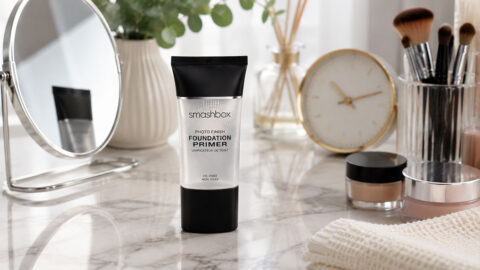
A hydrating primer, built around glycerin or hyaluronic acid, fills in rough texture with actual moisture instead of relying on silicone alone to smooth things over.
Silicone-based primers work differently. They smooth the surface mechanically, which does help with texture, but does nothing for the dryness sitting underneath since there’s no hydration in the formula itself.
Mattifying primer is the one that tends to backfire on patch-prone skin. Oil-absorbing ingredients strip away the moisture foundation needs in order to glide, which works against dry or textured skin more often than it works for it.
Learning how to use a makeup primer correctly matters as much as picking the right one, since primer applied too heavily, or too soon after moisturizer, pills instead of gripping.
Foundation Finish Comparison
| Finish | Coverage | Best for patch-prone skin | Watch for |
|---|---|---|---|
| Dewy | Light to medium | Best overall, reflects light off texture | Can look greasy on oily zones by midday |
| Satin | Medium | Good middle ground | Needs a hydrated base to look smooth |
| Matte | Medium to full | Hardest on dry or textured skin | Grabs onto flaking and rough patches fastest |
Generally speaking, the heavier the finish, the more it depends on skin that’s already prepped well underneath.
Fenty Beauty and NARS are both known for foundation formulas built to sit on textured skin without settling into it. Applying foundation with the right finish only works if the formula underneath is already suited to the skin in the first place.
How Do You Prep Skin Before Foundation to Avoid Patchiness?

Cleanse, moisturize, let the moisturizer absorb fully, then apply primer matched to that day’s skin condition before foundation goes on.
Skipping the absorption step is the most common mistake. Foundation applied over half-absorbed moisturizer slides and separates instead of gripping the skin.
Product Layering Order
- Cleanse the face and pat dry, without rubbing
- Apply a hydrating moisturizer suited to the skin’s current dryness level
- Wait two to three minutes for the moisturizer to fully absorb
- Apply primer matched to that day’s skin, hydrating over dry patches and mattifying only where oil is a separate problem
- Apply foundation in thin layers, building coverage only where needed
That wait actually matters. Foundation applied before the moisturizer has set is usually what brings the patchiness back by midday.
Dermatologists commonly recommend applying moisturizer while skin is still slightly damp from cleansing, since this locks in more water before it evaporates. CeraVe is one of the moisturizer brands built specifically around supporting a compromised skin barrier before anything else goes on top.
The full process for prepping skin before makeup goes beyond these five steps, but skipping any one of them is enough to bring the patchiness right back.
What Tools and Technique Blend Foundation Without Patches?

Sponges, brushes, and fingertips all blend foundation differently, and which one works best depends more on skin texture than on personal preference.
Beauty Sponge Technique
A damp sponge presses foundation into skin instead of dragging it across the surface, which keeps product out of the way of dry, flaking texture.
Damp is the key word here, not wet. The sponge should feel cool and springy, never dripping, since a soaked sponge dilutes the foundation instead of blending it.
Bouncing and stippling motions work better than wiping, since wiping drags product into dry patches and pulls it back out of smoother skin nearby.
The Beautyblender, invented by makeup artist Rea Ann Silva in 2002 for television application and brought to market in 2003, popularized this damp-sponge approach and remains one of the most recognized tools for it. Applying makeup with a sponge works best when the sponge is genuinely damp, not just misted.
Brush Technique
A dense, synthetic buffing brush works foundation into skin with small circular motions, building coverage gradually instead of depositing it all at once.
- Stippling brushes deposit product in small dots for an airbrushed effect
- Duo-fiber brushes sheer out product for a lighter finish
- Dense buffing brushes give the most coverage and control
As a rule, denser bristles mean more coverage. Softer bristles give a lighter, more natural finish instead.
Real Techniques is one of the brush brands built around this kind of dense, foundation-specific bristle work. Applying makeup with a brush gives more precision than a sponge, at the cost of a slightly less natural finish.
Finger Blending
Fingertips warm the product before it touches skin, which helps thin, cream-based formulas melt into texture rather than sit on top of it.
This works best for cream sticks and thin liquid formulas, the kind that need fast, minimal blending anyway.
The tradeoff is control. Fingers blend fast, but they can’t feather product into fine texture the way a sponge or brush can.
Sponges tend to give a more natural finish and work dry patches into the surrounding skin better than most tools, which makes them fairly forgiving for anyone still learning to blend. The downside is that they absorb product, need washing constantly, and take longer to build full coverage.
Brushes go the other way. More coverage per swipe, more precise placement, less product wasted overall, though stiff bristles can leave visible lines on skin that’s already textured.
Powder or Setting Spray: Which Fixes Patchy Makeup Better?

Setting spray works better than powder on patch-prone skin, since powder can settle into dry texture and make it more visible, not less.
Powder does have real advantages. It controls oil for hours, keeps concealer from creasing, and leaves a soft matte finish that a lot of people like. The catch is that it settles into dry patches and fine texture, and it can look chalky sitting over a matte foundation that’s already prone to the same problem.
Spray handles texture better, honestly. It melts powder and foundation together and softens whatever roughness is still showing, without adding another layer of product on top. The tradeoff shows up in wear time, since it does less for oil control and needs reapplying if you want it to hold.
Laura Mercier’s translucent powder remains one of the most recognized products in this category, prized for setting makeup without shifting its color. Applying setting powder only where oil is a genuine problem, usually the T-zone, avoids dusting it over drier areas that don’t need it.
Urban Decay’s All Nighter spray built its reputation specifically on holding makeup through long days without settling into texture. Applying setting spray in a fine, even mist from about a foot away avoids the beading that heavier spritzing causes.
The two aren’t mutually exclusive, either. Powder on the T-zone, spray everywhere else, gives oil control without emphasizing dry texture on the rest of the face.
How Do You Fix Patchy Makeup Without Redoing Your Whole Face?

Blot the area first, mist lightly, then re-blend with a damp sponge before adding any new product on top.
Spot correction fixes patchiness faster than a full reapplication, and it keeps the rest of the face from getting loaded down with extra layers of product.
- Blot the patchy area with a clean tissue or blotting paper to remove excess oil
- Mist the area with a fine setting spray to soften whatever foundation is left
- Re-blend with a clean, slightly damp sponge, working the existing product back into the skin
- Add a small amount of cream concealer or foundation only where bare patches remain
- Set just that corrected spot with powder, not the whole face
Skip step four if the sponge alone evens things out. Adding product before checking whether re-blending fixed it just builds another layer to manage later.
MAC Cosmetics built its Blot Film and pressed powder line specifically around this kind of targeted, midday correction rather than a full reset. Keeping a clean makeup sponge on hand for touch-ups matters, since a sponge already loaded with old product spreads bacteria into a spot correction meant to fix skin, not irritate it further.
A midday touch-up is also the natural point to check sunscreen. Reapplying sunscreen over makeup at the same time as a patch fix, using a mineral powder or spray formula, avoids disturbing the coverage just corrected.
How Often Should You Exfoliate and Moisturize to Prevent Patchy Makeup?
Two to three times a week for exfoliation, and twice daily for moisturizer, is the routine that keeps most patch-prone skin smooth enough for foundation to sit evenly.
| Skin concern | Exfoliation frequency | Product type |
|---|---|---|
| Oily, resilient skin | Up to 3 times a week | BHA, salicylic acid |
| Normal or combination skin | 2 to 3 times a week | Mild AHA, glycolic or lactic acid |
| Dry, sensitive, or rosacea-prone skin | Once a week or less | Gentle enzyme exfoliant, no scrub |
“The absolute maximum for exfoliation is three times a week,” according to Joshua Zeichner, MD, director of cosmetic and clinical research in dermatology at Mount Sinai. Going past that cap is what tips patch-prone skin from smooth into irritated.
Daily moisturizer matters as much as exfoliation. Morning and night, focused on barrier-repair ingredients like ceramides or glycerin rather than short-term glow.
A weekly hydrating mask reinforces the daily routine for skin that stays dry no matter how much moisturizer goes on. Richer products in winter, lighter ones in summer, keep the whole routine matched to the season.
The Ordinary built much of its catalog around this exact routine, pairing accessible AHA and BHA exfoliants with barrier-support moisturizers rather than one product trying to do both jobs.
When Does Patchy Makeup Mean You Need a Dermatologist, Not More Product?
Patchy makeup stops being a makeup problem once the skin underneath it stays scaly, red, or irritated no matter what product or technique changes.
- Redness or scaling that does not improve with hydration or a gentler formula
- A known condition, like eczema or psoriasis, visibly flaring rather than just showing normal dryness
- Stinging, burning, or a rash that appears after a specific product, not before it
- Switching foundations three or four times with no improvement, when prep and technique were never the real issue
Roughly 10% of people who undergo patch testing for a suspected skin reaction test positive for a cosmetic allergy, according to pooled data cited by DermNet.
A separate patch-testing study published in Dermatology Research and Practice found that an estimated 1% to 5.4% of the general population is sensitized to at least one cosmetic ingredient.
Clinique built its entire brand positioning, allergy-tested and fragrance-free, around this exact gap between what makeup promises and what reactive skin can actually tolerate. Sanitizing makeup regularly rules out contamination as a cause before assuming the formula itself is the problem.
If a dermatologist confirms the skin condition, not the routine, is driving the patchiness, treating that condition comes before any further product change.
FAQ on How To Fix Patchy Makeup
What Is the Difference Between Patchy Makeup and Cakey Makeup?
Patchy makeup leaves bare or thin spots where the coverage never sits evenly. Cakey makeup is the opposite: a thick, heavy layer sitting on top of the skin everywhere, not just in a few places. One is about missing coverage. The other is about too much product without enough blending to soften it.
Does Foundation Oxidize and Go Patchy Later in the Day?

Oxidizing and patchiness are two different problems that just happen to get lumped together. Oxidizing shifts the whole face darker, or more orange, as oil reacts with the foundation formula over several hours. Patchiness is uneven coverage from the very start, not a color shift that shows up later in the day.
Can the Wrong Shade Match Cause Makeup to Look Patchy?
A mismatched shade creates a visible line, not texture-based patchiness, though people mix the two up constantly. Foundation that’s too light or too dark against the neck and jaw just looks wrong, obviously so. It mimics unevenness, but there’s no actual texture problem underneath.
Do Beauty Sponges Work Better Damp or Dry on Patch-Prone Skin?
Damp, and it’s not close. A dry sponge absorbs foundation unevenly and drags product across rough texture instead of pressing it in. Wetting and wringing the sponge out first lets it press product into the skin rather than pull it around. This matters most on skin with visible dry patches or flaking.
Can Diet or Water Intake Affect Patchy Makeup?
Hydration status affects the skin directly, and dehydrated skin makes the flaking that foundation clings to even worse. Diet plays a role too, just a smaller and more indirect one, mostly through overall skin health rather than anything immediate. Neither one replaces a topical moisturizer, though, since that’s what actually touches the surface foundation sits on.
What Should You Fix First to Stop Patchy Makeup?
There’s an order that actually works here, and skipping ahead in it is usually why a fix doesn’t stick. Hydration comes first, because no amount of primer or technique adjustment fixes skin that’s still dry underneath the makeup. Getting the primer and foundation formula right comes next. Blending technique closes the gap after that, not before it.
That order takes patience on mornings when dry patches need a second thin layer of moisturizer instead of one, which slows the whole routine down before foundation even goes on.
Coverage that sits evenly is only half the goal in the long run.
Durability is the next test after that. Making makeup last all day comes down to the same prep-first order holding up through heat, oil, and hours of wear, without breaking back into patches by the time anyone actually needs it to hold.

She started writing on the site after fielding the same questions from clients and friends often enough to just write the answers down: which red won't turn orange on a warm undertone, how to keep lipstick from feathering into fine lines, why a "12-hour" formula rarely survives dinner.
Every review on the site follows the same rule she uses with paying clients: wear it first, then decide if it's worth recommending.
- How to Make Eyeliner Last Longer Without Smudging - August 31, 2026
- How to Make Eyeshadow Last Longer All Day - August 29, 2026
- How to Find Your Undertone in 5 Easy Steps - August 27, 2026