Lipstick that looks clean at 9am and has crept into your upper lip lines by lunch usually isn’t a bad lipstick. It just had nothing holding the edge.
How to stop lipstick from feathering comes down to a waxy barrier at the lip edge and thin layers of color blotted between coats. Liner does that job for most people, and lip primer or a little concealer around the border can do it too.
Feathering means color has crept past the vermilion border and into the fine vertical lines around the mouth. Smudging and transfer are different problems.
Lines aren’t the only culprit, though. Revlon’s guide points to excess skin oil as the typical cause on younger skin, which means smooth lips feather too. The fix has to match the cause.
How to Stop Lipstick Feathering, Step by Step
The routine is short. Everything in it either builds the barrier or cuts down on loose product that can travel.
- Exfoliate to lift flaking skin so the color sits evenly.
- Apply a balm to hydrate, then blot off whatever is left.
- Seal the edge with lip primer, or a thin layer of concealer or foundation around the border.
- Trace the lip line with liner, then fill the whole lip with it.
- Press on a thin coat of lipstick, ideally with a brush.
- Press a tissue over the lips to take off the slippery top layer, then add a second thin coat.
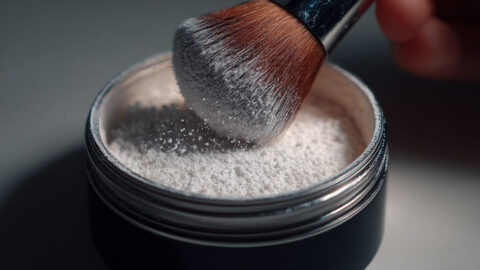
- Dust translucent powder around the perimeter with a fluffy brush.
Liner gets the most credit in the sources, but Revlon’s guide states that a concealer barrier, powder and thin blotted layers all reduce bleeding without one.
The first four steps prep the surface, and the last three decide how much product is left to move around.
What Causes Lipstick to Feather?

Mostly it’s fine lines or oil, and a slick formula makes both worse. Revlon names those two as the main causes.
Fine lines at the vermilion border
Lip lines usually develop around the 40s, and earlier with smoking or sun-damaged skin, according to Cleveland Clinic (2022).
The vermilion border is the line where lip skin meets the skin around it. Vertical creases cross that border and form physical channels that lipstick follows (Revlon).
Cleveland Clinic also notes that lipstick makes these wrinkles look more pronounced. Loss of collagen and elastin with age is the underlying driver.
There’s a gender gap here too. Women have more and deeper perioral wrinkles than men, and their perioral skin holds significantly fewer sebaceous glands and sweat glands, per a 2009 study in the Aesthetic Surgery Journal.
Oil around the lip edge
Oil breaks lipstick down without a single visible line.
Skin oil degrades the formula from the outside in, whatever the line depth (Revlon). The product matters as well, since the shinier the formula, the more likely it bleeds (Thrive Causemetics). Makeup artist Ruby Hammer adds that greasy meals break lipstick down faster.
No lines but still feathering? Oil is the typical cause on younger skin, according to Revlon.
Habits and conditions that make it worse
Smoking, sun damage, pursing the lips, sipping through a straw and dehydrated lips all deepen lip lines over time, and most of them are things you do dozens of times a day without noticing.
Smoking is the best-known trigger, yet non-smokers get lip lines too. Anyone who does smoke can follow lip care habits built for smokers.
Giorgio Armani Beauty makeup artist Beck Morgan names dehydrated lips and fine lines as the primary reasons lipstick feathers (makeup.com, 2021).
Which cause do you have?
Match the fix to the cause before buying anything.
| Cause | How to spot it | First fix |
|---|---|---|
| Fine lines | Color settles into visible vertical creases along and above the upper lip | Fill the lines with primer or concealer, then line and fill the lips |
| Excess oil | Feathering with no definite lines, often worse after oily food | Light concealer and powder around the edge |
| Slick formula | Glossy or creamy shades feather, satin or matte shades hold | Switch to a drier formula |
Causes can overlap, so start with the row that matches the most.
Should You Use Lip Balm or Lip Primer Before Lipstick?

Both, in that order. Balm hydrates the lip skin and primer seals the lip edge, and Look Fabulous Forever is clear that a primer is not a balm.
Balm softens flaking skin and restores moisture, and it gets blotted off before any color goes on. Primer is a different animal. It dries to a barrier along the lip edge, which is where feathering starts.
Ruby Hammer says to blot a balm or salve off completely, and Beck Morgan’s advice is to wipe off any excess before the first coat.
Lip skin explains why hydration matters more here than on the cheek. Cosmetic chemist Kelly Dobos reports in Skin Inc. (2023) that the stratum corneum on the lips is about 3 to 5 cell layers thick against 15 to 20 in typical skin, and that water loss runs three times higher on the lip than on the cheek.
Dry skin fights the application itself. Dobos notes that an even lipstick layer is harder on dry, cracked or peeling lips, and that many long-wearing lip colors make dryness worse.
Removing the flakes first helps. Exfoliating your lips at home with sugar or a similar mild scrub lifts them without tearing the skin.
Lips that stay chapped for weeks need a dedicated dry-lip care routine first, since color sits poorly on cracked skin.
How Does Lip Liner Stop Lipstick Feathering?

Liner works because it’s waxier and drier than lipstick, so it holds creamy or glossy color inside the border. Sally Beauty credits the waxy ingredients in the pencil. Thrive Causemetics puts it as liners being thicker and drier than the products they contain.
Outlining alone leaves the center of the lip unanchored. Revlon and Napoleon Perdis both tell readers to fill the whole lip with liner before the lipstick goes on.
Neat technique helps here, and a guide to lining and filling the lips covers the stroke.
Which liner shade works best
Sources don’t agree on shade. Napoleon Perdis suggests a liner in the lipstick shade or the natural lip color, and a Fox News Q&A on lip makeup recommends the lipstick shade for a bolder look.
Revlon says matching your natural lip tone looks seamless as lipstick fades. RMS Beauty founder Rose-Marie Swift warns that a lipstick-colored pencil leaves a bright ring behind as the color wears off.
Makeup artist Sonia Kashuk, quoted in O, The Oprah Magazine, lines the mouth with a neutral or colorless pencil. Maybelline sells one, Color Sensational Shaping Lip Liner in Clear, which the brand says can work as a lip primer or as a barrier outside the lip line.
The disagreement is about fade. A bold liner outlasts the lipstick and leaves a ring, so a lip-tone or colorless liner is the safer default.
Red is the exception Swift names, and the liner shade that pairs with a red lipstick follows its own rules.
Barrier options other than liner
Liner isn’t the only way to build a barrier.
| Option | How it works | Best for |
|---|---|---|
| Matching or natural-tone liner | Wax line and fill anchor the color | Most lipsticks, matching shade for red |
| Colorless liner | Invisible wax barrier under any shade | Switching colors without changing pencils |
| Lip primer | Seals the edge so color grips | Fine lines at the lip edge |
| Concealer or foundation | Fills lines and masks the border | Routines without liner, cleanup after bleeding |
| Translucent powder | Absorbs oil at the perimeter | Oil-driven feathering |
Liner is not a perfect wall. A US patent filing for a powder-based liner (US 5,352,441) argues that lipstick dissolves into conventional wax-and-oil liners, and that liquid liners, which carry even more oil than pencils, make feathering worse.
Which Lipstick Formulas Feather the Least?
Satin and drier mattes feather the least, though the driest mattes crack and flake, which brings feathering right back. Rose-Marie Swift of RMS Beauty warns about both ends. Slick lipsticks migrate, and overly matte ones break up.
| Formula | Pros | Cons |
|---|---|---|
| Matte | Holds the edge best | Cracks and flakes if too dry |
| Satin | Long-wear satin is Beck Morgan’s pick at Giorgio Armani Beauty | Heavy coats still travel |
| Cream | Comfortable and hydrating | Needs liner and thin layers to stay put |
| Liquid lipstick | Long wear, transfer resistant | Drying, harder to apply neatly |
| Gloss or stain | Gloss looks fuller | Glosses and stains travel more |
Patent filings explain why every formula costs something. One notes that volatile oils evaporate and leave a higher wax-to-oil ratio, which makes a more rigid film (US patent 6,482,398), and another says cutting feathering without a sticky feel is difficult, especially in high-shine products (US patent 9,040,027). The silicone resins behind long wear are very drying (US patent 10,688,034).
My rule of thumb is satin for dry or lined lips and matte for oily edges. Anyone torn between the two can read up on how matte and satin finishes differ before switching.
Gloss is a genuine split. Look Fabulous Forever finishes its routine with gloss for fuller-looking lips, while the Fox News Q&A on lip makeup lists glosses among the products that travel most.
The compromise is gloss on the center of the lips only, so nothing slick sits on the border. Layering gloss over lipstick that way keeps the shine without testing the barrier.
How to Apply Lipstick So It Stays Inside the Lip Line
Use less product than feels right, keep it off the border until the last pass, and press the color on instead of dragging it. A full walkthrough of applying lipstick from start to finish covers the basics, so this section sticks to what changes feathering.
Look Fabulous Forever starts at the lip edges with a brush and fills in the rest. Napoleon Perdis does the opposite, putting the first pass on the center of the top and bottom lip and working outward. Both work with thin layers, though center-first keeps the heaviest pass away from the border.
Dab instead of swiping, then run a brush over the top to compress the layers (Red Apple Lipstick). Makeup artist Ruby Hammer blots with a single-ply tissue. A Woman & Home makeup artist lines the lips again after the lipstick to define the edge.
Powder is where the sources disagree most. Revlon sets the liner with powder before any lipstick goes on. A Woman & Home makeup artist dusts the skin around the mouth afterward, and makeup.com taps it over the lips through a tissue.
| Method | Where powder lands | When |
|---|---|---|
| Perimeter dusting | Skin around the mouth, off the lips | After lipstick |
| Liner set | Over the liner | Before lipstick |
| Tissue method | Over the lips, through a tissue | After the final coat |
Perimeter dusting suits oil at the edge. The tissue method suits anyone who also wants less transfer, and the details of setting lipstick with powder are worth a look first.
How to Fix Lipstick That Has Already Feathered
Start by running a clean cotton swab along the outside of the lip line where the color has spread, as makeup artist Mary Irwin advises (Dermelect). Concealer or foundation then hides the leftover lines and doubles as a barrier against a repeat (Red Apple Lipstick). A light dusting of powder around the mouth goes on before the touch-up coat (Red Apple Lipstick).
Correction removes visible color. It does not touch the cause, so a mouth that feathers again by noon needs the barrier step revisited, not another swab.
Why Does Lipstick Still Feather With Lip Liner and Primer?
Liner and primer only work on the surface. If oil overwhelms them, you need a different barrier, and if the lines are too deep for makeup to fill, the answer is skin treatment.
Where makeup alone stops working
Thrive Causemetics says oils migrating toward the lips break down lip products. Deep lines are the other limit, since Cleveland Clinic grades lip lines as mild, moderate or severe, and depth sets the ceiling for what a barrier layer can fill. Perioral aging also comes from repetitive muscle movement, sun damage and resorption of underlying bone, among other factors, and makeup reaches none of them.
Thrive Causemetics answers the oil problem with its Eye Lift 360 Waterproof Eyeshadow Primer, applied around the lip perimeter above base makeup to create a barrier against oils migrating toward the lips and breaking down lip products. It is one brand’s method, but the logic behind an eyeshadow primer (grip and oil control on skin) explains why it is used there.
Skincare and in-office options for lip lines
Cleveland Clinic states that lip lines cannot be permanently removed, and that they worsen without sun protection.
| Option | Documented result | Limit |
|---|---|---|
| SPF 30 and lip balm | Listed by Cleveland Clinic as prevention | Does not remove existing lines |
| Topical tretinoin | Improved wrinkles from photodamage in a meta-analysis of randomized trials (searches through January 2024) | Covers facial photodamage, not lip lines specifically |
| Botulinum toxin | Lines reduced through week 16 at 7.5 U and week 20 at 12 U (Dermatologic Surgery, 2012) | Wears off, needs repeating |
| Hyaluronic acid filler | 80.7% responders vs 7.8% untreated at week 8, 66% still responding at week 52 (Dermatologic Surgery, 2022) | Manufacturer-funded trial |
Published durations for botulinum toxin vary. Cleveland Clinic says up to six months, the lead investigator of the 2012 trial described a durable response of about 12 to 16 weeks at the 7.5 U dose, and the trial itself stopped at week 20, so it shows the effect lasted at least that long at the 12 U dose.
Teoxane funded the filler trial, and the FDA approved its product in December 2021, a few months after the paper first appeared online. Anyone booking filler should check how long to wait before wearing lipstick after filler.
Skip the clinic until the cheaper fixes fail. Treatment only helps feathering that comes from lines, so consider it when lines are moderate to severe and color still travels with a filled lip, a powdered edge and a drier formula.
Lipstick Feathering FAQ
Is lipstick feathering the same as bleeding or smudging?
Feathering and bleeding are the same thing, color migrating past the lip line into the skin around it. Smudging is the separate problem of color rubbing or smearing, and transfer is color landing on teeth, cups or masks.
Can you stop lipstick from feathering without lip liner?
Yes. Sally Beauty names an anti-feathering lip base under the color or a lipstick sealer on top as alternatives, and liner is only one way to build the barrier.
Liner stays the most cited option, so skip it only if primer or sealer already holds your edge.
Do you have to smoke to get the lines that cause feathering?
No. Cleveland Clinic says everyone develops lip lines over time, and genetics, heavy alcohol use and poor sleep contribute alongside smoking.
Smoking deepens the lines faster, but the old “smoker’s lines” label misleads.
Is lipstick feathering only a problem for older skin?
No. Thrive Causemetics says people of all ages get it, though it grows more common with age because of fine lines.
Smooth lips that still feather point to oil around the mouth, so powder at the edge helps more than filling lines.
Touching Up Lipstick Without Feathering Again
Lipstick feathering restarts when fresh color lands on a worn border, so touch up the center of the lips only. Product on the edge goes back onto the exact line that already failed.
Makeup artist Ruby Hammer notes that lip products, creamy ones especially, shift with eating and drinking, so a mirror check after meals catches movement early.
Formula choice carries a trade-off. Drier long-wear formulas resist migration, yet they dry the lips, and a Giorgio Armani Beauty artist names dehydration as a primary cause of feathering. Balm under the barrier layer offsets that cost.
The sources reviewed here (October 2026) are artist and brand guidance plus patent filings, and the trials found measure lip lines rather than lipstick migration, so none ranks the steps by how much each cuts feathering.
Wear time beyond the edge is the next gain, and making lipstick last longer covers it.

She started writing on the site after fielding the same questions from clients and friends often enough to just write the answers down: which red won't turn orange on a warm undertone, how to keep lipstick from feathering into fine lines, why a "12-hour" formula rarely survives dinner.
Every review on the site follows the same rule she uses with paying clients: wear it first, then decide if it's worth recommending.
- How to Make Eyeliner Last Longer Without Smudging - August 31, 2026
- How to Make Eyeshadow Last Longer All Day - August 29, 2026
- How to Find Your Undertone in 5 Easy Steps - August 27, 2026