Whether highlighter flatters a mature face mostly comes down to finish and placement. A cream, stick or liquid with a satin or dewy finish works, as long as it only goes on the smooth high points, meaning the tops of the cheekbones and the brow bone, plus the inner corners of the eyes.
The reason is light. In a peer-reviewed study in Optical Review (2012), adding specular reflection, the hard glint of light off the skin surface, raised viewers’ age estimates by an average of 5 years.
Fine pearls spread light across the cheekbone, which is the effect you want. Frost and glitter send glints onto every line and pore, and that’s where the extra years come from.
Why Does Highlighter Emphasize Texture on Mature Skin?
Mature skin sheds more slowly and holds less oil, so reflective particles land on an uneven surface. The highlighter isn’t adding texture. It’s showing what was already there.
Slower cell turnover
A Journal of Cosmetic Science review (2024) cites forearm measurements where stratum corneum turnover time rises from 19.8 days in adults under 35 to 28.1 days in adults over 60.
Dead cells sit on the surface longer. The complexion looks duller, and anything shimmery has a rougher base underneath it.
Less sebum and moisture
In women, sebum output drops by about 40% during the sixth decade of life (Acta Dermato-Venereologica, 2017).
Skin type changes the picture, though. A 2025 Society for Investigative Dermatology conference poster covering 308 women found a 35% forehead sebum decline from pre- to post-menopause in Fitzpatrick types I to III, and no significant change in types IV to VI.
So the standard advice to avoid powder rests on an average, and forehead readings aren’t cheek readings. Check how your own cheeks look by midday before ruling powder out.
Dry skin has its own problem, since base makeup grabs onto flaky patches. If that sounds familiar, there’s a separate guide on applying makeup on dry skin.
Which Highlighter Formula Works Best on Mature Skin?

Powder usually loses to the creamier formulas on mature skin, though brands disagree on how strict that rule is.
| Formula | Finish on texture | Best for | Fails when |
|---|---|---|---|
| Cream | Soft, skin-like | Dry and normal skin | The T-zone is oily |
| Stick | Dewy, controlled | Fast cheekbone placement | Dragged across rough patches |
| Liquid | Sheer, glossy | Mixing into foundation | Layered heavily |
| Powder | Diffused, dry | Oily or combination skin | Dry patches, large pores |
Sources don’t fully agree here. Trinny London’s makeup artists caution that powder can look patchy and settle into wrinkles on dry skin. Adorn Cosmetics, which sells a pressed mineral highlighter, says powder can work if you use a small fan brush and a light hand.
I’d go with cream or stick on dry or normal skin and keep powder for skin that’s still oily by midday. Liquid is the one to reach for when the glow is going into foundation.
Cream, Liquid and Stick Highlighters
These sit in the skin instead of on top of it, which is why makeup artists at Trinny London and Patrick Ta tend to default to them. Blending matters as much as the formula, and the walkthrough on applying cream highlighter goes through it.
Westman Atelier’s Lit Up Highlight Stick is a gel stick with a glassy finish. The brand lists it for cheeks, the nose bridge, cupid’s bow, lids and lips, though lids are the one spot I’d skip on mature skin.
On the liquid side there’s Charlotte Tilbury’s Hollywood Flawless Filter, which has four ways to wear it, from on its own to mixed into foundation. The breakdown of using the Charlotte Tilbury Flawless Filter covers each one.
Cream and stick melt into skin, and a stick places without needing a brush. Liquid is sheer enough to mix into foundation for an all-over glow.
The downsides are mostly about oil and layering. Cream and stick slide on an oily T-zone, and liquid turns sheen into shine when you stack it. Put either next to powder blush on the same cheekbone and the layers can roll or cake (Trinny London).
Powder Highlighter
Powder is the riskiest of the four formulas, but it isn’t off the table.
Makeup artist Elise Marquam-Jahns, writing for Sixty and Me, says powder settles into fine lines and glitter makes it worse. She points to cream-to-powder hybrids such as Laura Geller’s Baked French Vanilla/Portofino Duo as the middle ground.
It works if your skin stays oily or combination through the day and the base is moisturized and set lightly. It falls apart on dry, flaky or visibly porous cheeks, and a dense brush that packs the pigment on will ruin it too.
Finish and Particle Size
Pigment suppliers list satin micas at 5 to 20 microns and sparkle micas at 20 to 200 microns (Go Native specifications). Small platelets give a soft sheen. The big ones each throw their own glint, and those catch on every ridge.
Finished highlighters rarely publish particle size, so the label wording is the best proxy. Rare Beauty’s Positive Light Liquid Luminizer, for one, describes superfine, light-catching pearls.
Satin, dewy, luminous and glassy on a label are good signs for textured skin. Anything described as frosted, sparkle, glitter or metallic is riskier.
How to Match Highlighter Shade and Undertone

The shade family follows your undertone. Warm skin suits champagne and soft gold. For cool skin, pearl or nude rose is the safer pick, and medium to deep skin does well in golden peach or bronze-gold.
Soft pink also works on cool undertones, and golden peach on warm ones. Neutral undertones sit between the two, so soft champagne or a light peach covers it. On deep skin, copper-gold and a rich peach join bronze-gold.
Westman Atelier describes its Lit Up stick shades by tone and finish (the brand’s shade descriptions). Petal is a glassy nude rose and Nectar a glassy golden peach. Lit is a glassy iridescent.
A shade that sits too far from your skin color reads as a pale patch, not a glow. Swatch on the cheekbone in daylight, not on the wrist.
If the undertone is the sticking point, a guide to matching makeup to your skin tone covers the checks.
Where to Place Highlighter on a Mature Face
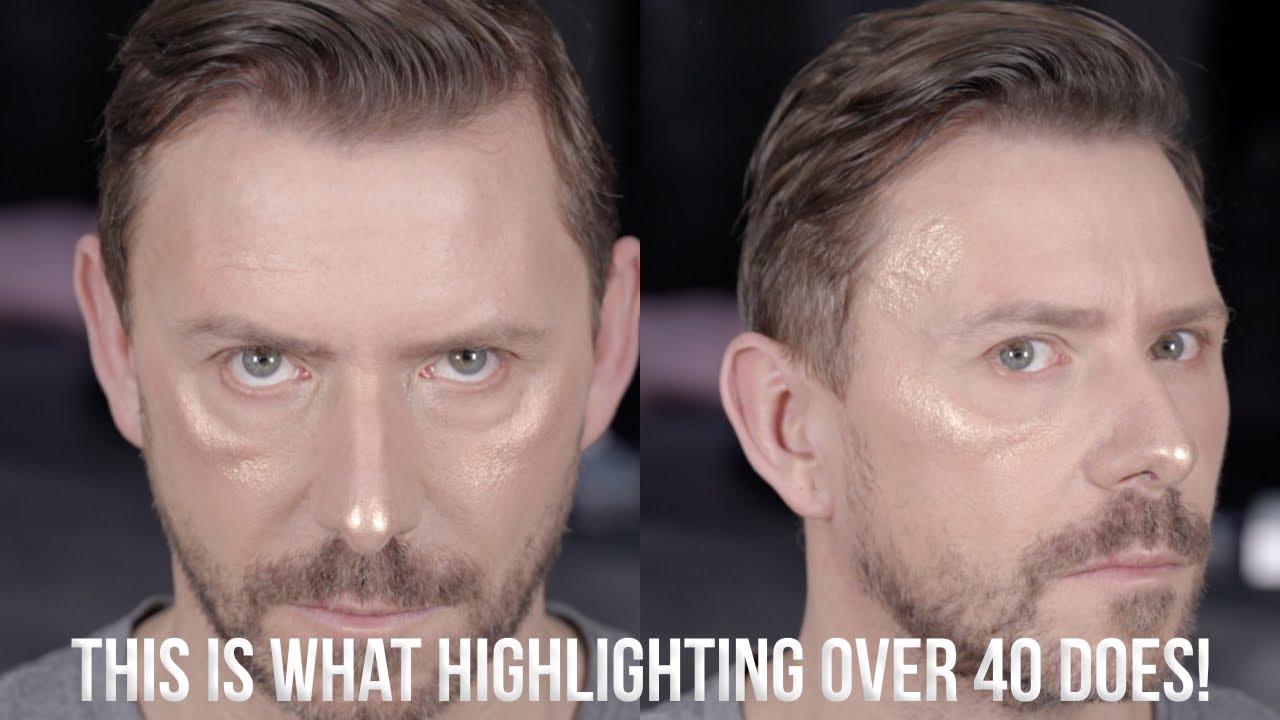
Highlighter belongs on the tops of the cheekbones and the brow bone, plus the inner corners of the eyes, always on skin that’s smooth and firm. The nose bridge and cupid’s bow are optional.
On the cheekbones, start just below the outer corner of the eye and blend upward toward the temple, not down toward the mouth (Patrick Ta). The brow bone gets a thin line just under the arch, following the curve of the brow. Inner corners need one small dot, and Adorn Cosmetics ranks them among the most effective spots on mature skin.
A thin line down the nose bridge is fine, but more than that makes it look oily. For cupid’s bow, use a small amount above the lip line.
The inner corner is a pinpoint job, and the mechanics are no different from any other inner corner highlight.
Less area is better. On a mature face the job is to lift a few high points and leave everything else alone.
Where and When to Skip Highlighter on Mature Skin
Anywhere the skin feels uneven is a place to leave highlighter off. A handful of areas are worth skipping every time.
Areas to leave bare
- Nasolabial folds
- Under-eye creases
- Crepey skin near the eyes and temples
- Jowls
- Textured cheeks and enlarged pores
- Fine lines and deep wrinkles, where shimmer catches light and draws attention (Patrick Ta)
Over under-eye concealer, highlighter pulls the eye to dark circles and puffiness, according to Trinny London makeup artist Maryam Ahmed. Creased concealer is a separate problem, and the guide to preventing creasing under the eyes deals with that.
A quick texture check
- Face a window with moisturizer fully absorbed.
- Tilt your face and find where the surface looks even.
- Press a fingertip on each planned spot and keep only the ones that feel smooth.
- Move any rough spot to the nearest smooth point on the same bone.
When to skip highlighter entirely
Adorn Cosmetics advises highlighting only the smoothest, firmest areas and avoiding zones where texture, deep wrinkles or sagging are most prominent. If those cover the whole cheekbone, a satin cream blush gives lift without the reflection.
Dry skin that hasn’t been prepped is the other situation where it fails. Adorn lists highlighter over dry, unprepped skin as a common mistake, and no formula fixes that.
Should Highlighter Go Before or After Foundation, Blush and Setting Powder?
Anything creamy or liquid goes on after foundation and cream blush and before setting powder. Powder highlighter goes on last. Where it lands in the routine also changes how strong it looks, and the same product applied earlier reads softer.
Skin prep before any highlighter

Moffitt Cancer Center’s guidance is to put sunscreen on first, ideally 10 to 15 minutes before makeup. Cleveland Clinic (2023) says a few minutes is enough for it to dry and sink in.
The two sources don’t match on the wait, and the longer one costs you nothing. Moisturizer goes on before the sunscreen, and both need to settle before any pearl-based product touches your face.
For the full pre-makeup sequence, there’s a guide to prepping skin before makeup.
Under, over or mixed: where the glow lands
| Position | Result | Example |
|---|---|---|
| Under foundation | Subtler glow | MAC Strobe Cream |
| Mixed into foundation | All-over radiance | Armani Fluid Sheer |
| On top of foundation | More intensity | MAC Strobe Cream |
| Over a lightly set base | Powder highlight grips | Adorn Cosmetics routine |
MAC’s directions for Strobe Cream and Armani’s for Fluid Sheer both allow several positions. The earlier the product goes on, the subtler the result.
Sources split on where powder fits. SheerLuxe makeup artist Valeria Ferreira puts a little highlighter before foundation for a luminous base, while Adorn Cosmetics sets foundation with a light dusting of powder before its highlighter goes on.
Both can be right, since wet formulas go before powder and dry ones go after it. The two artists are just describing different formulas.
Blush and setting powder

Cream blush goes down first, and highlighter follows on the bone above it. Ferreira’s own pairing is a cream blusher with highlight powder over it, and the guide to applying cream blush covers the base layer.
Setting powder stays on the T-zone and off the highlighted spots, because powder over a cream glow dulls it.
The routine in order
- Moisturizer, then sunscreen, then wait until both set.
- Hydrating primer on dry patches, if the base slips.
- Foundation or skin tint, applied thinly.
- Cream blush.
- Cream, stick or liquid highlighter on the high points.
- Setting powder on the T-zone only.
- Powder highlighter last, if your skin stays oily.
Fingers, Damp Sponge or Fan Brush: Which Tool Blends Best?

Fingertips work for cream and stick. Liquid goes on better with a damp sponge, and powder needs a soft fan or fluffy brush.
| Tool | Best with | Common mistake |
|---|---|---|
| Fingertips | Cream, stick | Swiping instead of tapping |
| Damp sponge | Liquid, cream | Too wet, or never washed |
| Soft fan or fluffy brush | Powder | Loading too much pigment |
Fingertips: tap, don’t swipe
Fingers warm cream and stick formulas until they melt into the skin. NYX Cosmetics recommends fingertips over a brush for a diffused glow, and both MAC and Armani list fingertips next to a brush in their directions.
Tap along the bone and work outward, using the ring finger near the eyes. Stop once the edge disappears.
Damp sponge
A damp sponge presses liquid and cream glow into skin really well. The catch is that the dampness is also what makes an unwashed one a bacteria risk, according to the researchers.
The Aston University study in the Journal of Applied Microbiology (2019) found that 93% of the beauty blenders it tested had never been cleaned, and 64% had been dropped on the floor at some point.
To use one, wet it, squeeze out the excess and bounce the product in. Beautyblender says its sponge expands to almost double its size when wet. Real Techniques describes its Miracle Complexion Sponge as dewy when damp and fuller-coverage when dry, and says it blends liquid and cream makeup.
Beautyblender also recommends cleansing the sponge after each use and replacing it every 3 to 6 months. There’s more on sponge handling beyond highlighter in this guide to applying makeup with a sponge.
Soft brush for powder
Powder needs a brush light enough to leave sheen instead of a film. SheerLuxe makeup artist Tania Grier prefers a soft, fluffy brush for mature skin.
Hourglass shows how much the state of the brush matters. Its Ambient Strobe Lighting Powder goes on dry for a soft, sheer highlight, and with the brush dampened for a more intense one.
Brush technique for the rest of the face is covered in this guide to applying makeup with a brush.
How Much Highlighter Is Enough, and How Do You Fix Too Much?

One thin layer per spot is enough. Add a second only where the first disappears in daylight, because highlighter is easier to add than to remove.
Building the glow
Adorn Cosmetics warns that a heavy hand crosses from luminous to shiny quickly. Armani says Fluid Sheer’s color builds in layers without feeling heavy, which makes thin passes the safer route.
Oriflame suggests judging the result in the light you’ll spend the day in, and it helps to let the first layer set before adding a second.
Fixing too much
Makeup artist Cantor, in an AOL feature, suggests going over the area with the tool you used for foundation, adding no new product. A clean brush buffed over the spot will also lift the excess.
If it’s still too much, Elise Marquam-Jahns at Sixty and Me recommends tapping a little leftover foundation from the foundation brush over the highlight. A thin veil of light powder dusted over a shiny patch is her other fix.
Powder takes the edge off a shiny spot quickly, and this guide to applying setting powder covers how much to use.
Highlighter on Mature Skin FAQ
Should women over 50 wear highlighter?
Yes. SheerLuxe makeup artist Zoe Taylor notes that women with mature skin tend to avoid it, though the right texture reads as youthful.
Stick to a satin or dewy cream, stick or liquid and keep it on the smooth high points only.
What is the difference between highlighter, strobing and contouring?
Highlighter is the product, and strobing is the technique of placing light-reflecting product on the high points for glow. Contouring goes the other way and adds shadow beneath the bones for definition.
There’s a separate piece on what contour does to the face.
Does face shape change where highlighter goes?
No. The core spots stay the same on every face shape, and only the width changes.
Oriflame’s beauty editors note that highlighting in the wrong areas can make a face look wider, so keep the strip along the cheekbone narrow.
Does highlighter work with hooded eyes?

Yes, on the brow bone above the fold and in the inner corners. Skip the lid itself, because shimmer catches light on fine lines.
For eye placement beyond highlighter, see this guide to makeup for hooded eyes.
How do you make highlighter last through the day?
Layer a light powder set over a cream base, but only on skin that stays oily by midday. Patrick Ta recommends the cream-plus-powder pairing for longer wear.
On dry cheeks, skip the powder and tap on a little more cream instead.
Choosing a First Highlighter for Mature Skin
Start with a satin cream or stick in the shade nearest your undertone. It blends with fingertips and forgives dry patches.
The trade-off is a quieter glow, and shorter wear on cheeks that turn oily by midday, where a powder finish lasts longer.
Try it at home first, since a swatch alone misses how the product settles. Wear one thin layer over a finished base, then check it in window light at midday. Keep it only if no glint sits on a line.
Dryness shifts through the day, so the midday check catches what the morning check misses. Repeat the test when you change moisturizer or foundation, or when the season turns.
With the cheeks settled, the same texture rules carry over to eye makeup for older women.

She started writing on the site after fielding the same questions from clients and friends often enough to just write the answers down: which red won't turn orange on a warm undertone, how to keep lipstick from feathering into fine lines, why a "12-hour" formula rarely survives dinner.
Every review on the site follows the same rule she uses with paying clients: wear it first, then decide if it's worth recommending.
- How to Make Eyeliner Last Longer Without Smudging - August 31, 2026
- How to Make Eyeshadow Last Longer All Day - August 29, 2026
- How to Find Your Undertone in 5 Easy Steps - August 27, 2026