Lipstick wear claims are rarely backed by measurement, so a 30-person clinical study makes a useful reference point. A bright red liquid matte kept a mean 82.67% of its color after 8 hours, essentially right at the 82.7% acceptability threshold that consumer panels established (Journal of Cosmetic Science, 2020).
Some brands claim up to 24 hours, but the study’s authors noted that long-wear claims had lacked quantitative substantiation. So lipstick longevity comes down to formula and technique working together, and the routine still matters even when the product is a long-wear one.
Which Lipstick Formulas Last the Longest?

Liquid long-wear formulas make the longest claims. Lip crayons sit behind them, and ordinary bullets wear off first. The gap comes from what holds the color on the lips, either a dried film or a wax and oil base that stays soft.
Typical wear time by formula type
Every figure below is a manufacturer claim, not a lab result.
| Formula | Wear claim | What holds the color | Trade-off |
|---|---|---|---|
| Cream bullet | 3 to 6 hours | Waxes and oils | Soft base transfers and fades with food |
| Matte bullet | Longer than cream, no published figure | Low-slip wax base | Drier on the lips |
| Liquid long-wear | 12 to 24 hours | Film left after the solvent evaporates | Can feel tight and dry |
| Lip crayon | Up to 8 hours | Stiff, low-slip stick | Wears out sooner than liquids |
Maybelline’s UK guide is where the cream, liquid and crayon numbers start. It gives typical lipsticks 3 to 6 hours. Liquids and tints such as Super Stay get up to 12, and the Super Stay Ink Crayon gets up to 8.
The spread inside the liquid category shows how loose these claims are. Maybelline’s India site gives SuperStay Matte Ink Liquid Lipstick up to 16 hours, and Revlon claims up to 24 for ColorStay Ultimate Liquid Lipstick.
A US patent on long-wearing cosmetics (USPTO No. 8,313,735) defines long wear as color, texture or consistency staying unchanged after an extended period, with 1, 2 and 8 hours as examples. It leaves the test method open, so each brand picks its own.
Lip stains sit outside the table. Makeup artist Bowman told NBC News that stains reliably last all day.
Matte versus satin splits the sources. Most guides say matte outlasts creamy or glossy formulas, while Glamour South Africa argues a satin pearl finish stays longer because pearl pigments, not oils, create the shine.
Revlon’s 24-hour liquid is a satin finish. That points to the film-forming system as the driver, not the finish, and the differences between matte and satin lipstick finishes matter less than the formula underneath.
What film formers, solvents and waxes do
Film formers are polymers that leave a film once the solvent evaporates (that’s the USPTO patent’s own definition). Trimethylsiloxysilicate is the silicone resin most long-wear liquids lean on.
Isododecane is a volatile solvent. It carries the pigment and film former onto the lips, then evaporates.
Bullets work differently. Candelilla and carnauba waxes give them hardness and shape but don’t form a transfer-resistant film. The oils and emollients keep a bullet comfortable and add slip, which is also what lets color move and transfer.
Elkem’s data sheet for PURESIL TMS IDD 50, a trimethylsiloxysilicate resin delivered in isododecane, lists lip colors among its uses at levels from 1 to 50 percent. Film load varies that widely between products, so two liquid lipsticks with the same claim can wear differently.
Anyone comparing labels can check the INCI list for these ingredients, and a longer explanation of what goes into lipstick helps with the rest.
The catch is dryness. Medical Esthetics magazine notes that many long-wearing lip colors can worsen dryness, so use should be minimized when lips are chapped.
How to Prep Lips Before Applying Lipstick

Exfoliate only when the lips are flaky, apply a balm, then blot it so a thin film stays behind. Lipstick grips a smooth, hydrated surface and slides off a rough one.
Lip skin explains why. The stratum corneum on the lips averages three to five cell layers, against 15 to 20 on typical skin (Medical Esthetics), and the lips have almost no oil glands to top up moisture.
Dermatologist Suzanne Friedler told Healthline that healthy lips don’t need exfoliating, but gentle exfoliation on dry, flaky lips helps lip color go on evenly. Harsh scrubbing weakens the barrier.
For hydration, the American Academy of Dermatology points to balms with ingredients such as ceramides, dimethicone, mineral oil or castor seed oil. It says to skip camphor, menthol and eucalyptus.
A lip primer smooths the surface so pigment has something to hold. Charlotte Tilbury’s own routine uses a moisture-locking balm in that role.
A sugar scrub, a soft toothbrush or a damp washcloth all do the job. Guides on exfoliating lips naturally cover the kitchen-cabinet options.
Waiting time is where guides disagree. Glamour suggests a few minutes for the balm to sink in before blotting, while another guide leaves it on for 15 to 20 minutes.
Start with a few minutes and a blot. Go longer only when the lips are visibly dry.
Chronically dry lips need more than a morning fix, and a routine built for dry lips works better than stacking more balm on the day.
Matte liquids need the most prep, since L’Oreal Paris India warns that dehydrated lips hold them poorly and look cracked and creased. Creamy bullets forgive more, though leftover balm still makes them slide.
Lip Liner as a Base: Outline Versus Full Fill
An outline stops color from feathering past the lip line, while a full fill gives the lipstick a pigment-rich layer to cling to.
Makeup artist Talia Favale told NBC News that liner keeps color from creeping into fine lines around the mouth. Bowman uses a clear primer-and-liner hybrid for the same reason.
Outlining controls feathering at the edges and leaves the center to the lipstick alone.
A full fill adds a base layer of pigment under the lipstick and keeps color on the lips when the top coat thins. It takes about a minute longer.
Outline when feathering is the only problem. Fill when the lipstick is a cream bullet or fades unevenly.
Shade matters more with a full fill, since liner color shows through. Glamour says to match the lipstick, or go one shade lighter when the lipstick is very dark, and a guide to choosing a lip liner shade goes through undertones.
Technique is simple. Trace the inside edge, fill toward the center, then blot, and a walkthrough on applying lip liner covers sharpening and cupid’s bow detail.
How Many Coats of Lipstick Should You Apply?

Two thin coats with a blot in between outlast one heavy swipe. Thickness matters more than the number of coats.
Thin layers and blotting
Makeup artist Jenny Patinkin told NBC News that the thinner the layer, the longer the wear.
Maybelline’s guide also recommends light, thin layers, and Lakme warns that too much product leads to smudging and feathering.
Most guides end up at the same order. Balm first, blotted, then liner, a first coat, another blot and a second coat.
For the blot, Charlotte Tilbury advises placing a clean tissue between the upper and lower lips. That lifts surface oil and excess pigment, so the second coat bonds to a drier base.
Liquids need less. Revlon’s instructions call for dabbing the color on, working from the center of the lips outward, and a guide to applying liquid lipstick covers the dab-and-wait method.
Brush or bullet?
The sources contradict each other here.
L’Oreal Paris India says always use a brush, and another guide adds that it pushes color into lip creases. Glamour goes the other way and says to skip it, since the tube gives richer color.
None of these guides tests the difference. Brush for crisp edges, tube for speed, and liquids come with their own applicator anyway.
The bigger wear gains come from thin layers and blotting, and a general guide to applying lipstick covers the tool question in more detail.
How to Set Lipstick With Tissue and Powder

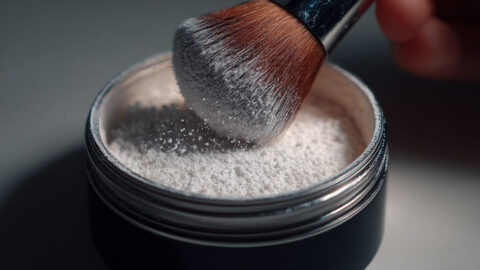
Blot the finished lipstick, lay one layer of tissue over the lips, and dust translucent powder through it. The tissue caps how much powder reaches the lips, which keeps the finish from going chalky.
- Finish both thin coats, then blot with a clean tissue.
- Lay a single layer of tissue flat over the lips.
- Load a fluffy brush with translucent powder and tap off the excess.
- Press the powder through the tissue with light dabs.
- Peel the tissue away and stop there.
Makeup artist Mae told Reader’s Digest the powder through tissue “acts as a setting powder for lipstick.”
Translucent powder is the default. Gulf News adds that a powder blush in a shade close to the lipstick also sets color, with a light dab of translucent powder as the fallback.
Order is where the guides split. Some powder between the first and second coat, while Glamour powders last and warns that reapplying lipstick over powder can turn cakey.
Powdering last is the simpler default, because it never stacks a wet coat on top of powder. Brush choice and pressure get more room in a full guide to setting lipstick with powder.
One more method moves the powder to the start. Makeup artist Rose-Marie Swift places talc-free powder along the lip edge before applying color, so the lipstick sets and deep lines stay hidden (Parade, June 2025).
Setting spray on lips
Setting spray is optional for lips, and the evidence for it is thin.
A setting spray works by leaving a thin film over finished makeup, and cosmetic chemist Ginger King compares it to a light-hold hairspray.
That guidance covers face makeup, and none of the sources reviewed tests spray on lips. Makeup artist Danh Doan also warns that too much spray leaves droplets and can start lifting the makeup underneath.
What Wears Lipstick Down During the Day?
Oily food, rubbing, licking and fine lines around the mouth wear lipstick down fastest.
Transfer-resistant lip patents (USPTO No. 6,071,503) single out oily or greasy foods as a transfer target. The in-vitro test in USPTO No. 8,545,823 leaves vegetable oil on the film for 15 minutes before measuring.
Rubbing does its share too. Mae also told Reader’s Digest to avoid resting a hand on the face or holding a phone against the cheek.
Dermatologist Andrea Suarez told Parade not to lick the lips, because it dries them out.
Color also creeps into the vertical lines around the mouth, which is why they get called lipstick lines.
Straws split the advice. Lakme recommends them to keep lipstick off the glass, while dermatologists quoted by The Healthy list sipping through a straw among the habits that carve lines around the mouth.
For a single big event, the straw wins. As a daily habit, it feeds the feathering problem later.
Eating is where most lipstick disappears. A tissue dab after a meal is the standard fix in brand guides, and a separate guide covers eating without ruining your lipstick.
Once fine lines are the cause, the fix is mostly technique, covered in a guide on stopping lipstick from feathering.
When Long-Wear Techniques Backfire
Powder, matte film and stacked layers all fail on dry lips, and no routine rescues lips that are cracked.
| Situation | What goes wrong | Better move |
|---|---|---|
| Powder on flaky lips | Powder clings to dry patches | Soften lips first, powder through tissue |
| Heavy powder or many layers | Finish turns cakey | Two thin coats, one light dusting |
| Matte film on dry lips | Lips feel tight and flake | Wear it on hydrated lips only |
| Thick balm under bright color | Color payoff drops | Use a moisturizing lip primer |
Makeup artist Gemma Peace says powder clings to dry patches and makes the problem worse. She was talking about face skin, but flaky lips behave the same way.
Swift told Parade that piling layers on the lips makes them look cakey.
Long-wear film has a built-in cost. A USPTO patent on transfer-resistant lipstick (No. 7,261,877) says the film left on the lips lacks flexibility, which adds to dryness and flakiness.
Fashion magazine makes a related point about balm. A balm under bright lipstick can compromise color payoff, depending on how the two interact, while a moisturizing lip primer extends wear instead.
Dry lips are the common thread, and a guide to applying lipstick on dry lips covers the workaround.
Matte wearers have their own version of the problem, which a piece on keeping lips moisturized under matte lipstick addresses.
There is a point where none of this helps. If chapped lips do not improve after two to three weeks of care, the American Academy of Dermatology says to see a board-certified dermatologist. Stinging or burning after a lip product means stop using it.
Touch-Ups and Removal for Long-Wear Lipstick
Blot first, then add a thin coat only where color has worn. At night, dissolve the film with oil before wiping.
Touch-ups go wrong on lips that have dried out, which is the scenario Fashion magazine flags for reapplied bright shades. Dab on a thin layer of balm, blot it, then add color.
For removal, an oil-based cleanser or balm goes first with liquid and matte formulas. Iba Cosmetics says oil breaks down the silicone and polymer film that holds long-wear color.
MasterClass says to press a damp micellar water pad to the lips for about one minute.
If an oil remover leaves color behind, Makeup.com (September 2022) says to leave a layer of petroleum jelly on for three minutes, then wipe with a warm washcloth.
Sources disagree on micellar water. MasterClass treats it as enough for stubborn lipstick, while Iba says it may not be enough alone for liquid or long-stay matte formulas.
Oil first, micellar water second covers both positions.
Liquid formulas set into the hardest film, and a separate guide covers taking off liquid lipstick in more detail.
Matte lipstick has its own removal quirks, laid out in a guide to removing matte lipstick.
Finish with a balm. MasterClass notes that long-lasting lipsticks can leave lips dry and cracked.
Lipstick Longevity FAQ
Can concealer replace lip primer?
Yes, for color and grip. Makeup artist Carl Ray pats concealer over the lips as a primer substitute to stop bleeding and feathering.
It adds no hydration, though, so dry lips still need balm underneath.
Do darker or brighter shades last longer?
Often, with a catch. Glamour says bright and dark shades outlast soft ones because they carry more pigment.
A makeup artist quoted by Fox News adds that red, fuchsia and other dark hues migrate into fine lines and corners, so edge control matters more with them.
Does lipstick wear off faster on oily lips?
Not by itself. Lips have almost no oil glands, so the oil that breaks down color usually comes from balm, food or the skin around the mouth.
Blot the balm before applying, and pick a film-forming liquid formula on oily days.
How do you keep lipstick off your teeth?
Remove the excess from the inner lip before it moves. After blotting, put a clean index finger in your mouth, close your lips around it and pull it out slowly.
Any color that would have reached your teeth stays on the finger.
How do you stop lipstick from transferring onto a face mask?
Choose a transfer-resistant formula and set it. Carl Ray, who aimed his routine at people who prefer satin lipsticks to matte liquids, lays a one-ply tissue over the lips and dusts loose translucent powder through it (Good Morning America, February 2021).
Only a very small amount of powder is needed.
Which Step Adds the Most Lipstick Longevity?
Formula choice adds the most lipstick longevity, and technique decides how much of that ceiling the lips reach.
With a morning that only has time for a few steps, start with a formula that dries to a film. Hydrated, blotted lips come next, and two thin coats followed by powder finish it off.
That order puts the largest gain first and the dryness risk second, since a hard film on flaky lips wears unevenly. No published test ranks these steps against each other (verified October 2026), so the order follows how each step works, and a controlled study that did rank them would reorder it.
The cost is comfort and removal time. Reserve the full routine for long events, and use a blot-and-powder pass on ordinary days.
Lips that stay healthy hold color longer, which starts with a daily lip care routine.

She started writing on the site after fielding the same questions from clients and friends often enough to just write the answers down: which red won't turn orange on a warm undertone, how to keep lipstick from feathering into fine lines, why a "12-hour" formula rarely survives dinner.
Every review on the site follows the same rule she uses with paying clients: wear it first, then decide if it's worth recommending.
- How to Make Eyeliner Last Longer Without Smudging - August 31, 2026
- How to Make Eyeshadow Last Longer All Day - August 29, 2026
- How to Find Your Undertone in 5 Easy Steps - August 27, 2026