Lipstick is one of those products people own for a decade without ever being taught to use it. The tutorials do not help much. A 15-second video shows the swipe and skips the ten minutes before it, which is where the result actually gets decided.
That gap shows up later as feathering, patchy matte, and color on teeth.
Prep comes first, then the shape, then the pigment itself. The swipe is the last of those and the part that matters least.
Every lipstick format behaves differently. Matching your technique to the formula fixes most problems before they start.
What Is Lipstick Application
Prepping the surface, defining the border, and depositing pigment on the vermilion are separate jobs that happen to share one name. Comfort gets decided in the first. Shape in the second. Color payoff depends on both of those going right, which is why the last stage takes the blame for problems that started much earlier.
Skip a stage and the result shows it. Dry lips wreck payoff. Leave out definition and the edge blurs inside an hour.
A touch-up is a different thing entirely. That is one pass straight from the bullet onto an already-prepped lip, no liner involved.
Staining is different again. A lip stain sinks dye into the surface rather than sitting on top of it, so the removal and prep rules change completely.
Most of what sits in a drawer falls into a handful of formats.
- Bullet (traditional stick)
- Liquid, applied with a doe-foot applicator
- Crayon and lip pencil hybrids
- Balm-hybrids and tinted formulas
Stick formats held 58.95% of the global lipstick market in 2024, while liquid formats are the fastest-climbing form at a projected 8.34% CAGR from 2025 to 2030 (Mordor Intelligence).
Formulation drives technique more than most people expect. Castor oil can run as high as 50% of a bullet formula and is usually the first item on the ingredient label (SpecialChem), which is why some sticks glide and others drag across the same lip on the same day.
The rest of the ingredient list is waxes, pigments, and emollients, and the wax-to-oil ratio decides whether a stick holds an edge or smears.
YouGov’s June 2023 poll of 1,000 US adults found 43% of women regularly wear lipstick or lip gloss, second only to mascara at 46%. Plenty of practice, not much technique.
What Tools Are Needed to Apply Lipstick
A bullet tip is fine for casual wear. Sharp edges, overlining, and anything deep enough to show a wobble want a brush, and once you have used one on a red you probably will not go back.
The working kit is a tapered lip brush, a liner pencil, a small flat brush for cleanup, and blotting paper. None of it is expensive.
| Tool | What it controls | Best for |
|---|---|---|
| Tapered lip brush | Edge sharpness, pigment load | Reds, deep shades, matte |
| Lip liner pencil | Shape, feathering, wear time | Every finish except sheer |
| Doe-foot applicator | Coverage speed | Liquid formulas |
| Flat concealer brush | Outer edge cleanup | Correcting slips |
A few things about the tools themselves.
- Buy synthetic bristles. Natural hair soaks up oil and drops pigment payoff on the second pass.
- A cotton swab fixes a wobbly corner faster than any brush will.
- Tissue leaves lint on matte. Blotting paper does not, which is the entire reason to bother with it.
Grand View Research notes that liquid lipstick applicators use a doe-foot or angled tip that allows a more defined lip line, which helps consumers who want sharp edges or high-accuracy fills. That control is part of why liquid formats keep gaining ground.
Pencils need upkeep. A dull tip cannot draw a crisp line, so keeping the pencil point clean and sharp matters more than the shade you picked.
Fingers still beat every tool for balm-hybrids and sheer tints. Body heat softens the formula and the blurred edge is the point.
How to Prep Lips Before Applying Lipstick
Exfoliate, hydrate, prime the border. The order is not flexible.
Lips lose water up to 3 times faster than cheek skin. Kobayashi and Tagami compared the lip and cheek in 303 healthy women (British Journal of Dermatology, 2004) and found transepidermal water loss significantly higher on the lip, with surface hydration around a third of the cheek’s. They put it down to incomplete corneocyte formation on the lip surface, which leaves a weak barrier and poor water-holding capacity.
Shiseido’s stratum corneum research reached the same conclusion. The lip has a thinner stratum corneum, does not readily form sebum membranes, and chapping follows.
Exfoliating Dry or Flaking Lips
Two or three times a week is plenty. Daily scrubbing strips a barrier that was already thin, and you pay for it the following week.
Sugar scrub, a damp toothbrush, an enzyme balm. Any of those lift flakes.
If your lips crack easily there are gentler routes, and natural exfoliation methods handle most flaking without abrasion.
Hydrating Without Causing Slip
Balm goes on, then you wait 5 to 10 minutes and blot the excess off.
Skip the blot and matte formulas slide. That slick residue is the single most common reason a liquid matte lipstick breaks apart within an hour.
Nothing annoys me more than watching someone slather on Aquaphor and swipe a matte over the top 20 seconds later. Chronic chapping needs a longer fix anyway, and a proper routine for persistently dry lips works better than pre-makeup rescue attempts.
Priming the Lip Border
Concealer or foundation tapped over the natural lip pigment neutralizes your base color, and it gives the liner something to grip on the way out.
Nude and pale shades need this. Deep berries and reds do not.
Chronic cheilitis is a dermatological condition, not a prep problem. In a 2022 Scientific Reports study of 109 patients, it was diagnosed on crusting, scaling, peeling, or chapping of one or both lips present for at least 8 weeks, and patients showed measurably higher lip TEWL than controls. When lips are already cracked, application on compromised lips follows different rules.
How to Apply Lipstick Step by Step
Start at the cupid’s bow. Not the center of the lower lip, which is where almost everyone starts.
The bow is the hardest shape on the face to make symmetrical, so it gets your steadiest hand while the pencil tip is still sharp. Everything after it is easier.
Budget 2 to 4 minutes for a full matte. A sheer takes under a minute.
- Exfoliate, hydrate, blot
- Draw both peaks of the cupid’s bow
- Mark the outer corners where upper and lower lip meet
- Connect the lower lip line from corner to center
- Fill with brush or bullet, working from center outward
- Blot on paper, then apply a second layer
- Clean the outer edge with concealer on a flat brush
Charlotte Tilbury’s own directions for Pillow Talk follow the same logic: outline starting from the top corner, drawing slightly over the outer edge of the natural lip line, then fill in for intensity.
Everybody skips the blot-and-reapply step. It removes surface oils and locks the first pigment layer down, and it is the cheapest thing you can do to stretch a cream formula.
Setting adds another layer of insurance. Powder pressed through a tissue mattifies without dulling the color, and blending two shades together fixes a color that reads slightly off.
How to Use Lip Liner With Lipstick
Liner stops feathering. It also corrects asymmetry and buys wear time, and that second part is what people underestimate. A full-lip liner base underneath color adds meaningful time to most cream formulas by giving pigment a dry, waxy surface to sit on instead of bare skin.
Circana data from the first half of 2024 shows lip gloss and liner were the top sales gainers in the US mass cosmetics aisle. Liner stayed a top gaining segment in prestige through 2025.
Charlotte Tilbury reports one Pillow Talk product sells every 10 seconds globally (Forbes, 2024), and the Lip Cheat pencil that started the whole thing in 2013 is a liner, not a lipstick.
Matching the pencil to your natural lip color gives you the your-lips-but-better version. If you want the edge to read deliberate instead, match the pencil to the lipstick and draw a firm line.
Overlining has a ceiling. Stay within 1 to 2 millimeters of the natural ridge, because past that you get a visible ledge in daylight and nobody wants that.
Penciling the whole lip and layering sheer color over it is the trick worth stealing. Wax grips pigment better than bare skin, and the difference on a short-wearing cream is obvious by lunch.
Solid options across price points: NYX Slim Lip Pencil, MAC Spice, Charlotte Tilbury Lip Cheat. If you have never used one, start with an explanation of what the pencil actually does before buying a shade.
Technique matters more than product here. Correct pencil placement and shade selection for your lip tone handle most problems, including color creeping into the lines around the mouth.
How to Apply Lipstick for Different Lip Shapes
Anatomy changes where the pencil goes. It does not change the order of the steps.
Thin lips, full lips, uneven sides, corners that turn down. Those cover most of what anyone deals with, and each wants a different pencil path and, honestly, a different finish.
| Lip shape | Liner placement | Finish that works |
|---|---|---|
| Thin | Outer edge of the vermilion border | Satin, gloss |
| Full | Directly on the natural line | Matte, deep shades |
| Asymmetric | One side only, to the fuller side | Cream, buildable |
| Downturned | Lift the outer corners upward | Satin, medium depth |
Thin Lips
Line just outside the border, keep the center lighter, and finish with a gloss dot on the middle of the lower lip.
Light reflection creates the illusion of volume. Flat matte does the opposite of that.
More detail in technique for narrower lips.
Full Lips
Precision beats volume tricks.
Draw exactly on the natural line. Deeper shades (brick, berry, plum) read intentional on a full lip, where a pale nude tends to look washed out.
Asymmetric Lips
Correct the thinner side only. Extend liner 1 millimeter on the smaller half, leave the fuller half alone, then blend the seam with a brush.
Concealer on the over-full side does the rest.
Downturned Corners
Stop the liner just short of the outer corner and angle the final stroke upward.
Charlotte Tilbury markets Lip Cheat on exactly this premise, that a pencil defines, reshapes, and resizes the appearance of the lips without anything invasive.
How to Apply Each Lipstick Finish
Formula decides the tool, the layering, and how much prep you can get away with. Matte wants one confident pass. Cream and satin are happy to be built up. Gloss stays in the center of the lower lip, and sheer tints do not need liner at all.
Mordor Intelligence puts satin at 43.41% of the 2024 lipstick market by finish, with matte forecast to grow fastest at 7.81% CAGR through 2030. Most people end up owning both and treating them identically. That is the error.
| Finish | Application rule | Typical wear |
|---|---|---|
| Liquid matte | One pass, no re-swiping | 6 to 8 hours |
| Cream and satin | Buildable, brush-friendly | 2 to 4 hours |
| Gloss | Center of lower lip, layered | 1 to 2 hours |
| Metallic | Even pressure, no rubbing | 3 to 5 hours |
Matte and Liquid Matte
One pass. Then stop touching it.
Going back over a half-dry liquid matte lifts pigment and leaves patches you cannot fix without full removal. Brand claims sit at the top end of the range. MAC advertises 12-hour comfortable wear on its Locked Kiss silky matte bullets, and 24-hour transfer-proof, waterproof wear on Locked Kiss Ink 24HR Lipcolour, its longest-wearing liquid formula. Velvet Teddy, by contrast, is a standard Matte Lipstick bullet and carries no such long-wear claim.
Full breakdowns: what defines a matte formula and the matte-specific method. Liquid formulas have their own sequence, covered in liquid application steps.
Satin and Cream
The forgiving ones. Build in 2 thin layers rather than 1 thick one, and a brush gives cleaner edges than the bullet does.
MAC Ruby Woo sells around 7 tubes per minute worldwide (Fashionista), and its blue undertone is the reason it reads as making teeth look whiter.
See satin finish characteristics and how cream formulas behave.
Gloss and Sheer Tints
Circana reported the US prestige lip segment grew 19% in 2024, driven by hybrid balms and oils rather than traditional bullets.
Gloss goes on the center of the lower lip, then presses out. Full coverage looks sticky and travels into the corners.
Sheer tints and balm-hybrids skip liner entirely. Fingers, one press, done.
- Sheer formulas for low-effort daytime color
- Gloss placement technique
- Fenty Gloss Bomb for the wide doe-foot applicator
Metallic and Frost
Even pressure, single direction, no rubbing. Reflective particles patch the second you drag them around.
Metallic formulas need a smoother base than any other finish, so exfoliation is not optional here.
How to Choose a Lipstick Shade That Suits You
Undertone and depth do most of the work. Undertone (cool, warm, neutral, olive) decides which color family flatters you, and depth decides how loud the result gets. Get both right and a surprising number of technique problems stop existing.
A 2024 study in Skin Research and Technology from LVMH Recherche and Parfums Christian Dior measured natural lower-lip color with hyperspectral imaging across 410 women aged 19 to 68, spanning Caucasian French, Caucasian American, African American, and Hispanic American groups. It found wide variation in lightness and hue inside every single group, with substantial overlap between them. A 2025 follow-up extended the work to 514 women across four ethnicities and produced a chart of 53 distinct lip tones.
Which kills the idea that any shade category is one color.
| Undertone | Reads well | Fights you |
|---|---|---|
| Cool | Blue-red, berry, plum | Orange, coral |
| Warm | Orange-red, terracotta, brick | Blue-based pink |
| Neutral | Rosewood, true red, mauve | Very few misses |
| Olive | Brick, warm brown, deep berry | Pale ashy nude |
Test on the lip, not the inner arm. Lip tissue and forearm skin differ in tone and in undertone, which is why counter swatching on the arm produces so many wrong purchases. A fingertip is a closer stand-in than the wrist. The lip itself is the only real test.
The Benchmarking Company surveyed more than 4,300 US female beauty consumers in March 2026 and found 25% feel brands do not understand the needs of people with their skin tone, rising to 48% among respondents with deeper skin tones. Even on lip color specifically, 19% said finding their match is somewhat to very difficult. Shade hunting is not a personal failure.
Research from Circana and the SeeMe Index (September 2024) found that beauty brands certified as inclusive grew 1.5 times faster than less inclusive competitors, at an 18% collective growth rate versus 12%. The index scores brands on representation across skin tone, age, gender expression, body size and more, not shade range alone. Market pressure is fixing this, slowly.
MAC Chili, a brownish orange-red, is the brand’s global best seller and skews heavily toward medium and deep skin tones, while the US market keeps crowning the cooler Ruby Woo.
Where to go deeper:
- Overall color selection method
- Shades built for cool undertones and shades built for warm undertones
- Neutral undertone options, the most forgiving group
- Red selection by undertone family and nude selection relative to your natural lip
One practical bonus: blue-based reds visually counteract yellow in enamel. Certain shades genuinely brighten teeth while warm oranges do the opposite.
How to Make Lipstick Last Longer
Wear time comes down to four habits and one purchase decision. Pencil the whole lip first, blot between layers, dust powder through a tissue, and buy the formula that matches how long you actually need the color to hold. Liquid matte gives you 6 to 8 hours. Cream gives you 2 to 4, and no amount of technique closes that gap.
Mordor Intelligence notes liquid formulations deliver stronger color intensity and longer wear than traditional stick formats, which is why the segment is forecast to grow at 8.34% CAGR through 2030.
| Formula | Realistic wear | Biggest wear killer |
|---|---|---|
| Liquid matte | 6 to 8 hours | Oily food |
| Cream bullet | 2 to 4 hours | Drinking, talking |
| Satin | 3 to 5 hours | Lip licking |
| Gloss | 1 to 2 hours | Everything |
The blot method runs like this. Apply, press once on blotting paper, dust translucent powder through a single-ply tissue, then apply layer two. It is the most reliable free upgrade to a cream formula’s wear.
For the liner base, pencil the full lip surface before color goes anywhere near it. Wax grips pigment better than bare skin.
Behavior matters more than product. Straws for cold drinks, the top-teeth-blot after coffee, no oil-based dressings at lunch. UC Berkeley researchers who tested 32 lip products in 2013 defined average use as roughly 2.3 applications a day, which works out to around 24 milligrams of product ingested per day; heavy reapplication pushed that to about 87 milligrams.
Setting sprays and sealants work, though most add a tight, drying feel by hour four. Fair trade for a wedding, bad trade for a Tuesday.
The mechanics get covered in full in extending wear across formulas, keeping color in place through a full day, and reducing transfer onto cups and collars.
Eating is the standard failure point, so managing meals without wrecking the color is worth learning, and liquid formula wear expectations set a realistic baseline.
What Are the Most Common Lipstick Application Mistakes
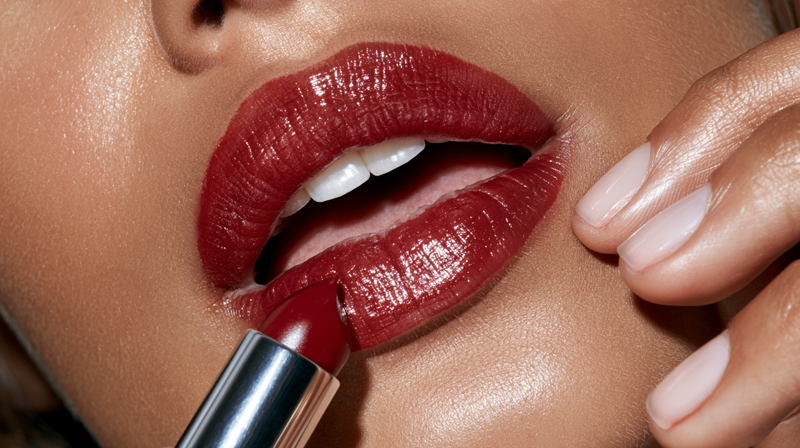
Most bad results trace back to the same small set of habits, and every one of them takes seconds to fix.
Applying over flaking lips is the first. Pigment catches on raised flakes and the texture dries out further underneath. Exfoliate first, always.
Re-swiping a drying liquid matte is worse, because the film is already setting. A second pass lifts it into patches and there is no fix short of full removal.
Then the blot. Took me an embarrassingly long time to accept that one tissue press outperforms every expensive setting product on the shelf.
Overlining past the ridge leaves a visible ledge in daylight that no filter fixes. Stay inside 2 millimeters.
Teeth-tint gets ignored constantly, and it is color theory rather than anything brand-specific. Warm, orange-based reds like MAC Chili sit next to the yellow in enamel and reinforce it. Blue-based reds like Ruby Woo sit opposite it and cancel it out.
Bleeding into fine lines is the last common one. Emollient-heavy creams migrate into perioral lines within an hour without a liner barrier, and stopping color migration takes one pencil pass.
Color on teeth is the mistake nobody catches on themselves. The index-finger trick (close lips around a clean finger, pull it out) removes the inner-rim deposit, and avoiding the transfer entirely handles the rest.
Reapplication has its own limit. Berkeley’s lip product research puts daily ingestion near 24 milligrams for average users, and the popular claim about pounds of lipstick swallowed over a lifetime falls apart under Snopes’ arithmetic: a typical bullet holds only about 3 usable grams, roughly 151 tubes to the pound, so “four pounds in a lifetime” would mean eating over 500 full tubes down to the nub with nothing blotted, kissed, or wiped off. Curious? The lifetime consumption numbers are messier than the headlines suggest.
How to Remove Lipstick and Care for Lips After
Oil-based cleanser, not rubbing. Long-wear and liquid matte formulas bind to the surface with silicone film formers, so oil dissolves them and water does not. Follow with an occlusive balm overnight.
Contact time changes depending on what you are taking off.
| Formula | Remover | Contact time |
|---|---|---|
| Liquid matte | Cleansing oil or balm | 30 to 60 seconds |
| Cream and satin | Micellar water | 10 seconds |
| Stain | Oil, then gentle cleanser | 60 seconds, repeat |
Micellar water handles cream bullets fine. It fails on stains, which sit in the surface rather than on it.
Rubbing is where the real damage happens. Friction on a barrier that already loses water up to 3 times faster than cheek skin produces the chapping people then blame on the lipstick.
Petrolatum reduces transepidermal water loss by roughly 98% at concentrations as low as 5%, far ahead of the 20% to 30% delivered by lanolin, mineral oil, and silicones such as dimethicone (dermatology literature summarized in Cutis/MDedge).
Aquaphor, Vaseline, and Laneige Lip Sleeping Mask all work on the same principle. Seal the surface while the tissue repairs overnight.
Hygiene is the part nobody talks about.
- A UK study of 467 used cosmetic products published in the Journal of Applied Microbiology (Bashir and Lambert, 2020) found 79% to 90% of them carried bacteria, including Staphylococcus aureus and E. coli. Lip glosses were among the more contaminated categories; lipstick bullets were the least contaminated of the lip formats tested
- JETIR’s in-use analysis found the same pattern within lipstick itself: liquid lipsticks carried the highest total bacterial and fungal counts, cream sat in the middle, and matte bullets the lowest
- Replace any lip product used during a cold sore outbreak
Matte wearers need a separate maintenance habit, covered in staying hydrated under drying formulas. Formula-specific removal steps live in matte removal and liquid removal.
Build the rest into a routine. A consistent daily lip care sequence prevents most application problems before they start, while cleaning your bullets properly and knowing what an expired formula does to your lips keeps the whole kit usable.
Never sleep in it. That one is not negotiable.
FAQ on How To Apply Lipstick
Do you apply lip liner before or after lipstick?
Before. Liner draws the shape and gives pigment a waxy surface to grip.
Some artists trace over the finished edge afterward to sharpen it, but the base layer always goes down first.
How do you apply lipstick without a brush?
Use the bullet tip on its angled side, starting at the cupid’s bow and working outward.
Bullets handle creams and satins fine. Deep reds and matte formulas need a brush for a clean edge.
Why does my lipstick always feather?
Emollient-heavy formulas migrate into the fine lines around the mouth within an hour.
A liner barrier stops it. Priming the border with concealer helps too, especially on mature skin where perioral lines run deeper.
How many layers of lipstick should you apply?
Two for cream and satin, with a blot between them.
One for liquid matte. Going back over a setting liquid film lifts pigment and creates patches you cannot blend away.
Can you apply gloss over lipstick?
Yes, and it turns a flat matte into a fuller-looking lip.
Place gloss on the center of the lower lip only. Full coverage travels into the corners. See layering gloss on top of color.
How do you make red lipstick look good?
Match the undertone first, then keep the edge sharp with liner and a brush.
Blue-reds suit cool undertones, orange-reds suit warm. Full technique in applying a red lip.
What is the ombre lip technique?
Darker liner on the outer edge, lighter color in the center, blended where they meet.
It creates depth on thin lips. Steps are covered in the gradient method.
How do you apply lipstick on naturally dark lips?
Neutralize the base with a thin layer of concealer, then build color in 2 sheer passes rather than one heavy one.
Details in application on pigmented lips.
How long does lip liner stay on?
Most pencils hold 4 to 6 hours, longer than the lipstick over them. Charlotte Tilbury, for example, claims up to 6 hours for Lip Cheat.
Wax content drives it. Wear expectations are broken down in liner longevity and extending pencil wear.
Can you fix a broken lipstick bullet?
Yes. Melt the broken edge briefly, press the pieces together, then set it in the fridge for 15 minutes.
The full repair sequence is in salvaging a snapped bullet.
Conclusion
Learning how to apply lipstick well comes down to one habit: matching the method to the formula in front of you.
Build the muscle memory in this order. Prep, liner, brush, blot.
Skip the shortcut of buying a new bullet every time a shade disappoints. Most disappointing shades are application problems wearing a shade’s name.
Start with one finish and get fluent in it before adding others. Working through wearing matte comfortably teaches more about pigment control than any other format.
There is also a case for doing this at all beyond looks. The documented effects of wearing lipstick reach past aesthetics into confidence and habit.
Practice on a Tuesday. Not on your wedding day.

She started writing on the site after fielding the same questions from clients and friends often enough to just write the answers down: which red won't turn orange on a warm undertone, how to keep lipstick from feathering into fine lines, why a "12-hour" formula rarely survives dinner.
Every review on the site follows the same rule she uses with paying clients: wear it first, then decide if it's worth recommending.
- How to Make Eyeliner Last Longer Without Smudging - August 31, 2026
- How to Make Eyeshadow Last Longer All Day - August 29, 2026
- How to Find Your Undertone in 5 Easy Steps - August 27, 2026