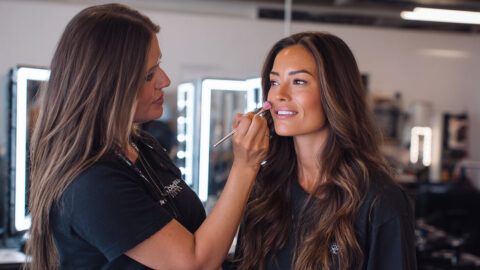
Most lipstick on teeth starts in one place, the wet strip along the inside of the lip. Product collects there, and every smile or sentence pushes some of it onto enamel.
The fix is to clear that strip before you leave the mirror. A clean finger pulled through closed lips does it, and L’Oreal Paris, IBA Cosmetics and Oprah.com all recommend it.
It only clears what is sitting there at that moment, though. Blotting and a liner base help for that reason, and a drier finish helps more, because they leave less loose pigment to creep in later.
How Does the Finger Trick Keep Lipstick Off Your Teeth?

You put a clean finger in your mouth, close your lips around it, and slide it out. The excess on the inner lip edge ends up on the finger, not on your enamel.
New York makeup artist Matthew Nigara, quoted by Oprah.com, calls it the best way to clear color that has migrated to the inside of the lips.
- Apply your lipstick and blot once with a tissue.
- Sanitize your index finger (Oprah.com), or wrap a tissue around it if you would rather not stain skin (The Beauty Department).
- Slide the finger between your lips and close them around it.
- Pull the finger out slowly.
- Check what came off. If the finger is heavily coated, repeat once, then look at your front teeth in a mirror.
The limit is simple. Anything that migrates later while you talk or eat is not covered, so I’d treat this as the last step of a routine and not the whole routine.
Why Does Lipstick End Up on Your Teeth?
Product sits on the wet inner edge of the lip and slides off as the lips move. Talking and eating do the rubbing.
The sliding has a chemical reason. Lipsticks are an anhydrous mixture of about 80% lipids (oils, waxes and butters), according to Abidh and colleagues in the Journal of the American Oil Chemists’ Society (2019). Across their 36 test formulas, oils had the strongest effect on physical and sensory properties, and butter had a negligible one.
If you want to know which of those oils and waxes sit in your tube, the breakdown of lipstick ingredients is a good place to start.
Color applied right up to the wet line has nowhere to go but the teeth. Puckering while you apply raises the odds of it landing on the inner area (Oprah.com).
Finish matters too. The Beauty Department found bright satin and liquid lacquer formulas more likely to cause trouble than matte ones.
Then there are dry, flaky lips, where uneven grip lets product lift off more easily, per IBA Cosmetics. Lip skin has a thin stratum corneum and no hair or sweat glands, so it dries out faster than skin elsewhere on the body.
Cut the excess and you cut the transfer.
How Do You Blot and Set Lipstick So It Stays Put?

Blot to lift surface oil, dust on a little translucent powder, and keep any balm underneath thin. Each step leaves less loose product to reach the teeth.
Blotting passes
Press a tissue between your lips after the first coat. New York makeup artist Maria Verel told Oprah.com that blotting lifts away the excess emollients that make lipstick smear.
Apply a thin first layer and blot (IBA Cosmetics), add a second coat for intensity, then blot again (BellaNaija). Skip the blot and the finger trick has more to remove.
Setting with translucent powder
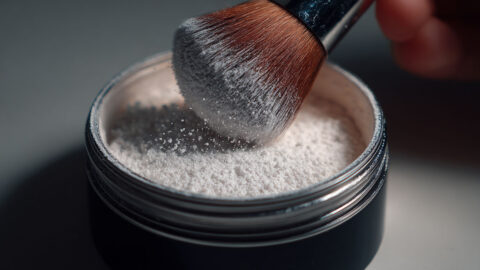
Lay a single sheet of tissue over your lips and dust fine translucent powder over it with a fluffy brush, as The Zoe Report describes. L’Oreal Paris adds that pressing powder through the tissue keeps the finish intact.
The brand names its Infallible Pro Sweep & Lock Loose Powder as an example of a fine translucent formula. The full routine for setting lipstick with powder is covered in a separate guide.
Go invisible with it. Visible powder makes color look dirty (BellaNaija).
Lip balm and primer before color
Balm smooths dry, flaky lips so color grips evenly, and a thin coat helps liner glide (Hadley Helps). Blot off the excess before lipstick goes on, or the balm turns into slip under the color.
For a drier surface, Beaut.ie sets foundation on the lips with translucent powder before liner and lipstick. A lip primer does the same job, giving pigment something to hold.
If your lips are flaky enough that color goes on patchy, a guide to applying lipstick on dry lips covers the prep in more detail.
Powder, balm and primer compared
Every step has a catch, and they are easier to see side by side.
| Step | What it does | Where it falls short |
|---|---|---|
| Blotting | Lifts surface oil and excess emollients | Removes only the top layer, so color can still migrate later |
| Translucent powder | Gives pigment a drier surface to hold | Visible powder dulls the color |
| Lip balm | Evens out dry, flaky lips | Excess adds slip and has to be blotted off |
| Primer or foundation base | Creates a grippy base for liner and lipstick | Needs setting with powder to hold |
Blot every time. Powder is for long days, and the balm stays thin.
Does Lip Liner Help Keep Lipstick Off Teeth?

Yes, if you fill the whole lip with it and don’t just outline. A liner base is drier and waxier than lipstick, so it holds color in place while the top layer wears down.
Outlining alone defines the edge and blocks outward bleeding (Oprah.com), but the center of the lip still has nothing to grip.
A full-lip base works better. Line the outer edge, then fill in (L’Oreal Paris). The waxy layer grips the lipstick (IBA Cosmetics, The Zoe Report) and fades evenly, with no ring of liner left behind (Guardian Nigeria). A neutral shade close to your natural lip color works best, and it shouldn’t be darker than the lipstick.
Short strokes with the side of the pencil keep the line soft, and a walkthrough on applying lip liner covers the technique step by step.
Stopping short of the wet line
Leave the innermost strip of the lip bare. W24 advises steering clear of the inner layer, because less product there means less to rub onto teeth.
The Beauty Department takes the opposite line on the cupid’s bow. Coat it fully, then clear the inner edge with the finger trick.
A clear liner drawn outside the colored one blocks outward bleed (Boldsky), and keeping lipstick from feathering has its own guide.
Applying with a lip brush
Swipe the bullet onto a small lip brush and apply from the brush. L’Oreal Paris says this gives more control than working straight from the stick.
The Zoe Report suggests pressing pigment in instead of swiping across the surface. Thin layers carry less product toward the wet line.
Which Lipstick Formulas Are Least Likely to Reach Your Teeth?
Lip stains and dried-down liquid mattes transfer least, matte sticks come next, and creamy, satin and glossy formulas transfer most. Faces Canada names liquid matte lipsticks and matte bullets as the formulas with the longest wear and least transfer.
| Finish | Transfer risk | Add this fix |
|---|---|---|
| Lip stain | Lowest | Apply to bare, smooth lips |
| Liquid matte | Low once dry | Let it dry fully before talking |
| Matte stick | Low | Light lip balm first, then blot |
| Cream or satin | High | Full liner base, blot, powder |
| Gloss or lacquer | Highest | Sheer coat, finger trick, nothing on the inner edge |
The ranking is relative. It draws on the makeup artist and brand guides cited below, not on a lab test.
Matte, satin and gloss
Ruby Hammer, the celebrity makeup artist writing for Live That Glow, says matte and liquid formulas tend to last longer while glossy or creamy ones transfer more easily. IBA Cosmetics makes the same split. Matte and liquid formulas dry down and set on the lips, and glossy and creamy ones contain more oils and slide more.
Matte has a cost, which is dryness. Estee Lauder advises choosing a creme finish over a matte one if that’s a worry, and prepping with lip balm, so a light balm underneath keeps the lips smooth.
If you are weighing a matte against a satin, a side-by-side of matte vs satin lipstick shows what each finish gives up.
Liquid mattes and stains
A liquid matte dries down to a film, but the film only works once it has dried. The eCosmetics beauty editor says Dior’s Rouge Dior Forever Liquid stays wet for a short while after application and should be left to dry.
Even then it’s no guarantee. A customer on Target’s listing for The Lip Bar’s liquid matte says people constantly tell them they have lipstick on their teeth.
Stains behave differently. L’Oreal Paris says the tint settles into the surface layer of the lips, which is why it resists transfer and fades gradually. NYX Cosmetics adds that stains generally carry less pigment than lipsticks, so you trade intensity for staying power.
The e.l.f. Cosmetics guide warns that dry, flaky patches turn a stain uneven, and anyone new to the category can start with what a lip stain is.
Does shade matter?
Red has a reputation for landing on teeth (In The Know), and it’s earned. A saturated shade shows every trace, so the finger trick matters more with it.
Bright reds and deep berries are the usual offenders, and dark plums show up on enamel just as easily.
My rule is simple. If you won’t blot and powder, buy a stain or a liquid matte and give it time to dry. If you want a creamy finish, accept the full routine.
Are Vaseline on Your Teeth and the Cotton Swab Hack Worth It?
Mostly no. Both are tooth-side workarounds, and lip-side prevention (blotting, the finger trick, a liner base) does the same job with less fuss.
Vaseline on the teeth
Sources split on this one. W24 (citing wikiHow), Beaut.ie and The Zoe Report all recommend a thin layer of petroleum jelly or a clear waxy balm on the front teeth.
Oprah.com notes that red-carpet regulars and pageant contestants do it, then adds that you will probably look as if you have Vaseline smeared on your teeth. The guides recommending it offer no test data, so the benefit rests on repeated advice, not measurement.
On safety, MedlinePlus lists petroleum jelly as nontoxic. Swallowing a large amount can cause abdominal pain and diarrhea, and breathing it into the lungs causes more serious symptoms.
It does form a barrier on the front teeth (Beaut.ie, The Zoe Report), and your lip routine stays the same. Against that, it can show on the teeth (Oprah.com), it does nothing for color sitting on the inner lip edge, and it puts one more product in your mouth.
The cotton swab hack
In The Know video producer Lisa Azcona tested it on a red shade. You place a cotton swab between your lips, bite it so it stays put, apply lipstick as usual, then remove the swab.
| What worked | What didn’t |
|---|---|
| Teeth looked clean right after application | Some lipstick reached the teeth once talking began |
| Biting the swab kept it from moving around | It got in the way at the corners of the mouth |
A swab protects the moment of application, but transfer happens when you talk. Blotting and the finger trick cover that part, which is why tooth-side barriers belong to photo shoots and stage events and not the daily routine.
What If Lipstick Still Gets on Your Teeth?
Check your teeth in a mirror after eating or a long conversation, wipe them with a tissue, and clear the inner lip edge again with the finger trick. Some situations beat every prep step, and then a quick repair makes more sense than a better routine.
When the prep steps fail
| Situation | Why it fails | What to do |
|---|---|---|
| Oily or greasy meal | Oils break down lip products faster | Touch up afterward |
| Glossy or creamy formula | The product stays mobile and transfers easily | Repeat the finger trick |
| Liquid matte not yet dry | The film has not set | Wait before talking or eating |
Faces Canada says oils act as natural makeup removers, which is why even long-wear formulas give way at dinner.
If a meal is on the schedule, the guide to eating with lipstick on is worth a skim first.
Checking and fixing on the spot
Open a compact mirror, smile wide, and scan the upper front teeth and the corners of the mouth.
If something is there, run a tissue over the front teeth (Hadley Helps). Wrap it around a finger if you need to reach the gum line. Then repeat the finger trick on the inner edge and blot lightly.
When the color has mostly faded, Faces Canada advises removing it completely and applying fresh thin coats instead of layering more on top. Blot, then finish with the finger trick.
No formula is immune. Ruby Hammer says lipstick will always transfer to some extent, and making a lipstick transfer proof is a bigger project than keeping your teeth clean.
FAQ About Keeping Lipstick Off Teeth
Which part of the lip puts the most lipstick on the front teeth?
The upper lip, along the cupid’s bow, according to The Beauty Department. Coat it fully, then clear the inner edge with the finger trick instead of leaving that area bare.
Is the finger trick hygienic?
Yes, with a clean finger. Oprah.com suggests sanitizing first, and a tissue wrapped around the finger works as well.
Does drinking through a straw help?
Partly. A straw cuts direct contact between your lips and the glass, so less color gets wiped off and moved around (Ruby Hammer, Live That Glow).
It does not clear the inner lip edge, so the finger trick is still needed.
How often should you check your teeth for lipstick?
After every meal or drink, and before any meeting or photo. A quick smile in a compact mirror takes a few seconds.
The Shortest Routine for Keeping Lipstick Off Teeth
One blot and the finger trick, every time. Press a tissue between the lips, then pull a clean finger through closed lips.
Creamy, satin or glossy finishes need a liner base and powder on top of that, and a mirror check after meals catches whatever slipped through.
The order runs from least to most effort, so extra layers only show up when the finish demands them. Each one trades some shine for lower transfer.
As of October 2026, the guides located for this topic carry no transfer test data for the finger trick or a petroleum jelly barrier, so a controlled comparison would reorder these steps.
With teeth clear, color that fades by midday becomes the next problem, and a guide to making lipstick last longer covers it.

She started writing on the site after fielding the same questions from clients and friends often enough to just write the answers down: which red won't turn orange on a warm undertone, how to keep lipstick from feathering into fine lines, why a "12-hour" formula rarely survives dinner.
Every review on the site follows the same rule she uses with paying clients: wear it first, then decide if it's worth recommending.
- How to Make Eyeliner Last Longer Without Smudging - August 31, 2026
- How to Make Eyeshadow Last Longer All Day - August 29, 2026
- How to Find Your Undertone in 5 Easy Steps - August 27, 2026