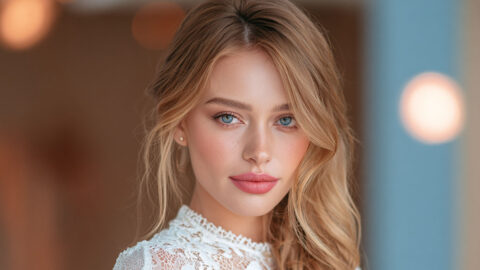
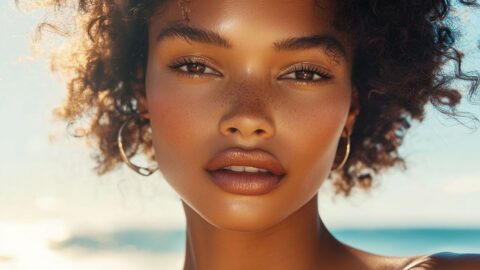
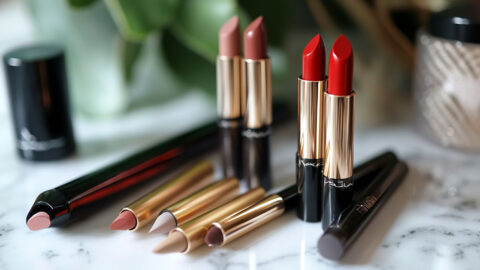
The shades that work are the cool, blue-based ones, meaning blue-based reds, cool pinks and fuchsias, berries and plums, and deep wine tones. Warm orange, coral and brown shades make teeth look yellower.
None of this changes the tooth. It’s contrast against the lips, and people do register it. In a 2023 Medicine and Pharmacy Reports study, 100 observers graded smiles photographed with 5 lipstick colors. Red and purple earned the highest whiteness grades, and nude earned the lowest.
Dentists take the bias seriously. VITA Zahnfabrik’s shade-taking guidance tells them to remove lipstick before reading a tooth shade.
Which Lipstick Colors Make Teeth Look Whiter?
Stick with cool, blue-based shades. Warm ones do the opposite.
| Shade family | Undertone | What the sources say |
|---|---|---|
| Blue-based red | Cool, no orange | Cancels yellow; red rated above pink and orange in a 2022 smile study |
| Cool pink and fuchsia | Blue-leaning | Bold, saturated versions get the recommendation; pale pinks are disputed |
| Berry and plum | Violet-blue | Purple tones graded among the whitest-looking in a 2023 photo study |
| Wine and burgundy | Deep, cool | Dentists cite wine, cranberry and dark reds for strong contrast |
Red has the most evidence behind it, so I’d start there. Pick by undertone and not by name, since plenty of reds lean orange.
Cosmetic dentist Lauren Becker, quoted by New Beauty, suggests going darker while staying in the cool blue and purple family. A deeper color gives teeth more to stand out against.
Charlotte Tilbury sells a red on exactly this basis. She pitches Matte Revolution in Red Carpet Red as a classic red with cool-blue undertones.
Pink is where the sources split. Bold fuchsia gets recommended and pale pink gets warned against.
Which Lipstick Shades Make Teeth Look Yellower?
Orange-red, yellow-based red, coral and brown shades make teeth look yellower. Beige nudes and pale pinks are more contested.
Warm shades that reflect yellow
Bright orange and yellow-toned reds emphasize the yellow in teeth, according to New Beauty’s dentist panel. Dentist Dustin Cohen says any yellow component makes a lipstick read warm (Who What Wear UK).
Makeup artist Nick Lujan of Kevyn Aucoin flags certain corals as dulling, and he gives brown the same warning for the same reason.
Colgate’s guidance groups yellow and orange undertones together, gold ones too, and says all of them make teeth look yellower than they are.
Reds are the tricky ones, because a cool red and a warm red can look identical in the tube. A look at how cool and warm red lipsticks differ makes the split easier to see.
A warm shade isn’t banned. You just trade some whitening contrast for the color you wanted.
Nude and pale shades, where sources disagree
New Beauty’s dentists say pale pinks and frosts, plus mattes, accentuate stains and dull teeth. Glamour South Africa adds that nudes often drift peach or brown, and both of those can make teeth look yellower. The Cluj-Napoca study (Medicine and Pharmacy Reports, 2023) lines up with that, since observers graded nude lipstick photos lowest.
On the other side, L’Oreal Paris says a nude lip can still work. Charlotte Tilbury says to pick brown nudes over orange ones.
Both brands sell nude shades, which is worth remembering. The only controlled evidence in this group sides with the warning.
Nudes that lean pink act like cool shades, while peach and beige ones act warm. Finding the pink-leaning kind takes some swatching.
Why Do Cool Lip Shades Make Teeth Look Whiter?
Blue sits opposite yellow on the color wheel, and a lip color placed next to the teeth shifts how they look. A cool, blue-based shade pushes the teeth away from yellow, which reads as whiter. The tooth itself doesn’t change.
Michel Eugene Chevreul described this effect as simultaneous contrast in his 1839 treatise. Neighboring colors look as different from each other as possible.
The yellow comes from inside the tooth. Enamel is translucent and the dentin beneath it is yellowish, so thinner enamel lets more yellow show through.
Lipstick leaves that tone alone. It only changes what the eye compares the tooth against.
Varvara and colleagues (Medicine and Pharmacy Reports, 2023) had 100 observers grade 4 smiles, each photographed with 5 lipstick colors (plus a no-lipstick photo), on a scale from 1 (dark) to 6 (white). Nude lipstick photos got the lowest grades and red and purple the highest.
Krajangta and colleagues (International Journal of Dentistry, 2022) took a different route. 212 raters scored 27 digitally edited smile photos from 0 to 10, and red averaged 4.45 against 3.75 for pink and 3.69 for orange. Red differed significantly from pink and orange, while pink and orange did not differ from each other.
Read those figures with care. The Cluj-Napoca study graded tooth whiteness, while the Thai study scored smile attractiveness, and its red advantage is under one point on a 10 point scale.
The Thai authors offer the blue-purple undertone of reds as an explanation, not a measured result. Neither abstract tests undertone as a variable.
Together the two studies agree on direction. Saturated red and purple beat nude, and red beats pink and orange too. What they leave open is how much of the effect comes from blue undertone and how much from plain darkness and saturation.
How to Tell if a Lipstick Has a Blue Undertone
Swatch it next to a true blue and a true yellow and see which one it blends with. The cooler match is the blue-based shade.
- Swatch the lipstick on the back of your hand or a white tissue, next to a second shade, so the cooler one shows.
- Hold each swatch against a true blue object and a true yellow one. A swatch that blends better with the blue has a cool base (Cohen, via Who What Wear UK).
- Read the shade name and packaging. Many brands label shades warm, cool, blue-toned or blue-based (Jones Road Beauty).
- Check the stain left on skin. A bluish or purplish tint means cool undertones (Colgate).
Trust the swatch over your eye.
The test finds a cool base and nothing else. Pale or sheer cool shades, frosted ones included, can still dull teeth, per New Beauty’s dentists.
Passing the test makes a shade cool, not flattering. Picking a lipstick color that suits your skin and outfit is a separate decision with its own rules.
Does Lipstick Finish Change How White Teeth Look?
Yes, though depth of color matters more than finish. Gloss and shimmer add reflected light, and matte formulas don’t.
| Finish | Effect on teeth | Source |
|---|---|---|
| Matte (general) | Can dull the smile | Colgate |
| Dark matte | Looks brighter than a dark gloss | Really Ree (UK beauty blog) |
| Gloss over a cool shade | Reflects light, adds sparkle | Colgate |
| Silver shimmer or clear blue gloss | Keeps the cool-tone rule | Colgate Australia |
| Warm gold shimmer | Can make teeth look duller | Colgate |
Colgate and Really Ree disagree on matte. The likely reconciliation is depth. A dark, saturated matte keeps its contrast, and a pale or sheer one has little to keep.
Shine is the easier fix. Layering lip gloss over lipstick adds reflection without touching the base shade, and L’Oreal Paris calls a clear gloss over any color a quick way to fake a brighter smile.
The cool-tone rule still applies to the gloss itself. Colgate Australia recommends silver shimmer or a translucent blue gloss over warm gold.
A gold-flecked gloss on top of a berry lipstick works against the berry.
How Do Skin Tone and Tooth Shade Change the Best Choice?
Skin tone decides which cool shades flatter you, and tooth shade decides how much yellow the shade has to offset. Pick the family by skin depth first, then check it against your teeth.
Colgate Australia points fair skin toward cool pinks and blue-based reds. Medium and warmer skin does well with brighter, saturated pinks and fuchsia, which a makeup artist quoted by Who What Wear calls flattering on any skin tone. Berry and wine go to deep skin, with Colgate Australia singling out deep berries for darker tones.
Fair skin has more options than cool pink alone, and a full guide to lipstick colors for fair skin shows where else the cool range goes.
Deep berry and wine sit at the darkest end of the cool range, which gives teeth the widest lightness gap to stand against. The wider set of lipstick colors for dark skin runs past those two families.
Tooth shade changes the target
Dentists record tooth shade with the VITA classical A1-D4 guide, which holds 16 natural shades in four hue groups (DentalCare). Group A is reddish-brown, B reddish-yellow, C gray and D reddish-gray, per DentalCare’s shade selection course.
Teeth with a yellow or brown cast (groups A and B) give a blue-based shade the most to offset.
Gray-cast teeth (groups C and D) have less yellow to cancel, by the same color logic, so shine does more work than blue. A dentist quoted by New Beauty says the shimmer in a neutral gloss reflects against graying enamel and makes teeth look shinier.
As a rule of thumb, choose the cool family by skin depth, then go as deep as you will actually wear.
What Lipstick Cannot Do for Your Teeth
Lipstick can’t remove a stain or lighten dentin, and it won’t change a measured tooth shade. It shifts perception and nothing else.
Where the effect stops
Pigment that smudges onto the teeth covers the tooth color directly, which is one way a good shade backfires. Gray or aging enamel gains little from blue and responds better to shine. A dentist’s shade reading ignores the lipstick, since the lipstick is the bias.
VITA Zahnfabrik’s shade-taking guidance tells dentists to remove lipstick and cosmetics and to cover bright clothing with a gray cape.
The effect that makes a cool lip useful at a party is the one clinicians work to remove from a shade reading.
When whitening is the better option
| Method | Changes the tooth? | How it works |
|---|---|---|
| Lipstick | No | Color contrast with the lips |
| Whitening toothpaste | Surface stains only | Polishing or chemical agents |
| Peroxide whitening | Yes | Breaks down stain compounds |
| Blue covarine toothpaste | No | Blue pigment on the surface, evidence mixed |
If the yellow bothers you at one event, lipstick is enough. If it bothers you in every photo and every mirror, lipstick is a patch.
An ADA News Morning Huddle summary of a Healthcare Business Today report says in-office treatments use 15% to 43% hydrogen peroxide, while dentist-supplied home trays use 10% to 16% carbamide peroxide. Hydrogen peroxide works faster and carries a higher risk of tooth sensitivity, and the summary advises choosing at-home products that carry the ADA Seal of Acceptance.
Blue covarine applies the lipstick logic to the tooth itself, depositing a blue pigment to offset yellow. The evidence conflicts. An in vitro study on 180 stained bovine teeth could not confirm a whitening effect (Oliveira and colleagues, Journal of Esthetic and Restorative Dentistry, 2016), while a clinical trial reported an instant optical whitening perception from a blue covarine toothpaste (Open Dentistry Journal, 2022).
The studies used different models, so neither cancels the other.
Common Questions About Lipstick Colors for Whiter-Looking Teeth
How do you keep lipstick off your teeth?
Blot once, then close your lips around a clean finger and pull it out, which removes the excess that would transfer.
Pigment on the enamel covers the tooth color directly, and a fuller routine for keeping lipstick off your teeth covers the remaining steps.
Does a tinted lip balm make teeth look whiter?
Yes, when the tint is cool. A sheer balm puts less color beside the teeth than an opaque lipstick, so the effect is smaller.
Colgate Australia advises a silver shimmer over warm gold in a balm.
Do blush and eyeshadow colors change how white teeth look?
Yes, according to Colgate Australia. Warm blush gives teeth a yellow cast, and so do orange or gold eyeshadows, while cooler blush and blue-toned shadows brighten them.
Lipstick sits closest to the teeth, so start there.
How long does the whitening effect of lipstick last?
The effect lasts only while the color stays on your lips.
Once the lipstick fades, the contrast fades with it, so making lipstick last longer stretches the effect.
Testing a Shade on Your Own Smile
A lipstick shade for whiter-looking teeth proves itself in daylight, against your own teeth, not on a swatch card.
Do the check in order, because each step narrows the next. Swatch in daylight first to confirm a cool base. Then photograph your smile with and without the lipstick, and land on the deepest cool shade that still suits your skin.
Judge each look quickly. VITA Zahnfabrik notes that the eye tires after approximately 5 to 7 seconds of shade comparison, so the first look is the reliable one.
The deepest cool shade gives teeth the most contrast and shows every smudge, so it costs more upkeep.
As of October 2026, the controlled studies located test color families, not undertone. A study that separates blue base from darkness would change which of the two to prioritize.
Once a shade passes, keeping lipstick off your teeth protects the result.

She started writing on the site after fielding the same questions from clients and friends often enough to just write the answers down: which red won't turn orange on a warm undertone, how to keep lipstick from feathering into fine lines, why a "12-hour" formula rarely survives dinner.
Every review on the site follows the same rule she uses with paying clients: wear it first, then decide if it's worth recommending.
- How to Make Eyeliner Last Longer Without Smudging - August 31, 2026
- How to Make Eyeshadow Last Longer All Day - August 29, 2026
- How to Find Your Undertone in 5 Easy Steps - August 27, 2026