Laura Mercier and L’Oreal Paris print opposite instructions for where highlighter sits relative to setting powder, and both are right. It comes down to the formula, so cream and liquid go before powder, and powder highlighter goes last.
The glow itself comes from mica, a mineral pearl pigment that reflects light. That’s why highlighter makeup belongs on the cheekbones, the brow bone and other high points of the face and not across the whole complexion.
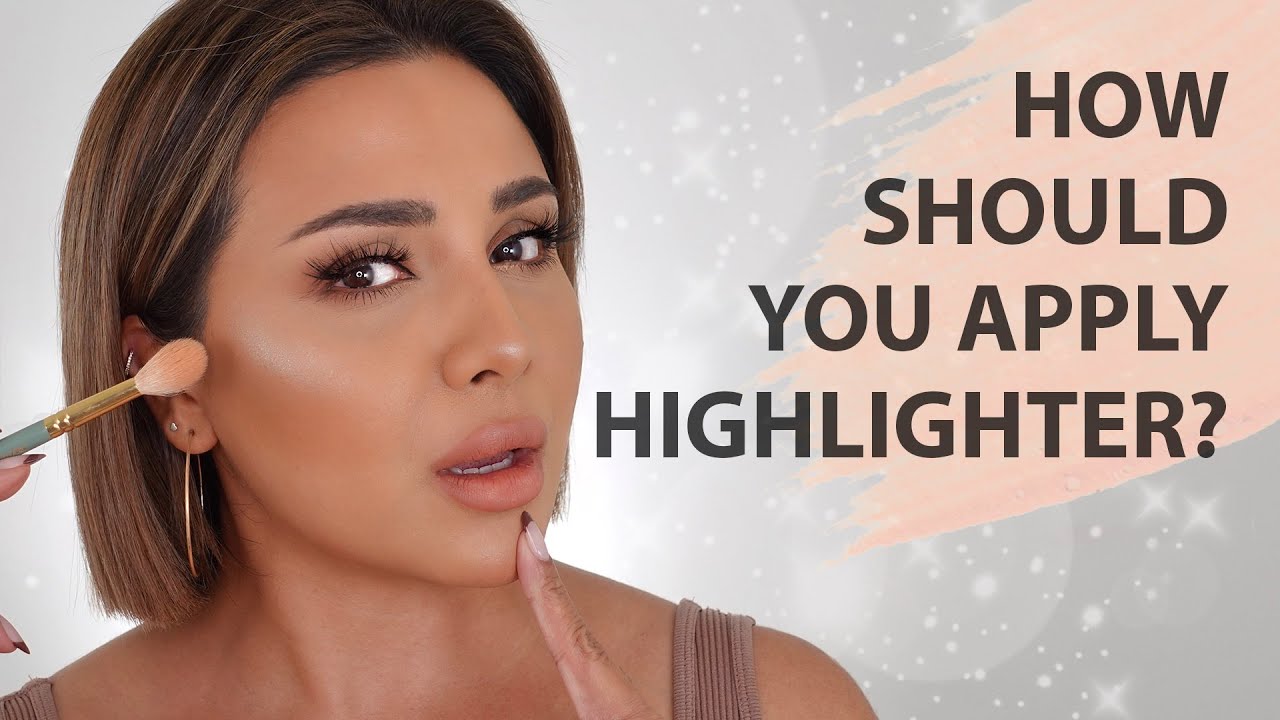
Powder wants a fan brush. Cream and liquid go on with fingertips or a damp sponge, and with either one, thin layers blended until no edge shows look better than a single heavy pass.
It’s the last step of the cheek routine, after foundation, then blush and bronzer. It works for a daytime sheen or an evening glow.
Where to put highlighter on your face

Anywhere light already lands. The tops of the cheekbones and the brow bone do most of the work, the center of the nose and the cupid’s bow come next, and the inner corners of the eyes are the finishing touch if you want one.
The temples finish the cheekbone sweep. Everything beyond that is optional.
Cheekbones and brow bone
Cheekbones come first. Set the product on top of the bone and carry it back toward the temple in a soft C shape, the same motion Becca’s directions describe for its Shimmering Skin Perfector.
Keep the glow above the hollow. A contour shade sinks the area under the bone, and highlighter brings the bone itself forward, so the two sit side by side and never overlap.
The brow bone gets a thinner line, right under the arch. It lifts the brow and brightens the eye without loading the lid.
Nose bridge, cupid’s bow and inner eye corners
On the nose, a thin line down the center laid on with a fingertip is plenty. A small dab above the middle of the upper lip, on the cupid’s bow, makes the lip look fuller.
The inner corners take the smallest amount on the whole face, tapped in with a small brush or a pinky.
Glossier’s Haloscope directions add a half halo around each eye, running from the brow bone down to the cheekbone.
The inner corner is where people overdo it. The brush technique for an inner corner highlight keeps the spot from turning into a harsh dot.
Temples and spots to skip
The temples are where the cheekbone sweep ends, so blend the last of the product there and stop.
- The center of the chin gets a touch in Beautyblender’s guide, but on oily skin it reads as shine, so skip it there.
- Collarbones and shoulders take the same powder with a large fluffy brush. They sit outside the face, so treat them as extra.
A solid default is cheekbones and brow bone, plus one small accent. That’s the setup I’d hand to anyone starting out.
Which highlighter formula suits your skin type and finish?
Powder is the usual call for oily and combination skin, while dry skin tends to do better with a cream or liquid. Sticks are mostly there for touch-ups. The finish depends on how large the pearl particles are and what base carries them.
| Formula | Best for | Tool | Main drawback |
|---|---|---|---|
| Powder | Oily and combination skin | Fluffy or fan brush | Looks chalky on dry skin and stresses texture |
| Cream | Dry and mature skin | Fingertips or damp sponge | Slides and turns shiny on oily skin |
| Liquid | Dry skin, dewy finish | Fingertips, brush or sponge | Easy to overapply |
| Stick | Touch-ups, combination skin | The stick, then fingertips | Firm swipe that needs blending fast |
Powder, cream, liquid and stick compared
NYX, L’Oreal Paris and Sephora Middle East all steer oily skin toward powder.
Cream is hydrating and dewy, which makes it the pick for dry and mature skin. Liquid is sheer and buildable, and it looks best over foundation on dry skin.
Sticks are built for on-the-go touch-ups. A firm one can drag base makeup if you swipe instead of tap.
Becca says its Shimmering Skin Perfector Pressed blends ultra-fine pearl with liquid, which is why Champagne Pop does not read as chalky or glittery.
Cream formulas press in rather than sweep on, and a walkthrough on applying cream highlighter covers that motion.
Dry skin also needs prep before any complexion product, which is where a routine for makeup on dry skin helps. Powder on dry patches is the fastest route to a chalky result.
Combination skin splits by zone, according to NYX. Powder goes on the oily T-zone and cream or liquid on the drier cheeks.
Rare Beauty lists 10 shades for its Positive Light Liquid Luminizer as of October 2026, from soft pink and champagne to bronze and copper. The brand says the superfine pearls take the glow from soft sheen to a stronger pop with layering.
What creates the glow: mica and finish types
Mica starts out as a mineral flake, and a coating of titanium dioxide or iron oxides sets its color. Particle size decides how loudly the reflection reads.
Supplier MakingCosmetics puts satin finishes at mica particles under 20 microns and sparkle effects at particles up to 150 microns.
The FDA lists mica as permitted in cosmetics generally, including the eye area, and exempt from batch certification under 21 CFR 73.2496 (eCFR, updated April 2026). That covers mica itself, not every other ingredient in a pot, so check the label before using a product near the eyes.
A sheen or satin finish means fine pearls and skin that catches light. Dewy comes from oils or butters in the base, so it looks wet instead of sparkly. Metallic is dense, saturated pigment with a foil look. Glitter, or sparkle, uses large particles that show up as separate points of light.
For daytime, pick satin or dewy. Keep sparkle for evenings.
How to pick a highlighter shade for your skin tone and undertone
Go one to two shades lighter than your skin tone, then match the pearl color to your undertone.
Makeup artist Melissa Collazo puts the gap at a shade or two lighter than your skin (Rose Inc), and Juvia’s Place says one to two shades lighter. Treat two as the ceiling.
How to find your undertone
Undertone doesn’t change with a tan or a flush. It leans warm (yellow, golden, peach), cool (pink, red, blue) or neutral, a mix of the two, and Maybelline notes that all of these occur in every depth of skin.
Check the veins on your wrist. Green leans warm, blue or purple leans cool. Gold jewelry flatters warm skin and silver flatters cool, and if both look fine you’re probably neutral. Hold a white cloth up to your face too, since yellowish skin against white is warm and pinkish or bluish skin is cool.
Sources split on the vein test. Maybelline lists it first, while Sterling Style Academy calls it a starting point at best because skin thickness changes how veins look.
Run two tests and trust the answer they share. If they disagree, swatch the highlighter on your cheekbone in daylight, since artificial light distorts the shade.
The same undertone logic for base products is laid out in this guide to matching makeup to skin tone.
Shade ranges by skin tone

Shade names tell you nothing, so read the descriptor. Milk Makeup’s Lit, Turnt and Flash are a champagne pearl, a white gold with pink pearl and a golden bronze, and Rare Beauty’s Exhilarate and Reveal are champagne gold and copper.
Fair skin does well with champagne, icy pearl or pink pearl. Medium and olive skin can carry gold, peach, bronze or copper. For deep skin, look at warm gold, bronze, copper or chocolate.
L’Oreal Paris warns that an overly light, opalescent shade turns deep skin gray. Rule that out first.
When nothing matches, a clear balm or facial oil on the high points works on every skin tone, according to Collazo.
How to apply highlighter step by step

Highlighter always comes after the base.
- Moisturize, then add a primer if your skin runs dry or textured.
- Finish foundation and concealer. Maybelline advises keeping foundation, blush and bronzer softly matte so the highlight has some contrast to work against.
- Choose the tool. A soft brush suits powder, and fingertips or a damp sponge suit cream and liquid.
- Place small amounts on the cheekbones first, then the brow bone and one accent spot.
- Blend the edges with a fan brush, fingertips or a damp sponge until you cannot see where the product stops.
- Add a second thin layer only if the first reads too faint, and judge it in natural light.
Primer helps most on dry or textured skin, and a separate guide covers how to use makeup primer step by step.
Thin layers matter because shimmer only goes one way. NYX notes you can always add more, but you cannot take excess shimmer away without touching up your base.
Tools by formula

A fan or fluffy brush dusts powder over the cheekbone in a light sweep. For the inner corners and the spot under the brow bone, Patrick Ta packs pigment on with a small angled brush.
Cream and liquid go on with fingertips, which warm the product so you can tap it in. A damp sponge presses wet formulas into the skin without streaks.
Fenty Beauty’s Cheek-Hugging Highlight Brush 120 splits the job by shape. The fatter side covers the cheeks and the leaner side does the nose and chin, while the precision tip gets into the eyes and cupid’s bow.
Powder also works wet. An xoNecole contributor says a damp brush fuses powder into the skin so it reads closer to a liquid.
Sponges carry the one real hygiene risk here. Aston University researchers found that 93% of beauty blenders had never been cleaned and 64% had been dropped on the floor, while nine in ten of the used products tested carried bacteria (Journal of Applied Microbiology, 2019).
Washing and fully drying the sponge is the fix, and a walkthrough on how to clean makeup sponges covers it.
Does highlighter go on before or after blush, bronzer and setting powder?

After blush and bronzer, in nearly every published sequence. Setting powder is less clear-cut, and there the formula decides. Cream and liquid go on before the powder, and a powder highlighter goes on after it.
The cheek order is settled. MARS Cosmetics brand manager Mukan Jain gives it as bronzer, then blush, then highlighter, and NYX warns that highlighter applied before blush or bronzer muddies the glow.
Setting powder is where sources split. Laura Mercier’s cream highlighter goes on ahead of the powder step, while L’Oreal Paris’ powder-highlighter routine sets the face with powder first. Boozy Shop sides with the cream-and-liquid half of that rule, placing cream and liquid products before powder.
The wider principle is cream before powder, which a guide on how to layer makeup applies across the whole face.
A cream or liquid highlighter goes on after foundation and concealer, alongside cream blush and bronzer. It needs to land before any powder, because cream pressed over powder streaks (The Zoe Report). Powder the center of the face only and leave the high points unset.
A powder highlighter is the last step on the cheek, after blush and bronzer. Over a cream highlight it intensifies the shine, a common layering move according to The Zoe Report. Match by texture where you can, so powder goes over powder blush and cream goes with cream (NYX).
Charlotte Tilbury’s Hollywood Flawless Filter shows the same logic in one bottle. Its directions let you wear it alone, under foundation, mixed into foundation, or on top of foundation on the high points, tapped in with a finger.
Worn alone, the directions follow with powder in the center of the face only. That is the model for setting without dulling the high points, and the powder step itself is covered in this guide to applying setting powder.
Benefit’s High Beam offers the under-or-over choice too. Under makeup it reads as subtle luminescence, and over makeup it works as a spot highlight.
Under spreads the glow out and over points it, so choose by how visible you want it.
Highlighter mistakes and the skin types that need extra care
Most highlighter problems trace back to a shade that’s off, too much product, the wrong order, or edges nobody blended. Textured, mature and oily skin carry an extra risk, since shimmer catches light on whatever sits underneath it.
Common mistakes and fixes

| Mistake | What it looks like | Fix |
|---|---|---|
| Shade too light or icy | Gray or chalky cheekbones | Swap to a warmer pearl and re-swatch in daylight |
| Too much product | A stripe or an oily sheen | Thin layers, one pass at a time |
| Highlighter before blush or bronzer | A muddy glow | Reorder so blush and bronzer go first |
| Hard edge | A visible line at the border | Tap the edge out with a fan brush, fingertips or a damp sponge |
Blend rather than wipe. Tapping with a clean fingertip or sponge lifts a little product, while wiping drags the base underneath.
Textured, mature and oily skin
Textured skin and enlarged pores
Shimmer particles catch light on every raised surface, so highlighter on pores and lines makes them more visible. Patrick Ta’s guidance is to keep it off fine lines and deep wrinkles, and away from large pores.
Makeup artist Melissa Collazo says dry or acne-prone skin and larger pores do better with cream or liquid, since powder makes textured skin look more textured (Rose Inc).
Choose a satin or dewy finish and keep the highlight broad and flat on the bone. Sparkle and glitter finishes are the ones to leave on the shelf.
Mature skin
Makeup artists agree on formula. Sophie Tilley says powders crinkle and settle into fine lines (SheerLuxe), and Jenny Patinkin says a cream’s emollients form a barrier between the skin and shimmery particles (PureWow).
They split on shimmer. Tania Grier avoids shimmer highlighters entirely (SheerLuxe), while Amanda Ramsay says luminous finishes restore radiance and chunky glitter may settle into lines (The Australian Women’s Weekly).
Heavy cream has its own problem. Parade’s report on makeup artists’ mistakes notes that heavy cream products can move, crease and sink into lines through the day, so pick a thin, balmy one.
Skip the outer corners of the eyes, where fine lines show most. A separate guide on how to apply highlighter on mature skin goes through placement by face area.
Oily skin
Oily skin tolerates highlighter when the amount stays small. L’Oreal Paris puts it plainly. A little goes a long way, and too much leaves you looking extra oily.
Use powder in one thin pass and stop at the bone.
Highlighter Makeup FAQ
How is highlighter different from bronzer and contour?
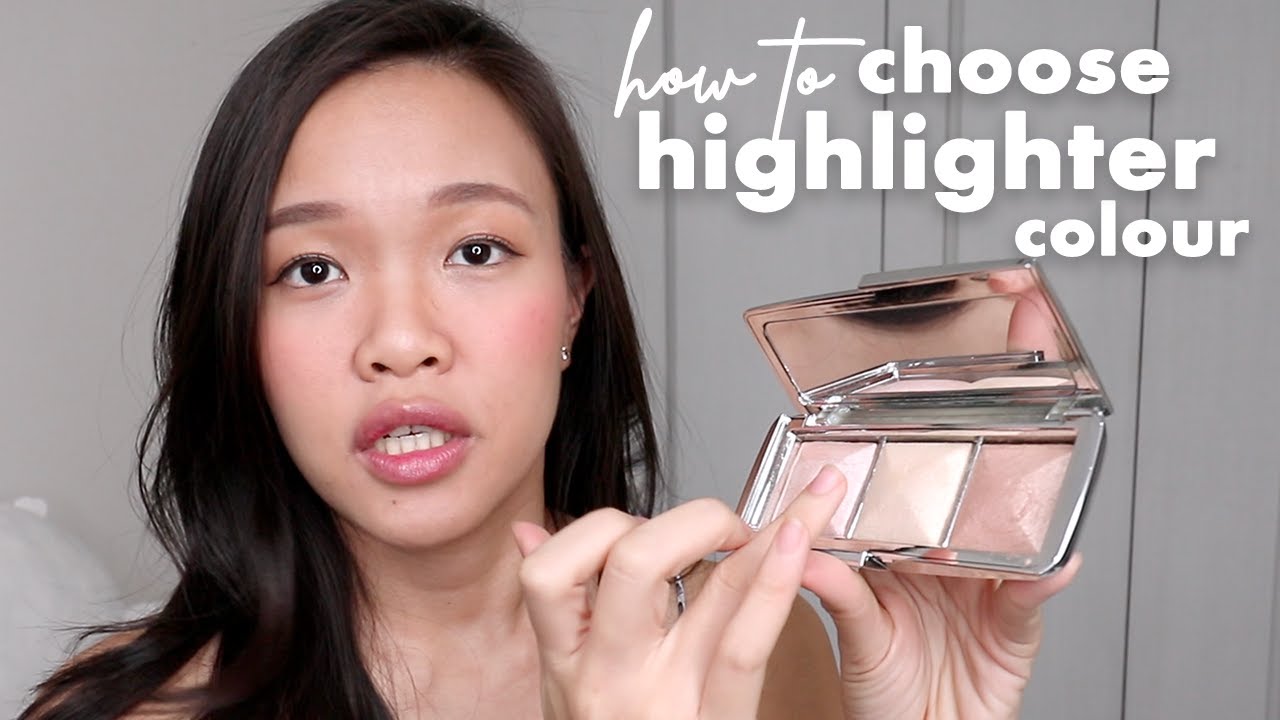
Contour adds shadow and bronzer adds warmth, which leaves highlighter as the one that adds light.
A bronzer goes where the sun would tan you, while highlighter goes last, on the points of the face that catch light.
Is strobing the same as highlighting?
Not quite. Highlighting adds a glow to a few high points, while strobing builds the whole look around highlighter in place of contour.
The placement is identical, so every placement and blending rule above applies to both.
Can highlighter double as eyeshadow or a lip highlight?
Yes, when the label allows use near the eyes. Fenty Beauty positions its Killawatt highlighter for the eyes and lips as well as the face, and suggests topping a lipstick with it.
On the lid, a sheer pearl reads as a soft shimmer shadow.
Does setting spray lock highlighter in place?
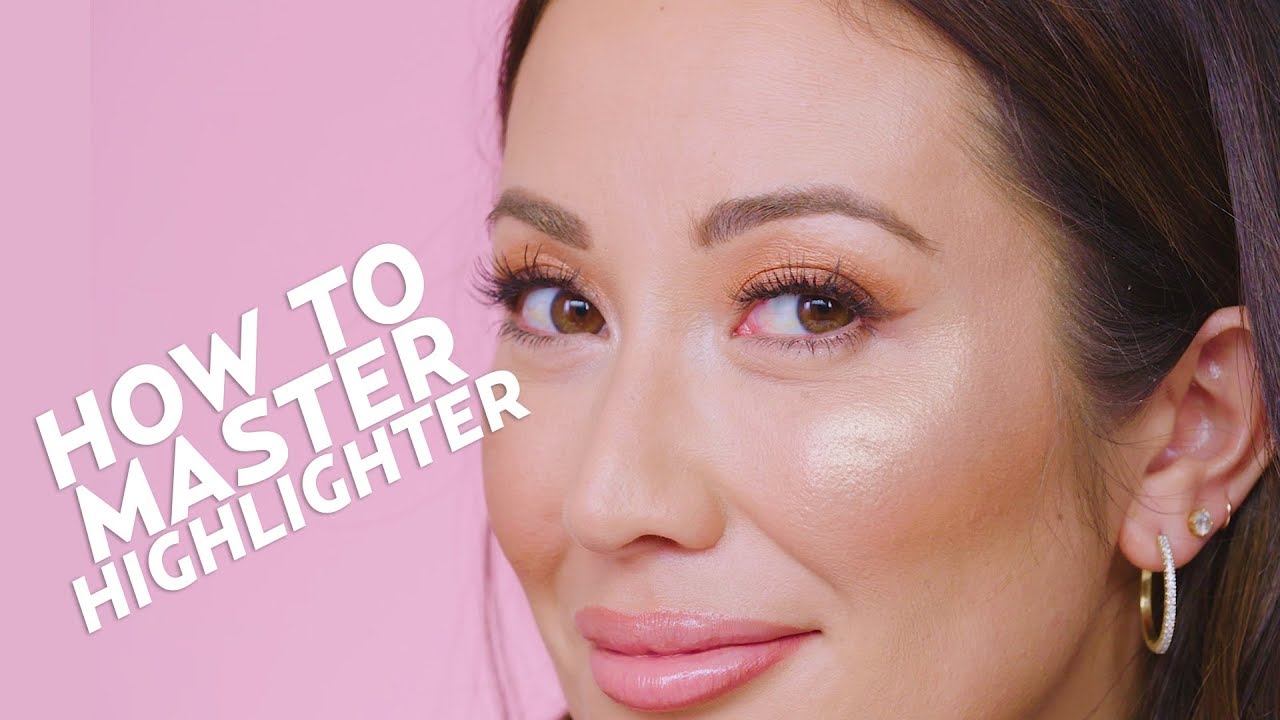
Yes, as the last step of the routine, after any powder. AleuCo’s guide uses it to lock a cream base and powder highlight together.
The spray step is covered in this guide on how to apply setting spray.
Can highlighter be worn every day?
Yes, in a sheer satin or dewy formula and a small amount. Benefit positions its High Beam liquid highlighter for day or night wear.
Keep glitter and sparkle finishes for evenings.
Start With One Highlighter and One Spot
For a first highlighter makeup routine, one satin-finish formula in a shade that matches your undertone is plenty. Put it on the tops of the cheekbones and nowhere else, in one thin pass.
Judge the result in daylight after a full day of wear, then change one variable at a time. Formula goes first, then shade, then placement.
If it’s greasy or sliding by midday, blame the formula. Chalky or gray means the shade is off, and a visible stripe is a blending problem.
The catch is less dimension than a full set of placements, and less intensity than a metallic finish would give you. Both are easy to add later.
Shade ranges and formulas change by season, so recheck a brand’s current listing (this sequence was verified in October 2026). Once the highlight holds, the next gain is learning how to make makeup last all day.

She started writing on the site after fielding the same questions from clients and friends often enough to just write the answers down: which red won't turn orange on a warm undertone, how to keep lipstick from feathering into fine lines, why a "12-hour" formula rarely survives dinner.
Every review on the site follows the same rule she uses with paying clients: wear it first, then decide if it's worth recommending.
- How to Make Eyeliner Last Longer Without Smudging - August 31, 2026
- How to Make Eyeshadow Last Longer All Day - August 29, 2026
- How to Find Your Undertone in 5 Easy Steps - August 27, 2026