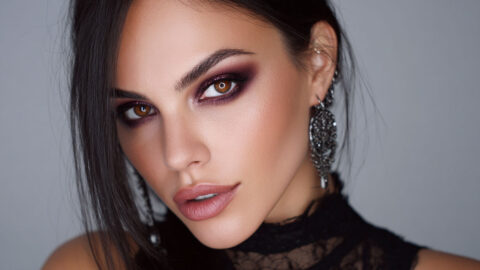
Pressing a light shade into the corner of the eye next to your nose makes the whole eye look more open. That is all an inner corner highlight does, and it takes a couple of minutes once the lids are finished.
The shade has to be the lightest on the eye. I reach for a fingertip most days, though a small pencil brush gives you more control over a dot, wedge or short line of product.
Placement is not universal, which surprises people. Clinique’s eye shape guide puts a medium shadow on the inner half of wide-set eyes, and makeup artist Jamie Greenberg goes darker at their inner corners. So the bright corner suits close-set eyes best.
How to Do an Inner Corner Highlight Step by Step

Do the lids first. The highlight is the last real step, and it goes fast.
- Start with clean, dry lids and a thin layer of eyeshadow primer, including the inner corner.
- Apply your lid and crease shades, and liner if the look has one.
- Pick a shade lighter than anything else on the eye. Champagne or pearl is a safe start, and soft gold works if your skin runs warm.
- Load a small pencil brush or your fingertip, then tap the excess off on the back of your hand.
- Press and pat the product onto the inner third of the lid, right beside the nose. Sweeping drags it across the lid and makes it look muddy.
- Blend only the outer edge into the lid shade with a clean finger or a small blending brush, then tidy the borders with a cotton swab.
- Look straight ahead in the mirror. If the highlight shows only when your eyes are closed, move it up and in, then finish with mascara.
Shimmer needs something to grip, which is what a primer made for eyelids is for. The inner corner needs it more than the rest of the lid, since tears collect in the small space beside the nose.
Tutorials disagree on order. The Beauty Department adds the highlight after shadow and liner but before mascara, while L’Oreal Paris starts from bare lids or primer and builds the look around it.
Both work. I like doing it after the lid is done, because you can judge the contrast against a finished eye, so build the lid with your usual eyeshadow routine first.
Primer wear claims vary more than most people expect. Urban Decay’s own Eyeshadow Primer Potion page lists up to 8 hours of wear (checked October 2026), while some retailer listings for the same product still say 24 hours.
Plan a touch-up for long days instead of trusting the bigger number.
Where Does an Inner Corner Highlight Go?

On the corner of the eye closest to the nose. The target is the lid and lower-lid skin around the lacrimal caruncle, the small pink bump of tissue inside the inner corner. A light shade there brightens the spot, which makes the eyes look more open and slightly further apart.
People call that bump the tear duct, but the drainage openings, called puncta, sit on the lid margins just beside it (Elsevier’s anatomy reference).
Keep product on the skin side of both. The American Academy of Ophthalmology advises applying eye makeup outside the lash line, away from the eye, so it does not block the oil glands.
The shape is up to you. A single press at the corner gives a dot, which is subtle and the right call for daytime. A small triangle that tapers along the upper lid is a wedge, and it opens the eye more, especially over a bare lid.
A thin stripe that runs a little way along the lower lash line is the short line. It adds length and suits evening looks.
Light shades throw more light back than the skin around them, and that is the whole mechanism. Makeup.com’s creator tips describe the goal at this corner as simply reflecting light.
It does a different job than the other eye highlights. A brow bone highlight sits under the arch and lifts the brow area, and a lid highlight sits mid-lid and makes the lid look rounder. The inner corner version brightens the corner and visually separates the eyes.
Size matters more than shade, at least in my experience. A highlight wider than a fingertip stops brightening and starts looking like a smudge.
How to Choose the Shade and Finish
Go with the lightest shade on your eye and match it to your undertone. Champagne and pearl work for most people, with soft gold close behind. Finish is the part you can actually control.
One rule comes before color. FDA’s eye cosmetic guidance says a number of color additives approved for cosmetics in general are not approved for the eye area, so check that a shimmer shade is labeled for eye use (content current as of June 2022).
Shade by Skin Tone and Undertone
Cool undertones tend to suit pearl, ice, silver-white or a pale pink. Warm undertones look better in champagne, gold or peach.
Neutral undertones sit in between, so a soft champagne or pearl-gold does the job.
On deep skin, gold, bronze-gold and copper-leaning shades read brighter than white or silver, which can look like a patch.
The Beauty Department’s rule applies to every undertone, and it is that the corner shade has to be the lightest tone on the eye. If the lid color is pale, step up to a brighter pearl or gold so the contrast still shows.
Finish by Effect and Wear
Finish decides how the highlight reads in daylight and under flash, not only in the mirror.
Matte brightens without any sparkle, so it suits the office. Satin has a low-key sheen that forgives rough edges, and shimmer is the easiest default with a soft glow. Metallic is wet-look foil and shows every edge. Glitter is maximum sparkle with the most fallout.
L’Oreal Paris spritzes Infallible Makeup Extender setting spray onto the brush tip to intensify a light shimmer.
Glitter asks for more care, so it helps to read up on applying glitter eyeshadow before trying it at the inner corner. A glitter or eyeshadow primer underneath gives the flecks something to grip.
Glitter eye makeup is a common cause of corneal irritation or infection, especially for contact lens wearers, according to the American Academy of Ophthalmology.
The same body warns that flaking metallic and glitter particles can get into the tear film and irritate the eyes. Honestly, that is a good reason to keep those finishes small at the inner corner.
Powder, Cream, Liquid or Pencil: Which Format and Tool Works Best?

Cream with a fingertip is the easiest to get right, and powder with a small pencil brush gives the most control. Liquid metallics and sticks cover narrower jobs.
| Format | Best tool | Blendability | Main drawback |
|---|---|---|---|
| Powder shadow | Small pencil or flat shader brush | Easy to build in layers | Fallout on oily lids |
| Cream shadow | Fingertip | Blends in seconds | Creases without primer |
| Liquid metallic | Fingertip or small brush | Sets fast, little blending time | Hard edges if misplaced |
| Stick or pencil | Fingertip | Needs blending right away | Can drag on dry lids |
Pros and Cons by Format
Powder builds from sheer to bright in thin layers and sets without a sticky feel. The catch is fallout, since loose shimmer ends up on the cheek.
Cream blends in seconds and sits flat on the skin, but it creases on a bare lid. The American Academy of Ophthalmology also warns that bacteria grow easily in creamy or liquid eye makeup, so toss it after three months.
The Beauty Department’s pick is Bobbi Brown Longwear Cream Shadow in Sandy Gold.
Liquid metallic works when you want a wet, foil look and know exactly where it lands. It fails when you hesitate, because it sets fast and leaves hard edges.
A wide, chubby stick covers the corner in one press, then needs blending right away with a finger. Makeup.com’s eye-shape guide suggests dotting NYX Jumbo Multi-Use Highlighter Stick in Vanilla Ice Cream into the corner and blending with a small brush or ring finger.
Which Tool Applies It Best
Start with a fingertip, and move to a brush when you want a sharper edge.
- Pinky or ring finger for cream, stick and pressed shimmer, since you can feel how much pressure you use
- A small pencil or domed brush for precise placement, such as the Laura Mercier Crème Eye Detail Brush
- A small shader brush, such as the MAC 239S Eye Shader or the Sigma E55 Eye Shading Brush, for pressing powder shimmer onto the lid
- A cotton swab or makeup wipe to clean up edges and fallout
Keep the tools clean. FDA’s checklist says to wash your hands before applying eye cosmetics.
An ophthalmologist quoted by Sutter Health adds that bacteria can build up on eyeshadow when brushes are not cleaned.
How Does Eye Shape Change Inner Corner Highlight Placement?

Close-set eyes gain the most from a bright inner corner, and wide-set eyes gain the least. Hooded and monolid eyes need the placement checked with the eyes open, because a fold can hide the highlight.
| Eye shape | Placement change | Shade or finish note |
|---|---|---|
| Close-set | Slightly larger wedge on the nose side | Pearly or shimmer, no dark matte at the corner |
| Wide-set | Tiny dot, or skip it | Medium or darker shade on the inner half instead |
| Hooded | Set where it shows with eyes open | Satin or soft shimmer against a darker lid |
| Monolid | Dot or wedge fading into a light inner lid | Light shimmer at the corner, darker shades at the lash line |
| Almond | Standard dot or wedge | Any finish |
Close-Set and Wide-Set Eyes
Eyes count as close-set when there is less than one eye length between them, according to Clinique’s eye shape guide. A pearly or shimmery corner opens that gap, and makeup artist Susan Giordano adds that dark matte shades should stay off the inner corner here.
Wide-set eyes have more than one eye length between them. Clinique puts a medium shadow on the inner half of the lid to bring the eyes closer, and makeup artist Jamie Greenberg goes darker on the inner corners.
Charlotte Tilbury’s guide agrees, blending a matte shade from the inner corner into the crease.
That splits from the standard advice. Most tutorials highlight every inner corner, yet these sources do the opposite for wide-set eyes, so shrink the highlight to a dot or skip it.
The eye-length test isn’t universal either. In 500 Turkish adults aged 18 to 25, the intercanthal distance averaged 30.0 mm in women against a palpebral fissure length of 31.0 mm (Bozkir et al., 2003).
A 2000 Taiwanese study of 4,446 children found wider inner canthal distances than in Caucasian children, with palpebral fissure length about the same, and its authors argued for race-specific norms.
Use the eye-length rule as a starting point, then judge in the mirror whether the gap reads narrow or wide.
Hooded, Monolid and Almond Eyes

- On hooded lids, keep the lid darker in matte or satin, as Giordano advises, and let a light inner corner supply the contrast
- For monolids, build the lid as a vertical gradient, darkest at the lash line, a mid tone in the middle and lightest under the brow bone (PureWow)
- With an epicanthic fold, press the product where it shows with your eyes open, not onto the fold itself
- Almond eyes need no adjustment, so start with the standard dot or wedge
An epicanthic fold is a fold of skin across the inner corner of the eye. Britannica ties it to central and eastern Asian eyes, and notes it in some Native American peoples and occasionally in Europeans.
Coverage varies a lot. Some people have a minimal fold that barely touches the corner, while others have a pronounced one, which is why eyes-open placement beats any fixed rule.
Hooded lids hide more of whatever you place, so a full guide to doing makeup for hooded eyes covers the lid placement around the highlight.
How Does It Fit With Liner, Mascara and a Brow Bone Highlight?

Whatever else is on the eye, the inner corner should stay the brightest point. Liner, mascara and the brow bone all either frame it or compete with it.
Liner should start thin at the inner corner and thicken toward the outer corner, the pattern Makeup.com’s eye-shape guide gives for downturned eyes. A heavy line at the corner swallows the highlight.
Dark lashes against a pale corner create the contrast that makes the highlight read, which is why 100% Pure ends its inner-corner look with mascara. Makeup artist Andrada Rusu, quoted by SheerLuxe, applies more mascara toward the inner corners and follows it through the whole lash line for a more open look.
Clumps at the inner lashes crowd the highlight, so a guide to applying mascara cleanly is worth a read.
On the brow bone, SheerLuxe, quoting Rusu, suggests a soft, light-reflecting shade placed with a small, precise brush, and it covers the inner corners too. Greenberg uses light shadow under the brow bone for monolid eyes.
Make the brow bone shade matte or softer than the corner. Two equal highlights split the eye’s focal point.
Tightlining Near the Inner Corner
Sources define tightlining two ways. The Beauty Department presses gel liner into the upper lash line from directly below, while FASHION Magazine applies waterproof liner to the waterline.
Eye-care guidance points the other way. Sutter Health relays an ophthalmologist’s warning that makeup inside the lash line can clog oil glands and increase dryness.
If you tightline anyway, a walkthrough on tightlining your eyes covers the technique, and the liner should stop short of the inner corner where the highlight sits.
Why Does Inner Corner Highlight Crease, Fall Out or Look Patchy?

Oil and tears cause most failures at this spot, and loose pigment causes the rest. All of it is fixable.
| Problem | Likely cause | Fix |
|---|---|---|
| Creasing | Oil or tears breaking down product, no primer | Thin primer layer, set lightly with translucent powder |
| Fallout | Loose shimmer or glitter, heavy loading | Tap off excess, lift flecks with tape |
| Patchiness | Sweeping instead of pressing, uneven layers | Press thin layers, pat the edges with a clean fingertip |
| Too bright | Product spread wider than the corner | Blend the edge outward, mute it with a matte shade |
Creasing at Watery Corners
RMS Beauty’s guide to creasing says natural oils mix with powder or cream shadow, break it down and push it into the lid’s creases. It names excess oil as the main cause and lists skipping primer, and hooded or oily lids, as contributing factors.
Rose-Marie Swift of RMS Beauty keeps the lid light, saying the less product on it the better.
Too Faced’s Kate Watson ties lid oil to eye shape and gland position rather than skin type, and recommends Shadow Insurance as the fix.
Tears add a second problem at the inner corner. Makeup.com’s guide to watery eyes recommends an eyeshadow primer, then powder, then a waterproof setting spray.
Fallout and Glitter Cleanup
- Do eye makeup before face makeup, so fallout lands on bare skin you can wipe (Beautylish)
- Press Scotch tape lightly on flecks and peel, keeping it away from the lashes
- Use targeted eye remover swabs or a mesh glitter duster for clean edges
At Altuzarra’s Fall 2014 show, Tom Pecheux dabbed MAC Glitter in Brass Gold onto models’ lids over a layer of gloss, and a makeup assistant’s answer for cleanup was Scotch tape (Into The Gloss, 2014).
The American Academy of Ophthalmology says to remove all eye makeup before sleeping, so finish the day with careful eye makeup removal.
When to Skip or Change the Technique
With an eye infection or irritation, the American Academy of Ophthalmology says to toss all eye makeup and skip it until the infection clears.
After recent eye surgery, wait until your ophthalmologist says makeup around the eye is safe.
Chronic watery eyes keep lifting product, and persistent tearing deserves an eye doctor’s look. Makeup.com also notes that expired or irritating makeup can itself cause watery eyes.
Prominent eyes are the odd case. Giordano warns against light colors and anything too reflective on this shape, so a bright corner can work against you.
If the corner never behaves, FASHION Magazine offers an alternative, which is to put the light-reflecting shade on the center of the lid instead.
Inner Corner Highlight FAQ
Can you use face highlighter on the inner corner of the eye?
Only when the label lists it for use around the eyes. FDA advises against using any cosmetic near the eyes unless it is intended specifically for that use, and warns against lip liner as eyeliner for the same reason.
Does a colored inner corner follow the same method?
Yes. The zone and the press-and-pat motion stay the same, but use a firmer brush so the color lands exactly where you want it, then clean the edges with a makeup wipe, as Makeup.com’s color tutorial advises.
Keep the lid neutral so the corner is the only statement.
Is it safe for contact lens wearers and sensitive eyes?
Usually, with the right products. Sutter Health’s ophthalmologist favors water-soluble formulas because waterproof products can build up on lenses, and suggests asking your eye doctor for a list of contact-lens compatible cosmetics.
How do you keep both inner corners symmetrical?
Work both eyes at the same stage instead of finishing one first. Press one dot, then the other, and step back from the mirror to compare at arm’s length before you blend.
Add any extra product to the lighter side only.
Does an inner corner highlight hide dark circles?
No. It brightens the area and pulls attention upward, but it does not cover discoloration. PureWow calls the brightening effect on dark circles a bonus, while concealer still does the correcting.
Does an inner corner highlight work without other eye makeup?
Yes. L’Oreal Paris’s tutorial presents it as an easy look on a bare eye, and it also layers under smoky or cat-eye looks.
100% Pure’s version needs only 3 products, which are mascara, a skin-tone shadow and the highlight.
Judging Your First Inner Corner Highlight in Daylight
It’s right when it reads as a soft brightening at arm’s length, in daylight, with the eyes open. A visible patch or a hard edge calls for one adjustment at a time, in a set order.
Fix placement first by moving it up and in. Then deal with the edge by blending outward with a clean fingertip, and change shade and finish last.
Placement goes first because a misplaced highlight stays misplaced in every shade, while edge and finish only refine a correct position.
The trade-off is time, since two thin presses take longer than one heavy swipe, but only thin layers can be corrected.
This order holds as of October 2026, and a new formula or advice from an eye doctor would change it.
Once the corner reads right, building a full eye makeup look is the natural next step.

She started writing on the site after fielding the same questions from clients and friends often enough to just write the answers down: which red won't turn orange on a warm undertone, how to keep lipstick from feathering into fine lines, why a "12-hour" formula rarely survives dinner.
Every review on the site follows the same rule she uses with paying clients: wear it first, then decide if it's worth recommending.
- How to Make Eyeliner Last Longer Without Smudging - August 31, 2026
- How to Make Eyeshadow Last Longer All Day - August 29, 2026
- How to Find Your Undertone in 5 Easy Steps - August 27, 2026