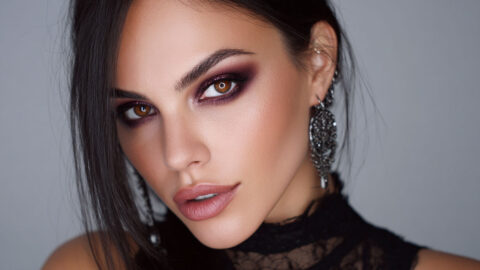
Most of the work in eye makeup for small eyes is taking things away. The black pencil comes off the lower rim and a nude or white one goes on instead. Light shades go on the lid center and the inner corner, and the liner stays thin, running only across the outer two thirds of the upper lid. Then you curl the upper lashes and coat them with mascara.
A 2015 Journal of Cosmetic Science study by Osaka University and Shiseido researchers measured how much makeup changes perceived eye size. Eyeliner and mascara enlarged it by up to 6%, and eyeshadow by about 5%.
The effects of liner and mascara did not add up, though. Once mascara was on, liner added no further size, so the lashes carry the lift and the liner just supplies definition.
How Do You Make Small Eyes Look Bigger With Makeup?

The aim is to show more lid, more lash and more of the white of the eye. Pale shades, a light waterline, short liner and curled lashes all help with that. A heavy dark rim works against it.
Light brings a feature forward and dark pushes it back. That’s about the only rule you need to hold onto here.
In practice, that means a light shade on the lid center, a bright inner corner and a nude or white pencil on the lower rim. Liner stays on the outer two thirds of the upper lid only. The upper lashes get curled and coated, and the brow gets a lifted arch.
Those 2015 numbers are modest. Eyeliner and mascara made eyes read up to 6% larger, and eyeshadow about 5% larger. It’s a visible lift, not a new eye shape.
The same study also complicates the old warning against dark liner. Thicker, darker liner worn alone made eyes look bigger, not smaller, and it added nothing once mascara was on. Its heaviest look still stayed within everyday range, so it says nothing about thick smoky rims.
What matters is how much area the dark covers. A thin line at the lash roots defines the eye. Dark shade spread across the lid, or packed onto the waterline, hides the very space you’re trying to show.
Where to Place Eyeliner on Small Eyes
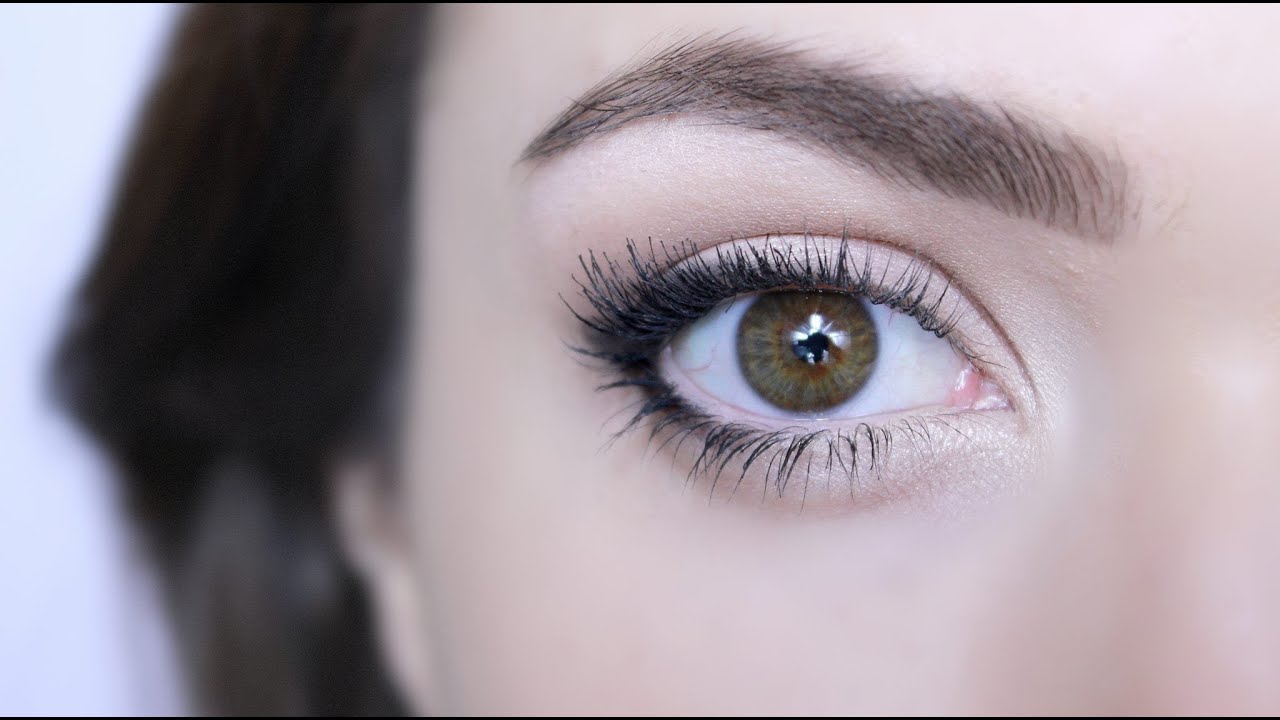
Line the outer two thirds of the upper lid and keep the line thin. Stopping short of the inner corner leaves the front of the eye open.
Start at the middle of the lid and run the line just past the outer corner, where a short wing can begin. Keep it fine through the middle and a little heavier toward the outside.
Pencil usually beats liquid on small eyes, since a softly smudged edge reads lighter than a sharp black line. I’d reach for a pencil nearly every time. Urban Decay’s product copy says its 24/7 Glide-On Eye Pencil stays blendable for about 30 seconds before it sets, so smudge right after you draw.
Tightlining the Upper Lash Line
Press liner into the gaps between the upper lash roots and the lashes look denser, with no visible line sitting above them. That’s tightlining.
It covers two placements, and they are not equal. Wang and Craig’s 2018 review in Clinical Optometry reported, from prospective studies, that liner on the inner lash margin caused more tear film contamination and discomfort than liner on the skin outside it.
The outside version dots liner between the roots from above, with the lid gently lifted. That matches the American Academy of Ophthalmology advice to apply eye makeup outside the lash line. The inner rim version looks darker and denser, and it’s also the placement tied to the contamination findings.
A guide to tightlining the upper lid step by step shows the lifted-lid method in detail.
Wing Length and Angle
Keep wings short. A tail that follows the line of the lower lashes upward adds width without dragging the outer corner down, so angle it up rather than straight out and taper it to a point.
Huda Beauty makes the same split. A wing helps, but heavy liner across the whole upper lid doesn’t. Practice a winged eyeliner technique with a pencil before you move to liquid.
Which Waterline Color Works for Small Eyes?
Nude or white. Both extend the visible white of the eye, while black along the inner rim closes it in.
| Color | Effect on apparent size | Best for | Risk |
|---|---|---|---|
| Nude, matched to skin tone | Opens the eye, looks natural | Daily wear | Wrong undertone looks gray |
| White | Strongest brightening | Evening, photos | Harsh if applied thickly |
| Soft brown | Defines without closing | Outer third of the lower lash line | Darker browns start to shrink the eye |
| Black | Shrinks the visible eye | Deliberate smoky looks | Closes the eye in, worst on both rims |
White works best in a small amount with the edge softened. The full method for applying white eyeliner without a stark line is worth reading before you try it.
Sources disagree on the lower lash line. Huda Beauty suggests a little liner on the outer third, smoked out with soft brown shadow, while a 2014 HuffPost UK column warns that lining only the lower rim and skipping the top lid looks droopy.
What works is doing both, a thin upper line plus soft brown at the outer third below. Never the lower line alone.
The health side is clearer on the inner rim. In a Cardiff University pilot (Ng and colleagues, Eye & Contact Lens, 2015), liner on the waterline put 15 to 30% more particles into the tear film within five minutes than liner outside the lash line.
The pilot had three participants, and by two hours the contamination had fallen to a negligible level. Contact lens wearers were the group most likely to notice problems, according to Ng. Three people is a tiny sample, so read it as a hint, not a verdict.
A nude pencil on the skin just beneath the lower lashes gives a softer version of the brightening effect with no contact on the rim.
Eyeshadow Shades and Finishes for Small Eyes

Warm neutrals do most of the work (champagne, peach, soft bronze, light taupe). Dark tones stay small and sit at the outer corner only.
Shade Placement by Zone

- The lid center gets the lightest shade, pressed on with a finger or a flat brush.
- A dot of pale champagne or shimmer goes in the inner corner.
- One soft mid-tone in the crease, carried slightly above the natural crease line.
- Darkest shade at the outer corner, blended outward.
Prep the lid first. A cream base such as MAC Paint Pot brightens it, and an eyeshadow primer keeps the shades from creasing as the day goes on.
The inner corner is easy to overdo, so use less than feels right. A tutorial on how to place an inner corner highlight shows how small the dot should be.
Where Matte, Satin and Shimmer Belong
Guides split on finish. Urban Company’s tutorial picks matte over shimmer for small eyes, while L’Oreal Paris’s December 2017 guide to making eyes look smaller says shimmer reflects light and enlarges, and matte makes the eye recede.
Both are right about different zones.
Put shimmer or satin on the lid center and inner corner, since that’s where light helps. Matte belongs in the crease and at the outer corner. Depth matters there, and sparkle only adds texture.
Choose fine shimmer over chunky glitter. Glitter settles into the crease and draws attention to the lid instead of opening it.
Lashes: Curling, Mascara and False Lashes

Lashes give the biggest return per minute. In the Osaka University and Shiseido experiment, lash makeup raised perceived eye size by about 6%, and extra eyeliner added nothing once mascara was on.
For small eyes, that argues for lashes first and liner second. Most guides do it the other way around.
Curl before mascara, never after. Clamp at the root, hold, then ease up the lash in a second squeeze.
Brush choice matters too. Collection ambassador Francesca Neill says smaller or more hooded eyes suit a thinner brush that picks out and lengthens each lash, while a bigger brush adds volume for bigger eyes. Coat the upper lashes first, wiggling from the roots up.
Working the wand from the roots upward is covered in a walkthrough on how to apply mascara cleanly.
Where to put the weight is contested. Some artists concentrate mascara in the center for a rounder eye, and others flare the outer lashes for width. An even coat with a little extra length at the outer third opens the eye without turning it into a cat shape.
Lower lashes are another split. Huda Beauty says a coat opens the eye, while Beautylish community threads report it can shrink some eye shapes. One light pass on the tips settles it.
Thick strip lashes work against you. L’Oreal Paris lists thick falsies among the ways to make eyes look smaller, so individual clusters at the outer corner are the lighter choice.
The American Academy of Ophthalmology says to discard mascara three months after opening, and straight away after any eye infection. It helps to know how long a tube really lasts and to write the opening date on it.
Brow Shape and Eye Openness
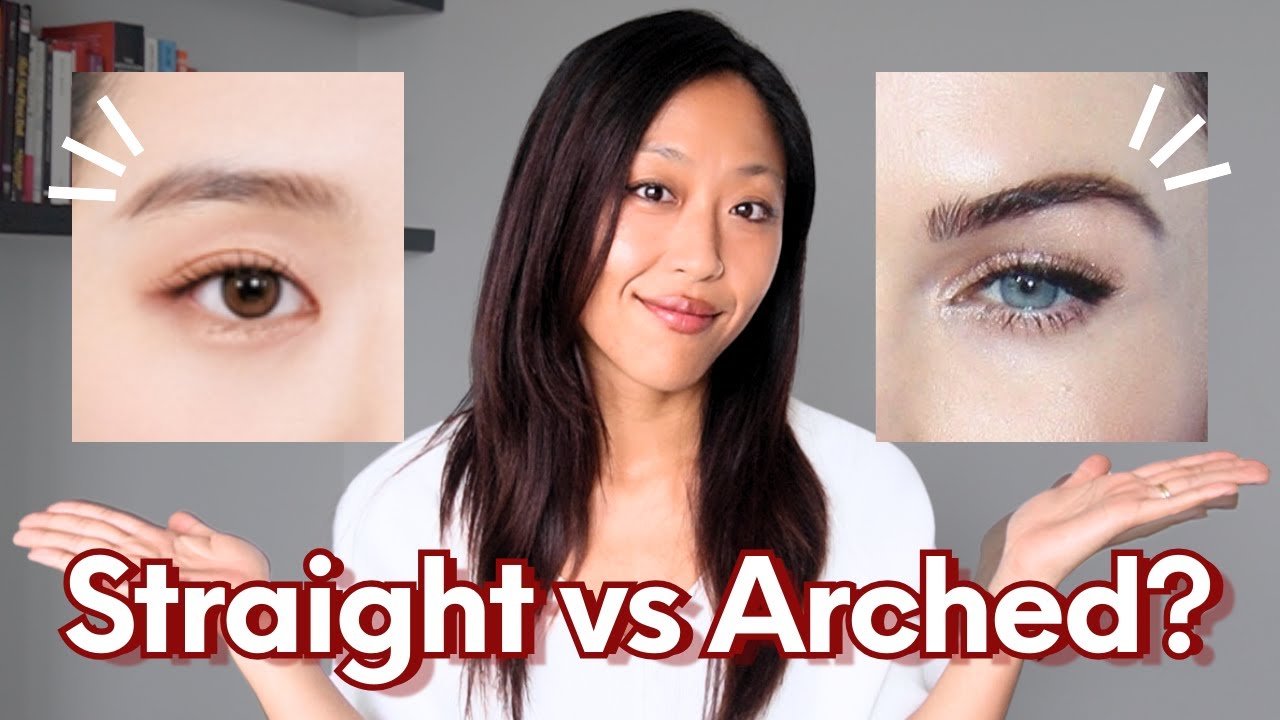
The brow frames the eye, and the gap between brow and lid matters as much as the arch itself. Makeup guides and lab data point in different directions on that gap.
Guides favor a defined arch, which reads as lifted and awake. Urban Company’s tutorial says arched brows give the illusion of larger eyes.
The lab data goes the other way. Morikawa and colleagues (Frontiers in Human Neuroscience, 2015) placed the brow high or low on a controlled face image and found that brows closer to the eyes made the eyes look larger. They link this to the same assimilation effect behind the Delboeuf illusion.
The likely reason for the split is that the lab measured a size judgment on a standard face, while guides describe how open and awake a face looks.
A workable middle keeps the brow clean and close, with a modest arch and no heavy fill at the tail. Fill sparse spots with light, hair-like strokes and keep the inner end lightest. Peak the arch toward the outer third, and don’t let the tail drop below where the brow starts.
A brow pencil gives more control over those strokes than powder.
Huda Beauty suggests a touch of highlighter on the brow bone to lift the brow. Keep it to a small dab, because on hooded lids a full-length highlight overwhelms the eye (MasterClass).
How Eye Shape Changes the Technique
Small eyes are rarely just small. Hooded and monolid eyes need different placement, and deep-set ones need light more than anything. Close-set and downturned eyes call for liner that pulls outward.
| Eye shape | Main problem | Liner | Shadow |
|---|---|---|---|
| Hooded | Lid space hidden when the eyes open | Thin line, small flick at the outer corner | Matte mid-tone above the natural crease, applied with eyes open |
| Monolid | No crease to define the lid | Slightly thicker so it shows when the eyes open | Gradient, darkest at the lash line |
| Deep-set | Lid recedes into the socket | Middle to outer corner, pale pencil on the lower rim | Light or shimmer on the lid, deeper tone only at crease and outer corner |
| Close-set | Little space between the eyes | Thin at the inner edge, heavier outward | Light inner corner, darker toward the outside |
| Downturned | Outer corners dip | Wing angled up, deeper liner on the outer third of the lower lash line | Blend the outer shade up and outward |
With hooded eyes, look straight into the mirror with your eyes open while you place shadow. The shape changes when the eye closes, as makeup artist Jamie Dorman told Bustle.
Chanel Beauty ambassador Marco Antonio (Marie Claire UK) puts a matte shade slightly above the natural crease, since the hood hides color placed in the fold once the eyes open. A walkthrough on makeup for hooded eyes goes deeper on that placement.
On close-set eyes, keep dark, matte shades away from the inner corner, advises makeup artist Susan Giordano (The Fashion Spot). L’Oreal Paris adds a highlighter at the inner corner and a flick that lengthens the eye outward.
Many small eyes combine two shapes, such as hooded and close-set. Fix placement first for hooded and monolid eyes, then direction for close-set and downturned ones. Depth can wait.
How to Do Eye Makeup for Small Eyes, Step by Step

- Insert soft contact lenses first, if you wear them. The American Optometric Association says soft lenses go in before makeup, and rigid gas permeable lenses go in after.
- Prime the lid with a cream base or an eyeshadow primer.
- Press a light shade over the lid center and a pale dot into the inner corner.
- Add the mid-tone in the crease and the darkest shade at the outer corner. Blend with a clean, fluffy brush until no edge shows.
- Draw a thin line along the outer two thirds of the upper lid and finish with a short, upward wing.
- Brighten the lower rim with a nude pencil on the skin under the lower lashes, plus soft brown at the outer third for depth.
- Curl the lashes with an eyelash curler, then coat the upper lashes.
- Fill and shape the brows.
- Step back from the mirror and check the look from a distance.
That last step has data behind it. The same 2015 Frontiers study tested viewing distances of 0.6 m and 5 m and found the eyeshadow effect stronger from farther away.
A look that seems faint at arm’s length reads stronger across a room.
Take everything off before bed, lenses first. A guide on how to remove eye makeup covers the gentle method.
When These Tricks Backfire
Some of this goes wrong in predictable ways.
- Liner that slides into the fold makes the lid look smaller. Oil and friction push it there, and a long-wear base helps, according to Marco Antonio (Marie Claire UK).
- A dark, matte inner corner on close-set eyes pulls them closer together, so keep that corner light.
- A full-length brow bone highlight on hooded lids overwhelms the eye. A small dab is enough.
- Judging the look up close only is a trap, since shadow reads stronger from a distance. A step back catches depth that went too far.
For the sliding-liner problem, a walkthrough on how to stop eyeliner from running covers base and setting choices.
If the goal is definition rather than size, a September 2023 Makeup.com roundup includes creator Sandy Lin’s monolid tutorial, which uses warm eyeshadow to add definition instead of creating the illusion of bigger eyes.
After eye surgery or during an infection, the American Academy of Ophthalmology says to skip makeup around the eye until your ophthalmologist clears it. Anything you used during an infection goes in the bin right away.
Eye Makeup for Small Eyes FAQ
Can you do a smoky eye on small eyes?
Yes, in brown or taupe, with the depth held to the outer third of the lid.
Keep the lid center and inner corner light and blend every edge, since Huda Beauty notes that harsh lines make small eyes look smaller.
What does a natural everyday look for small eyes include?
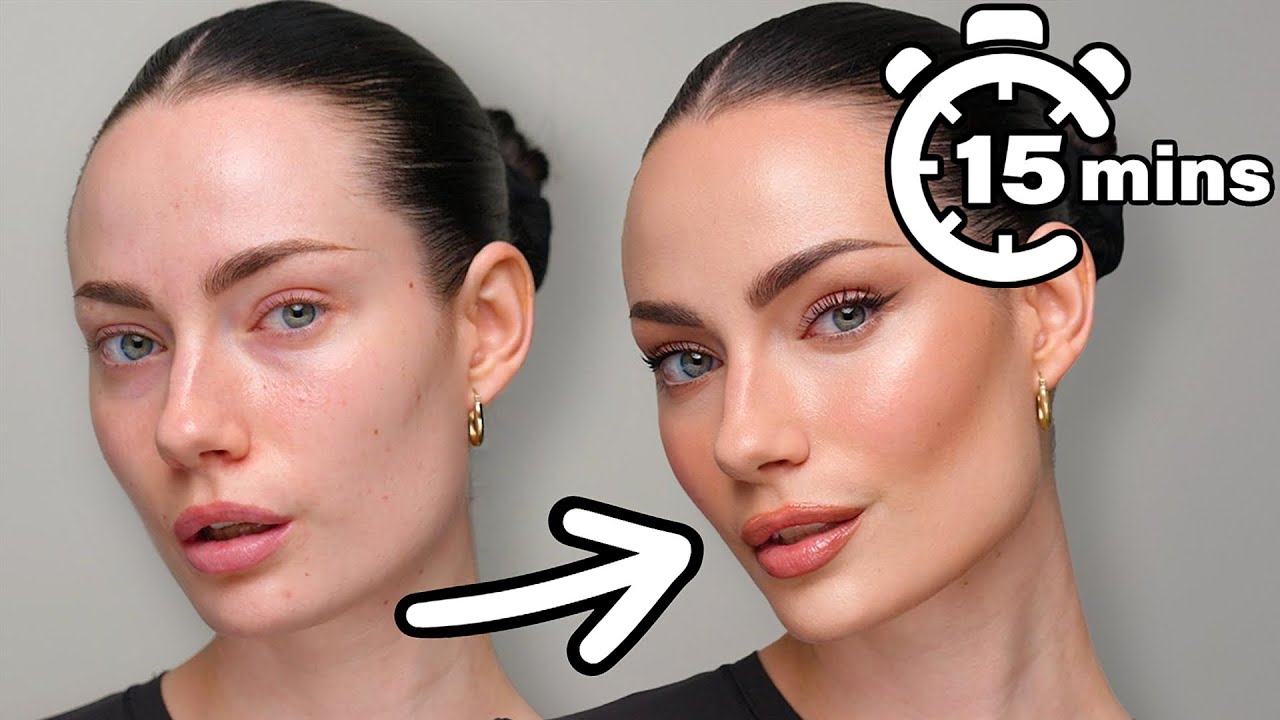
Eyeshadow primer, one light neutral on the lid, soft brown in the crease, a thin brown line on the outer two thirds of the upper lid, curled lashes with one coat of mascara, and a nude pencil under the lower lashes.
That’s the whole routine, and it takes less product than a standard daytime eye look.
Does concealing dark circles make small eyes look bigger?

Yes. Aditya Arya of Yes Madam says dark circles make eyes look smaller and duller, and that covering them lifts the face and gives the eyes more space.
Setting concealer with powder, a method Huda Beauty calls baking, adds brightness and keeps liner from smudging.
Is brown eyeliner better than black for small eyes?
For everyday wear, usually yes. Brown reads softer and gives definition without the weight of black.
Black still works as a thin line on the outer two thirds of the upper lid, provided the lower rim stays pale.
Where to Start With Eye Makeup for Small Eyes
Start with the lashes. Curl and coat the upper set, then add a light shade on the lid center and inner corner, and finish with thin liner on the outer two thirds.
Liner has a ceiling. In a 2022 Kao Corporation study of digitally drawn liner (Journal of Cosmetic Science), black lines enlarged perceived eyes from 1.0 mm thick, and at 2.0 mm some participants perceived no enlargement.
Neither that study nor the Osaka University and Shiseido experiment tested eyeshadow combined with liner and mascara, so the total effect of a full routine stays unmeasured in the sources reviewed in October 2026.
For an evening version, a guide to smokey eye makeup applies the same blending to a darker palette.

She started writing on the site after fielding the same questions from clients and friends often enough to just write the answers down: which red won't turn orange on a warm undertone, how to keep lipstick from feathering into fine lines, why a "12-hour" formula rarely survives dinner.
Every review on the site follows the same rule she uses with paying clients: wear it first, then decide if it's worth recommending.
- How to Make Eyeliner Last Longer Without Smudging - August 31, 2026
- How to Make Eyeshadow Last Longer All Day - August 29, 2026
- How to Find Your Undertone in 5 Easy Steps - August 27, 2026