Eyeliner is mostly short strokes. Draw thin dashes right at the lash roots, make the line a little thicker toward the outer corner, and clean up the edges with a cotton swab dipped in micellar water.
That works on the upper lash line and the lower one. Eye shape only changes where the line thickens and which way a wing points.
There’s one catch, and it comes from doctors rather than makeup artists. The American Academy of Ophthalmology (2022) says to apply eye makeup outside the lash line, so pigment doesn’t block the meibomian glands that oil the tear film. Plenty of beauty tutorials tell you to do the opposite.
Which Eyeliner Type Is Easiest to Apply?
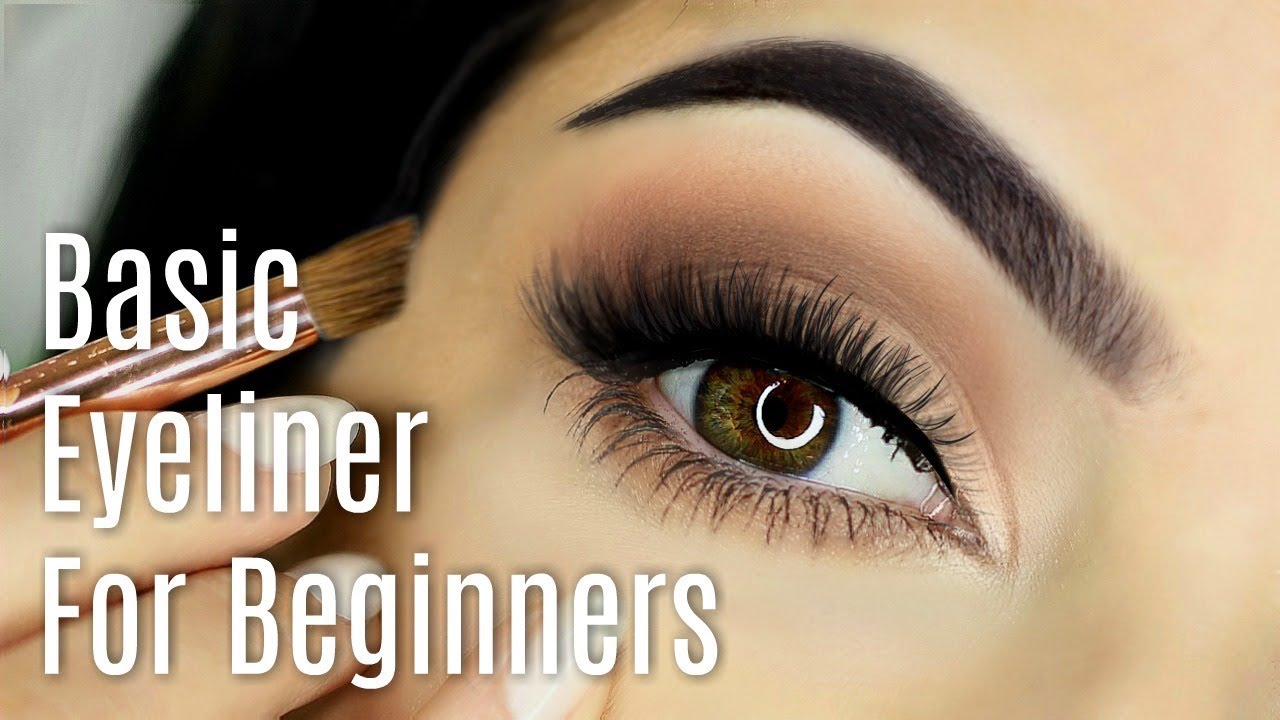
Start with a pencil or a felt-tip liquid. Those two give a beginner the most control. Gel and brush-tip liquid formulas reward practice and punish the first few attempts.
| Type | Control and finish | Best for | Drawback |
|---|---|---|---|
| Pencil | Forgiving, soft line that smudges easily | Beginners, smoky looks | Tip needs regular sharpening |
| Felt-tip liquid | Pen-like control, crisp line | Beginner wings, thin lines | Fixed tip width limits line variety |
| Gel (pot) | Rich, buildable line with an angled brush | Regular wearers, defined lines | Needs a brush and a steady hand with the amount |
| Liquid (brush tip) | Sharp, glossy, graphic line | Confident wings | Least forgiving of a shaky stroke |
RMS Beauty says a classic kohl-style pencil is the most forgiving format for beginners. Oh My Cream sends new users to felt-tip liquid instead, and keeps pot gel for people with some experience, since you also have to judge how much product to load.
Formula matters for hygiene too. Ercan’s 2022 study in the Saudi Journal of Ophthalmology points out that liquid eyeliners have a high water content, which is why they need preservatives, while a pencil can simply be sharpened to get rid of the exposed product.
Kohl Pencils and What the Label Means
A pencil labeled “kohl” isn’t always the real thing, and the gap between the two is a regulatory problem.
Traditional kohl is made from heavy-metal salts (antimony and lead) and also goes by kajal, al-kahl or surma. The FDA lists it as unapproved for cosmetic use in the US and cites reports linking it to lead poisoning in children (Eye Cosmetic Safety page, content current as of June 2022).
Plenty of eye cosmetics just borrow the word as a shade name. For those, check the declared color additives on the label against FDA’s list of additives approved for the eye area.
A kohl-style pencil with a clean ingredient list is simply a very soft, smudgy liner. The kohl eyeliner category has its own explainer if you want the full background.
Prep and Tools for Applying Eyeliner

A prepped lid holds liner better than a bare one, and the prep takes about a minute.
Dab an eyeshadow base or concealer across the whole lid and let it set. Oh My Cream’s guide calls for exactly that before any liner goes on, and a purpose-made eyeshadow primer fills the same role. Wash your hands first, and keep every tool near the eye clean.
The tool list is short.
- An angled brush loads gel and lays a controlled line.
- Cotton swabs fix edges and wing tips.
- Micellar water or remover dampens the swab for clean-up.
- A sharpener gives a pencil a fresh tip.
- Tape guides wing angle (more on that in the wing section).
A brush that gets reused picks up pigment and skin oil, so keeping makeup brushes clean belongs in the routine.
Sharpen before every use, not once the tip goes dull. Dr. Alison Ng of Waterloo’s Centre for Contact Lens Research gives that advice for pencils, and says to trim the end off a twist-up liner each time (University of Waterloo, 2015).
How to Apply Eyeliner Step by Step
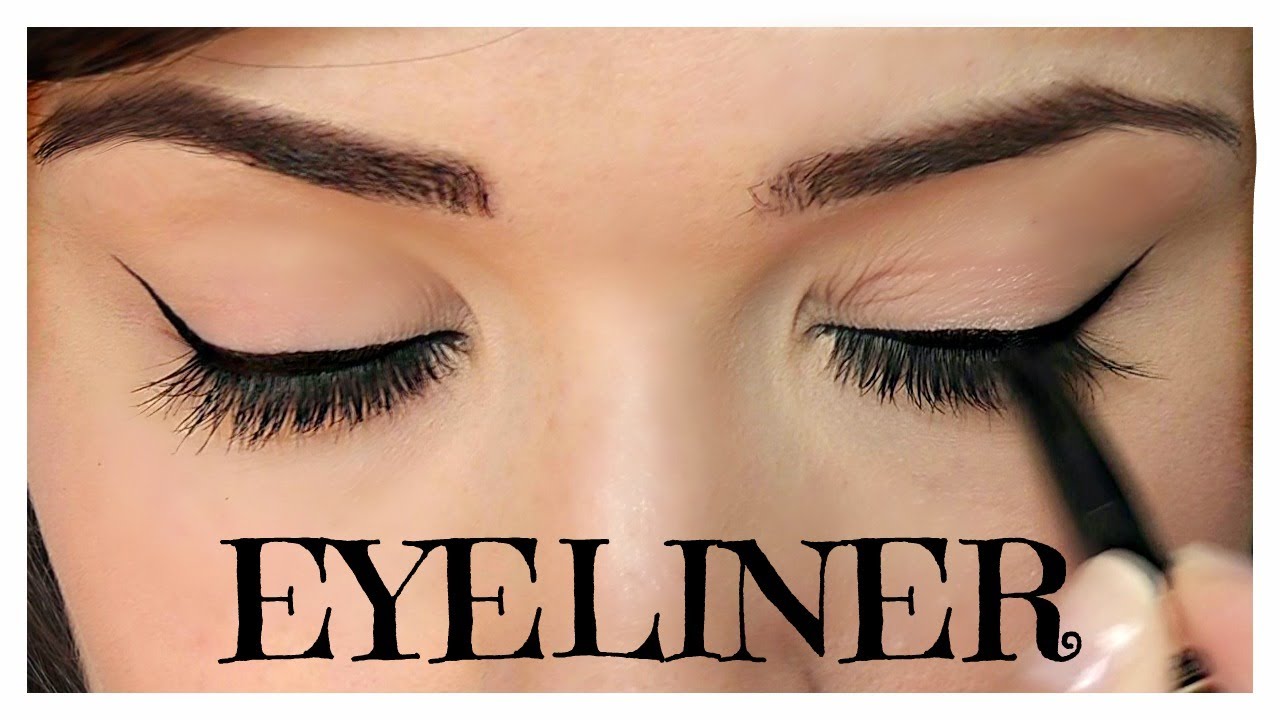
Start thin and build the line up in short strokes instead of drawing it in one pass.
- Sit at a fixed mirror at eye level. Rest your elbow on a flat surface, tilt your chin up slightly and look down so the tip stays off your lashes.
- Hold the lid taut with your free hand, gently.
- Place the tip as close to the lash roots as you can, then draw short dashes from the midpoint or inner corner outward.
- Dab the tip over any gaps. Keep the line thin at the inner corner and thicker toward the outer corner.
- Drag a cotton swab dipped in micellar water or remover along the top edge to lift bumps.
- Let the line dry, curl the lashes, then add mascara.
Oh My Cream and Birchbox’s Eyeko tutorial agree on step 2: keep the lid taut without pulling hard. Oh My Cream warns that stretching the lid too far leaves smudges once you let go.
On thickness, Oh My Cream calls a thin line the most universal and often the most flattering. Thick lines, it says, are best kept for younger wearers because they can harden the eyes.
RMS Beauty flags a different mistake. Lining too far above the lashes leaves a gap that reads as eyeliner instead of definition.
RMS Beauty puts liner first because it leaves a clean canvas, though it allows mascara first when you want to see where the lash line naturally falls. Applying mascara comes once the line is dry. If you line after mascara, slide a clean eyeshadow brush between the coated lashes.
Where Eyeliner Goes on the Eye
Liner can go on the upper lash line, the lower lash line, between the upper lashes, or on the waterline. Each changes how open the eye looks, and only the first two stay outside the lid margin.
Upper Lash Line
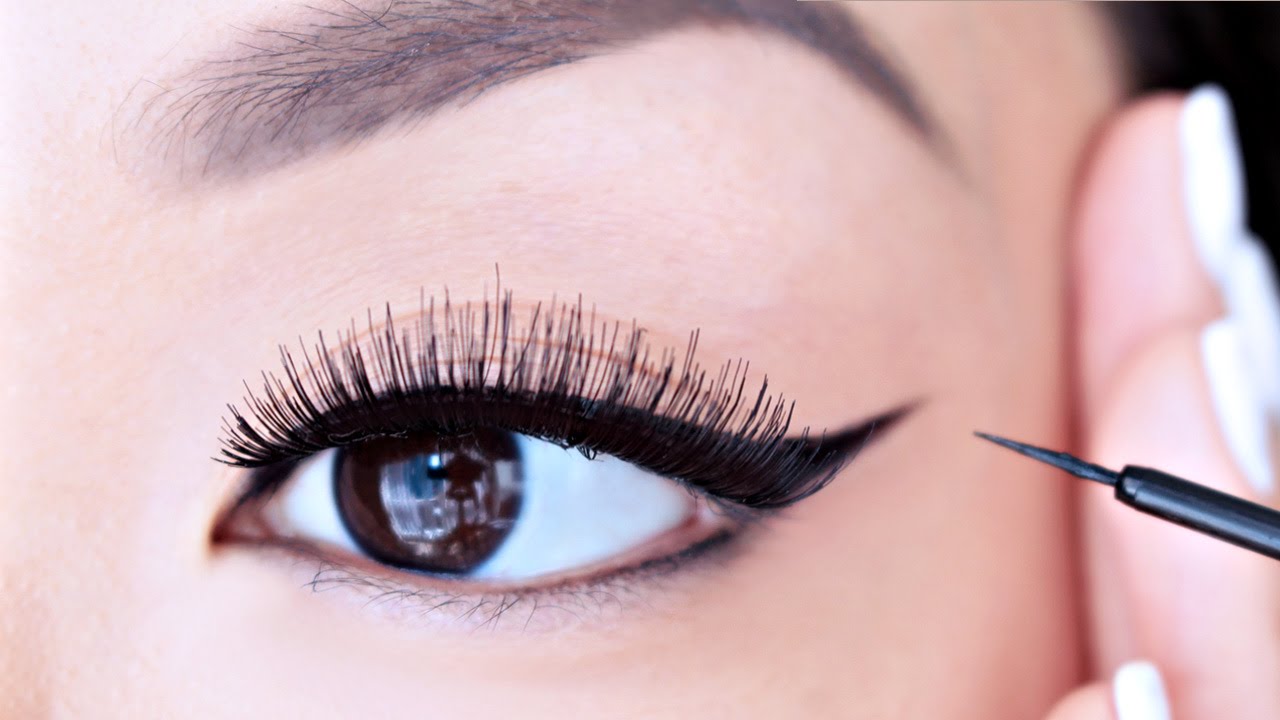
This is the default zone. It defines the eye and sits outside the lid margin. Keep the line flush with the lash roots and thicken it toward the outer corner. A gap above the lashes is the usual mistake, so skip it.
Lower Lash Line
Go a shade lighter than the upper line if you want a natural look, and use short, gentle strokes with the tip kept off the eye itself. RMS Beauty suggests lining under the lower lashes as well when you want more drama.
Tightlining

Tightlining fills the spaces between the upper lash roots, so the lashes look denser and there’s no visible line. Where exactly the liner goes depends on who you ask.
L’Oreal Paris USA describes it as lining the upper waterline, pressing the pencil along the inner rim, and MasterClass has it as lining the waterline where the lids meet. Adore Beauty goes the other way and defines it as dotting liner between the upper lashes, saving “waterlining” for the lower inner rim.
Which version you follow decides whether the pencil touches the lid margin, and that has a cost. For the mechanics of dotting between lashes, a dedicated tightlining walkthrough goes step by step.
Waterline
Lining the moist inner rim behind the lashes is the most contested move in eyeliner.
MasterClass suggests white liner here when the goal is bigger-looking eyes. White eyeliner on the lower rim has its own placement rules.
If you do line it, use a pencil made for the waterline and sharpen it first. Lip liner is never a substitute.
Is Eyeliner on the Waterline Safe?
The American Academy of Ophthalmology says to keep eye makeup outside the lash line, away from the eye, because liner on the lid margin can block the oil glands that protect the eye’s surface (AAO, article published August 2022 and reviewed by Rebecca J. Taylor, MD).
Beauty brands teach the opposite, and the two camps rarely cite each other. L’Oreal Paris USA says not all eyeliners suit the waterline, recommends smooth-gliding gel or cream formulas, and walks through upper and lower waterline application. MasterClass tells readers to sanitize the pencil first.
The glands open along the lid margin and supply the oil layer of the tear film. Put pigment there and it moves.
In a University of Waterloo study using glitter-laced pencil liner, 15 to 30% more particles reached the tear film within five minutes when liner went inside the lash line than outside it (Ng et al., Eye & Contact Lens, 2015). By two hours the amount had fallen to almost nothing, though the waxes and oils in the liner can still alter the tear film.
Regular wearers show effects too. Women who lined at least three days a week for six months or more had a tear break-up time of 3.0 seconds against 5.8 seconds in non-users, in a Cornea study of 42 women with no dry eye symptoms (Prabhasawat et al., Mahidol University, 2020).
The evidence is not unanimous. Ercan’s 2022 study of 220 women using pencil liner inside the lower lash line found more gland loss in every makeup group than in the no-makeup group, but a small 2019 conference poster with 31 participants (Alkawally et al.) saw only non-significant trends.
A few rules hold for every liner, whatever the formula.
- Never share liner, not even with family.
- Wash your hands before applying.
- Sharpen a pencil before each use, or trim a twist-up liner.
- Don’t use lip liner as eyeliner (mouth bacteria, and color additives not approved near the eye, per the FDA).
- No applying in a moving vehicle.
The AAO’s replacement rule is three months, since bacteria grow easily in creamy and liquid eye makeup. Type-by-type detail sits in a closer look at eyeliner shelf life.
The AAO also says to remove all eye makeup before sleeping, and a clean cotton swab brushed along the base of the lashes catches leftovers. A full routine for removing eye makeup properly is worth learning before you start lining the waterline.
Contact lens wearers have a further reason to skip the waterline, since pencil waxes and oils can stick to lenses and build up if used for more than one day (University of Waterloo, 2015). With an active eye infection, the FDA says to stop eye cosmetics until the area heals and to discard the ones you were using. After eye surgery, no makeup around the eye until your ophthalmologist clears it (AAO).
The safer default is a line on the outer lid, drawn as close to the lash roots as it will go.
Matching Eyeliner Placement to Eye Shape

Eye shape decides where the line starts and thickens, and where it stops. Downturned eyes want some lift at the outer corner, and close-set eyes want a thin inner corner. Hooded eyes are the odd one out, because the liner has to stay visible once the eyes are open.
| Eye shape | Placement | Line style | Avoid |
|---|---|---|---|
| Hooded | Above the fold, or dotted between upper lash roots | Upward wing, drawn with eyes open | Wings that vanish into the fold |
| Monolid | Just above the lash line | Bold, saturated line | Thin lines that disappear |
| Round | Start mid-lid, extend past the outer corner | Elongating wing | A steep upward flick |
| Downturned | Lift at the outer corner, inner corner left open | Upturned wing, thin at the inner corner | Dark liner along the lower lash line |
| Close-set | Start at the middle or outer third, extend outward | Thinnest at the inner corner, wing or double wing | Dark liner at the inner corner |
| Wide-set | Concentrate on the inner corners | Thicker inside, tapering outward | Extending or thickening past the outer corner |
| Mature eyelids | Close to the lash roots | Thin to medium, soft edges | Thick wings, heavy lower liner |
Makeup artist Romy Soleimani gave Harper’s Bazaar Singapore the spacing rules. Close-set eyes start at the outer third with the inner corner thinnest, and wide-set eyes stop at the outer corner because a longer or thicker tip pulls the eyes further apart.
Round eyes split the sources on angle. The Handbook says to wing the liner out, while Watsons warns that a steep upward flick makes round eyes look closer set.
Almond eyes are the easy case. FASHION Magazine notes the visible lash line lets them take almost any technique.
Sources split on hooded eyes and monolids, and the argument is about line weight.
Makeup artist Min Min Ma, quoted by Bustle, says to build the line slightly thicker on hooded eyes, and Soleimani calls thick liner great for monolids. On the other side, Jessica Kohn of Laura Mercier (Hello!) warns that thick or heavy liner closes a hooded eye down, and Soleimani suggests tightlining the top lash line so the eye keeps its visible lid space.
What these artists do share is judging the line with your eyes open. Bat-wing liner, which went viral through Katie Jane Hughes, shows a gap only when the eye is closed, according to makeup artist Ruby Hammer (Hello!).
Kirin Bhatty told L’OFFICIEL USA that her hooded-eye wing feels wrong at first and sits right once the eyes open. A fuller routine for makeup for hooded eyes covers shadow and crease as well.
For small eyes, makeup artist Jaleesa Jaikaran skips liner on the lower lash line, which can shrink the eye, and switches to a lighter or metallic shade on top. Thin liner close to the lash roots keeps the eye open. A broader guide to eye makeup for small eyes adds mascara and shadow placement.
Skin on mature eyelids gets thinner and less elastic, which Drita Paljevic, head makeup artist at Kevyn Aucoin Beauty, says calls for less product and creamy pencils or gel formulas that glide easily (Marie Claire UK).
Katie Jane Hughes adds an eyeshadow stick as a creamy base and a “working backward” stroke that follows the applicator’s shape to limit pulling (Marie Claire US).
How to Draw a Wing

A wing is just the natural direction of the lower lash line, continued from the outer corner toward the end of the brow. Getting both sides to match takes a guide, and tape and dots are the two common ones.
Tape Method
Tape is the easiest way to get both wings at the same angle. Angle a small strip from the outer corner toward the end of the brow, draw along its edge, then peel it away (XLash).
It lifts concealer and foundation from wherever it sits, so apply those after, and skip tape on sensitive skin. A hard-edged card held at the same angle does the same job.
Dabbing the tape on the back of your hand first lowers the stick.
Three Dot Method
Mark first, draw second. Dots are easier to correct than a finished line.
- One dot where the wing ends
- One where the line should be thickest
- A third along the diagonal for extra guidance (Swiss Beauty)
Check that the dots sit at the same height and angle on both eyes before you connect them. Then join the dots and fill the gaps.
Comma Method
Start with the hardest part.
Build the wing first and the lash-line stroke second. Maybelline UK’s wing tutorial lays the applicator flat at the outer corner, follows the natural extension of the lower lash line, then draws along the upper lash line from the inner corner to meet it.
Thrive Causemetics describes the same build as a triangle: a line from the outer corner toward the brow tail, a sweep back to the upper lash line, then a fill. For the full sequence from prep to clean-up, follow a separate guide to doing winged eyeliner.
Beginners who want symmetry should reach for tape. Dots work better for freehand wings, and the outer-corner-first build gives the most control once your hand is steady. Once the angle is dependable, it stretches into a bolder cat eye makeup look.
How to Stop Eyeliner From Smudging and Make It Last

Smudging comes mostly from oily lids and formulas that stay soft, with movement making it worse. Fix the lid first, then choose a formula that grips.
On an oily lid, an eye base or cream eyeshadow stick gives the liner something to grip, and a light hand with eye cream keeps the lid from going slippery (makeup artist Keeley Wilson, via Refinery29).
Wilson favors gel liners because they dry quickly and resist water, sweat and heat, while Bustle’s smudge guide steers oily lids away from soft kajal pencils and some whipped gels. A matching eyeshadow patted over a soft liner adds staying power (Bustle).
Set the primer with translucent setting powder before you draw, then press the shadow over the finished line.
Lash curling order is contested. Many tutorials curl right after lining, but Bustle’s smudge list says to stop curling after the liner goes on.
If yours transfers, curl first and compare.
Hooded lids add a timing problem. Liquid liner smudges if it is still wet when you open your eyes (Bustle’s hooded-eye tips, quoting Kim Baker), so let it dry first.
Waterproof gel liners tend to stay put on hooded or creased lids, and they resist transfer to the upper lid, according to makeup artist Laura Geller (Prevention Australia). The cost is a stubborn finish at night, so keep a remover made for waterproof formulas close and read up on removing waterproof makeup without tugging.
How to Fix Common Eyeliner Mistakes
Most eyeliner mistakes can be fixed in under a minute with a cotton swab and a flat brush, so a full restart is rarely needed.
| Mistake | Cause | Fix |
|---|---|---|
| Uneven wings | Each wing drawn by eye | Mark tip dots or use tape, then trim edges |
| Bumps and gaps | Dragging the tip in one pass | Dab to fill, swab the top edge |
| Gap above the lashes | Line sitting off the roots | Redraw close to the roots, connect with dabs |
| Tugged lid | Pulling the skin too hard | Hold lightly, switch to a creamier formula |
| Wing too thick or long | Overdrawing | Trim with remover on a swab |
| Smudge below the lash line | Oil, transfer, wet liner | Swab with remover, reset with powder |
A line that keeps drifting under the eye is a prevention problem, and a separate guide covers keeping eyeliner from running.
Makeup artists disagree on how to clean up a wing.
Chanel makeup artist Anna Payne (via The Handbook) dips a cotton bud in micellar water to sharpen the wing, and Better Homes and Gardens Australia suggests following up with concealer on an angled brush.
Alfie Sadsad, then Bobbi Brown’s lead makeup artist (Marie Claire Australia, 2017), goes another way. He says micellar water lifts the makeup around the error and cotton buds can leave fluff, so he dabs a flat brush in eye cream and flicks the stray liner away.
Use the swab for bold errors on bare skin. Reach for the eye-cream brush when there is shadow underneath you want to keep.
Common Questions About Applying Eyeliner
Which eyeliner is safest for sensitive eyes?
No eyeliner type is proven safest. The AAO (2022) says to use only products designed for the eye area, avoid harsh or untested chemicals, and add one new eye product at a time so a reaction traces back to its source.
The FDA says to stop using any eye cosmetic that causes irritation.
How do you sharpen an eyeliner pencil without breaking the tip?
Use a cosmetic sharpener, because a sharpener made for writing utensils will break soft kohl and gel pencils (MasterClass).
Chilling the pencil in the fridge for 20 minutes first, as Natio’s sharpener directions suggest, helps it shave instead of snap.
Can eyeshadow or lip liner replace eyeliner?
Yes for eyeshadow, no for lip liner. Dampen an angled brush, load it with shadow and sweep it along the lash line for a darker line, or work it dry for a softer one.
Lip liner is out because the FDA cites mouth bacteria and color additives not approved for the eye area.
What is the gentlest way to remove waterproof eyeliner?

Dissolve it, don’t rub it.
Uriage’s directions for its dual-phase waterproof remover hold a soaked cotton pad on each closed eye and gently pat for 10 seconds.
Where to Start With Applying Eyeliner
Applying eyeliner well starts with a pencil or felt-tip liquid liner drawn on the outer lid, close to the lash roots, and repeated until both eyes match.
Add techniques one variable at a time. Get a thin upper line with short strokes first, then try a wing using tape or three dots, and bring in the lower lash line, one shade lighter, last.
Staying off the waterline costs some lash density, a trade the AAO guidance asks for.
Long-term prospective studies, which Ercan’s 2022 paper calls for, are the evidence that would change that guidance (position verified October 2026).
Once the line stays even, a full eye makeup routine builds the rest of the look around it.

She started writing on the site after fielding the same questions from clients and friends often enough to just write the answers down: which red won't turn orange on a warm undertone, how to keep lipstick from feathering into fine lines, why a "12-hour" formula rarely survives dinner.
Every review on the site follows the same rule she uses with paying clients: wear it first, then decide if it's worth recommending.
- How to Make Eyeliner Last Longer Without Smudging - August 31, 2026
- How to Make Eyeshadow Last Longer All Day - August 29, 2026
- How to Find Your Undertone in 5 Easy Steps - August 27, 2026