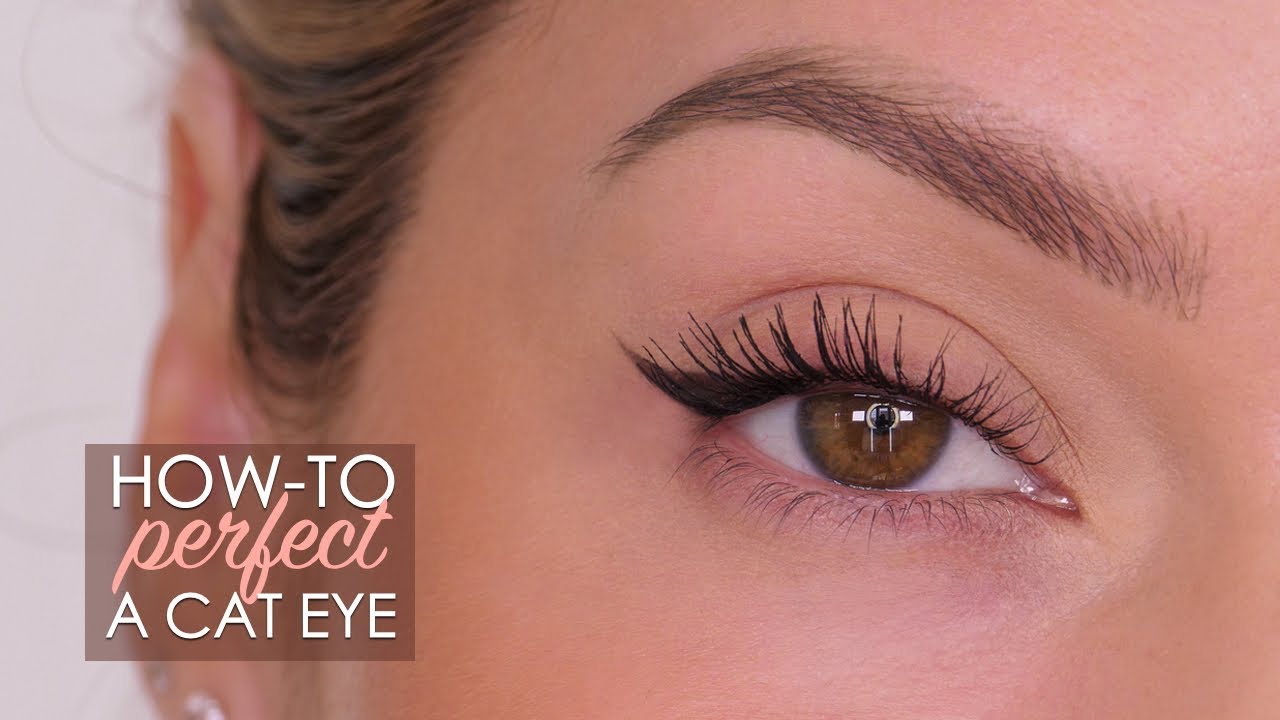
Cat eye makeup mostly comes down to the angle of one wing. It is a tapered flick drawn from the outer corner toward the tail of the eyebrow, joined to a thin line along the upper lash line, and it lifts and lengthens the eye.
Felt-tip pen, brush liquid, gel and pencil liners can all do it, though they behave very differently in your hand.
Proportion is what makes the wing look deliberate. Maybelline’s guidance keeps the wing about as wide as the lash line and angled slightly upward, unless you want an extra dramatic look.
Eye shape changes the angle, and it matters most on hooded and downturned lids.
Liquid, Gel, Pencil or Felt-Tip: Which Eyeliner Suits Cat Eye Makeup?
For a first cat eye, a felt-tip pen is the easiest place to start. Verily’s Sophia Loren tutorial uses a felt-tip liquid liner because the lines come out smooth and defined.
Gel and brush liquid give a sharper edge once your hand is steady. Pencil works best as a guide line you go over later.
| Formula | Line quality | Difficulty | Best for |
|---|---|---|---|
| Felt-tip pen | Crisp, even | Low | First wings |
| Pencil | Soft, smudgeable | Low | Outlining the wing |
| Gel with brush | Defined, buildable | Medium | Hooded lids, custom angles |
| Brush liquid | Sharpest, high-gloss | High | Steady hands, evening looks |
If you have never drawn a wing, start with the felt-tip. Move to gel or brush liquid once your wing edges already come out clean, and not before.
Felt-tip pen
Felt-tip liners work like a marker, so the line goes down in one pass. The MUA Eye Define Felt Liner shows up in Superdrug’s cat eye guide as a typical example.
The tip is fine and consistent, and it flicks outward easily with no brush to load or wipe. The catch is the fixed tip width, which limits how thick a wing can get, and the tip wears down with use.
Brush liquid
Brush liquid gives the sharpest edge and the least forgiveness.
A good brush on a liquid eyeliner draws the wing in one stroke, and every wobble shows. makeup.com demonstrates L’Oreal Paris’s Infallible Flash Cat Eye Waterproof Liquid Eyeliner in a hooded-eye wing tutorial.
It wins with a crisp tip and a high-contrast wing that holds up in evening light. It falls apart with shaky hands, and with any mistake you try to fix mid-line (L’Oreal Paris says to wait until you finish before correcting).
Gel liner
Gel liner goes on with a thin brush, which MasterClass pairs with gel, cream and liquid pen liners for hooded lids. It stays workable for a few seconds, so you can reshape the wing.
The downsides are a brush that needs cleaning every time and a pot that dries out.
Pencil liner
Pencil sits at the soft end of the range.
It lacks the sharp tip of a pen, but pencil eyeliner is what Maybelline’s guide recommends for mapping out the wing before liquid goes over it.
- Trim a small piece off twist-up pencils before each use, as vision scientist Alison Ng of the University of Waterloo advises
- Never swap in a lip liner, since the FDA warns about mouth bacteria and color additives not approved for the eye area
Tools That Keep the Wing Straight

Most wing problems get solved with cheap stuff you probably own already.
- An angled brush draws the wing edge and sharpens a blunt tip.
- Tape gives you a straight edge to draw against. L’Oreal Paris’s winged liner tutorial places it at the outer corner angled up toward the end of the brow. It fixes one angle only, so check it with your eyes open.
- A cotton swab and micellar water tidy the edge once the line is done.
- An eyelash curler keeps lashes visible above the liner.
- Any long thin item, such as a pencil, held from the outer corner shows where the wing will land (an Instructables guide uses this).
Plastic wing stencils and the spoon trick copy a fixed curve. Neither adapts to your eye shape, so use them only while you practice.
Whatever you pick, wash your hands first and keep every tool clean. The FDA says anything placed near the eye needs to be clean.
How to Set the Wing Angle, Length and Thickness

The angle comes from the tail of the eyebrow or from the extension of the lower lash line. Length and thickness then decide how dramatic the wing looks.
Angle and direction
The brow tail line is the usual guide. Draw from the outer corner toward the end of the eyebrow, following the curve of the eye (Superdrug). The lower lash line extension works too, and it follows the angle of the bottom lashes so both eyes share one consistent angle (Maybelline).
Hooded lids are the exception. Wing outward instead of upward, because an upward wing gets caught in the lid fold (makeup.com).
The Instructables guide adds a way to find your own line. Hold a thin item at the outer corner and tilt it between the brow tail and the edge of the nose.
The same guide notes that straighter lines toward the ear elongate the eye, while a steeper climb toward the temple makes it look bigger.
If you already know how to draw a plain winged eyeliner look, the angle is the only new decision here.
Use the brow tail line on flat or lightly hooded lids. Drop to the lower lash line extension when an upward wing would run into a fold.
Length and thickness by occasion
Settle length first. Thickness follows.
For daytime, keep it to a short flick and a thin line, starting about a third of the way along the upper lash line, as Escentual’s guide does. Superdrug also starts with a thin line, so any mistakes can be disguised by thickening it later.
For evening, go longer and start the line farther toward the inner corner. The Instructables guide says the farther along the lash line you begin, the more dramatic the result.
How to Do Cat Eye Makeup Step by Step

Most brand tutorials put the wings first and the lash line second, and the sequence below follows that order.
- Prime the lid with eyeshadow primer or concealer, then apply any eyeshadow first.
- Look straight into the mirror with your eyes open and keep them that way.
- Mark the wing tip with a small dot, or sketch a mini triangle at the outer corner.
- Draw the wing line from the outer corner to the dot.
- Repeat on the other eye now, so the pair matches instead of copying a finished first eye (Verily).
- Connect each wing back to the lash line and fill the gap with short strokes.
- Line the upper lash line toward the wing, keeping it thin near the inner corner.
- Curl the lashes, apply black mascara, and clean the edges with a swab and micellar water.
Verily’s tutorial starts with primer to stop smudging through the day. An eyeshadow primer gives the lid a grip so the wing stays where you drew it.
For a denser lash base, you can also tightline the upper lash roots before mascara. Keep that line on the lash roots and off the wet inner rim.
Where the liner sits matters for your eyes as well as for the look. A University of Waterloo and Cardiff University pilot study published in Eye and Contact Lens in 2015 found 15 to 30 percent more liner particles reached the tear film when liner went inside the lash line than outside it.
The study had three participants and used a glitter pencil, so read it as a direction, not a dose. The Discovery Eye Foundation gives the same advice, that liner belongs outside the lash line and not along the eyelid margin.
How Does Eye Shape Change the Wing?
Eye shape changes where the wing starts, how steeply it climbs and how thick the line runs. The wing that lifts a downturned eye can vanish on a hooded lid.
| Eye shape | Wing approach | Source |
|---|---|---|
| Hooded | Low, extended from the lower lash line | Maybelline |
| Monolid | Floating wing | Maybelline UK |
| Round | Thin strokes pulled outward | L’Oreal Paris |
| Downturned | About 45 degrees at the outer corner | Lancome |
| Almond | Almost any wing works; thin at the inner corner, thicker toward the outer edge | Maybelline, Maybelline UK |
Hooded eyes
Sources split on line weight for hooded lids.
Maybelline says to lay the liner on thick so it can be seen, and Lancome calls for a thick, elongated wing so the line is not hidden. makeup.com’s hooded-eye tutorial goes the other way with a thin wing, and Vieve warns that thick bands of liner across the lid make hooded eyes look smaller and heavier.
The split follows how much lid shows. More visible lid carries more liner, so test the weight with your eyes open before you commit.
If you can’t tell which camp you fall in, I’d start thin. Thickening a line is easy and undoing one isn’t.
For the rest of the eye look, this guide to makeup for hooded eyes covers shadow and lashes.
Monolid, round and downturned eyes
Maybelline UK’s floating wing for monolids treats the spot where a crease would sit as the upper lash line, so the flick stays visible. L’Oreal Paris adds a rule for the line itself, which is to build it with small strokes.
Round eyes get lifted by thin, elongating strokes pulled outward, according to L’Oreal Paris.
Downturned eyes need the wing to do the lifting. Lancome aims for a 45-degree angle as the line reaches the outer corners.
Charlotte Tilbury’s guide for downturned eyes, built around its Feline Flick pen, gets there another way. It continues an imaginary line upward from the outer bottom lash line, with the liner pen held in place as an anchor.
Almond eyes and mature lids
Almond eyes are the easy case. Maybelline calls them versatile enough for almost any liner look, and Maybelline UK suggests a thin line at the inner corner that thickens toward the outer edge.
Mature lids need a different base. Primer goes on first, because crepey lids let liner crease and feather (makeup artist Sandy Linter, AARP, 2023). Linter’s stand-in when liquid feels hard to control is gel liner, and makeup artist Caroline Barnes favors cream textures for hooded, mature eyes (SheerLuxe).
For a fuller routine beyond the liner, see this guide to eye makeup for older women.
How to Fix Uneven or Crooked Wings

Wait until the line is finished before fixing anything. A small angled brush with a little foundation or makeup remover sharpens the edge, and a swab dipped in micellar water lifts stray liner. Both fixes come from L’Oreal Paris tutorials, and neither needs a redraw.
| Problem | Fix | Source |
|---|---|---|
| Blunt or messy edge | Sharpen the edge with an angled brush and a little foundation or makeup remover | L’Oreal Paris |
| Stray smudge | Dab with a swab or small shadow brush dipped in micellar water | L’Oreal Paris |
| Wobbly line | Pull the skin taut at the end of the brow while you draw, and work back toward the middle in short sketching strokes | Superdrug |
| Heavy wing | Lift the excess with a micellar-water swab and blot, then rebuild from a thin line, adding gradually | L’Oreal Paris |
Judge the pair from arm’s length. Faces are not symmetrical, so two matched lines can still read as uneven.
If one wing is weaker, change only that one, in small moves, and leave the good one alone.
Most wing repair is subtraction, not addition.
Making Cat Eye Makeup Last and Removing It Cleanly
Set the liner and match the formula to your lid’s oil level, and a wing stays put through the day. Removal takes one gentle product and a clean cotton swab.
Keeping the wing in place

- Press a coordinating eyeshadow over the liner with a small flat-top brush to set it (L’Oreal Paris)
- On oily lids, blot with blotting papers and then dust a finely milled translucent setting powder over the lid (Barnes, SheerLuxe)
- Spritz setting spray over the face with your eyes closed (L’Oreal Paris)
- Hooded, wrinkled lids crease more, so Barnes picks long-lasting, non-transferable cream liners for them
If liner still travels after all that, this guide to stopping eyeliner from running goes through the other causes.
How long to keep eyeliner
Old liner is not harmless. Of 467 used cosmetic products donated in the UK, 79 to 90 percent carried bacteria, according to Aston University’s 2019 study in the Journal of Applied Microbiology.
The set included 92 eyeliners, and the researchers noted that products were being used beyond their expiry dates.
The American Academy of Ophthalmology takes the strict view and advises throwing eye makeup away three months after purchase. Barnet Dulaney Perkins Eye Center is looser and says pencil eyeliners last up to two years.
The cautious call is three months for liquid and gel, with pencils replaced well inside two years and sharpened before each use. I’d go with the cautious call. A separate guide covers how long eyeliner lasts by formula.
Removing the look
- Take all eye makeup off before sleep, and keep remover out of the eye itself (American Academy of Ophthalmology)
- Run a clean cotton swab along the base of the lashes to lift what the remover leaves behind
- Skip foaming cleansers near the eye, since the sodium lauryl sulfate in many of them dries the skin (Discovery Eye Foundation)
- For sensitive eyes, an eye-care expert quoted by AARP recommends a remover that blends oil and water
Cat Eye Variations: Soft Brown, Double Wing and Graphic

Beyond the classic black wing, most requests are for a softer daytime version or something bolder, like a double wing or colored graphic liner.
Soft brown and diffused wings
Brown liner gives a softer wing than black. L’Oreal Paris’s neutral cat eye and its reverse cat eye both lean on browns, the latter with a medium-brown shadow along the lower lash line.
Makeup artist Emily Cheng calls the diffused version a “soft baby wing” (Vogue Singapore). BeautyCrew reported in 2017 that Patrick Ta’s daytime take is a super-thin line drawn with a skinny angled brush and dark eyeshadow.
Blending a pencil line out with an eyeshadow brush gives a smudged wing (Daily Vanity). For a heavier smudge, the smoky eye technique goes further.
Double wing
A double wing adds a second wing beneath the first.
L’Oreal Paris’s double-winged tutorial drags the upper lash line toward the temple, then starts the second wing at the outer corner of the lower lash line and runs it parallel to the first, sharpening the edges with an angled brush.
For graphic liner looks that need this kind of precision, Lancome recommends its Idole Ultra Precise Felt Tip Liquid Eyeliner.
Graphic and colored liner
- White or navy liner suits monolids (L’Oreal Paris)
- A graphic double wing traces a line just above the crease with a very slight curve in the middle, highest above the pupil (L’Oreal Paris)
- Makeup artist Jonet Williamson drew a thin upward wing with Maybelline’s TattooStudio Smokey Gel Pencil Eyeliner, then pressed a mascara wand across it for a speckled texture (makeup.com)
Graphic wings pair well with lashes. L’Oreal Paris suggests individual lashes at the outer corner for monolids, and a guide to applying false eyelashes covers the technique.
Cat Eye Makeup FAQ
Is a cat eye the same as winged eyeliner?

Yes, in practice. Maybelline describes winged eyeliner as a technique often called a cat eye or flicked eyeliner look.
Both rest on the same upward flick at the outer corner of the eye.
Where does the cat eye look come from?
The look traces to ancient Egypt, where, according to Canterbury Museum, men, women and even effigies of gods wore thick black lines around the eyes.
That pigment, kohl, was predominantly galena (lead sulphide), which is why the FDA now advises consumers to avoid kohl near the eye.
Can you do a cat eye with eyeshadow only?
Yes. Escentual’s cat eye guide prefers black eyeshadow to pencil for a softer, more flattering finish.
An angled brush draws the wing, and the edge comes out less crisp than liquid liner gives.
Do you line the lower lash line with a cat eye?
No, it is optional. Maybelline’s tutorial runs brown liner along the lower lashes and extends it just past the outer corner, parallel to the wing but never touching it.
L’Oreal Paris also treats the lower lash line as extra definition for monolids, where little lid space shows.
Practicing Cat Eye Makeup Before You Wear It Out
Practice cat eye makeup at night, just before cleansing, so a crooked wing costs nothing. The Instructables guide recommends that window for testing out the angle and the length, plus how thick the line gets, without any pressure.
Start with angle, using one felt-tip pen, and move on to a matched pair by drawing both wings before finishing either. Thickness comes last, built up from a thin line.
Angle goes first because extra thickness cannot rescue a wing aimed the wrong way.
Switch to gel or brush liquid only when the pair matches without cleanup.
The trade-off is repeated removal on delicate lid skin, so a gentle routine for removing eye makeup matters as much as the drawing.

She started writing on the site after fielding the same questions from clients and friends often enough to just write the answers down: which red won't turn orange on a warm undertone, how to keep lipstick from feathering into fine lines, why a "12-hour" formula rarely survives dinner.
Every review on the site follows the same rule she uses with paying clients: wear it first, then decide if it's worth recommending.
- How to Make Eyeliner Last Longer Without Smudging - August 31, 2026
- How to Make Eyeshadow Last Longer All Day - August 29, 2026
- How to Find Your Undertone in 5 Easy Steps - August 27, 2026