A winged eyeliner look starts as a thin line along the upper lashes that keeps going past the outer corner and kicks upward. The flick follows the angle of your lower lash line, and one short stroke from the tip back to the lash line closes the shape. That tail lifts the eye and makes it look longer.
The wing sits on skin beyond the lash line, which matches the placement the American Academy of Ophthalmology (2022) recommends for all eye makeup, so the oil glands that protect the eye surface stay unblocked.
Liner on the waterline doesn’t fit that guidance.
How to Do Winged Eyeliner Step by Step
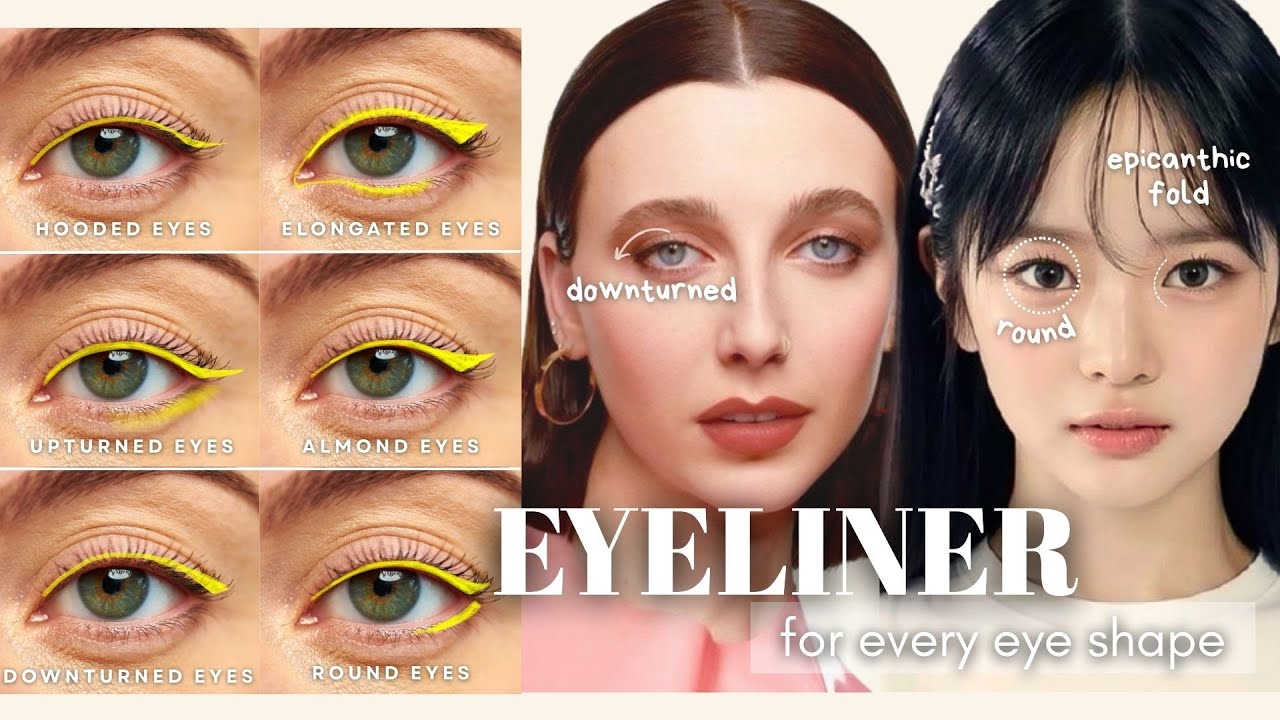
Go in this order. Skipping the dry time is where most smudged wings come from.
- Start with a clean, dry lid and a thin layer of primer or concealer. If you’re still learning, leave eyeshadow out for now so mistakes wipe off easily (Cut Out + Keep tutorial).
- Draw a thin base line, beginning slightly inward from the tear duct and working toward the outer corner in short strokes. Leave the outermost lashes bare for now (Slashed Beauty).
- Look straight ahead and flick the wing, drawing from the outer corner upward at the angle you chose.
- From just below the wing tip, sweep back down to the base line.
- Color in the triangle between the two lines and sharpen the point.
- Keep still until the liner sets.
- Add mascara last (L’Oreal Paris, 2021).
Maybelline says its Hyper Easy brush-tip liquid liner needs 20 seconds to dry, so count it out.
Bustle’s tips for hooded eyes add that liquid liner wants extra dry time with your eyes kept closed, otherwise it transfers onto the fold.
Tutorials don’t agree on where to look while you draw. L’Oreal Paris has you make the wing with your eyes open, a tip it gives for hooded lids so you can see where it lands.
Cut Out + Keep draws the connecting line while looking down, and notes the line looks slightly curved once the eyes open.
I’d place the wing with your eyes open and use the downward gaze only for the connecting line. Then check both eyes straight on.
How Do You Pick the Right Wing Angle and Length?
Extend the line of your lower lash line outward and stop before the brow bone. Most tutorials start from that rule and adjust it.
The guides don’t agree on the angle itself.
- Slashed Beauty follows the natural direction of the lower lash line outward.
- Charlotte Tilbury glides the line up and out until it meets the tip of the brow tail.
- L’Oreal Paris, in its eye-shape guide, says hooded lids should wing outward in a straight line and not steeply upward.
The brow tail rule and the hooded lid advice pull in opposite directions. Draw a small test wing with your eyes open, and if the tip vanishes into the fold, lower the angle.
Length follows landmarks too. Stop just short of the brow bone, because a wing that runs toward the brow tail moves the look from a soft flick to a full cat eye look.
Not one of those guides gives a length in millimeters.
Thickness is simpler. Start thin and build, because adding liner is easier than removing it (Cut Out + Keep).
Gel, Liquid, Felt Tip or Pencil: Which Eyeliner Is Easiest for Wings?

For most beginners a felt tip liquid pen is the easiest to wing, unless your hand needs the extra seconds a gel formula allows.
L’Oreal Paris lists a 0.4 mm ultra-fine felt tip for Infallible The Super Slim, and tip width sets how thin your first wing can be.
| Type | Control | Main drawback | Best for |
|---|---|---|---|
| Gel with angled brush | Workable for a few seconds | Needs a separate brush | Practiced hands |
| Liquid felt tip pen | Fixed fine point | No blending once dry | First wings |
| Liquid brush tip | Thick to thin in one stroke | Dries fast, needs a steady hand | Graphic wings |
| Pencil | Soft, forgiving edge | Blurrier point | Sketching the wing |
Gel needs a brush. Bobbi Brown sells its Long-Wear Gel Eyeliner without one (the Ultra Fine Eyeliner Brush is separate), and you wipe excess off the brush before drawing.
Wear claims for that gel vary by listing. Bobbi Brown’s US page says up to 8 hours, while retailers such as Selfridges UK and Liberty London still say 12 hours, so read the label on the pot you buy.
Sources split on where beginners should start. Cut Out + Keep recommends gel because of the control. Slashed Beauty prefers liquid for clean lines and a sharp point.
Liquid eyeliner formulas dry quickly, so a mistake needs a swab and remover instead of blending.
If you want a safety net, start with pencil eyeliner. Maybelline’s own tutorial draws the wing in pencil and layers liquid liner over it.
Urban Decay describes its 24/7 Glide-On pencil as creamy and blendable before it dries waterproof and smudge-proof, so correct the shape while the formula is still creamy.
Which Winged Eyeliner Method Should You Use?

Tape gives the sharpest edge on a first attempt. Dots help when matching both eyes is the problem, and a spoon only earns its place for a curved tip. Freehand comes after you know your angle.
| Method | How it works | Best for | Fails when |
|---|---|---|---|
| Tape | Trace the edge of angled tape | Straight, sharp wings | Tape is not pressed flat |
| Three dots | Dots mark the wing, then join them | Matching both eyes | First dot lands off-angle |
| Spoon | Handle sets the edge, bowl shapes the tip | Rounded wing tips | Bowl is too big for the lid |
| Freehand | Draw by eye, elbow supported | Fast, practiced routines | Hand shakes or wings drift |
Tape goes at the outer corner and gets pressed flat against the skin so liner can’t bleed under it. Then you trace the edge with felt-tip liner (makeup.com). Maybelline’s Eyeliner 101 guide uses household tape.
Swiss Beauty’s guide places three dots in a diagonal line where the wing will sit, then fills the gaps between them.
For the spoon, hold the handle at the outer corner as a straight edge, then flip it so the bowl rests on the lid and trace the tip (ITV’s Emmerdale make-up hack). A Bustle writer who tested it found the spoon too big for her eyelid and had to trust the spoon instead of her own hand.
L’Oreal Paris built the Infallible Flash Cat liquid liner around the same guide idea, with a brush tip and a removable wing stencil (L’Oreal Paris Canada).
Freehand works best once basic eyeliner application feels automatic. Rest your arm on a table (Maybelline), or draw the flick backwards, starting at the tip and following the shape in toward the lash line.
Guides help until they don’t. If one fights your lid shape, drop it and try another.
Winged Eyeliner for Hooded, Monolid and Downturned Eyes
Hooded lids need a wing that stays visible. For monolids a floating line works, and downturned eyes do better with an angle that lifts the outer corner.
Hooded eyes
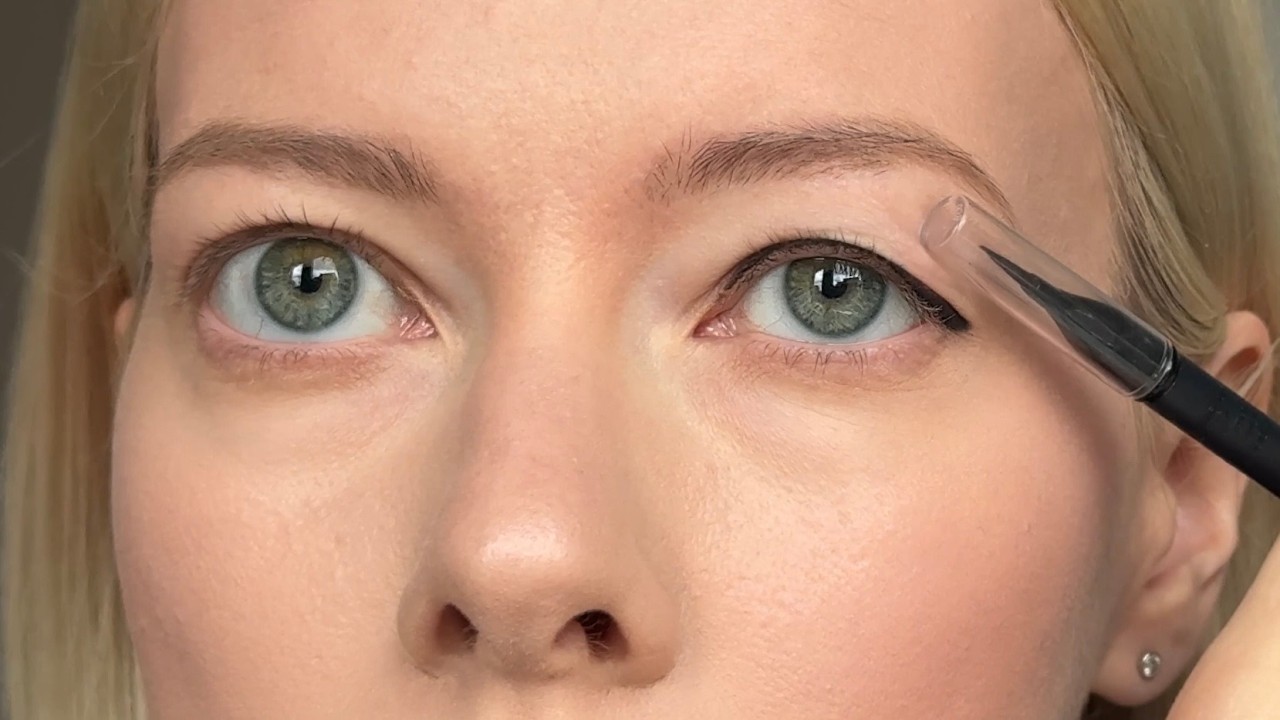
Sources disagree on thickness, and it matters because a thin line is the first thing a fold swallows.
Charlotte Tilbury advises the thinnest line you can draw, as close to the lash line as possible. Bustle’s makeup artist Min Min Ma goes the other way and says not to be afraid of a slightly thicker line, and The Handbook warns that the wing tends to hide on hooded lids, so it advises keeping the liner above the fold.
Thicken the line only until it stays visible with your eyes open, then stop.
Keep liner off the inner corner as well. Makeup artist Jessica Kohn tells Hello! magazine to keep eyeliner away from the inner corners of a hooded eye, and a bat-wing shape is her suggested alternative.
Shadow and lash choices change on hooded lids too, and this guide to makeup for hooded eyes covers them.
Monolids and small eyes
Gene at makeup.com says to draw the wing with your eyes open and extend it straight. The Handbook pairs a thicker line with the wing for definition, or blends it into a gradient smoky wing.
A floating liner is another route. It outlines the crease instead of the lash line.
Small eyes need restraint. Start at the outer corner and bring the liner in less than halfway, which opens and elongates the eye.
The rest of the look matters here, and a guide to eye makeup for small eyes pairs well with a short wing.
Downturned eyes
Charlotte Tilbury sets the angle by imagining a line that continues upward from the outer lower lash line.
Kalyani Nayak tells Elle India to start the wing where the outer corner begins to slope, not at the very tip, and to add concealer under the wing for extra lift.
Puppy eyeliner reverses the goal and wings slightly downward, following the natural shape of the eye.
Lift suits a sharp look. Puppy liner suits a soft one.
How to Fix a Crooked, Uneven or Smudged Wing

Wipe a wing back with a cotton swab dipped in makeup remover or micellar water, then redraw the edge in one stroke. Concealer carves the final sharp line.
| Symptom | Likely cause | Fix |
|---|---|---|
| Crooked wing | Hand drifted with no guide | Swab off the edge, redraw in one stroke |
| Heavy or thick wing | Too much liner on the tip | Trace under the wing with concealer |
| Mismatched wings | Each eye drawn start to finish | Draw both flicks first, compare straight on |
| Smudged edge | Liner touched the lid before it set | Let it dry, then lift with a swab |
Chanel makeup artist Anna Payne dips a cotton bud in micellar water to sharpen the wing (The Handbook). L’Oreal Paris likewise suggests a cotton swab or small shadow brush with micellar water.
Faviana’s guide corrects mistakes with a small brush and makeup primer, which works when a swab feels too wet.
Order prevents most mismatches. L’Oreal Paris draws the two wings first, checks that they match, and only then connects each one to the lash line.
How Do You Keep Winged Eyeliner From Smudging All Day?

Start with primer on clean, dry lids. Use a waterproof liner, or a pencil layered under liquid, and set the whole thing with a matte shadow close to the liner color.
Oil is the usual culprit. It shifts pigment, and an eyeshadow primer gives the liner something to hold, according to Women’s Weekly Singapore.
Advice on the base varies. Earlier steps in this article allow primer or concealer on the lid, while L’Oreal Paris recommends an eye primer before liner.
Use either on normal lids. On oily lids, choose an invisible primer and set it with powder.
Daily Vanity suggests a pencil base under liquid liner, which adheres longer on oily lids, and filling only three-quarters of the lash line so there’s less liner to smudge.
Curl lashes before lining, not after, so the curler does not smear the finished line.
Waterproof formulas are the surest fix for eyeliner that keeps running, per Women’s Weekly. Avoid creamy concealer under the eyes, or set it with translucent powder.
Eye Safety Rules for Winged Eyeliner
- The American Academy of Ophthalmology (2022) says to apply makeup outside the lash line, so the oil glands that protect the eye surface stay clear.
- Throw eye makeup away after three months, the Academy says, because bacteria grow easily in creamy or liquid products.
- The FDA says never to share eye cosmetics, to wash your hands first, and never to use a lip liner as an eyeliner.
Pencil liner needs one more habit. Alison Ng, who led the University of Waterloo study, says to sharpen thoroughly before each use, or cut some off the end of a twist-up pencil.
Clean tools matter for the same reason, and a guide to how to sanitize makeup covers the routine.
Tightlining puts liner on the upper waterline, and medical sources and makeup artists disagree on it.
The Academy says to apply outside the lash line. Avni Rambhia calls lining the inner upper waterline key to building drama (Elle India), and Oz Hair and Beauty’s guide tightlines with a waterproof pencil.
The University of Waterloo study found 15 to 30% more particles in the tear film when pencil liner went inside the lash line instead of outside, with migration fastest in the first five minutes.
It was a pilot with three participants wearing glitter pencil, according to the published paper, and negligible liner remained in the tear film two hours later.
Longer-term evidence is mixed. A Cornea study of 42 women (Prabhasawat et al., Mahidol University, 2020) found a tear breakup time of 3.0 seconds in regular eyeliner users against 5.8 seconds in non-users.
A smaller trial presented at the World Congress of Optometry (Alkawally et al.) found only non-significant trends, with 9 participants wearing liner on the lid margin four or more times a week. The two studies compare different groups, so neither settles the question.
Skip waterline liner if you wear contact lenses, because Ng says eyeliner stuck to lenses can cloud them and disrupt vision.
A few situations call for skipping eyeliner altogether.
- An eye infection or inflamed lid skin. The FDA says to wait until it heals and discard the products you were using.
- Recent eye surgery, until your ophthalmologist clears makeup around the eye (Academy).
Glitter or flaking liner is a problem too, especially with contact lenses, since flakes can enter the tear film (Academy).
Remove all eye makeup before sleeping. The Academy recommends Vaseline as a makeup remover and baby shampoo for washing the lids, and a clean cotton swab along the base of the lashes catches what is left.
Stubborn wings need more than a wipe, and a guide to how to remove waterproof makeup covers the formulas that resist it.
Winged Eyeliner FAQ
Is winged eyeliner the same as cat eye?
Mostly, yes. Nourish Mantra and Oz Hair and Beauty both treat the two names as the same technique, a line flicked past the outer corner.
In practice, a short flick reads as a wing and a long, sharp one as a cat eye.
How do you practice winged eyeliner without ruining your makeup?
Draw on the back of your hand first to feel how the pen or brush releases liner (Maybelline).
Then try a full wing on one eye only. If it fails, wipe it off with remover and repeat before touching the other eye.
How do you make a soft or smoky wing instead of a sharp one?

Use a pencil and blend the edge. Draw along the lash line, flick the wing, then buff it with a small blending brush for a diffused daytime shape (Oz Hair and Beauty).
Maybelline’s Eyeliner 101 guide softly blends a gel pencil line for a smudged effect instead of chasing a perfect edge.
Does a wing need liner on the lower lash line?
No. The wing and the upper lash line are enough, and lower lash line definition is an optional finish that Maybelline’s tutorial adds near the end.
For round eyes, Thrive Causemetics also keeps the focus on the upper lid, thickening the line toward the outer corner into a soft wing.
Do you apply eyeshadow before or after winged eyeliner?
Before. CoverGirl’s tutorial blends eyeshadow onto the lid first and draws the wing afterward, and Slashed Beauty primes, adds the shadow look, then moves on to the liner.
Shadow first makes the wing the last, sharpest detail on the lid.
What to Change First When Winged Eyeliner Comes Out Uneven
When a wing comes out uneven, change the guide first, before the angle or the liner.
Tape or three dots remove hand drift, so any error that remains belongs to the angle or the formula. If the wings still don’t match, retest the angle with your eyes open, and only then think about swapping the liner type.
The order follows cost. A guide is free and an angle test takes one extra wing, while a new liner costs money and resets what you know about its drying time.
The downside is speed. A guide adds a step to every routine, and freehand returns only after the angle becomes habit.
When both wings match, move on to mascara application to finish the eye.

She started writing on the site after fielding the same questions from clients and friends often enough to just write the answers down: which red won't turn orange on a warm undertone, how to keep lipstick from feathering into fine lines, why a "12-hour" formula rarely survives dinner.
Every review on the site follows the same rule she uses with paying clients: wear it first, then decide if it's worth recommending.
- How to Make Eyeliner Last Longer Without Smudging - August 31, 2026
- How to Make Eyeshadow Last Longer All Day - August 29, 2026
- How to Find Your Undertone in 5 Easy Steps - August 27, 2026