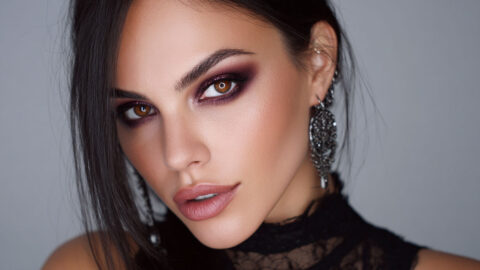
Eye makeup mostly comes down to order. Clean, primed lids go first, then brows, then shadow and liner, and the lashes get curled and coated at the very end.
Every product has its own spot (lid, crease, outer V, brow bone and lash line), and blending is what makes those spots read as one look instead of separate patches of color.
A lot of tutorials line the waterline or tightline the upper lash line. The American Academy of Ophthalmology (2022) says to apply eye makeup outside the lash line, away from the eye, so the oil glands of the eyelid stay unblocked. Worth knowing before you pick up a pencil.
What do you need to start doing eye makeup?

Less than most kits suggest. One neutral palette, one pencil liner and one tube of mascara already cover a full everyday look, and everything beyond that is optional.
The palette needs a light base, a mid-tone transition shade and one deeper shade for depth. Matte shades build shape. Shimmer catches light, so go easy on it. Eyeshadow primer is a thin layer that evens out the lid and gives pigment something to grip.
Pencil is the most forgiving liner on the lash line, which is why it suits a first kit. Mascara can be regular or waterproof. For brows, a pencil, gel or pomade all do the job, and concealer evens out any discoloration on the lid.
On the brush side, a flat shader brush packs color onto the lid, and a soft, fluffy blending brush blurs the edges between shades. An angled brush handles gel liner, brow filling and dark shadow along the lash line. The eyelash curler lifts lashes before mascara goes on.
Once you own a flat brush and a blending brush, skip the sponge-tip applicators that come in palettes. They deposit color but blend poorly.
Primer is the product beginners skip most, and it’s the one I’d skip last. Once you know what an eyeshadow primer does, the order makes sense. It creates an even surface, so shadow grips and resists creasing.
For brows, a brow pencil works in tiny strokes that follow the direction of hair growth, which is the method KIKO shows in its complete eye makeup tutorial.
The FDA advises against storing cosmetics above 85 degrees F, because heat speeds the breakdown of the preservative. A product left in a hot car is one example.
In what order does eye makeup go on?

Start with clean, primed lids. Brows come next, then eyeshadow, eyeliner, lash curling and mascara, with setting spray as an optional last step.
- Clean the lids and apply primer. The American Academy of Ophthalmology (2022) asks for very clean eyelids before any eye makeup.
- Fill and set the brows.
- Apply eyeshadow: base, transition shade, depth shade, highlight.
- Line the upper lash line.
- Curl the lashes.
- Apply mascara from root to tip.
- Seal the look with setting spray (optional).
Guides split on whether brows go before or after primer. Maybelline and KIKO start with brows, while other tutorials prime the lids first and do brows second. Brow product never touches the lid, so both orders work. Starting with brows does give you a frame to judge shadow placement against.
Beginners also ask constantly whether liner goes before or after shadow. Maybelline and Beauty Bay both say after.
The reason is practical. Shadow dust that lands on a finished liner line smears it, and a line drawn over blended shadow can be matched to the finished look.
Curl before mascara, never after. KIKO’s tutorial curls on clean lashes first, then adds mascara.
If the look has to last all day, apply setting spray last, with your eyes closed.
How to apply eyeshadow by zone

Shade goes where light and shadow would fall naturally. Base on the lid, transition in the crease, depth in the outer V, highlight on the brow bone and inner corner.
Each zone gets its own shade and blending joins them. A longer guide to applying eyeshadow covers the same sequence for beginners.
Lid and Base Shade
The base covers the moveable lid, from the lash line up to just above the crease. Pick a tone close to your skin or slightly deeper.
Powder is the fiddly one. Pat it on with a flat shader brush, then sweep lightly across the top edge. Cream and stick are simpler. Cream goes on with a finger or a brush, and a stick gets swiped across the lid and blended with a fingertip.
Beauty Bay’s beginner tutorial packs one shade from the lash line to just above the crease, then softens the edge with a slightly lighter shade.
Crease and Transition Shade
The transition shade is what makes eyeshadow look blended.
Pick a warm, neutral tone a step or two deeper than your skin tone, load a fluffy blending brush and work it back and forth through the crease in small, quick motions.
Outer V and Depth
The deepest shade in the palette goes on the outer third of the lid, shaped like a sideways V that points toward the end of the brow.
Build it in thin layers and blend inward toward the crease. Going too dark in one pass is the usual error, and a dark shade is hard to lift once it grips.
Brow Bone and Inner Corner Highlight
An angled brush lays a light, matte highlight along the bone under the brow.
The inner corner works differently. A small, fine-tipped brush places shimmer on the skin there, and a rice-grain amount is enough. An inner corner highlight is the easiest zone to overdo.
Blending Without Harsh Edges
Blending separates a finished look from stripes.
L’Oreal Paris’s beginner tutorial credits blending with solving most eyeshadow problems, and the technique is short. Use a clean fluffy brush with light pressure, and build color in thin layers. If an edge stays harsh, go over it with transition shade on the blending brush.
How to apply eyeliner and draw a wing

Eyeliner goes on the upper lash line in short, connected strokes. A wing is that same line extended toward the tail of the brow.
Pencil, Gel and Liquid Liner Compared
| Type | Control | Best for | Weak point |
|---|---|---|---|
| Pencil | Forgiving, smudges easily | Beginners, soft and smoky lines | Fades and smears on oily lids |
| Gel | Precise with an angled brush | Defined lines, wings | Needs a steady hand and a brush |
| Liquid | Sharpest line | Graphic wings | Dries fast, little room to correct |
Pencil is the right pick for a first liner. University of Waterloo researcher Alison Ng (2015) advises sharpening it before every use to expose a fresh tip, and cutting a little off twist-up pencils.
How to Draw a Wing
Wings come down to angle and patience.
- Place a dot at the outer end, angled toward the tail of the brow.
- Connect the dot to the outer corner of the upper lash line.
- Fill the gap between the line and the lashes.
- Clean the edge with a cotton swab.
Expect the first few to come out uneven. A dedicated guide to doing winged eyeliner goes deeper on technique.
Waterline and Tightlining Versus What Eye Doctors Say
Tutorials often line the waterline or tightline the upper lash line for thicker-looking lashes. L’Oreal Paris’s beginner guide lifts the lid and applies liner directly at the base of the lashes.
Eye doctors say the opposite. Apply makeup outside the lash line, away from the eye, so the oil glands of the eyelid stay unblocked (American Academy of Ophthalmology, 2022).
The research sides with the eye doctors. In a three-person pilot published in Eye and Contact Lens, 15 to 30 percent more eyeliner particles reached the tear film within five minutes when pencil went inside the lash line (Ng et al., 2015).
A 2020 Cornea study of 42 women found tear breakup time of 3.0 seconds in regular eyeliner users against 5.8 seconds in non-users (Prabhasawat et al.). Regular meant three or more days a week for at least six months.
A 2018 review in Clinical Optometry by Wang and Craig (University of Auckland) points the same way across prospective studies. Tightlining produced more tear film contamination and discomfort than liner on the outer skin.
The two small studies read as a direction, not a verdict. My rule would be to line outside the lashes day to day and save tightlining for occasions.
Tightlining places pencil in the thin rim between the upper lashes. A separate walkthrough covers how tightlining is done for anyone who still wants to.
One more caution on pencils. The FDA does not approve true kohl as a cosmetic color additive in the US, and some eye pencils use the word only to name a shade. Check the ingredient statement.
How to curl lashes and apply mascara

Curl clean, bare lashes first, then wiggle the mascara wand from the base of the lashes to the tips.
Clamp the curler at the root and hold a few seconds, then repeat mid-lash for a smooth bend instead of a crimp. For mascara, wiggle the wand at the root to push product between the lashes, then pull through to the tips. A second coat adds volume once the first is tacky, not wet. Run a clean spoolie through before the formula dries.
KIKO’s four-step tutorial follows the same order: curler on clean lashes, mascara, then a top coat.
Heated curlers are the exception worth skipping. Eyelid skin is thinner than other skin, and the AAO (2022), quoting clinical spokesperson Natasha Herz, MD, notes that skin gets first-degree burns at 118 degrees F and second-degree burns at 131 degrees F, while heated curlers often run from 100 to over 200 degrees F.
Skipping the heater costs little, and there are ways of curling lashes without a curler anyway.
Clumps are fixable with a clean spoolie, and there is a separate guide on how to fix clumpy mascara. The AAO’s rule is firm. Never separate clumped lashes with anything sharp, because it can scratch the eye.
Waterproof formulas resist smudging but take more effort to remove at night.
How do you match eye makeup to your eye color and eye shape?
Pick shades from the opposite side of the color wheel to your iris color, then shift the placement to suit where your crease and lid sit. Color changes how the eye reads, and placement decides whether the effect shows at all.
Shades for Blue, Brown and Green Eyes
Blue sits opposite orange, green sits opposite red, and brown is neutral enough to take almost anything.
- Blue eyes suit copper, bronze, warm brown, peach and terra cotta. Cool blue shadow can wash them out.
- Green eyes take plum, mauve, burgundy and warm taupe, while green shadow can cancel out the iris color.
- Brown eyes work with gold, bronze, olive, plum, navy and teal.
RMS Beauty’s color-theory guide lists those pairings. e.l.f. Cosmetics adds a refinement: find the shade directly across from your eye color, then pull from one or two colors on either side of it.
Contrast is not the only school. Ulta also lists analogous shades (neighbors of your eye color on the wheel) for a softer, more harmonious look.
Light blue eyes break the warm-tone rule in advice a makeup artist gave LookFantastic. Silver, grey, pink and lilac brighten them, while deeper blue eyes take warm gold, red and orange.
Neutral beige, brown and taupe pair with nearly every eye color, per Ulta, and skin undertone narrows the choice further. Brown eyes are the most forgiving, and this guide to eye makeup for brown eyes goes deeper on them.
Placement Adjustments by Eye Shape

Eye shape changes where depth goes, because the same shadow can vanish or overwhelm.
| Eye shape | Where depth goes | Watch for |
|---|---|---|
| Hooded | Slightly above the natural crease or near the upper lash line, applied with eyes open, blended upward | Liner thickness (sources split, see below) |
| Round | Darker shade in a sideways V at the outer corner | Wings (sources split, see below) |
| Monolid | Gradient, darkest at the lash line, fading upward | A very light inner highlight can look stark, so choose a flesh tone |
| Downturned | Blended upward toward the tail of the brow | Curl lashes, center the mascara, skip dark lower liner |
| Deep-set | Light or shimmery shade on the lid | Dark shadow in the crease deepens the socket |
The table draws on guides from Clarins, Bobbi Brown, Juvia’s Place and PureWow. Almond eyes need no adjustment, since Bobbi Brown notes that most looks work on them.
Hooded eyes are where the advice splits on liner. Makeup artist Laura Geller advises keeping it understated because heavy liner overwhelms the lid. Nylon’s makeup artist Ashleigh Ciucci goes the other way and suggests a slightly thicker line so it does not vanish when the eyes open.
Check the result with your eyes open and adjust until the line is visible but not heavy. A full walkthrough of makeup for hooded eyes covers more of the placement.
Round eyes get the same disagreement over wings. Makeup artist Risa Rodriguez says to stay away from them, while The Handbook and Juvia’s Place both extend the liner outward to elongate round eyes.
Why does eye makeup crease, fall out or smudge?
Excess oil on the lid causes most creasing, loose pigment causes fallout, and oily skin or unset formulas cause smudging.
Primer on bare lids and thin layers head off most of it, and a light dusting of translucent powder to set finishes the job.
Creasing

Oil breaks pigment down and gathers it in the fold, which is why hooded and oily lids crease first. Prime bare lids and build in thin layers.
Makeup artist Rose-Marie Swift of RMS Beauty traces creasing mainly to excess oil and pats setting powder between layers of shadow.
Concealer can work as a shadow base if it is silicone-based and dusted with powder, according to makeup artist Jamie Dorman. For oily lids, Renee Loiz prefers primer over adding another creamy layer.
Fallout
Tap excess powder off the brush before it touches the lid, and load lightly so color builds in layers. Brush stray dust away before liner and mascara.
Glitter and loose powder drop the most. They are also the formulas eye doctors flag first.
Smudging and Transfer
Smudging is the oil problem again, plus formulas that have not set.
Mascara transfers to the skin under the eye when the lids and cheeks are oily or the product is still wet. A separate guide shows how to stop mascara from smudging under the eyes.
Pencil and gel liner migrate for the same reason. This walkthrough on how to stop eyeliner from running goes into more detail.
Setting liner with powder locks it in place, and waterproof formulas resist transfer. Swift cautions against making waterproof products an everyday habit, since the trade-off is dried-out, crepey-looking lids.
How often should eye makeup be replaced, and how do you remove it?

Throw out mascara and creamy or liquid eye makeup after three months, and take all of it off every night.
That is the American Academy of Ophthalmology (2022) position. It sets the discard window at 3 months for mascara and creamy or liquid eye makeup, and it asks for nightly removal, mascara above all.
The numbers behind it are not small. In a 2008 Optometry study, 36.4% of mascara tubes showed microbial growth after 3 months of daily use (Pack et al.). A 2020 paper in the Journal of Applied Microbiology found bacteria on 79 to 90% of used cosmetic products, eyeliners and mascaras included, across 467 products (Bashir and Lambert).
The Pack study followed 40 women who used one of two nonwaterproof mascaras daily for three months. Of the 33 tubes returned, most contaminated ones grew Staphylococcus epidermidis, Streptococcus species or fungi, and the authors recommend a three-month maximum.
The two studies disagree on scale. Bashir and Lambert tested donated products, and coverage of the paper reports that many were used past their 3 to 12 month expiry, which likely explains the higher figure.
Write the opening date on every tube. A separate page looks at how long mascara lasts in more detail.
For standard removal, hold remover on a cotton pad against the closed eye, then rinse. Run a clean cotton swab along the base of the lashes for leftovers, and skip scrubs with beads or grit (AAO).
Waterproof formulas need more patience. Clarins advises pressing a pad soaked in oil-based remover, micellar water or a bi-phase formula on the lashes for 10 to 20 seconds, then sweeping downward.
Sources split on remover type. The AAO calls Vaseline an effective remover and recommends tear-free baby shampoo for lids, while contact lens guidance from Emory’s Michael Ward (Discovery Eye Foundation) says to avoid oil and petroleum based removers.
Lens wearers should take lenses out first and use an oil-free cleanser. Everyone else can use either.
Skipping removal has a documented cost. The AAO describes a 50-year-old woman who slept in mascara for more than 25 years and developed black lumps under her eyelids and follicular conjunctivitis.
The nightly routine is spelled out in this guide on how to remove eye makeup.
When should you skip or change your eye makeup?
Skip eye makeup during an eye infection or while the skin around the eye is inflamed, and after eye surgery until a surgeon clears it. Change formulas if you have dry eye, wear contact lenses or react to products.
| Situation | What to do | Source |
|---|---|---|
| Eye infection or inflamed skin | Stop, discard every product in use, wait until healed | FDA, AAO |
| Recent eye surgery | No eye makeup until the ophthalmologist clears it | AAO |
| Dry eye or blepharitis | Hypoallergenic cream shadow, nothing on the waterline | Melissa Toyos, MD (AARP) |
| Contact lenses | Lenses in first, out before removal, no liner on the inner lid edge | Cedars-Sinai |
The AAO calls glitter a common cause of corneal irritation and infection, especially in contact lens wearers. Larger flakes can scratch the eye much like sand.
With dry eye, Toyos advises skipping mascara that flakes or contains fibers, and favors cream shadow over powder for the same reason. London eye surgeon Sabrina Shah-Desai prefers liquid liner to pencil because pencil may migrate into the eye.
Allergies call for a slower approach. Introduce one new product at a time, as the AAO advises, so a reaction has one suspect. People with reactive skin can start with this guide to makeup for sensitive skin.
The FDA’s rule is blunt. Stop using any eye cosmetic that causes irritation.
Eye Makeup FAQ
How do you do a smoky eye?

Pack a dark shade along the upper lash line, then blend it upward and outward until no edge remains. Build the color in thin layers, because dark pigment is hard to lift once it grips.
The full build is laid out in this guide to smoky eye makeup.
Are false eyelashes safe to wear?
Yes, when worn for special occasions and applied well. The AAO warns that both glued and magnetic lashes can irritate the eyelid or scratch the cornea if they are applied badly.
See an ophthalmologist if discomfort follows. For strip lashes at home, this guide covers applying false eyelashes.
How do you fill in sparse eyebrows?
Choose the product by the gap. Pencil draws hair-like strokes where hairs are missing, gel sets and tints the hairs, and pomade covers larger sparse areas.
Fill the gaps lightly instead of outlining the whole brow.
Can you apply eyeshadow with your fingers?
Yes for cream and stick formulas, and rarely for powder, which blends unevenly under a fingertip.
Wash your hands first. The FDA advises washing before applying eye cosmetics and keeping anything that touches the eye area clean.
What is the simplest eye makeup look for a beginner?
One neutral shade across the lid, pencil liner along the upper lash line, curled lashes and a single coat of mascara.
That covers base, definition and lift. Every fuller look builds on the same pieces.
Should your eyes be open or closed when applying eyeshadow?
Closed for most application, which keeps product out of the eye. Open for hooded lids.
With hooded eyes, looking straight ahead shows where the shadow sits when the lid is relaxed, so you can place it above the fold.
Can eyeshadow replace eyeliner?
Yes. Press a dark matte shade along the upper lash line with an angled brush and smudge it, which gives a softer line than pencil.
Keep it outside the waterline, in line with the AAO advice to apply makeup outside the lash line.
Does mascara go on the lower lashes?
It is optional. Round eyes take mascara top and bottom, according to makeup artist Patrick Ta, while PureWow’s monolid guide keeps the lower lash line free.
Use one thin coat and let it dry before blinking to limit transfer.
Which Eye Makeup Skill to Practice First
Practice blending eyeshadow first, because a blended lid makes every later step read as finished.
Liner follows, since a line shows every wobble, and it belongs on the upper lash line, outside the lashes. Lashes come last. Mascara completes a look instead of rescuing one.
Outside-the-lash-line liner trades the thicker-looking lash base of tightlining for open oil glands.
The three-month discard window means four replacements a year for every mascara, creamy shadow or liquid liner in the kit, so stagger purchases instead of replacing everything at once.
This advice reflects American Academy of Ophthalmology guidance as of October 2026, and a revised position on liner placement would change the liner step.
Once blending feels automatic, a library of eye makeup looks to practice gives the next step.

She started writing on the site after fielding the same questions from clients and friends often enough to just write the answers down: which red won't turn orange on a warm undertone, how to keep lipstick from feathering into fine lines, why a "12-hour" formula rarely survives dinner.
Every review on the site follows the same rule she uses with paying clients: wear it first, then decide if it's worth recommending.
- How to Make Eyeliner Last Longer Without Smudging - August 31, 2026
- How to Make Eyeshadow Last Longer All Day - August 29, 2026
- How to Find Your Undertone in 5 Easy Steps - August 27, 2026