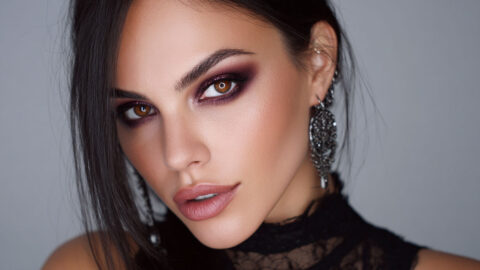
Green eyes show up in about 2 percent of the world’s population, the rarest of the four standard eye colors, according to a 2024 Genetic Literacy Project analysis citing population geneticist Timothy Sexton’s estimate. That’s exactly why picking the wrong eyeshadow shade for them is such a waste.
Most people choose eye makeup by mood: whatever matches the outfit, whatever feels fun that morning. Green eyes are the one eye color where that approach backfires hardest, because green shadow on a green iris just disappears into it.
The fix isn’t a list of “flattering colors” pinned to a mood board. It’s placement on the color wheel. Shades sitting opposite green, coppers, plums, warm bronzes, pull the iris forward instead of blending into it. That’s the whole rule underneath everything below, for eyeshadow, liner, and mascara alike.
What Is Color-Matched Eye Makeup for Green Eyes
Contrast is the whole point here, not coordination. A shadow sitting across the color wheel from green pulls the iris forward. A shadow sitting close to it just blends in. That’s the difference between eye makeup picked because it happens to be green, or blue, or brown, and eye makeup picked for where it sits relative to green specifically.
Most beauty advice treats eye color like a mood choice: green feels earthy, so people reach for green-toned shadow, and end up flattening the exact thing they were trying to bring out. Placement matters more than category here.
It’s also not one shade fits every green eye. Hazel-green carries brown flecks that warm metallics pull forward. Blue-green leans cooler and looks sharper under plum or violet. Gold-flecked green catches light differently, and bronze or copper plays into that instead of fighting it. None of that changes the underlying rule, it just changes which complementary shade gets reached for first.
How Complementary Color Theory Makes Green Eyes Stand Out

Complementary colors sit directly opposite each other on the color wheel, and pairing them creates the strongest contrast two hues can produce together. Johannes Itten, the Bauhaus theorist who formalized this system, placed red and green as one of the core complementary pairs on his twelve-hue wheel.
Put green shadow on a green iris and it flattens, since the shadow and the eye sit in the same color family. Copper and plum sit on the other side of that family entirely, which is why they pull the color forward instead of getting absorbed into it.
The rarity is what makes the extra effort worth it. Green eyes show up in about 2% of the world’s population, the rarest of the four standard eye colors (Genetic Literacy Project, 2024). In the United States specifically, 9% of people have green eyes, according to a 2014 Harris Poll survey done for the American Academy of Ophthalmology. Hazel eyes get confused with true green constantly, and they’re a distinct green-brown blend that shows up in roughly 5% of the world and 18% of the US (Medical News Today, 2024).
A color this uncommon already pulls attention on its own. Complementary shading just makes sure the makeup works with that instead of undercutting it.
Best Eyeshadow Colors for Green Eyes

Copper, plum, bronze, purple, and terracotta cover the core complementary shades for green eyes, since each one sits opposite green or red-violet on the wheel. Copper and bronze run warm and suit warm undertones. Plum and purple cool things down and work for cooler undertones without going full black.
Most looks build the same way underneath, whatever the exact shade. A matte terracotta or soft brown gets swept through the crease first to build depth, that’s the transition step. Then copper, bronze, or plum gets packed onto the mobile lid itself for the actual color payoff. Last, a warm gold goes into the inner corner and brow bone to open the eye up.
That inner corner step does more work than people give it credit for. A light gold or champagne there brightens the whole eye and makes the transition and lid shades read as intentional instead of muddy. The inner corner highlighting technique covers exact placement.
Which Finish Works Best for Green Eyes
Matte, shimmer, metallic, and satin finishes show up most often in green-eye recommendations, and each behaves differently once it catches light.
| Finish | Best For | Trade-off |
|---|---|---|
| Matte | Crease definition, daytime wear | Needs more blending to avoid flatness |
| Shimmer | Light everyday wear | Less pigment payoff than metallic |
| Metallic | Evening looks in copper or bronze | Shows lid texture more |
| Satin | A middle ground between matte and shine | Less dramatic than full metallic |
Glitter and foil formulas need a different application approach than powder shadow entirely, since fallout and adhesion behave nothing alike on the lid. The glitter eyeshadow application method covers how to pack it on without scattering it across the cheek underneath.
Eyeshadow Colors That Wash Out Green Eyes
Green, mint, and seafoam eyeshadow blend straight into a green iris instead of framing it, since they’re sitting in the same hue family as the eye itself. The contrast just disappears and the whole eye reads flat instead of defined.
Gray-based and ashy shadows cause a separate problem. They pull warmth out of the eye area entirely, which is how green eyes end up looking dull or tired instead of sharp.
Same-hue shadow is the mistake people make most, though it’s not a hard rule across the board. Deep jewel-toned green (think emerald, not mint) can actually work as a liner or outer-corner accent, because its saturation contrasts against the lighter iris around the pupil. Grayed-out, muted green still flattens the eye no matter how lightly it’s applied. And pastel green washes out pretty much any eye color, not just green, since it doesn’t have the depth to contrast against skin in the first place.
The rule stays simple regardless. If a shade could pass for the same color as the iris, it isn’t going to contrast with it.
Best Eyeliner Colors for Green Eyes

Brown, plum, navy, and black each pair with green eyes in a different way, and which one’s right depends on how much contrast the look actually needs. Brown sits closest to skin and blends into the lash line for soft, nearly invisible definition. It’s a solid daytime pick, but too subtle to hold up under strong lighting or anything after dark. Black sits at the complete other end, delivering the sharpest possible contrast against the iris, though it can swallow smaller or hooded eyes whole once it goes on too thick.
Plum lands in between the two. It adds warmth and real contrast without going full black, but it’s not the strongest choice as a single everyday liner on its own. Navy does something similar from the cool side instead, reading close to black with an undertone that flatters blue-green eyes specifically, though it can look muddy against very dark lash lines.
Kohl-based formulas smudge more easily than gel or liquid does, which matters mostly for waterline work. The kohl eyeliner formula stays the softest option for that inner rim specifically.
Worn as a wing instead of a straight line, navy or plum holds its shape without the harsh edge black tends toward, and the winged eyeliner technique works the same regardless of which color ends up filling it in.
Best Mascara Shades for Green Eyes

Brown, navy, burgundy, and black mascara all change how the lash line reads without touching the actual shape of the eye. Black stays the default for a reason, it delivers maximum definition in a single coat. Brown does the opposite job, softening the eye area, which comes in handy when the lid already carries a heavy copper or bronze look and doesn’t need more weight piled on top. Navy adds a cool undertone that plays well against plum or purple shadow, and burgundy adds warmth that echoes copper without just repeating it.
Stack too many dark, saturated pieces together (heavy shadow, black liner, black mascara, all at once) and the whole look flattens instead of getting sharper. Swapping just the mascara for brown or navy keeps the definition without piling on that heaviness.
None of that matters if the application itself falls apart. Clumped or unevenly coated lashes flatten the effect no matter what color went on, and the mascara application technique covers wand angle and coat count.
Eyeshadow Palettes and Products Worth Trying

A handful of named palettes cover the copper, bronze, and plum range well enough that buying five separate singles isn’t really necessary.
Urban Decay’s original Naked Palette built its whole reputation on exactly these warm neutrals. The brand discontinued it in 2018 after more than 30 million units and over 1 billion dollars in sales, then relaunched it in a limited run in August 2024 (PR Newswire, 2024). That kind of demand was never really about Urban Decay specifically, it says more about how often a warm, complementary-leaning neutral palette ends up being the one people reach for daily, green eyes or not.
| Brand | Shade Range | Finish | Price Tier |
|---|---|---|---|
| Urban Decay Naked | Warm neutrals, taupe to bronze | Matte and shimmer mix | Prestige |
| NYX Ultimate | Broad warm and cool mix | Matte, satin, shimmer | Drugstore |
| Anastasia Soft Glam | Copper, terracotta, plum | Matte and metallic mix | Prestige |
| Charlotte Tilbury Pillow Talk | Rose, mauve, bronze | Matte and shimmer mix | Prestige |
Budget and prestige palettes overlap more in pigment than most people expect going in. What actually separates them is blendability, and how much fallout ends up under the eye mid-application.
Priming still matters more than the price tag on the palette. A primer built for eyeshadow keeps warm tones from oxidizing or fading by midday, whatever brand happens to be filling the lid.
Testing shades before buying is the easiest way to avoid a palette that sits unused in a drawer. The makeup color palette generator previews copper, plum, and bronze combinations against an actual photo before committing to a full palette.
How to Apply Eye Makeup for Green Eyes Step by Step

The order matters as much as the shades themselves. Skipping or reordering a step is where most green-eye looks fall apart before they even get to color.
- Prime the lid. A thin layer stops oil from breaking down pigment, and keeps the transition and lid shade from sliding into the crease by midday.
- Place the transition shade. Sweep matte terracotta or soft brown through the crease first, before any bold color goes anywhere near the lid.
- Pack on the lid shade. Press, don’t swipe, copper, bronze, or plum onto the mobile lid for full pigment payoff.
- Blend the edges. Work the transition shade up into the lid color until the line between them disappears completely.
- Highlight the inner corner and brow bone. A light gold or champagne here opens the eye up before liner goes on.
- Line the eye. Brown, plum, navy, or black, applied close to the lash line, whichever fits the contrast the look calls for.
- Finish with mascara. Coat lashes evenly instead of in one heavy pass, since clumped lashes flatten everything built up underneath.
The eyeshadow application technique gets into blending tools and brush shapes in more depth than one step here really can.
The eyeliner application technique covers angle and pressure for a cleaner line, no matter which color ends up getting used.
Skipping the highlight step is the shortcut people take most often, and it’s the one that costs the most. Without it, the eye reads smaller, and all the color payoff built up through steps two through four loses most of its impact.
Which Technique Fits Your Green Eye Variation
Green eyes don’t all behave the same way under the same shadow. The exact undertone in the iris changes which side of the complementary wheel actually does the work.
| Variation | Best Shades | Technique |
|---|---|---|
| Hazel-green | Copper, warm gold, bronze | Cut crease to define the brown flecks |
| Blue-green | Plum, violet, cool purple | Halo eye to frame the cooler cast |
| Gold-flecked green | Bronze, warm copper, amber | Metallic wash across the full lid |
Hazel-green eyes have brown flecks near the pupil, and warm metallics pull those flecks toward the surface instead of letting them sit back. A cut crease helps here specifically, blending the transition shade sharply rather than softly so that warmth stays visible instead of getting blended away.
Blue-green leans cooler across the board. Plum and violet create the sharpest contrast against that cooler cast, and a halo eye, color concentrated at the center of the lid and faded out toward the corners, keeps it from reading flat.
Gold-flecked green catches and throws back light in a way a solid green iris just doesn’t. A metallic wash in bronze or warm copper across the whole lid plays into that instead of competing with it, which is really the simplest of the three approaches here.
Kevyn Aucoin, the makeup artist known more for sculpting and defining faces than for simply coloring them, built a good chunk of his reputation on exactly this kind of variation-specific adjustment.
The hazel eye makeup approach goes deeper into shade choices for the brown-green mix specifically, for anyone whose green leans more hazel than true green.
Which Shades Match Your Skin Tone and Hair Color

Undertone decides how a complementary shade actually reads on skin. Hair color adds a second layer on top of that, though a smaller one.
Warm undertones can wear copper and bronze without any adjustment needed, since both already sit on the warm side of the wheel to begin with. Cool undertones have it slightly harder: plum and mauve can pull toward gray unless the formula carries enough pigment to hold its own color against the skin.
Deep skin tones generally need more product to register the same intensity fair skin gets from less, especially with matte finishes. Fair skin shows terracotta and copper fast, almost too fast, so a lighter hand keeps it from tipping into orange. Tan and olive undertones sit somewhere in between warm and cool, and both copper and plum tend to work there without much adjusting at all.
Fenty Beauty built its whole reputation on exactly this kind of undertone-first thinking, launching in September 2017 with 40 foundation shades specifically to cover undertones most other brands had skipped over.
Hair color moves the needle less than skin tone does, but it still shifts things. Red hair paired with green eyes is a genuinely uncommon combination, not just something people say. A genetic correlation study in Twin Research and Human Genetics found red hair and green or hazel eyes share the weakest hair-eye correlation measured, at negative 0.14, meaning the pairing shows up less predictably than blue eyes with blond hair does, which had the strongest correlation measured at 0.87.
Blonde and brunette hair don’t really change which shades work. They change how much contrast shows up around the face overall.
The skin tone matching approach covers undertone identification in more depth, for anyone still unsure where they land.
Eye Makeup Looks for Green Eyes by Occasion

The same complementary logic scales up or down depending on where the look needs to hold up, and for how long it needs to last.
For everyday wear, one warm neutral washed across the lid does the job, nothing more than two shades total. Dramatic calls for a full plum or copper smokey eye instead, built up in layers with a properly defined crease. Bridal sits in its own category: soft definition that photographs well and actually survives tears, hugs, and several hours in front of a camera. Date night splits the difference, a metallic or shimmer lid shade paired with a sharper liner than daytime wear would ever call for.
Bridal carries the highest stakes for longevity out of all of these, and most brides plan around that well in advance. Nine out of ten brides get their hair and makeup done professionally and run a trial before the actual wedding day, according to WeddingWire’s Wedding Day Look Survey.
That trial run matters even more for green eyes specifically. A shade that photographs differently under flash than it did in natural light can throw off the entire look once the day actually arrives.
Charlotte Tilbury’s Pillow Talk palette, built around rose and bronze tones, shows up in bridal kits constantly for exactly this reason. It holds enough warmth to complement green eyes without competing against the rest of a soft bridal face.
For a full evening or event look, smokey eye styling covers the layering and blending that separates a soft smoke from one that just goes muddy.
The broader collection of green-eye looks breaks each occasion down into a full step-by-step, beyond just the shade logic covered here.
Common Mistakes That Dull Green Eyes
Skipping primer is the big one. Pigment fades and shifts within a few hours without it, and a shade that looked perfectly complementary that morning turns muddy by early afternoon.
Over-blending the edge is a quieter mistake but just as costly, since softening a transition shade too much erases the exact contrast the whole technique depends on in the first place. Lining too thick for the eye shape backfires too, a heavy line on smaller or hooded eyes closes off the definition the liner was supposed to add. And skipping the highlight step means even the right lid shade ends up looking flat instead of dimensional.
None of these are actually color mistakes. They’re technique mistakes undoing a color choice that was already correct to begin with.
Uneven blending shows up faster on lighter eyes than darker ones, simply because there’s less natural contrast around to hide a rough edge. The patchy makeup fix covers the blending correction for shadow that’s gone uneven mid-application, without needing to start the whole look over.
Creasing is the complaint tied most directly to skipping primer in the first place. The crease prevention approach gets into the oil-control side of that problem in more depth.
When Color Matching for Green Eyes Does Not Apply
The complementary approach only works if the eye underneath is actually green. That assumption breaks down more often than people think.
Colored contacts are the biggest one, since they change the base color the whole technique gets built around in the first place. A green iris covered by a blue or gray lens needs shades matched to whatever color the lens is, not the natural eye hiding underneath it. This isn’t some niche scenario either. The US market for colored contact lenses alone was valued at 0.8 billion dollars in 2024, and is projected to grow to roughly 1.2 billion dollars by 2033, an annual growth rate of about 4.9 percent (Verified Market Reports, 2024). Brands like Alcon’s Air Optix Colors sell specifically to change how eye color looks to other people, so anyone wearing them needs a completely different shade-matching approach than the one built around a natural green iris.
Stage, editorial, and costume makeup break the rule on purpose, and that’s fine. When the goal is a character or a concept instead of a flattering everyday look, contrast with the actual eye color underneath just stops mattering.
Monochrome and trend-driven looks work the same way, chosen deliberately rather than by accident. A fully green-toned eye styled as a graphic or artistic statement was never trying to flatter the iris underneath it, so judging it against the complementary rule misses the point entirely.
And then there’s just preference. The complementary approach describes what creates the most contrast, that’s it, it’s not a rule anyone actually has to follow. Plenty of green-eyed people like how a same-tone shadow looks on them regardless of what the color wheel says about it.
FAQ on How To Do Eye Makeup For Green Eyes
What Eyebrow Shape Complements Green Eyes

A soft, slightly arched brow with a defined peak pairs best with green eyes. Feathered brow styling complements a bold copper or plum lid without stealing attention from it, while heavily filled, angular brows tend to pull focus away from the eye color instead.
Should Eye Makeup Differ for Glasses Wearers With Green Eyes
Lenses shrink or magnify how eyeshadow reads, and it comes down to prescription strength. Farsighted lenses magnify the eye, so lighter, softer shades keep the look from reading overdone. Nearsighted lenses do the opposite, minifying the eye, which is why deeper, saturated shades like plum or bronze tend to hold up better there.
Is Waterproof or Washable Mascara Better for Everyday Wear
Washable formulas win out for daily wear. They’re gentler day to day and come off easily without tugging at lashes, and that matters more than color choice ever will for something worn every single day. Waterproof holds up better through humidity, workouts, or events specifically, but it needs a dedicated remover, otherwise lashes end up stripped along with it.
How Do You Make Green Eye Makeup Last All Day
Primer under both the shadow and liner is the single biggest factor, with setting spray at the end doing most of the rest. Powder eyeshadow outlasts cream once humidity gets involved. Waterline liner fades the fastest out of anything on the eye, so a gel or kohl formula sealed with translucent powder is what actually holds longest there.
What Should You Fix First in How To Do Eye Makeup For Green Eyes?
When a green-eye look falls flat, there’s actually a fixed order to fixing it, and shade choice isn’t where that order starts. Lid placement and primer come first, since a technically correct copper or plum tone will still read muddy without the right base underneath it.
Placement and primer get checked first. Then shade family gets checked, warm or cool. Then finish and liner intensity get checked last, once the first two are actually ruled out. Checking placement before anything else isolates whether the technique itself failed, before any color gets blamed and swapped out for nothing.
There’s a real trade-off buried in all of this: versatility. A palette built around copper and plum favors green eyes specifically, and it does noticeably less for brown or blue eyes than a neutral-toned palette would.
Lip color is the next thing that shifts once the eye look is locked in, and lip color for green eyes carries that same complementary logic down into the lower half of the face.

She started writing on the site after fielding the same questions from clients and friends often enough to just write the answers down: which red won't turn orange on a warm undertone, how to keep lipstick from feathering into fine lines, why a "12-hour" formula rarely survives dinner.
Every review on the site follows the same rule she uses with paying clients: wear it first, then decide if it's worth recommending.
- How to Make Eyeliner Last Longer Without Smudging - August 31, 2026
- How to Make Eyeshadow Last Longer All Day - August 29, 2026
- How to Find Your Undertone in 5 Easy Steps - August 27, 2026