Most hooded eye makeup fails in one spot. The color goes where the lid folds, and the second you open your eyes it’s gone. Put it above the natural crease, on skin that stays visible with the eyes open, and keep liner thin with a small upward flick. Primer and waterproof formulas then keep that placement from creasing or transferring.
A hood is skin from below the brow folding over the upper eyelid and covering the crease. The strip of lid that normally shows is small to begin with. A 2021 normative study in the Philippine Journal of Ophthalmology measured the visible strip between the lash line and the skin fold at an average of 4.5 millimeters across 75 Filipino adults, and a hood covers part or all of it.
What Are Hooded Eyes and How Can You Tell If You Have Them?

Excess skin and soft tissue below the brow drops over the upper eyelid, and the crease, along with part or all of the mobile lid, disappears when the eyes are open. The eyeball itself stays uncovered.
Some people are born with it. Others pick it up as eyelid skin loses elasticity and the brow settles lower, according to Medical News Today and a 2023 clinical supplement in Review of Ophthalmology.
Thinner skin doesn’t explain it, though. A 2013 review in Anatomy and Cell Biology reported upper eyelid skin at 818 micrometers in Korean women aged 60 or older and 884 in those aged 21 to 30, a difference that was not statistically significant. What changes with age is the fold, and the fold is what your makeup has to work around.
How to Check Your Own Lids
Sit at a mirror, relax your face and look straight ahead with your eyes open. If the crease is hidden or only partly visible, and skin from below the brow touches the lashes or sits close to them, that’s a hood. The other giveaway is shadow you can see with your eyes closed that vanishes the moment they open.
L’Oreal Paris treats that last sign as a good indication, so if most of the color on your lids disappears when you look forward, you likely have hooded eyes.
Check each eye on its own. Occasionally only one eye is hooded, and depth can differ between the two.
Hooded Eyes vs Monolids vs Ptosis
On a hooded eye the crease exists but sits under the fold. EyeWiki, the American Academy of Ophthalmology’s clinical wiki, calls the excess skin dermatochalasis and notes the crease can look indistinct, low or doubled.
A monolid has no visible crease fold at all, so the structure differs even when little lid shows.
Ptosis is something else again. The lid edge itself sits low, usually from a weak levator muscle or a nerve problem, according to St. Luke’s Eye patient education material.
Clinicians tell skin from lid by lifting the overhanging skin and checking whether the line of sight clears. A clear view points to dermatochalasis, and little change points to ptosis.
Makeup technique applies to both. A lid or skin fold that blocks your vision needs an eye doctor first.
How Hood Depth Changes the Technique

How much lid shows with your eyes open decides where color can sit. The table below splits that into rough working depths, each with its own mix of shadow, liner and lashes.
| Visible lid space (eyes open) | Eyeshadow | Eyeliner | Lashes |
|---|---|---|---|
| Crease partly visible | Transition shade just above the crease, blended up and out | Thin line with a small upward flick | Curl, then coat evenly |
| Thin strip of lid | Matte color above the crease, light lid color only inside the visible strip | Tightline or draw close to the lash line | Curl, then weight mascara toward the outer corner |
| No lid visible | Depth on the hood skin and outer V, nothing on the hidden lid | Wing sketched with shadow first, then a thin flick | Curl, plus half lashes at the outer corner |
The table is a working guide drawn from the expert advice in this article, not a clinical scale.
Work from the row that matches each eye, not from one routine for both.
How to Stop Eyeshadow From Creasing and Transferring on Hooded Eyes
A hood presses against the lid all day, so oil and friction push color into the fold unless something gives it grip. Prime the lid with a thin layer, let it dry, keep shadow layers light, and use long-wear or waterproof formulas for liner.
Makeup artist Shreni Patel calls color migrating into the crease a common hooded lid struggle. SheerLuxe’s experts add that hooded eyes tend to crease more.
Primer Types and What They Do

Urban Decay’s Eyeshadow Primer Potion is a creamy nude primer that dries invisibly. The brand advertises up to 24 hours of crease-free wear and says you can mix it with shadow for a custom cream shadow. Too Faced Shadow Insurance is translucent and comes with a doe-foot wand, and Too Faced claims 24+ hours of non-creasing wear and a formula that fights breakthrough oil.
MAC’s Pro Longwear Paint Pot is a different animal. It’s a cream shadow that works alone or as a base under powder shadows, and it sets to a velvety finish by MAC’s description.
Those hour counts come from brand product copy, not lab testing. Treat 24 hours as a ceiling, not a promise.
Primers work by absorbing excess moisture and giving pigment something to grip, which matters most on oily or friction-prone lids. MasterClass covers the basics in its hooded eye guide, and the same idea gets a longer breakdown in this piece on what an eyeshadow primer actually does.
Setting and Layering Order
Order matters more than product count. A thin layer does the job, and a step-by-step on using Urban Decay’s eyeshadow primer shows the same light-touch routine the brand itself recommends.
- Primer goes on in a thin layer and is left to dry
- Shadow goes on in light layers, built only where it shows
- Check placement with your eyes open at every step
- Use a smudge-proof or waterproof liner for the wing
MasterClass and L’Oreal both say working with the eyes open prevents smudging beneath the hood.
Primer fails when it is rushed. Too Faced’s directions put dry time before any blending.
It also can’t rescue misplaced shadow. Color sitting in the fold still transfers, because the fold touches the lid every time the eyes open.
Where Should Eyeshadow Go on Hooded Eyes?

Above the natural crease, on skin that stays visible with the eyes open. Anything tucked into the fold is hidden the moment you look up.
Eyes-Open Working View
Apply everything with your eyes open and relaxed, looking straight ahead. With your eyes closed, product lands on the lid and then slides under the fold. With them open, it lands where other people will actually see it.
L’Oreal Paris says applying makeup with your eyes open means there won’t be any surprises.
Zones and Blending Direction
Start with a matte neutral transition shade just above the natural crease, blended upward and outward with a fluffy brush. PAC Cosmetics advises keeping color out of the fold itself.
Depth goes at the outer corner (the outer V) and gets pulled up toward the end of the brow. Beauty creator Mackenzi (@satinsilkskin), quoted by makeup.com, says a rounded shape makes hooded eyes look closed off, while an extended shape elongates them. The inner corner only needs a light touch of color, since it stays visible even on deep hoods.
A white or champagne shimmer there opens the eye, according to the expert roundup on makeup.com, and the placement is covered in this walkthrough of an inner corner highlight.
Brushes matter here. A small oval blender like the MAC 217, which MAC describes as built for shading powders or creams, handles the transition, and a pencil brush places the outer V.
Cut Crease, Smoky Eye and Halo Eye Adapted for Hoods

Sources split on the cut crease. A Vogue Adria writer says it never worked on their hooded eyes, while PAC Cosmetics lists it as a step that makes hooded eyes look bigger.
The likely difference is where the line sits. A cut crease drawn on the natural crease sinks under the fold, and one drawn higher on visible skin stays on show.
The standard smoky eye technique sends dark shadow across the whole lid, which hides under a hood and reads heavy. Keep the depth in the outer third and diffuse it upward.
A halo eye, with color centered on the lid, only works when some lid shows, so it fits the first two rows of the hood depth table.
Which Eyeshadow Shades and Formulas Work Best on Hooded Lids?
Matte shades go above the crease, and shimmer only where it stays visible. Dark colors belong in the outer corner, not across the whole lid. Where the skin moves a lot, cream or long-wear formulas hold up better.
| Formula or finish | Best use on hooded lids | Main risk |
|---|---|---|
| Matte powder | Transition shade and outer V above the crease | Dark mattes make the eye look heavy |
| Shimmer powder | Inner corner or the visible center strip | Above the fold it highlights the hood instead of shading it |
| Cream shadow | Base layer or standalone color, which SheerLuxe’s experts call the best texture for hooded eyes | Moves if applied thick or left unset |
Light or Dark: Where the Sources Disagree
L’Oreal Paris and MasterClass steer hooded eyes toward lighter shades, with dark tones saved for the outer corner and everything blended up and out.
The Whoorl newsletter, written by a hooded-eyed writer over 40, goes the other way. It argues the hood area needs shade, because light shimmer there erases the depth that makes the eye stand out.
Both agree that shimmer stays off the hood and color goes above the crease. The split is only about how deep to go on the hood skin itself.
As a working rule, shallow hoods tolerate lighter shades, and deeper hoods do better with controlled shade.
Cream Bases for Mature Lids
Too much product exaggerates skin texture and fine lines, a point the Whoorl newsletter makes about makeup in the forties and fifties. Thin cream layers are the safer start.
A fuller treatment sits in this guide to eye makeup for older women.
How Do You Apply Eyeliner on Hooded Eyes?
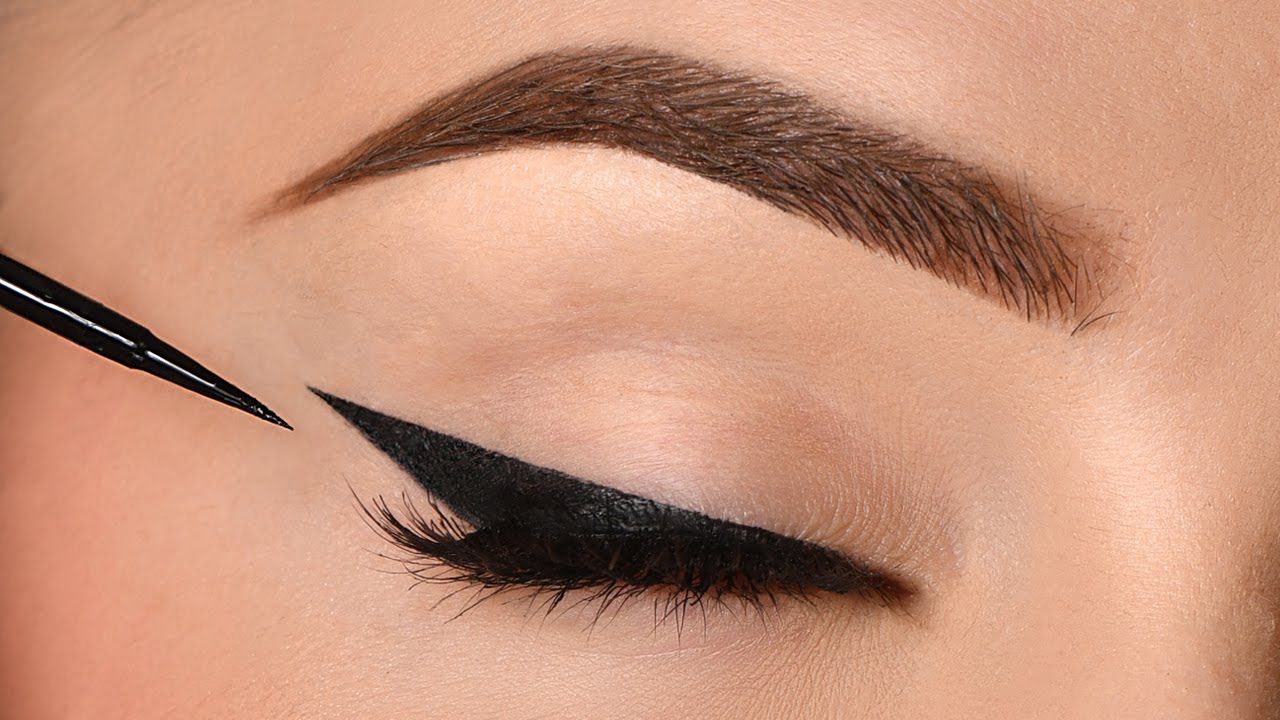
Thin, close to the lash roots, flicked up at the outer corner. Draw it with the eyes open, because thick liner eats the little lid space a hood leaves.
An expert quoted by the Irish News keeps liner soft and close to the lashes for exactly that reason. Heavy lines make the eyes look smaller.
Wing Shape and Angle
Vogue Adria calls the kitten wing, a short upward flick, one of the most flattering options for hooded eyes, because it respects the natural anatomy of the eye. Shreni Patel’s method is to map the shape with dark shadow and an angled brush first, then trace it with liner. L’Oreal Paris also offers a double wing as a cat eye option for hooded lids.
Tools change the result. Kat Von D’s Tattoo Liner has a needle-precise tip, and the brand’s own directions have you place dots as a guide before connecting them into a wing.
Stila’s directions for its Stay All Day liner call for pulling the upper corner of the eye gently to smooth the skin. Small feathering strokes into the lashes then close any gap between the roots and the line.
The basic mechanics are covered in this guide to drawing a winged liner. A hood only changes the angle and the thickness.
One step splits the sources. MasterClass pairs its eyes-open rule with a separate instruction to keep the eyes closed for a few minutes while liquid liner dries.
The tension is the drying minute, because a closed lid presses a wet wing into the hood skin. A quick-drying waterproof formula, left to set with the eyes open, avoids the problem (Stila describes its formula as quick drying).
Tightlining and the Waterline
Between 15 and 30 percent more eyeliner particles reached the tear film within five minutes when pencil went inside the lash line rather than outside it, according to a Waterloo and Cardiff study in Eye and Contact Lens (2015).
It was a pilot study with a glitter pencil, and contamination was negligible two hours later. The finding still points at one technique in particular, because how tightlining is done puts liner on the lid margin right behind the lashes.
The Whoorl newsletter prefers tightlining or working pencil into the upper lashes so liner takes no lid space. Patel pairs a dark upper line with white or nude liner on the lower waterline for bigger, brighter eyes. The American Academy of Ophthalmology (2022) pulls the other way and says to apply makeup outside the lash line, away from the eye, to keep the oil glands clear.
Filling the lash line with small strokes between the roots, without touching the inner rim, keeps most of the lid space benefit and stays outside the AAO warning. In the hood depth table, read tightline as that lash-line fill.
If you do line the inner rim or the waterline, remove it completely every night.
How Should You Curl and Mascara Lashes on Hooded Eyes?

Curl with an eyelash curler first, then coat the lashes with the weight kept on the outer corner so they clear the fold. Vogue Adria calls mascara the most powerful ally for hooded eyes.
MasterClass lists the curler among the core tools, since lifted lashes make the eyes look more open.
Human skin can sustain first-degree burns at 118 degrees Fahrenheit and second-degree burns at 131 degrees, while heated eyelash curlers run from 100 to over 200 degrees, the American Academy of Ophthalmology (2022) reports. Eyelid skin is thinner, so it damages at lower temperatures than that.
I’d skip the heated kind. If a heated curler is off the table for you too, there are ways to curl lashes without a curler.
Maybelline’s Lash Sensational Sky High uses a flexible Flex Tower brush that bends to coat each lash from root to tip, and it is also sold in a waterproof version. SheerLuxe’s experts recommend waterproof or tubing mascaras for hooded eyes, since hooded eyes are more prone to transfer. PAC Cosmetics adds a placement rule, which is to concentrate on the outer lashes to lift the eye.
makeup.com’s Mackenzi suggests half lashes on the outer lash line to elongate hooded eyes. The AAO cautions that glued or magnetic lashes can irritate eyelid skin or scratch the cornea when applied badly, and it advises wearing false lashes for special occasions only.
A walkthrough on applying false lashes covers technique for the outer-corner placement.
Replace mascara every three months. The AAO says infection-causing bacteria grow easily in creamy or liquid eye makeup.
What Brow Shape Opens Up Hooded Eyes?

A brow with the tail lifted slightly upward adds visible space above the lid. Look Fabulous Forever starts its hooded eye routine with the brows, brushing them with a spoolie and shaping the tail upward for lift.
Angle the tail up, not down. Outline from the highest point of the arch toward the tail with light pressure, then fill sparse spots with hair-like strokes and brush through.
The Anastasia Beverly Hills Brow Wiz suits that job, with an ultra-slim retractable pencil, a fine tip for hair-like strokes and a spoolie end to blend. Its directions run close to the above. Outline the lower arch toward the tail, then the upper arch, add hair-like strokes in sparse areas and blend with the spoolie.
SheerLuxe’s experts also say it is just as important to frame the brows. A fine-tipped brow pencil does the detailing without adding bulk.
Opinion splits on the brow bone. PAC Cosmetics suggests a lighter shade there to open the eye. SheerLuxe says no highlighter under the brows, and MasterClass says highlighting the whole brow bone overwhelms hooded eyes, though it allows a slight highlight on the arch of the brow bone. MasterClass prefers matte shades there to minimize the look of the brow bone.
Skip the broad highlight. A hood already puts volume at the brow bone, and both SheerLuxe and MasterClass steer away from highlighting it broadly.
What Is the Step-by-Step Routine for Hooded Eye Makeup?
Brows first, primer second, shadow before liner, lashes last. Shadow goes on before liner so a shadow-sketched wing can guide the line.
- Brush the brows with a spoolie, fill sparse spots, and lift the tail
- Smooth a thin layer of primer on the lid and let it dry
- Blend a matte transition shade above the crease, up and out
- Deepen the outer V and extend it toward the brow tail
- Add lid color or an inner corner touch only where lid space shows
- Sketch the wing with shadow, then trace it with thin liner close to the lashes
- Curl the lashes and add mascara weighted toward the outer corner
- Check each eye separately in the mirror, eyes open and looking straight ahead
On the deepest hoods, step 5 drops out and the wing in step 6 carries most of the look.
When Does Makeup Stop Being Enough for Hooded Eyes?
When the hood leaves no lid to work with, or when the skin blocks your vision. A drooping lid is a separate matter. Technique shifts the look but does not change the anatomy.
Conditions Where Technique Runs Out
- On deep hoods with no lid showing, the whole look depends on liner, lashes and brows
- Vision-blocking skin or ptosis needs an eye doctor to assess it
- The AAO links loose glitter eye makeup to corneal irritation and infection, especially for contact lens wearers
- Heavy waterproof formulas demand thorough removal every night
- After eye surgery, no makeup around the eye until the ophthalmologist clears it, the AAO says
The AAO is specific about nightly removal, especially for mascara that sticks to the lashes. Lids that never get a clean slate are the real failure mode, which is why removing waterproof formulas properly matters.
Surgery and Medical Evaluation
Upper blepharoplasty is among the procedures ophthalmic plastic surgeons perform most often, for cosmetic or functional reasons, according to EyeWiki. Doctors document functional impact with photography and visual field testing, with and without lifting the lid.
The American Society of Plastic Surgeons counted 120,755 eyelid surgeries by its member surgeons in 2024, and 56 percent of those patients were aged 55 to 69.
Surgery is a medical decision, not a makeup step. It belongs with an eye doctor, not a mirror.
How to Tell Which Variable Failed
If the look falls apart after a few hours, the symptom usually tells you where to start.
| Symptom after a few hours | Likely variable | Change first |
|---|---|---|
| Color vanishes when the eyes open | Placement | Move shadow above the crease and recheck with eyes open |
| Color gathers in the fold or smears upward | Primer or formula | Prime, let it dry, thin the layers |
| Eyes look smaller or heavier | Shade depth | Lighten the hood area and keep depth at the outer V |
Change one thing at a time. The AAO advises introducing only one new eye product at a time, which also tells you what caused a reaction.
Makeup for Hooded Eyes FAQ
Can you wear eye makeup with glasses if you have hooded eyes?
Yes, with the same placement rules. ZEISS Vision Care says minus lenses make eyes look smaller, and curled, lengthened lashes help counter that.
EZ Contacts says the thicker the frames, the thicker the liner you can get away with, but a hood limits how much liner fits, so add only a little.
How do you handle downturned outer corners on hooded eyes?
Flick liner upward at the outer corner and pull shadow toward the end of the brow instead of out and down.
makeup.com’s Mackenzi says a rounded shape makes hooded eyes look closed off, while extended color elongates them.
Can beginners keep hooded eye makeup to four steps?
Yes. Primer, one matte transition shade, thin liner and mascara cover the basics.
Vogue Adria says hooded lids need no layered techniques or hours of blending.
How do you take hooded eye makeup from day to night?
Keep the day look to a transition shade and mascara, then add depth only at the outer corner after dark.
MasterClass blends dark shades into the outer corner, and L’Oreal Paris warns that dark shadow across the whole lid reads heavy.
Where to Begin Adjusting Makeup for Hooded Eyes
Makeup for hooded eyes improves in a set order, and each change only shows its effect once the one before it is settled. Fix placement first, since it costs nothing. Add a primer next, which is one new product.
Formula changes to liner and mascara come last, and they follow from the American Academy of Ophthalmology’s three-month limit on eye makeup. Replacing them on that cycle means a switch costs nothing extra, since the old product is retired anyway.
This order was verified in October 2026. Medical News Today says a hood grows more prominent with age, so a routine that worked once needs a fresh mirror test whenever the look starts to fail.
An eye doctor’s instruction overrides the sequence.

She started writing on the site after fielding the same questions from clients and friends often enough to just write the answers down: which red won't turn orange on a warm undertone, how to keep lipstick from feathering into fine lines, why a "12-hour" formula rarely survives dinner.
Every review on the site follows the same rule she uses with paying clients: wear it first, then decide if it's worth recommending.
- How to Make Eyeliner Last Longer Without Smudging - August 31, 2026
- How to Make Eyeshadow Last Longer All Day - August 29, 2026
- How to Find Your Undertone in 5 Easy Steps - August 27, 2026