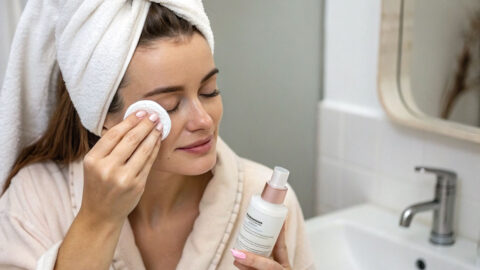
Soak a pad in an oil-based or dual-phase remover, hold it against the closed eye, wipe once, then cleanse with a water-based wash.
Waterproof formulas carry their pigment in a film of waxes and polymers, plus silicones such as dimethicone. Water slides over that film without dissolving it. Oil breaks it down.
The label won’t tell you how hard a product is to remove. In a 2022 IFSCC laboratory test of mild surfactant cleansers, a water-in-silicone foundation was the hardest base to remove, whatever the cleanser’s composition.
How Do You Remove Waterproof Makeup Step by Step?

Press an oil-based or dual-phase remover against the skin for 20 to 30 seconds, wipe away without rubbing, and finish with a water-based cleanser.
Eyes go first because mascara and liner take the longest. Lips and the rest of the face come after.
- Wash your hands and take out contact lenses.
- Soak a cotton pad in a remover labeled for waterproof formulas. A few drops will not do it, so wet the pad through.
- Close one eye and press the pad against the lashes and lid for 20 to 30 seconds.
- Wipe once, downward, from the base of the lashes to the tips. Switch to a clean section of the pad and repeat until it comes away clear.
- Run a remover-dipped cotton swab along the lash line and into the inner corner.
- Massage a balm or cleansing oil over dry lips and face, add warm water to emulsify, then rinse.
- Cleanse again with a water-based face wash and rinse the eyelids completely.
Beauty Crew’s removal guide puts the hold at 20 to 30 seconds with slight pressure. That contact time lets the remover loosen the film before any wiping starts, which is the part people skip.
The American Academy of Ophthalmology adds a couple of details. Brush a clean cotton swab along the base of the lashes for the last resistant debris, and rinse the remover itself off the lids so it doesn’t irritate.
Do all of it at a sink. FDA guidance on eye cosmetic safety warns against applying or removing eye makeup in a moving vehicle, where one bump can scratch the eyeball.
Rubbing is the habit to drop. In a 2021 Journal of Cosmetic Dermatology study of 35 women with mild atopic dermatitis symptoms on the face, switching to a cleansing oil that needed less rubbing force significantly decreased dryness, scaling, irritation, redness and itch over four weeks.
Lighter, non-waterproof formulas need less of this, and a general guide to removing everyday eye makeup covers them.
Why Water and Face Wash Do Not Lift Waterproof Makeup

Waterproof makeup holds its pigment in a water-repellent film. Water has nothing to grip, so it rinses over the top.
Waxes and film-forming polymers do most of the work. Carnauba and candelilla wax appear as optional plant-derived waxes in a Canadian Intellectual Property Office mascara-waterproofing patent (CA 2276031), while polyethylene polymers, PVP copolymers, ethylene vinyl acetate and acrylics dry into a continuous layer on the lash.
Silicones sit alongside them. Dimethicone, cyclopentasiloxane and resins such as trimethylsiloxysilicate are listed by suppliers in SpecialChem’s ingredient catalog for water-proof, long-lasting wear.
Oil dissolves that film because wax and silicone behave like oils. Micellar water takes another route, with surfactant molecules wrapping around makeup particles and carrying them off the skin.
A 2025 study from Sofia University (Slavova, Stanimirova, Marinova and Danov, published in Molecules) tested surfactant solutions on artificial skin. It found that sebum was removed mainly by emulsification, while dimethicone left by a roll-up mechanism in which the droplet’s contact area on the surface shrinks.
Not every waterproof formula is built the same way. A L’Oreal cosmetics patent (US 8,211,415 B2) describes waxes dispersed in non-aqueous solvents on one hand, and aqueous emulsions where film-forming polymer particles give the waterproof finish on the other.
Whichever base a formula uses, the remover has to be built for it. L’Oreal Paris notes that not every eye makeup remover is designed for waterproof makeup, so read the packaging before buying.
Oil Cleanser, Balm, Micellar Water, Dual-Phase Remover or Wipes: Which Works Best?

Oil cleansers, balms and dual-phase removers handle waterproof makeup best. Micellar water suits lighter wear, and wipes only start the job.
| Remover type | How it works | Best on | Example |
|---|---|---|---|
| Oil cleanser or balm | Oil dissolves wax and silicone films | Mascara, long-wear foundation, full face | Clinique Take The Day Off Cleansing Balm, DHC Deep Cleansing Oil |
| Dual-phase remover | Two layers, an oil or silicone phase and a water phase, shaken together | Waterproof eye makeup | Lancome Bi-Facil Double-Action Eye Makeup Remover |
| Micellar water | Surfactant micelles lift makeup and oil | Light to moderate waterproof wear | Garnier Micellar Cleansing Water All-in-1 Waterproof Makeup Remover |
| Oil-free eye remover | Oil-free two-phase formula, shaken before use | Eye area, oil-sensitive users | Neutrogena Oil-Free Eye Makeup Remover |
| Wipes | Pre-soaked cloth | A first pass on the go | L’Oreal Paris Ideal Clean All Skin Types Makeup Removing Towelettes |
Oil cleansers and balms melt heavy waterproof formulas with very little friction, and one product takes off eye, face and lip makeup. The catch is the water-based second cleanse they need afterward.
Dual-phase removers get a nod from makeup artist Kenneth Soh in Woman and Home, who says the oil and water phases together dissolve waterproof mascara faster. You have to shake the bottle before every use. Easy to forget.
Micellar water is gentle enough for sensitive skin. Heavier makeup can take several passes, though, and results depend a lot on the formula.
Wipes are fast and easy to keep by the bed. They may also leave makeup behind, and they can irritate if left on the skin.
Oily removers come with a documented cost. The background section of L’Oreal’s cosmetics patent US 8,211,415 B2 notes that oil- and solvent-based removers can sting, leave a veil over the eyes or leave a greasy film on the eyelids.
Sources also split on oil itself.
Dermatologist Mona Gohara, quoted in a Cosmopolitan piece syndicated by AOL, recommends oil-based removers or micellar water formulated for waterproof products, and says to skip harsh rubbing. Oil-free dual-phase removers such as Neutrogena’s Oil-Free Eye Makeup Remover, meanwhile, are marketed as able to remove even waterproof eye makeup.
Brand guides disagree on micellar water too. L’Oreal Paris says it removes even waterproof mascara and eyeliner, while Clarins says it can work depending on the mascara’s formula.
Balms such as Clinique’s Take The Day Off Cleansing Balm go onto dry skin first, and a walkthrough on using Clinique’s cleansing balm covers the massage and rinse.
For waterproof mascara and long-wear foundation, I’d start with an oil cleanser or a dual-phase remover and keep micellar water for lighter days.
Matching the Remover to the Product: Mascara, Eyeliner, Foundation, Lip Stain and Setting Spray
Mascara and liner need a soak-and-press with a dual-phase or oil remover. Foundation and setting spray need a balm or cleansing oil, and lip stain needs oil held against the lips first.
Waterproof Mascara and Eyeliner
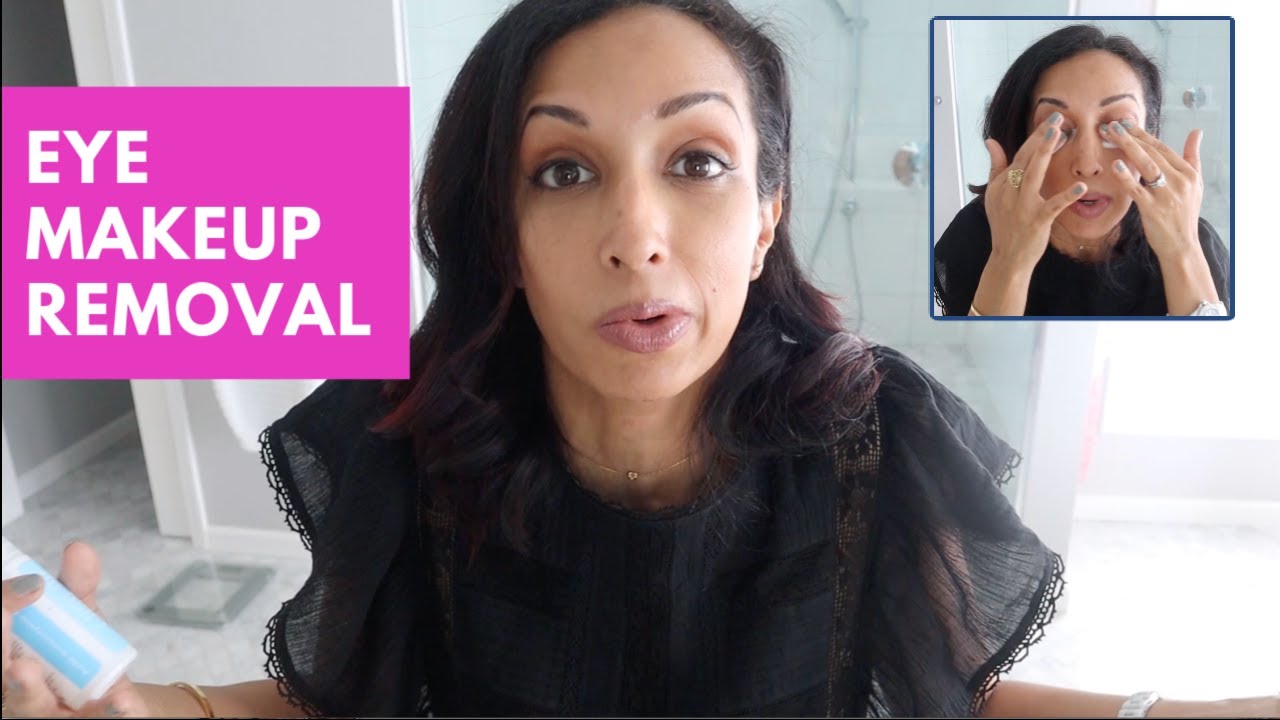
These two take the most patience.
Soak the pad with a dual-phase or oil remover, press with light pressure for 20 to 30 seconds, then make one downward wipe. A cotton swab takes care of the lash line and the inner corners.
Rubbing back and forth costs lashes. Beauty Crew’s guide calls for a tugless remover, and L’Oreal Paris warns that a quick swipe across the lashes may leave waterproof makeup behind.
Long-Wear Foundation and Setting Spray

In a 2022 in vitro study presented at the IFSCC congress, researchers tested mild surfactant cleansers on foundations, and the water-in-silicone foundation was the hardest to remove whatever the cleanser’s composition.
Long-wear bases often list cyclopentasiloxane and trimethylsiloxysilicate on the label. Mild-surfactant cleansers such as micellar water can struggle against them, so a balm or cleansing oil is the safer pick.
For foundation, massage the balm or oil over dry skin, emulsify with warm water, then rinse. Setting spray gets the same oil step, since it sits over the base.
Skipping the spray is the usual mistake. The layer a setting spray adds sits on top of the foundation, which is why one oil step covers both.
Lip Stain

Lip stain and long-wear liquid lipstick leave color that plain wiping does not clear.
Hold an oil-soaked pad on the lips for 20 to 30 seconds, then wipe and repeat until the pad stays clean. Some dual-phase eye removers are also labeled for lips, which saves you buying another product.
For long-wear liquid formulas, the removal steps for liquid lipstick go through the process in more detail.
A water-based cleanse afterward clears the oil off the lips.
Why Double Cleansing Follows Waterproof Makeup Removal
Oil dissolves the waterproof film but leaves an oily residue of its own, so a water-based cleanser follows to clear it. Oil goes first and the water-based cleanser second, never the other way round.
The first cleanse uses an oil or balm on dry skin, which breaks down makeup, sebum and sunscreen. The second uses a gentle, low-pH water-based cleanser to lift the emulsified residue and anything water-soluble.
Cleveland Clinic describes the split the same way. The oil step handles makeup and sunscreen, while water-based formulas, usually foaming ones, remove sweat and dirt.
The routine comes from Japanese and Korean skincare practices, according to The Everygirl.
Dermatologists disagree on who needs it.
Cleveland Clinic calls double cleansing usually unnecessary and offers micellar water before a water-based cleanser as an alternative. Jane Yoo, MD, takes the other side and says it earns its place for anyone in long-wear makeup or mineral sunscreen that a single water-based wash will not clear.
Both camps back the oil step for heavy or long-wear makeup. The argument is about everyone else.
Two failure modes are documented. Cleveland Clinic warns that an oil cleanser used alone can cause breakouts on acne-prone skin.
A dermatologist quoted by The Everygirl saw patients develop milia after a second cleanser that turned out not to be water-based. Check the label.
CeraVe pairs its Hydrating Foaming Oil Cleanser with its Hydrating Cream-to-Foam Cleanser for the second step. For a gentler routine it swaps the first step for micellar water, but on waterproof days the oil step stays.
Can Coconut Oil, Baby Oil or Petroleum Jelly Remove Waterproof Makeup?
Yes, as a fallback. AOL’s mascara-removal guide, built on dermatologist interviews, says natural oils such as coconut or olive oil work when no remover is on hand, though a product formulated for the job suits it better.
Coconut oil is already in most kitchens and dissolves film-forming makeup the way any oil does. It is also comedogenic, and raw coconut oil is the worst form for pores.
Jojoba oil is better tolerated by reactive skin, per Advanced Dermatology PC, but it still leaves a film that a second cleanse has to clear.
PureWow lists baby oil with jojoba oil and Vaseline as a cabinet option, though an expert it quotes warns these can irritate or feel too oily for some skin. Most baby oil is mineral oil, which makes it a poor fit for contact lens wearers and lash extension wearers.
Petroleum jelly works too. AOL’s guide says Vaseline can remove mascara and other makeup, and the same guide still rates a purpose-made remover as the better fit.
On the comedogenic scale, coconut oil rates 4 out of 5, according to Advanced Dermatology PC. Dermatologist Corey Hartman, quoted by PureWow, calls raw coconut oil the most comedogenic form of it.
Sources split on coconut oil for the eye area. AOL’s guide offers it as a stand-in, while Curology advises against it and recommends micellar water on a cotton pad or swab, followed by a water-based cleanser.
If you go the oil route, a few drops on a cotton pad handle the eyes. Follow with a water-based wash.
When even oil is missing, this guide to taking makeup off when you have no remover at all covers the other cabinet options.
When Standard Waterproof Makeup Removal Does Not Apply
The oil-first routine breaks down for people with lash extensions, for contact lens wearers, and for anyone with dry or reactive eyes. Each group needs a different swap, and the sources do not fully agree.
Lash Extensions
Oil loosens the extension adhesive, so every oil-based remover above is off the table. That rules out cleansing balms, cleansing oils, baby oil, coconut oil and waterproof mascara. What works is an oil-free cleanser made for lash extensions, used with no rubbing.
Cristina Monaco, of Schweiger Dermatology Group, told Makeup.com that an oil-based remover will make lashes slide right off. The same article calls waterproof products best avoided with extensions.
A dermatology column on eyelash extensions in MDedge Dermatology News lands in the same place. Oil weakens the bond between glue and lash, and regular eye rubbing speeds shedding.
Some lash studios also advise against micellar water, since micelles attract oils, so check with your lash artist before using it.
Contact Lenses
Lens-wearer guidance cuts against the advice earlier in this article. Contact Lens Spectrum’s February 2013 care column says not to use oil- or petroleum-based removers, names mineral oil and cocoa butter formulas as the ones to avoid, and says to skip oil-based or waterproof eye-area products because oils travel across the skin into the tear film.
Prevent Blindness adds in its 2010 eye cosmetics safety fact sheet that oily remover can leave a cloudy buildup on lenses. Sutter Health’s guidance favors water-soluble eye makeup because waterproof products build up on lenses.
So it’s a water-based, oil-free remover only. Most baby oil is mineral oil, so it falls in the same category. If residue sticks to a lens, rinse it with fresh solution, or replace the lens when it will not come off.
Dry or Reactive Eyes
The American Academy of Ophthalmology warns that flakes from glitter and metallic powders can get into the tear film and irritate the eye, and its tips for people with dry eyes include skipping flaking products. Mascara left half-removed on the lashes can flake the same way.
For allergy-prone eyes, the Academy advises introducing one new eye product at a time. Apply the same rule to a new remover, so a reaction has one suspect.
FDA says to stop using any eye cosmetic that causes irritation, and to avoid eye cosmetics until an infection or inflamed skin around the eye has healed.
What Happens When Waterproof Makeup Is Rubbed Off or Left On Overnight?

Rubbing strains the thin skin around the eye, and sleeping in eye makeup is something eye doctors advise against. The American Academy of Ophthalmology, as reported by HealthDay, says to remove all eye makeup before sleeping.
Dermatologist Kristina Goldenberg, MD, points out that the skin around the eye is sensitive and the thinnest on the body, which is why scrubbing it is a bad idea. Black residue in the inner corners when you wake up signals an incomplete removal.
The studies below link regular eye makeup use to changes in the oil glands along the lid margin and to a less stable tear film.
Two cross-sectional studies point the same direction. In a 2022 Saudi Journal of Ophthalmology study of 220 healthy women, eyeliner-only, mascara-only and combined users all showed significantly more meibomian gland loss than non-wearers (P = 0.01, 0.002 and 0.007), and the study covered waterproof mascara.
A 2019 Cornea study of 42 women measured tear breakup time of 3.0 seconds in regular eyeliner users against 5.8 seconds in controls. Both studies compare wearers with non-wearers, so neither separates wear from removal habits.
A 2018 case report in Ophthalmology describes a 50-year-old woman with more than 25 years of heavy mascara use and inadequate removal. Doctors found dark concretions under the conjunctiva, some breaking through the surface, and examination of the tissue indicated chronic inflammation.
It is an extreme case. ScienceAlert notes that removing mascara properly and replacing it about every three months should keep most people out of trouble.
One 2025 survey in Frontiers in Public Health runs against the standard advice. Of 1,741 valid responses from Jordanian women, 1,438 were eye makeup users, and 85% of those users reported at least one adverse reaction. Consistently removing eye makeup before sleep was associated with higher odds of a reaction (adjusted odds ratio 4.718, p = 0.003).
A cross-sectional self-report survey cannot show cause, and the result may reflect reverse causation or pre-existing sensitivity rather than removal itself. Read it as a reason to check technique, not to skip removal.
Waterproof Makeup Removal FAQ
Can regular makeup remover take off waterproof makeup?
Sometimes. A standard remover lifts regular mascara but can leave a waterproof film behind, so check that the label says it is formulated for waterproof makeup.
If it does not, hold the pad on the lashes longer and follow with a cleanser, or switch to an oil-based or dual-phase formula.
Do oil-based removers clog pores?

On some skin, yes, especially acne-prone skin when the oil cleanser is used alone. Cleveland Clinic ties that risk to skipping the second cleanse.
Pick a lightweight, non-comedogenic formula that emulsifies fully with water and rinses clean.
Does waterproof brow product come off the same way as mascara?
In most cases. L’Oreal Paris’s brow guide has you saturate a cotton pad with a remover made for waterproof products and massage it into the brows.
Hold the pad on the brow for 20 to 30 seconds, then wipe gently. No scrubbing.
Why do my eyes sting after removing waterproof makeup?
The remover is the usual cause. The background of a L’Oreal cosmetics patent (US 8,211,415 B2) notes that oil- and solvent-based removers can sting, and the American Academy of Ophthalmology says to rinse remover completely off the eyelids.
If stinging continues, switch to an eye-formulated or oil-free remover.
What should I do if remover gets in my eye?
Rinse the eye with clean water right away. Take out contact lenses if you wear them.
FDA advises stopping any eye cosmetic that causes irritation, so see an eye doctor if redness or pain lasts.
Making Tomorrow’s Waterproof Makeup Removal Easier
Waterproof makeup comes off with less effort when a coat of regular mascara goes on underneath, and waterproof formulas are kept for the days that need them. RevitaLash and PureWow both advise a regular-formula base under waterproof mascara.
Put the regular mascara base on first, then add the waterproof coat on the eyes only. Keep the remover and pads beside the bed.
The base cuts the work at night, the placement limits how much film needs dissolving, and the bedside setup removes the excuse to skip it. The cost is one extra coat each morning.
Everyday wear belongs to regular formulas, which bring back the smudging problem that drew people to waterproof mascara. This guide to keeping mascara from smudging under the eyes covers that trade.
As of October 2026, the evidence behind this guide comes from laboratory tests and expert guidance rather than a head-to-head clinical trial of removers on waterproof mascara. A controlled comparison would change which remover ranks first.

She started writing on the site after fielding the same questions from clients and friends often enough to just write the answers down: which red won't turn orange on a warm undertone, how to keep lipstick from feathering into fine lines, why a "12-hour" formula rarely survives dinner.
Every review on the site follows the same rule she uses with paying clients: wear it first, then decide if it's worth recommending.
- How to Make Eyeliner Last Longer Without Smudging - August 31, 2026
- How to Make Eyeshadow Last Longer All Day - August 29, 2026
- How to Find Your Undertone in 5 Easy Steps - August 27, 2026