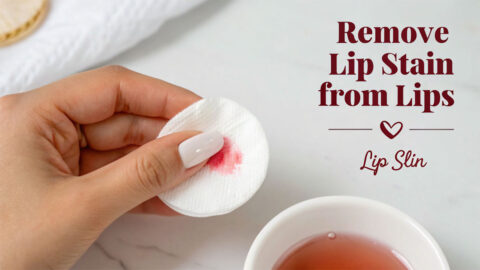
Lipstick usually wears off somewhere during a meal. A stain mostly doesn’t, because it dyes the outer layer of the lips with a thin water-based or gel formula, so the tint stays after the wet product dries down. Lipstick sits in a layer on top of the lips, while a stain soaks in.
The chemistry behind it is old news in laboratories. D&C Red No. 21, a color additive FDA permits in lip products, is principally tetrabromofluorescein (21 CFR 74.1321), an eosin dye. Its close relative, eosin Y, is what pathologists use to stain proteins in tissue slides, according to Cayman Chemical.
What Is Lip Stain?
L’Oreal associate principal chemist Roselin Rosario puts the difference plainly on makeup.com: a stain’s color is absorbed by the skin, while lipstick forms a layer over it.
That one distinction explains the sheer look and the long wear. It also explains why removal takes effort.
Shelves carry these products under a handful of names. Water stains and jelly stains have a watery or gel texture with translucent color. Lip markers or pens put a marker tip to work for easy, precise application. Peel-off stains are painted on like liquid lipstick, dried, then peeled away to leave a semi-transparent tint (Notino).
“Tint” causes most of the label confusion. Benefit sells Benetint as a rose-tinted lip and cheek stain, and e.l.f. sells a Glossy Lip Stain with built-in shine.
Dyes alone give no shine, Rosario notes, so a glossy stain is formulated differently from a classic one.
Judge a product by how its color behaves, not by the word on the box.
How Does Lip Stain Color the Lips?

The dye gets carried into the outermost layer of skin, the stratum corneum, and it stays there until those cells wear away.
Lipstick works the other way around. Its pigment sits in a layer on top of the lips.
How the Color Binds to Lip Skin
The lip vermilion has 3 to 5 cell layers, against about 16 in typical facial skin, according to a lip aging review on PubMed Central.
On a barrier that thin, dye sits close to the surface, and a dry flake changes how much color a spot takes up. e.l.f. makes the same point in its application guide: flaky skin gives a patchy, uneven result.
Removal follows the same logic. Rosario says the stain does not break down chemically, it leaves only when it is physically removed.
Put simply, lipstick leaves a layer to wipe off, and a stain leaves tinted skin.
Which Dyes Stain the Lips
Few dyes stain lips safely, which keeps stain shade ranges narrower than lipstick ranges. Pigments cover a wide spectrum of safe colors, Rosario explains, and dyes do not.
In the US, every cosmetic color additive needs FDA approval, and the D&C reds listed in 21 CFR Part 74 also need batch certification before they reach a shelf.
- D&C Red No. 21 is cleared for lipsticks and cosmetics generally, though not for the eye area (FDA permitted-color list). D&C Red No. 27 has the same status on that list.
- D&C Red No. 36 is allowed in lip products up to 3 percent total color by weight (21 CFR 74.2336, as revised April 1, 2026).
The contrast is useful. Red 21’s listing sets no percentage ceiling, only current good manufacturing practice, while Red 36 carries a hard cap.
The base is mostly water, so stain formulas need extra preservatives for shelf life, per Henne Organics.
One label trap worth knowing: a Colour Index (CI) number on an ingredient list does not signal FDA certification, FDA’s color additive fact sheet states.
Lip Stain Formats and Which Lips They Suit

Choose by lip condition first and by how much precision you want second. Liquid, gel, pen, balm stain and peel-off cover most of what’s sold.
| Format | Application | Best for | Trade-off |
|---|---|---|---|
| Liquid | Wand or brush, thin coat | Quick flush on lips and cheeks | Patchy on flaky lips |
| Gel or water stain | Jelly-like, translucent layer | Light, natural wash | Water-heavy base |
| Pen or marker | Tip draws color directly | Defined edges, ombre | Hard line unless blended |
| Balm stain | Balm base with stain color | Lips that run dry | Color strength varies by brand |
| Peel-off | Painted on, dried, peeled | Even, see-through tint | Extra peeling step |
Liquid stains are thinner and more watery than a liquid lipstick, so they read as a wash of color rather than a coat.
Benefit made a rose-petal tint its first product in 1976, according to the San Francisco Chronicle. Benetint is the lip and cheek stain that descends from it.
A balm stain pairs a balm base with stain color, so it feels closer to a tinted lip balm while still leaving some tint behind.
If I had to give a rule, dry or chapped lips should go with a balm stain. Pens suit defined edges or an ombre look. A liquid is the fast way to flush lips and cheeks, gel is the one to pick for a sheer wash you can layer, and peel-off gives an even, see-through tint.
How Is Lip Stain Different From Lip Tint, Lipstick and Lip Gloss?

Where the color ends up decides most of it. A stain goes into the lip skin, and tint, lipstick and gloss all stay on the surface, which is what sets coverage, finish and wear.
| Feature | Lip stain | Lip tint | Lipstick |
|---|---|---|---|
| Where color sits | In the outer skin | On the surface | On the surface |
| Coverage | Medium, fixed once dry | Sheer, buildable | Full |
| Finish | Usually matte | Natural, often dewy | Varies by formula |
| Hydration | Little | Often moisturizing | Varies by formula |
| Wear | Longest | Shortest, fades with oil and water | In between |
Descriptions follow the comparison guides from Henne Organics, Tatcha, Maybelline and Luxehouze.
The sources don’t fully agree on opacity. Henne Organics calls stains fairly opaque, holding more pigment than a tint. Tatcha describes a tint as buildable from a wash to opaque, and a stain as an unbudgeable hue, though it notes stain opacity varies by formula.
Both hold up for a first coat. A stain delivers more color in one pass, while a tint needs layers to catch up.
For the full tint-versus-lipstick split, see this guide on how lipstick stacks up against a lip tint.
There’s a quick way to tell what you’re wearing. Once the product dries, blot with a damp tissue. Color that lifts onto the tissue sits on the surface, and color that stays in the lips is stain.
Transfer-proof lipsticks that dry to a film can resist the blot, so treat the test as a guide, not a verdict.
Stains dry down matte, Henne Organics notes, so a clear lip gloss on top adds the shine the dye cannot. When layering, stain goes on first over clean, dry lips, tint or balm over it for moisture, and gloss last.
What Finish Does Lip Stain Give, and How Long Does It Last?
Expect a sheer to medium, natural-looking flush. Brands claim up to 12 hours of wear, and few of those claims point to a color-retention test.
Finish and Opacity
Glossy stains flip the usual order. Shine comes first and tint second.
Sephora Collection says its Totally Juicy formula glides on like gloss, then dries down to a stay-put tint, with sheer shades that deepen layer by layer.
YSL’s Vernis a Levres Water Stain follows the same logic, a glossy formula enriched with up to 40% water, according to YSL Beauty.
YSL’s own advice is one coat for a natural splash of color, then a second coat for more coverage and shine once the first has had 20 seconds to set.
Wear Time
Several mainstream products land on the same 12-hour number.
| Product | Wear claim | What backs it |
|---|---|---|
| JAFRA Always Long Lasting Liquid Lip Stain | Up to 12 hours | 93% of respondents agreed (independent test) |
| MAC Lustreglass Stainglass Lip Tint | Up to 12 hours | 30-panelist clinical test of shine, plumping, conditioning |
| Sephora Collection Totally Juicy Lip Tint | 12 hours | 11 volunteers, moisture measured at 12 hours |
Only JAFRA ties its figure to a wear question, and that is a self-reported agreement score. The MAC and Sephora Collection clinical figures measure shine, plumping, conditioning and moisture, not how long the color stays.
Two of the products above are sold as tints, so the 12-hour figure doesn’t separate stain from tint. I’d treat all of it with some skepticism.
Oil is also what dissolves stain pigment, so oily food and a heavy balm worn over the color are the likeliest causes of early fading. No published test puts a number on it.
How to Apply Lip Stain Without a Patchy Finish
Apply it in thin layers over smooth, prepped lips, and let each coat set before the next. Dried stain is hard to correct, so the sequence matters more than the product.
- Exfoliate with a soft scrub or a damp cloth, then rinse.
- Prep the base with a thin balm if lips feel tight, and blot dry before any color goes on.
- Outline along the lip line with a pointed tip or fine brush, then fill the center and brush outward (YSL’s method).
- Apply one thin coat and wait 20 seconds before adding a second.
- Blend the edge with a fingertip, sponge or brush for a diffused look, per Notino.
Sources differ on the balm step. Maybelline saves its balm-first advice for tints, and its stain guide goes straight from exfoliating to application, while Tatcha says to layer a stain over clean, dry lips.
The middle path is a thin balm, given a few minutes to sink in, then a blot.
If scrubbing feels rough on sore lips, a softer route is covered in this guide to exfoliating lips naturally.
For the whole routine from prep to topcoat in one place, see this walkthrough on using a lip stain day to day.
How to Remove Lip Stain
Start with an oil-based cleansing balm or oil, then follow with a water-based cleanser or micellar water for what is left. Cosmetic chemist Amanda Lam (Azelis), quoted by Milk Makeup, calls that double cleanse the best bet for long-lasting stain color.
L’Oreal’s chemist Roselin Rosario adds that liquid removers lift only the outermost layer and need rubbing, so a faint tint can survive the first pass.
Try these in order:
- Massage a cleansing balm or oil onto dry lips and give it 20 to 30 seconds before wiping (IBA Cosmetics).
- Go over the lips again with micellar water or a water-based cleanser to pick up leftover pigment and oil.
- Swipe on a lip balm, let it sit about a minute, and wipe off (Bustle).
- For stubborn patches, petroleum jelly left on for two to three minutes, then wiped with a cotton pad or paper towel (MasterClass, 2022).
No dedicated remover in the bag? Bustle suggests olive or baby oil on a cotton round, and this guide to removing makeup without a remover covers other stand-ins.
Finish with a plain, untinted lip balm, which is the last step in MasterClass’s removal routine too. MasterClass also notes that long-wearing liquid lipsticks and matte lip colors are hard to take off without the right remover.
When Lip Stain Is a Poor Fit
Chronically dry lips are the main problem, along with anyone who needs a deep, saturated shade. A history of reactions to lip cosmetics is reason enough to skip it entirely.
Dry or Flaky Lips
Lips lose water almost three times as fast as cheek skin, according to a study of 303 healthy Japanese women by Kobayashi and Tagami.
A dye stain adds no moisture to that deficit, so the lip care you do around it carries the comfort. This guide to lip care for dry lips covers the daily basics.
Cracked or bleeding lips should skip color until they heal. Tight, flaky ones do better with a balm stain or a moisturizing tint. If your lips feel fine and the day is long, a liquid or gel stain is a reasonable pick.
Needing a Deep or Specific Shade
Stain makes sense when the goal is a flush that looks like your own lips, or when you want color that survives a meal.
Lipstick is the better call when the shade is the point, like a dark berry or a full red, or when you need to wipe a mistake and redo it. Matching an outfit exactly is easier that way too.
A stain that has set is hard to take back, as the removal steps above show. Lipstick forgives.
Sensitivity and Reactions
Lipsticks and lip care products are the commonest cause of allergic contact cheilitis in women, according to DermNet NZ. The condition shows as swelling, scaling, soreness or small blisters.
DermNet NZ says eosin, the commonest lipstick allergen until 1960, is rarely a problem now because it is used less and purified more. Ricinoleic acid, the main constituent of castor oil, leads the current case series.
Older papers in the Journal of the Society of Cosmetic Chemists took a harder line, treating the halogenated eosin dyes of indelible lipsticks as established sensitizers, with positive patch tests appearing as late as 72 to 96 hours.
Both can hold. D&C Red No. 21 sits in the eosin family, and YSL’s ingredient list for its Water Glossy Lip Stain includes CI 45380 (Red 21) among its shade-dependent colors, so purification lowered the rate without removing the possibility.
Acute reactions can start within minutes, per DermNet NZ, and delayed ones take longer to show. Stop using the product if lips swell, scale or sting, and ask a dermatologist about patch testing.
Lip Stain FAQ
Can lip stain be used on the cheeks?
Yes, if the label allows it. Notino notes that a stain blends out with fingers, a sponge or a brush and works as a long-lasting blusher.
Dab a few dots and blend right away, because pigment sets fast on skin.
Is it possible to make lip stain at home?
Yes, with food-based colors. Vitacost’s DIY guide mixes strawberry, cherry or raspberry juice with a dab of beeswax or petroleum jelly, and blends beet powder into melted beeswax and sunflower oil. Expect a lighter, shorter-lasting tint than a commercial stain.
Keep the berry version in the fridge to stay fresh.
Does lip stain transfer to cups, clothes and masks?
Much less than lipstick once it has set. JAFRA markets its liquid stain as transfer-resistant, but wet color still marks rims and fabric.
Give each coat time to dry before eating or putting on a mask.
Is lip stain waterproof?
Largely, yes. Food, drink and sweat do not disturb dried stain color, per Notino.
Oil is the exception, since oil-based cleansers are what dissolve it.
Does lip stain expire?
Yes. Water-heavy stain formulas depend on extra preservatives for shelf life, Henne Organics explains.
Check the period-after-opening symbol on the pack, and discard the product if the smell or texture changes.
Trying Your First Lip Stain Safely
The lowest-risk first lip stain is a balm or gel formula, tested on a small patch of lip skin before a full application. A set stain cannot be corrected, and reactions can lag behind first contact, so the order matters.
- Dab one spot at the lip edge and watch it for 4 days.
- Wear one thin coat for a few hours, then build.
Starting gentle means accepting a lighter first result, which a second thin coat can deepen.
This advice reflects the FDA color additive list as verified in October 2026, which clears D&C Red No. 21 and No. 27 for lip products. A change to either listing would change which dyes to look for on the label.
Readers ready to buy can compare a roundup of the best lip stain options.

She started writing on the site after fielding the same questions from clients and friends often enough to just write the answers down: which red won't turn orange on a warm undertone, how to keep lipstick from feathering into fine lines, why a "12-hour" formula rarely survives dinner.
Every review on the site follows the same rule she uses with paying clients: wear it first, then decide if it's worth recommending.
- How to Make Eyeliner Last Longer Without Smudging - August 31, 2026
- How to Make Eyeshadow Last Longer All Day - August 29, 2026
- How to Find Your Undertone in 5 Easy Steps - August 27, 2026