A tube of lip gloss looks foolproof right up until it ends up on a chin, a collar, or smeared clean across a front tooth. Knowing how to apply lip gloss the right way is what keeps that from happening.
Lip gloss content pulled in 1.3 billion TikTok hashtag views in a single year, plus another 5.7 million on Instagram over that same stretch (StellarMR, 2023). None of that traffic makes the actual technique any more obvious.
Wand pressure, how the lips get prepped, and the order gloss goes on over whatever else is already there all shape whether the finish ends up glassy or sticky. Most of that gets decided before the wand ever touches skin.
What Is Lip Gloss

Oils, waxes such as beeswax or candelilla, and film-forming polymers form the base of most lip gloss formulas. They coat the lips in shine, usually with just a soft wash of color rather than the full pigment load lipstick carries.
The category is sized at $4.52 billion in 2025, with projections putting it at $7.17 billion by 2031. Tinted and colored formulas already hold 68.04% of that market (Mordor Intelligence, 2026).
Finish types vary more than people expect:
- High-shine, glass-like finish
- Sheer tint
- Shimmer
- Glitter-fleck
Formula behavior varies just as much as finish does. Some tubes lean hydrating, others add a tingling plump with menthol or capsaicin, a mechanism covered separately here.
Sephora, Ulta, and department store counters all carry dozens of these formulas side by side. L’Oréal, Coty, Revlon, Oriflame, and Chanel show up among the market’s top players, with Estée Lauder holding a significant share too. e.l.f. Beauty and other accessible-price brands drive most of the volume at the mass-market tier (Mordor Intelligence, 2026).
The product’s roots go back further than most people assume, long before influencer culture turned it into a daily staple. That history gets its own look in the origin story of lip gloss.
Lip Gloss Compared to Lip Oil and Lipstick
The three products overlap in purpose but differ sharply in pigment and feel. The gloss versus lipstick comparison breaks that distinction down in more detail.
| Product | Pigment Level | Primary Function | Typical Finish |
|---|---|---|---|
| Lip Gloss | Low to moderate | Shine, light tint | Glassy, sheer |
| Lipstick | High | Full color payoff | Matte, satin, cream |
| Lip Oil | Very low | Hydration, subtle sheen | Wet, non-tacky |
Lip oil sits closest to gloss on the shelf, which is exactly why the oil versus gloss breakdown exists. The two get confused constantly.
What Tools Are Used to Apply Lip Gloss
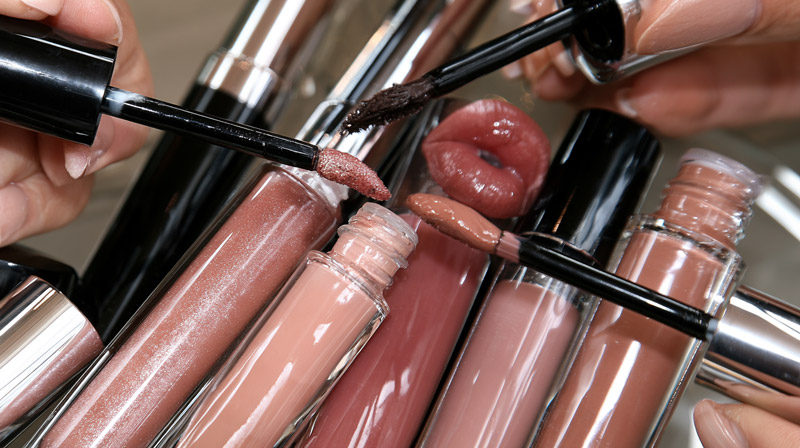
Most tubes come with their own doe-foot wand built in, though plenty of people reach for a separate lip brush, a bare fingertip, or, in older formulas, a sponge tip or squeeze-tube applicator instead.
The doe-foot wand shows up everywhere, from budget picks like NYX’s Butter Gloss up to premium options such as Fenty Beauty’s Gloss Bomb Oil. Fenty’s version pairs a paddle-shaped applicator with shea butter, vitamin E, passionfruit oil, and hyaluronic filling spheres, and the brand claims up to 8 hours of hydration from it (Fenty Beauty).
A lip brush trades speed for control. It works better along liner edges or on an uneven lip line, anywhere precision matters more than getting it done fast.
Fingertips come into play mostly with lip oils. Dior’s Lip Glow Oil is a good example. It relies on a pH-reactive colorant called eosin that shifts shade depending on each wearer’s own chemistry (Harper’s Bazaar Singapore, 2025).
Sponge tips and squeeze tubes are the older format, and they haven’t fully disappeared. MAC’s Lipglass still uses one.
Hygiene matters more than most people give it credit for. When Aston University researchers actually tested used cosmetics, lip gloss included, 79 to 90 percent carried bacterial contamination, according to a study published in the Journal of Applied Microbiology (2019).
Double-dipping the wand after it’s touched your lips is the main culprit. A tube’s warm, closed interior is basically an incubator between uses.
Wand Versus Brush Versus Finger
| Tool | Control Level | Best For |
|---|---|---|
| Doe-foot wand | Moderate | Quick, everyday application |
| Lip brush | High | Precise edges, uneven lips |
| Fingertip | Low | Sheer, blended lip oil looks |
How Do You Prep Lips Before Applying Gloss

Lips don’t have sebaceous or sweat glands. They can’t produce their own moisturizing oil the way facial skin does, and they lose surface moisture at a much faster rate because of it (Oral Health Group, 2021).
That’s a big part of why prep matters more here than it does for most other makeup categories.
Start with a light exfoliation. A lip scrub, or even a soft-bristle toothbrush worked in small circles, clears away the flaking skin that would otherwise show through a glassy finish.
Follow with a balm, applied a minute or two before the gloss goes on. Laneige’s Lip Sleeping Mask or a basic layer of Aquaphor both work fine, and either one needs a little time to actually sink in. Gloss applied over wet, unabsorbed balm tends to slide around rather than sit, so skipping that short wait isn’t really optional.
Thick, waxy balms are the one thing worth avoiding under a high-shine formula. They tend to cause pilling, those small rolled bits of product that ruin an otherwise smooth finish.
A full lip care routine covers the daily maintenance side of things in more depth.
How Do You Line Lips Before Applying Gloss

Liner is not always necessary under gloss, but it earns its place whenever a formula is sheer enough to let the natural lip edge show through.
For anyone unfamiliar with the basics, what lip liner actually is and how it differs from lipstick pigment is worth a quick read first.
Shade matters most. Pick a liner close to your natural lip tone, or match it to the gloss tint itself. Either way keeps the edge soft instead of obvious.
Formula matters too, maybe more than people expect. A matte, long-wear liner holds its boundary better under a slick topcoat than a creamy one, which tends to blur.
A slight build-up at the cupid’s bow and lower center, sometimes called overlining, adds fullness without looking obviously drawn on, as long as it’s kept subtle.
And for a bare, no-makeup gloss look, skip liner altogether. It’s optional, not required.
Picking the right shade and finish is its own decision, one the guide to choosing lip liner walks through.
The technique itself, cupid’s bow to corner, traces back further than the modern beauty aisle. That history gets covered in the lip liner origin piece.
How Do You Apply Lip Gloss Step by Step

The technique itself is short. Six steps, done in under a minute once it becomes routine.
- Load a small amount onto the wand or brush, and wipe off any excess against the tube’s opening.
- Start at the center of the top lip, right at the cupid’s bow.
- Drag outward toward the corners in one smooth motion, not a bunch of short strokes.
- Repeat on the bottom lip, working from center to corners again.
- Press the lips together lightly to spread the product evenly. Don’t rub or wipe.
- Blot once with a tissue, but only if the formula feels heavy or sticky.
Most formulas need less product than people assume. Overloading the wand is the single most common reason gloss ends up patchy instead of even.
One smooth motion beats several short ones, since choppy strokes are what create streaky, uneven coverage in the first place.
How Do You Apply Lip Gloss Over Lipstick
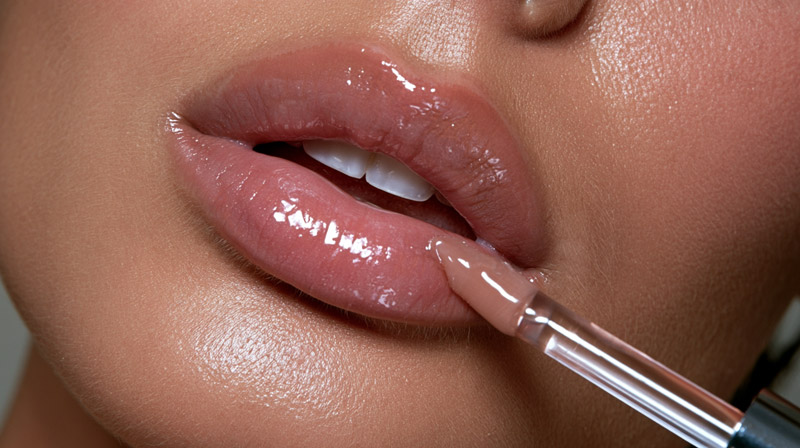
Lipstick goes on first, then gets a single blot with a tissue to set the color before gloss touches it.
Whichever type of lipstick sits underneath changes the result. Matte bases hold gloss differently than cream or satin formulas, which are already slicker to begin with.
Load gloss at the center only rather than edge to edge. Full coverage on top of full pigment tends to muddy the shade instead of sharpening it.
A clear or tone-matched gloss works best here. One with its own strong pigment ends up fighting the lipstick underneath instead of complementing it.
Touch-ups need their own order too. Blot the gloss off completely before adding fresh lipstick, rather than layering more gloss on top of whatever’s already there.
Fenty Beauty says as much directly in its own guidance for Gloss Bomb: wear it alone, or use it as the last step over lipstick in a full lip look (Fenty Beauty).
The full layering process, sheer bases, opaque bases, and everything between, gets a dedicated walkthrough in the piece on applying gloss over lipstick.
How Does Lip Gloss Application Differ by Lip Shape
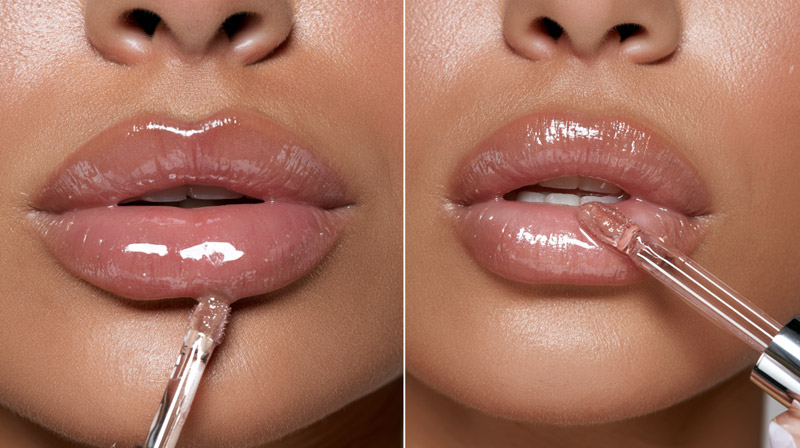
The same formula reads differently depending on lip size and shape, so the technique has to adjust with it.
Thinner lips look fuller when gloss concentrates at the center. Light reflects off the built-up product there and creates the illusion of volume. Product picks for this exact concern are covered in ideas for thin lips.
Fuller lips do better with even, edge-to-edge coverage instead. Center-loading here tends to exaggerate volume rather than flatter it.
Asymmetrical lips usually need liner correction first, then slightly uneven wand pressure to balance the two sides out.
Downturned corners benefit from a light upward drag at the outer edges, rather than one straight horizontal line across.
| Lip Shape | Technique | Effect |
|---|---|---|
| Thin | Center-load gloss | Adds visual volume |
| Full | Edge-to-edge coverage | Keeps proportion balanced |
| Asymmetrical | Liner correction, uneven pressure | Evens out both sides |
| Downturned corners | Upward drag at edges | Lifts the mouth’s outer line |
What Mistakes Cause Lip Gloss to Apply Unevenly

Most uneven application comes down to habit, not a bad formula. The table below breaks down the usual suspects.
| Mistake | Why It Happens | Fix |
|---|---|---|
| Overloading the wand | Too much product pools instead of spreading | Wipe excess against the tube opening first |
| Skipping prep | Dry, flaking skin breaks up the shine | Exfoliate and hydrate before applying |
| Applying over flaking skin | Product catches on rough patches | Buff gently, then wait for balm to absorb |
| Wand too wide for the lips | Excess product spreads past the lip line | Switch to a lip brush on smaller lips |
A dedicated breakdown of fixing patchy makeup covers the same root causes across other product categories, not just gloss.
Fixing Gloss That Clumps in Lip Lines
Clumping happens when gloss settles into fine lines instead of sitting flat, usually because the base underneath was not hydrated first.
- Exfoliate gently before reapplying, instead of layering more product over the clump
- Let balm fully absorb, a full minute at least, before adding another layer of gloss
- Switch to a thinner formula on days when lips already feel tight or dry
The same friction between dry skin and product shows up as pilling in other makeup categories, and gentler prep options are covered in the guide to exfoliating lips naturally.
How Long Does Lip Gloss Last After Application

Wear time runs 2 to 4 hours before reapplication becomes necessary, with formula thickness driving most of that range, according to the full breakdown on lip gloss wear time.
Eating removes 60 to 80 percent of product almost immediately. Humid climates cut wear duration by roughly 30 percent on top of that.
| Formula Type | Average Wear Time | Why |
|---|---|---|
| Thick balm gloss | 3 to 4 hours | Wax adheres better to the lip surface |
| Thin liquid gloss | 2 to 3 hours | Oils absorb into lip tissue faster |
| Applied over liner | Extended | Liner creates a barrier against absorption |
bareMinerals’ Dewy Lip Gloss-Balm claims 8 hours of continuous shine, based on a clinical test of 34 people, well above the category average.
That kind of gap usually comes down to film-forming polymers versus a straight oil-and-wax base. Not marketing exaggeration, just different chemistry.
How Do You Reapply or Touch Up Lip Gloss During the Day
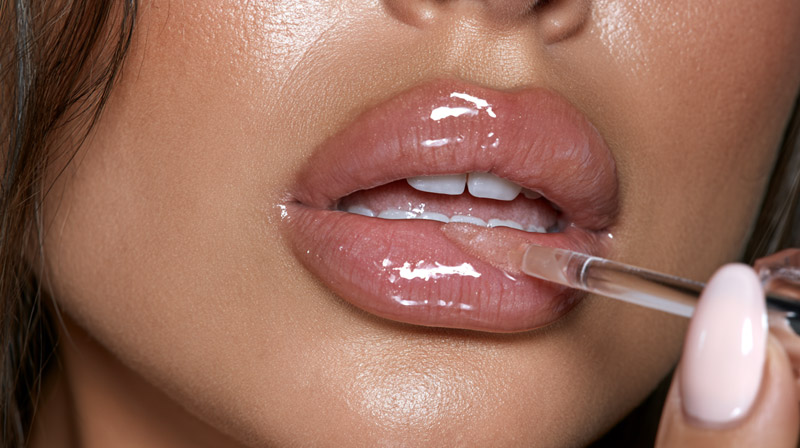
A touch-up is not a fresh application. Treat it as one and the lips end up carrying more product than the formula was built to hold.
Blot first. Press a tissue against the existing layer before adding anything new, rather than applying straight over what’s already there.
A travel-size tube is worth carrying if there’s room for it. Most brands package one specifically for this, and it fits a pocket or small bag without much thought.
Skip the full second coat. Layering fresh gloss over a textured, half-worn layer is what causes clumping, not the reapplication itself.
Tools are worth switching out mid-day too. Once a wand has picked up lint or debris from a bag, a lip brush gives a cleaner touch-up than the original applicator did.
Each habit matters more as the day goes on, since product buildup compounds with every pass.
When To Avoid Applying Lip Gloss

Chapped lips and known sensitivities are the two clearest reasons to skip gloss entirely, not just apply it more carefully.
In one controlled study of dry, hot-weather exposure, moderate to severe chapping affected roughly a third of subjects, steep enough to change how skin handles any occlusive product layered on top (Shulman et al., Military Medicine, 1997).
Carmine, a common red-tint pigment, is behind a meaningful share of cosmetic allergy cases. Personal care products accounted for 77.1 percent of clinically relevant carmine reactions in one contact dermatitis analysis, with lip products making up 8.6 percent of those sources (North American Contact Dermatitis Group data).
| Situation | Why To Skip | What To Do Instead |
|---|---|---|
| Chapped or peeling lips | Occlusive ingredients trap irritation underneath | Treat with plain balm, see care for dry lips |
| Known ingredient sensitivity | Carmine, synthetic fragrance, certain plant oils can trigger reactions | Check the label, patch test if unsure |
| High wind or humidity | Product migrates off the intended line | Wait for calmer conditions or use a liner barrier |
| Right before oily or heavily seasoned food | The meal strips the product anyway | Reapply after eating instead |
Old, past-expiration tubes belong on this list too. The shelf life guidance on lip gloss covers how to tell when a formula has turned.
How Do You Remove Lip Gloss Without Irritating Lips
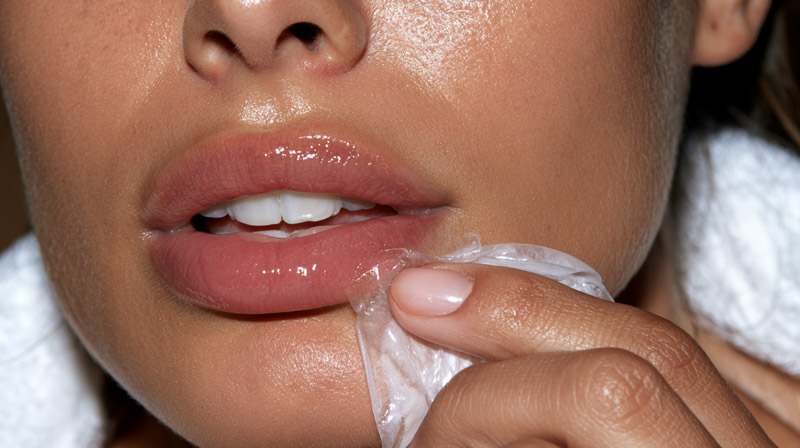
Rough removal undoes any benefit gained from careful prep earlier in the process.
Oil or balm works well as a first pass. Massaging in something plain breaks down the wax and polymer base without needing a dedicated remover at all, a method covered in more depth in the guide on removing makeup without makeup remover.
Micellar water is the better call for lighter formulas. A cotton pad soaked in it works fine on sheer or non-tinted gloss, no oil step needed first.
CeraVe’s Hydrating Micellar Water, formulated with ceramides and niacinamide, is one option built specifically to support the skin barrier during that kind of removal.
Skip the rough wiping, though. Dragging a cotton pad or tissue across the lips strips skin right along with the product, and that’s usually what leads to next-day chapping.
Stain gets handled separately from shine. A tinted gloss can leave color behind even after the shine is long gone, and that residual tint needs its own pass, similar to the extra step required to fully remove matte lipstick.
FAQ on How To Apply Lip Gloss
Does Lip Gloss Actually Make Lips Look Bigger
Gloss doesn’t add actual volume. It reflects light off raised, wet-looking product, and that’s what creates the illusion of fullness when it’s applied at the center of the lip rather than edge to edge. Separate trick entirely from the tingle you get with menthol or capsaicin plumping formulas.
How Much Lip Gloss Should You Use Per Application
One light swipe per lip is usually plenty, wiped once against the tube opening before it ever touches skin. More product doesn’t mean more shine. It just raises the odds of pooling in the corners or ending up on teeth and glasses.
Should You Apply Lip Gloss Before or After the Rest of Your Makeup
Gloss goes on last: after foundation, eye makeup, and any lipstick or liner underneath. Apply it earlier and it risks smudging onto brushes or your face, plus it picks up powder or setting spray residue pretty easily.
Do You Need a Lip Primer Before Gloss
Primer is optional here, unlike with foundation. A hydrating balm does more of the actual work, since gloss needs a smooth, moisturized base rather than a grip layer. Skip it unless the gloss is going over long-wear lipstick.
How Do You Know When Lip Gloss Has Expired
A separated oily layer, a change in scent, or a texture that’s gone thinner than usual are the clearest signs. Most formulas last 12 to 24 months unopened and 4 to 9 months once opened, less for natural or oil-heavy versions.
Does Application Change for Shimmer or Glitter Gloss
Shimmer and glitter formulas need lighter pressure and less product per swipe, since built-up glitter clumps more visibly than a plain gloss does. Tapping the wand instead of dragging it distributes the shimmer particles evenly rather than streaking them across the lip.
How Do You Keep Lip Gloss From Feathering Into Fine Lines
Feathering happens when a thin, low-viscosity gloss travels past the natural lip border into the surrounding skin. A matte lip liner creates a barrier that stops it, and thicker formulas migrate less than watery, high-shine ones to begin with.
Is Applying Lip Oil Different From Applying Lip Gloss
Lip oil goes on with lighter coverage, usually by finger or a small doe-foot tip, since the goal is a wet sheen rather than a built-up glassy layer. It absorbs faster too, so touch-ups happen more often than they do with standard gloss.
Can You Apply Lip Gloss With Braces
Yes, though thinner, less sticky formulas work better since heavy gloss can catch on brackets and wires. Applying slightly inside the natural lip line, rather than right to the edge, cuts down on contact between gloss and hardware while eating or talking.
Does Cold Weather Change How Lip Gloss Applies
Cold air dries lips out faster, so gloss grips less evenly and settles into any cracked or flaking skin. Thicker balm-based formulas hold up better than thin, watery glosses in low temperatures, and prep matters more once winter hits.
Conclusion
Most guides on how to apply lip gloss treat technique and prep as separate steps. They are not.
Prep decides more of the outcome than the wand or brush ever will. Clumping, feathering, and shine that fades by lunch usually trace back to one unmoisturized base.
A hydrating balm, given a full minute to absorb before the wand reaches the cupid’s bow, prevents most of what later gets blamed on technique.
If time is short, skip the extra swipe of color for more balm instead. That trade beats any fix made after the fact.
No wand, brush, or finger application fixes lips that were dry going in. Get the base right, and layering, touch-ups, and wear time all improve.

She started writing on the site after fielding the same questions from clients and friends often enough to just write the answers down: which red won't turn orange on a warm undertone, how to keep lipstick from feathering into fine lines, why a "12-hour" formula rarely survives dinner.
Every review on the site follows the same rule she uses with paying clients: wear it first, then decide if it's worth recommending.
- How to Make Eyeliner Last Longer Without Smudging - August 31, 2026
- How to Make Eyeshadow Last Longer All Day - August 29, 2026
- How to Find Your Undertone in 5 Easy Steps - August 27, 2026