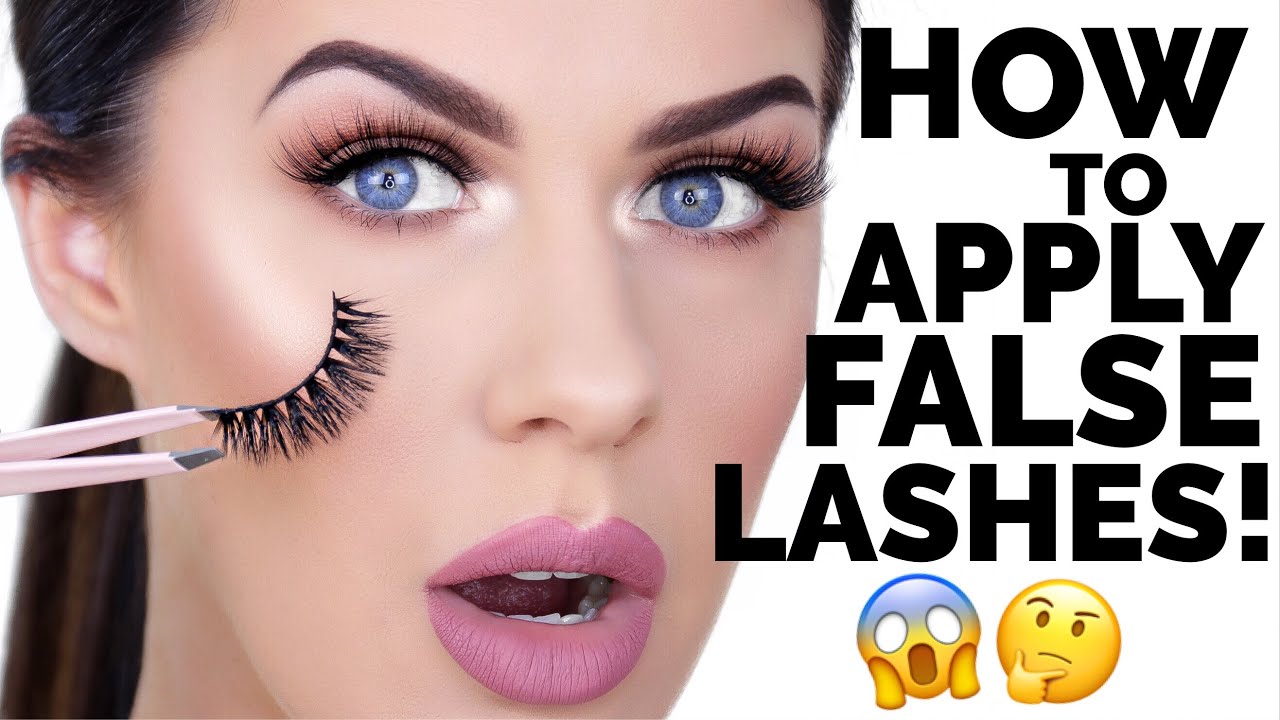
Strip lashes go on in a fixed order. Trim the band to fit, spread a thin line of glue along its base, give the glue time to turn tacky, then press the band onto the natural lash line from the center outward.
Cluster and individual lashes attach differently, and magnetic ones skip glue entirely, but the placement rule stays the same. Get as close to the lash base as you can.
The adhesive decides how long a pair can last. As of October 2026, Kiss rates its strip lash adhesives for a secure hold of up to 24 hours. The pair still comes off before sleep, in line with the American Academy of Ophthalmology’s advice to remove all eye makeup at night.
What Tools and Lash Glue Do You Need?

Grab tweezers, an eyelash curler, small scissors, a toothpick for spreading glue and a mirror set below eye level. The adhesive is the one item worth real thought, since it has to suit your lash band.
Ardell’s directions call for small scissors and a toothpick, and Lashify points out that looking down into the mirror makes placement easier.
Wash your hands and clean the tools before anything else. The FDA lists washing your hands before applying eye cosmetics as a basic infection control step.
Clear glue goes on white and dries clear, so it hides a seam on light or colored bands. Dark glue dries dark and doubles as a thin eyeline under black bands. DUO sells both.
If you react to natural rubber latex, latex-free is the only option, so read the ingredient list before you buy.
Formulas differ even inside one brand. As of the listings reviewed in October 2026, DUO’s original Striplash Adhesive is latex-based, while its Quick-Set clear version is listed as latex and formaldehyde free.
The tube in your hand matters more than the brand name.
DUO states that its strip adhesives are formulated for lash bands only, and that putting them directly on the eyelids can cause eye and skin irritation.
Latex and acrylate bases behave differently on the lash line, and a breakdown of what goes into lash glue makes a label easier to read.
On timing, DUO’s directions have you wait 30 seconds for the glue to become tacky, and Ardell LashGrip says to wait about 30 seconds for it to set. On the safety side, the FDA received 30 reports of allergic reactions between January 2015 and September 2017 involving cosmetics that typically contain natural rubber latex, eyelash adhesives among them.
The FDA treats false eyelashes and their adhesives as cosmetics, so an ingredient list has to be on the label. Natural rubber latex can appear there under names such as latex, rubber latex or natural latex.
How to Measure and Trim the Lash Band

Lay the unglued band along your lash line and cut the band, never the hair tips.
DUO and Ardell both direct you to trim the outer end of the band when it runs past your lash line, using small scissors.
Tutorials look split on this. The Fashion Spot warns against trimming because snipped lashes end up short and blunt, while The Zoe Report cuts the strip evenly from both ends for a custom fit.
The gap is smaller than it looks. The warning is about cutting the hairs, and the manufacturers only shorten the band.
Shape matters too. House of Lashes and Glossybox both suggest bending the band into a U, or rolling it around a pencil for a minute, so the outer corner does not flick up. If placement keeps failing, Eylure makeup artist Sara Sordillo suggests cutting the strip into thirds and placing each piece (Woman & Home).
Do all the cutting before any glue touches the band.
Curler, Mascara and Eyeliner Order Before the Lashes Go On
Curl first, then finish the rest of your eye makeup. Mascara is the awkward one, because the tutorials disagree on when it goes.
Curling matches your natural lashes to the curve of the band, so both sets lift together. The pad rests against your lid, which is why a walkthrough on sanitizing an eyelash curler belongs in the routine.
MasterClass and The Fashion Spot add mascara only after the strip is on (MasterClass reverses this for individual lashes). Woman & Home, quoting Eylure’s makeup artist, and Glossybox, with Kiss Lashes, coat first, and Glossybox says that supports the weight of the band. Superdrug does both, curling and coating first, then adding a second layer afterward for volume.
A workable rule: one thin coat at the roots before the band goes on, then a light pass afterward only to blend the join. Keeping that first coat thin is easier with solid mascara application technique.
Mascara in this routine should be under 3 months old. The American Academy of Ophthalmology advises discarding eye makeup after 3 months because bacteria grow in creamy and liquid products.
Liner has a fixed place. The Zoe Report traces black liquid liner just above the lash line as a placement guide, and The Fashion Spot lines over the base of the band afterward to hide excess glue.
Keep liner on the outside of the lash line. Dr. Gayle Howard of Sharp Community Medical Group warns that makeup applied inside the lash line can clog the glands along the lid edge.
How to Put On Strip Lashes, Step by Step

Clean the lash line, fit the band, glue it, wait for the glue to turn tacky, then press the band down from the center outward.
- Curl your lashes and finish eye makeup, leaving the lash line clean and oil free (Ardell).
- Check the fit and trim the outer end of the band.
- Run a thin line of glue along the band, with a small extra dot at each end, where lifting starts.
- Wait for the glue to turn tacky, which is 30 seconds on a DUO or Ardell label.
- Hold the band with tweezers, look down into the mirror and set the center first, as close to the lash line as possible.
- Press the outer corner, then the inner corner.
- Press along the whole band for 20 to 30 seconds, then blend with liner and mascara.
Wait time is where tutorials drift most. The Fashion Spot gives about 10 seconds, Glossybox a couple of seconds, House of Lashes 30 seconds to a minute, and DUO and Ardell both print 30 seconds.
Go with the label on your tube. Glue that is still wet lets the band slide around, and the longer waits exist to prevent exactly that.
Placing the Band on the Lash Line
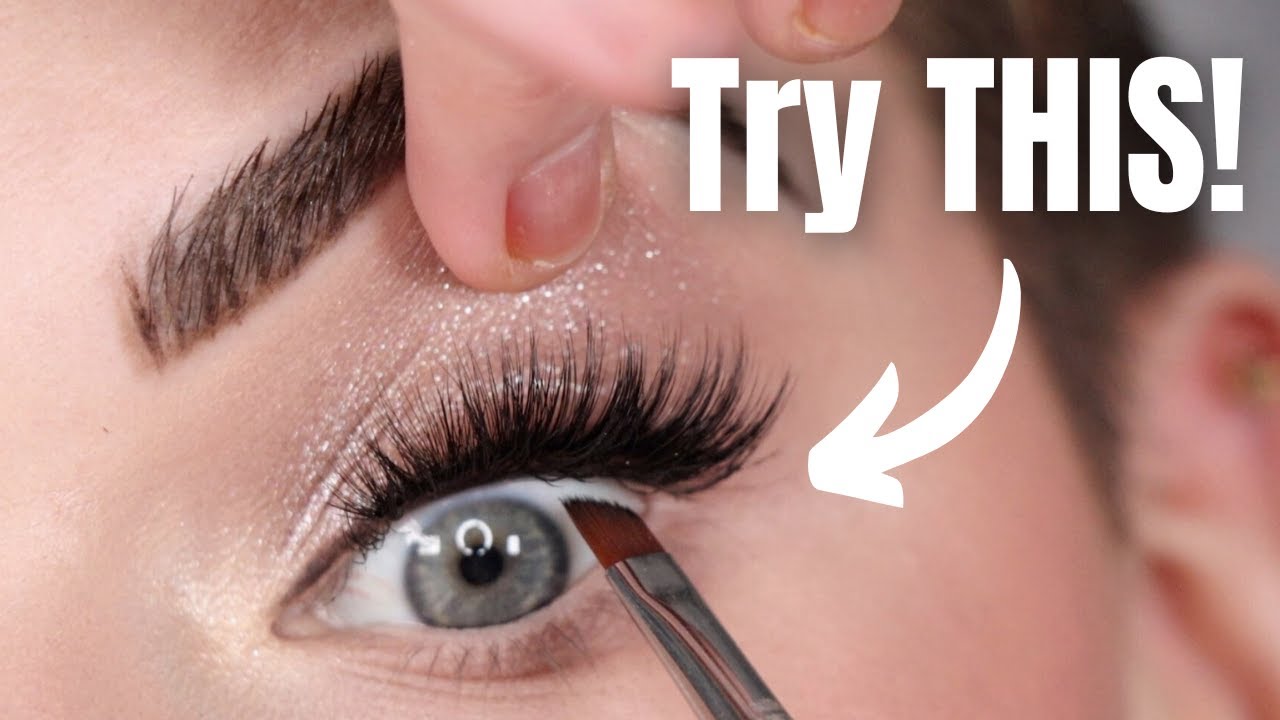
Aim close to the base and keep it outside the waterline.
House of Lashes anchors the center first, then does the outer corner and the inner corner in turn. The Zoe Report starts at the outer corner instead. Woman & Home adds extra glue at the ends because that is where bands start to lift.
Center first gives you an anchor to adjust from either side. Give the ends the longest press.
Tweezers or Fingers

Tweezers let you grip the band without touching wet glue, and they place with more precision, so you can nudge the edges flat.
DUO lists a fingertip as an option for the placement press, and Ardell uses one to press along the whole band. In my view a finger is better for the final seating than for first placement.
Blending the Join With Your Own Lashes

Liquid liner over the base of the band hides any glue that shows, and a light coat of mascara fuses the false lashes to your natural ones. Give the glue about 5 minutes before lining over it, as The Fashion Spot advises.
A thin, steady stroke works best, and the basics of applying eyeliner carry over directly.
Applying Cluster, Individual and Magnetic Lashes
Cluster and individual lashes go on one piece at a time with tweezers, while magnetic lashes need no glue and no tweezers.
| Lash type | Attaches with | Tool | Hardest part |
|---|---|---|---|
| Strip | Adhesive on the band | Tweezers or fingertip | Placing close to the lash line without gaps |
| Cluster | Bond or glue at the root | Tweezers or applicator wand | Spacing pieces evenly |
| Individual | Glue on the knotted end | Tweezers | Handling single hairs |
| Magnetic | Magnetic liner or paired magnets | Fingers | Letting each liner coat dry |
Cluster and Individual Lashes
Lashify’s Gossamer lashes are clusters on a thin spine that attach to the underside of your natural lashes. The company tells users to place them 1 to 2 mm from the waterline, with nothing touching the skin.
Keep clusters off the waterline itself, since they will not adhere there and cause discomfort (Lashify). For individual lashes, pick up each one with tweezers, dip the knotted end and let it go tacky (Woman & Home).
Mascara goes on before individual lashes to prevent clumping (MasterClass), and the inner-corner cluster goes on last because the angle is awkward (Lashify).
Spacing is the fiddly part. When brick stacking, leave about half a spine’s length between clusters on the base layer, then stack the second layer over the gaps (Lashify).
Magnetic Lashes
Magnetic lashes come in two builds. Some clip onto magnetic liner, and others are double-layer pairs that grip your own lashes between two magnetic bands, according to Women’s Health South Africa.
For the liner type, Eylure’s ProMagnetic directions call for 3 coats along the upper lash line, each one dry before the next. You then lay the lash on as close to the lash line as possible.
Magnets stick to metal tweezers, so Eylure’s makeup artist advises placing magnetic lashes by hand (Woman & Home). Remove them from the outer corner and clear the liner with an oil-based cleanser.
Safety is a split verdict. Retail copy for Eylure’s liner calls it safe, while Dr. Gayle Howard of Sharp Community Medical Group lists magnetic-particle liners and lash glues among eye makeup choices that can cause irritation, infection and allergic reactions.
Both positions stand. The label and your own lid reaction decide.
Adjusting Application for Hooded Eyes, Small Eyes and Curly Lashes

Eye shape decides where the lash length should sit, and natural curl decides how easily the band lands.
For hooded lids, makeup artist Amy Conway recommends wispy lashes that are short at the inner corner, with the length through the center or outer edge. Makeup artist Shreni Patel prefers a half lash at the outer corner of a hooded lid for an open, elongated look (Makeup.com, 2023). She adds that individual lashes suit hooded eyes too, though they take longer to apply.
Hooded lids also reverse the usual mirror advice. Conway recommends working while looking straight ahead, so you judge the band as it will sit with your eye open.
The rest of the look follows its own rules, which makeup for hooded eyes covers in detail.
Small eyes get the same weighting toward the outer corner, with a short inner end. For small eyes, Vogue Singapore’s makeup artists amplify lashes at the outer corners to give an enlarging effect, and the short inner end keeps the band from crowding the inner corner.
Shadow and liner placement shift for smaller lids as well, and eye makeup for small eyes walks through it.
Curly natural lashes are the opposite problem. Clear mascara straightens them temporarily so the band can sit flush (KIKO Milano). Straight natural lashes are the easy case for placement and the hard case for curl, according to KIKO Milano.
Fixing Lifting Corners, Visible Glue and Other Problems
Lashes that lift or slip after a few hours usually fail because of oil on the lid, heat, or a gap at the lash line. The brand of glue is rarely the cause.
Women’s Health South Africa reports that oil-based removers and products weaken lash adhesive, heat softens it, and water-based makeup is gentler on the bond than waterproof makeup.
| Symptom | Likely cause | Fix |
|---|---|---|
| Lashes lift hours later | Oil on the lid, or heat softening the bond | Keep oil-based cleanser and eye cream off the lid before application |
| White streaks along the band | Clear glue goes on white and dries clear (DUO) | Let it finish drying, then line over the base |
| Gap of skin under the band | Band sits above the natural lashes | Squeeze the band down into the lash base with tweezers (Glossybox) |
| Clumped lash hairs | Mascara layered over the glue line | Separate with a clean spoolie, never a sharp tool |
The American Academy of Ophthalmology advises against separating clumped lashes with sharp items, which is the one fix in the table that carries an injury risk.
A thin coat and a clean wand prevent most clumps, and a guide to fixing clumpy mascara covers the rest.
Removing, Cleaning and Reusing False Lashes

Loosen the glue first, then peel from the outer corner.
DUO’s directions have you peel the band off the lid starting at the outer corner, then pick residual adhesive off the band. Makeup remover or baby oil clears what stays on the eyelid.
For strip lashes, DUO’s method is makeup remover or baby oil followed by a slow peel. Individual and cluster lashes need a dedicated adhesive remover, because Ardell warns against pulling them off once the adhesive has set. Any residue left on the lid can come off with baby shampoo, which Dr. Gayle Howard of Sharp Community Medical Group calls a very gentle eye makeup remover.
Once the lashes are off, clear the rest of your mascara and liner too. The AAO says to remove all eye makeup before sleep, and a walkthrough on removing eye makeup covers the steps.
Cleaning the pair is a short routine.
- Peel residual glue off the band with clean hands.
- Wipe the band with micellar water or eye makeup remover (skip remover on mink, which can lose its shape and curl, per L’Oreal Paris).
- Comb out mascara with a spoolie or cotton swab dampened with micellar water (Makeup.com).
- Air dry, disinfect, and store in a clean case so dust stays off the fibers.
Wash the spoolie too, or it carries old mascara onto the next pair. Here is how to clean a spoolie brush.
| Source | Wears claimed | Condition |
|---|---|---|
| Kiss | Up to 10 | Most strip lashes, with proper care |
| L’Oreal Paris | Synthetic up to 5, mink or silk up to 20 | Depends on fiber |
| Makeup.com stylist (2023) | Up to 15 cleaned, 2 to 3 reused as-is | Depends on cleaning |
Claims run from 2 to 20 wears, and the three sources split on different variables: brand, fiber and cleaning. Retire a pair when it can no longer be cleaned or no longer looks right, since the Makeup.com stylist ties disposal to hygiene and appearance.
When False Lashes Are Not a Good Idea
Skip false lashes during an eye infection, inflamed eyelids, a past reaction to lash glue, and recovery from eye surgery.
- With an eye infection or inflamed lid skin, the FDA advises avoiding eye cosmetics and discarding the ones you were using when the infection started.
- With blepharitis, Mayo Clinic Care Network content suggests stopping eye makeup while the lids are inflamed, and notes the condition can itself cause lash loss.
- After eye surgery, wear no makeup around the eye until your ophthalmologist clears it, then use fresh products only (American Academy of Ophthalmology).
- If you had a past glue reaction, any redness, swelling or itching after application means stop and contact a healthcare provider (FDA).
Two published cases show what a bad outcome looks like. A Korean report in Annals of Dermatology (2014) traced bilateral eyelid contact dermatitis and toxic conjunctivitis to an acrylate-containing false eyelash glue.
A second case, in The PMFA Journal, described a painful, inflamed eyelid 24 hours after application. The clinicians pointed to a thermal burn from cyanoacrylate setting, with a negative patch test and no inflammation at the lash base.
Taken together, the cases show that a patch test screens for allergy, not for a burn, so a clean patch test does not clear every glue.
Both reports involve acrylate-type glues, and neither measures how often strip lash adhesive causes these injuries.
The American Academy of Ophthalmology’s warnings about corneal and eyelid infection, allergic reaction and lash loss concern eyelash extensions, not strip lashes. Its advice for any eye product still applies: see an ophthalmologist right away after an infection, an allergic reaction or irritation.
Applying False Eyelashes FAQ
Are false eyelashes the same as eyelash extensions?

No. False eyelashes are removable strips, clusters or magnetic sets that come off the same day.
Eyelash extensions go on one fiber at a time with semi-permanent glue, applied by a technician, according to the American Academy of Ophthalmology.
Can I wear contact lenses with false eyelashes?
Yes. Put your lenses in first, with clean hands, so you do not tug the lashes afterward.
The UK College of Optometrists (2019) cautions that false lash glue can cause irritation, inflammation and allergic reactions, and says it sees more complications in people who also wear contact lenses. See an optometrist if irritation starts.
Can false lashes go on without glue?
Yes, in two ways. Magnetic lashes clip onto magnetic liner or pair up around your own lashes, and pre-glued press-on clusters, such as the 42-cluster tray from Sophie’s Lashes, carry their adhesive on the band.
Pre-glued sets still need a patch test, per the same product listing.
Is it safe to sleep in false eyelashes?
No. Sleeping in them bends and wears out the pair, and it can hurt your eyes, according to Pinky Goat.
Take them off at night with the rest of your eye makeup.
How long can false eyelashes stay on in one day?
The adhesive outlasts the day, so comfort and hygiene set the limit. As of October 2026, none of the FDA, AAO or optometry sources reviewed names a maximum wear time.
Wear them for the event, then remove them.
Do false lashes damage natural lashes?
Not when removal is gentle. Kiss and Pinky Goat both state that correct application and removal cause no damage.
The risk comes from pulling. The AAO’s guidance on lash extensions notes that rubbing, tugging or pulling can fracture natural lashes and even cause permanent damage to the follicle, so loosen the glue before peeling.
What to Do the Day Before Your First Pair
Applying false eyelashes for the first time goes best with a little prep the day before. Patch test the glue, then dry fit the band and trim it before any glue touches it.
The order follows the clock. A patch test goes first because a reaction needs hours to show, while a dry fit and trim take minutes and use no glue, so they cost the pair no wears.
As of October 2026, one listing reviewed, Sophie’s Lashes, prints a patch protocol: a snipped piece of band worn behind the ear or on the forearm for a few hours.
The cost is lead time. The test cannot wait for the morning of the event.

She started writing on the site after fielding the same questions from clients and friends often enough to just write the answers down: which red won't turn orange on a warm undertone, how to keep lipstick from feathering into fine lines, why a "12-hour" formula rarely survives dinner.
Every review on the site follows the same rule she uses with paying clients: wear it first, then decide if it's worth recommending.
- How to Make Eyeliner Last Longer Without Smudging - August 31, 2026
- How to Make Eyeshadow Last Longer All Day - August 29, 2026
- How to Find Your Undertone in 5 Easy Steps - August 27, 2026