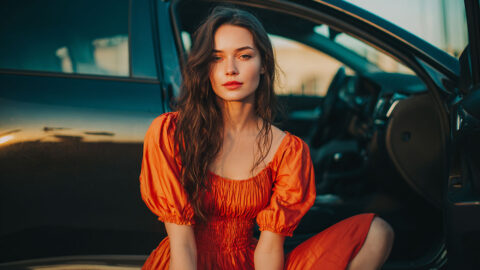
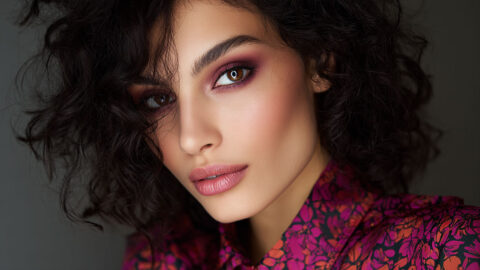
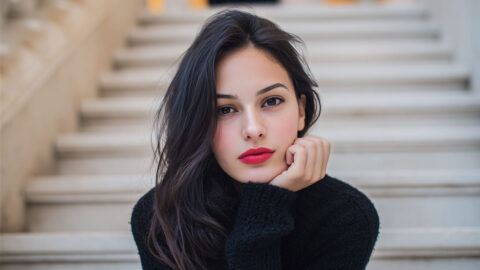
A base can look perfect in the bathroom mirror and come out gray in the first flash photo. Usually the sunscreen or the powder is to blame, and a phone flash test (a photo with the flash on, taken before the first frame) shows it before the photographer does.
Headshots, bridal sessions, and outdoor portraits all run on the same routine. Coverage and intensity are what change.
The pale cast that flash exposes is called flashback, and zinc oxide and titanium dioxide are most often behind it. A 2025 peer-reviewed study found that higher zinc oxide concentrations produced unacceptable white cast.
How to Prep Skin Before Photoshoot Makeup

Cleanse first, exfoliate lightly, then moisturize and apply primer. Give the skincare layers a minute to settle before any color goes on, because makeup applied over wet product drags and streaks.
Exfoliate the night before, lips included, so skin is calm by shoot time. Dry skin pulls foundation into flakes. Oily skin still needs moisturizer, just a light gel one. Primer follows the same split, mattifying for oily skin and hydrating for dry. A hydrating mist such as MAC Prep + Prime Fix+ finishes prep before the base goes on.
Press primer into the T-zone first and work outward, the way a standard makeup primer routine does it.
Dry and oily skin need different prep products, and a full guide to prepping skin before makeup covers the split.
Where SPF fits in the routine
Sunscreen goes on before primer and needs time to absorb.
The FDA tells people to apply sunscreen 15 minutes before sun exposure and to reapply at least every two hours (FDA sunscreen guidance).
On an outdoor shoot longer than two hours, that means topping up SPF over finished makeup. So the filters in the base matter before the first brush touches skin.
How Do You Match Foundation Shade and Undertone for Photos?

Check the shade along the jawline and neck in natural light, and settle the undertone (cool, warm, or neutral) before worrying about depth. A shade that runs too light causes more trouble on camera than one slightly deep, since a pale foundation is a named trigger for flashback (Blavity).
Where to test the shade
Swipe a stripe at the jawline and another on the neck, plus one on the upper chest if the outfit shows it. Judge them in daylight once they dry, not under bathroom bulbs.
Face and neck have to read as one skin tone, and the chest too, because photos often crop wide enough to show all of it.
If undertone is the sticking point, a walkthrough on matching makeup to your skin tone covers it step by step.
Do skin tone scales help?
Fitzpatrick’s 1988 paper in Archives of Dermatology presented the six-type sun-reactive scale (types I to VI), extending the four-type scale he first proposed in 1975. Types are ranked by how skin burns and tans, so it measures UV response and says nothing about undertone.
Google’s Monk Skin Tone Scale (2022) offers 10 shades, and Reuters reported that a significant share of about 3,000 US survey respondents said a 10-point scale matched their skin as well as a 40-shade palette.
Estee Lauder’s Color Capture shows how fine matching can get. A spectrophotometer reads skin tone and recommends from dozens of Double Wear shades.
Scales give a makeup artist shared vocabulary. None of them replaces a swatch.
Match exactly or go slightly darker?
An exact match reads natural in daylight and in photos without flash.
Blavity goes the other way and recommends a foundation a touch darker than your natural tone to calm brightness under direct flash. Test both on the neck and keep whichever one shows no pale edge in a flash test.
Concealer follows the same rule, since L’Oreal Paris lists a concealer that is too light as a flashback contributor. Swatch it like the foundation, and a concealer buying guide helps narrow formulas.
Which Coverage and Finish Work for Each Type of Photoshoot?

Medium coverage with a satin finish is the safest default, and the shoot type pushes it lighter, fuller, or more matte.
| Shoot type | Coverage | Finish | Intensity |
|---|---|---|---|
| Corporate headshot | Light to medium | Satin | Low to medium |
| Bridal | Medium to full | Satin to matte, long wear | Medium |
| Outdoor daylight | Light to medium | Satin | Low |
| Maternity or family | Light | Natural glow | Low |
| Studio flash or editorial | Medium to full | Matte | High |
Treat the table as a starting point. The test shot decides.
Building coverage

Light coverage means a tinted moisturizer or skin tint with spot concealer only. Medium is foundation in thin layers, with concealer under the eyes and around the nose.
For scars, tattoos, or redness that has to disappear on camera, full-coverage formulas such as Dermablend do the job. Airbrush systems such as Temptu spray a fine mist, which suits long shoots and close-ups, though they cost more and take some practice.
Build in thin layers instead of one heavy coat, the principle behind layering makeup in the right order.
A damp Beautyblender sponge keeps each layer thin, and applying makeup with a sponge comes down to pressing, not wiping.
Matte
Matte finishes absorb shine and survive heat and strobes.
L’Oreal Paris recommends matte foundation for flash photography for that reason, since light does not bounce off it the way it does off an ultra-dewy complexion.
The downside is that dry or mature skin can look flat, and texture shows.
Satin
Satin looks like skin instead of product, and it forgives mixed skin, which is why it’s the default for headshots and daylight.
It sits between the other two finishes, with enough glow to look alive and little enough to keep shine under control.
Dewy
Dewy works on dry skin in soft light, as long as the shoot is short.
It falls apart once the shoot runs long or the room gets hot, and strobes aimed straight at the face make it worse.
What Causes Flashback and How Do You Prevent It?
Zinc oxide and titanium dioxide are the usual culprits behind the pale or gray cast that shows up on skin in flash photos. Both have a high refractive index (Amorepacific, 2020), so they reflect light straight back to the lens.
Ingredients behind flashback
Both are mineral SPF filters that scatter light, which is the usual source of a white cast under strobes. Blavity ranks loose setting powder among the biggest offenders. A concealer that runs too light adds to the cast too, per L’Oreal Paris.
Concentration drives the effect. A 2025 peer-reviewed study found that higher zinc oxide concentrations produced unacceptable white cast in both in vivo and in vitro scoring.
Put that next to the FDA’s two-hour reapplication guidance and the pattern is clear: every extra SPF layer over makeup raises the filter load. On a long outdoor shoot, count layers, not products.
Sources split on SPF in the base itself. L’Oreal Paris advises skipping SPF-containing makeup for evening flash photography, while an older Beautylish editorial piece says chemical filters absorb light instead of reflecting it.
Both hold up, because the cast tracks mineral filter content, not the letters SPF on the label.
What to use instead
Read the label first. US sunscreens are regulated as drugs (FDA), so a product with SPF lists its actives in the Drug Facts box, and zinc oxide or titanium dioxide will show up there if it’s in the formula.
A tinted moisturizer is one way around it. Laura Mercier markets its Tinted Moisturizer Natural Dewy SPF 30 and Tinted Moisturizer Blurred Matte SPF 30 as giving SPF without flashback (Laura Mercier).
Setting mist helps as well. Makeup artist Wayne Goss, as summarized by Skindinavia, says a mist such as MAC Fix+ or Jane Iredale Pomm takes away most of the flashback. L’Oreal Paris adds that a light layer of setting spray diffuses excess product.
Outdoor shoots raise the problem because SPF must go back on over a finished face. A walkthrough on topping up sunscreen over makeup shows how to do it without lifting the base.
If translucent powder stays in the kit, confine it to shine zones and use a light-handed translucent powder method.
The flash test
- Finish makeup and set it exactly as planned for the shoot.
- Switch on the phone’s rear camera with the flash on and the room lights off (Blavity).
- Repeat under direct overhead light and in front-camera mode.
- Zoom to full size and check under-eyes, nose, forehead, and jawline for gray or pale patches.
- Fix any patch with a light mist of setting spray or a deeper concealer, then shoot again.
A phone flash is far weaker than a studio strobe, so a clean result lowers the risk without removing it. Shoot one test frame with the photographer’s actual light before the real session.
How Does Lighting Change the Way Makeup Looks on Camera?

Camera light mutes color and shifts shade, so makeup needs checking under the application light and again under the shoot light. Improve Photography’s guide advises exaggerating the look even when the goal is subtle, because the camera never captures makeup at its real-life vibrancy.
Which light should you apply makeup under?
Natural window light is the best place to apply. If the makeup holds up there, it holds up under nearly any other source (Improve Photography).
Warm vanity bulbs flatter skin and hide the flaws you need to see, so skip them. When daylight is not available, an adjustable-temperature LED makeup light is the next best thing.
Color Rendering Index (CRI) matters here. The CIE’s CRI rates how faithfully a source shows color on a scale to 100, and a low-CRI bulb shifts the shades you think you are applying.
How each shoot light behaves
- Strobe light is brief and hard, and the likeliest source of flashback.
- A softbox diffuses light and softens shadows, which is forgiving on texture and powder.
- Ring lights give even frontal light that fills shadows, so contour reads weaker and needs more definition.
- Tungsten hot lights pull foundation toward yellow and heat the set, which brings shine.
- Natural outdoor light shifts with the hour and cloud cover, so test at the actual shoot time.
Color temperature in Kelvin
BetterPhoto rates electronic flash at about 5,500 K and tungsten at about 3,200 K. Photographer Adrian Bacon notes that strobes usually run at 5,500 K or higher and sometimes past 6,500 K, depending on the unit and power setting.
Lower Kelvin numbers mean warmer, redder light, and higher numbers mean cooler, bluer light. That gap is why a shade matched under a warm bulb reads differently on a strobe set, so match under neutral light first and confirm under the shoot light.
How Strong Should Contour, Brows, Eyes and Lips Be for Photos?
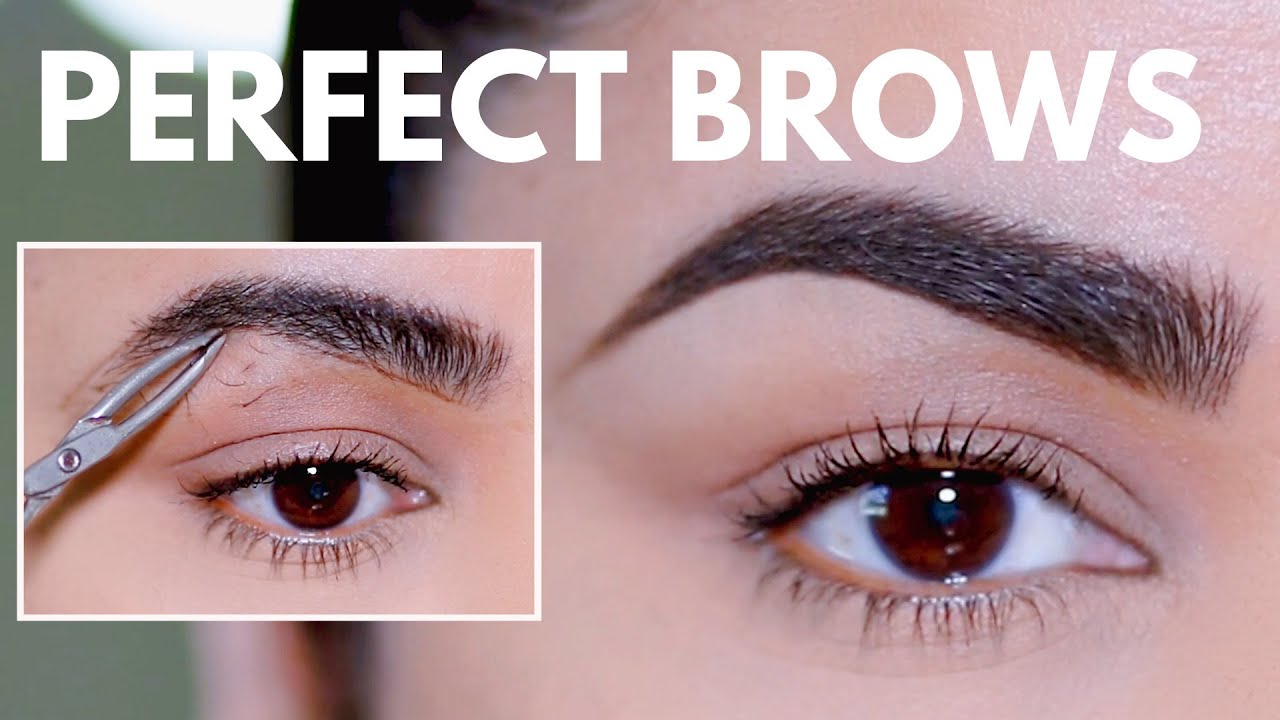
Contour gets deeper, brows get filled, eyes stay matte, and lips go one notch darker. Soft edges matter more than strength, because a hard line reads as a mask in a sharp frame.
Contour and highlight

Use a cool, matte shade under the cheekbone and along the jaw, blended until no edge remains. Cream formulas blend out cleanly, and a cream contour walkthrough shows the placement.
Highlight stays small, a satin sheen on the cheekbone tops and the center of the nose. Skip chunky glitter.
Brows and eyes

Keep brows soft and add definition with a soft pencil or tinted gel, since hard, sculpted lines look severe (InstaHeadshots).
Eyeshadow should be matte neutrals with no shimmer, because reflective finishes bounce studio light unpredictably (Profile Bakery). Curl lashes first to open the eye, then add mascara (a makeup artist quoted by the Une Femme blog). Liner can be tightlining or a slim wing, kept subtle.
False lashes are a judgment call. The makeup artist quoted by Une Femme recommends individual lashes with a light coat of mascara so false and natural lashes meld, and headshot photographer 4the1image says that if you wear false lashes, you should pick a style that complements your eyes without overpowering them.
A workable rule: individual lashes for tight portraits, none for wide frames.
Lips
Go one notch darker than usual. Profile Bakery’s headshot guide gives the reason: digital cameras lighten color.
Gloss is the contested choice. InstaHeadshots advises a matte or satin finish because gloss creates glare.
Line the lips first to hold the shape, following a lip liner application guide. Keep the line close to the natural edge, since overlining looks unnatural (InstaHeadshots).
How Do You Set Photoshoot Makeup So It Lasts?
Powder goes only on the zones that shine, and a setting spray goes over the whole face last. Label claims put wear time between 12 and 24 hours, but those numbers come from brand-run tests, not from a day under studio lights.
Setting powder
Use powder on the T-zone and chin, plus under the eyes, and leave the cheeks alone. Choosing one comes down to tint and undertone, and a setting powder buying guide covers the range.
Ben Nye Banana Powder is yellow-tinted, so it brightens the under-eyes and counters redness. Makeup.com’s 2023 guide steers cool or pink undertones to translucent, lavender, or blush-tinted powders instead.
RCMA’s No-Color Powder skips pigment altogether and is built for professional kits. RCMA calls it invisible on all skin tones, while the retailer MakeupMania says the loose version turns ashy on medium-dark or darker skin.
For baking, press a heavy layer under the eyes for 5 to 10 minutes, then dust it off (Maybelline India).
Baking cuts against the flash test, since heavy powder is what that test exists to catch. Bake only on flash-free shoots, or test the result first.
RCMA’s own listings show one more reason to test. They disagree on Translucent Powder: the set page lists titanium dioxide and mica, while the standalone product page lists only talc, silica, and iron oxides. Its loose No Color Powder lists only talc and silica.
Setting spray
Retailer listings for Urban Decay All Nighter disagree. Nordstrom and Macy’s cite a 7-day study of 50 people in which 78% said it helped their makeup last 16 hours, while Sephora now cites up to 24-hour wear from a consumer study of 102 participants.
Other brands print different headline numbers. Sephora Collection cites 12 hours from a clinical study of 33 people after 28 days of use for its Glow Makeup Setting Spray, and Benefit cites 24 hours from an instrumental test on 30 participants for its POREfessional Super Setter.
Different products and test designs mean the figures do not compare directly. Read them as relative claims, not guarantees.
Directions vary a little on distance. Morphe says to hold the bottle 8 to 10 inches from the face, Benefit says about 8 inches, and Urban Decay’s Sephora listing says 6 to 8 inches. Close your eyes and follow the standard setting spray method.
Powder or spray?
Powder absorbs oil and keeps under-eye concealer from creasing, but layers build into visible texture.
Spray melds layers without adding any. Its claims depend on the brand and formula, though, and none were tested on a shoot.
Use both, powder where oil shows and spray over everything.
What Belongs in a Photoshoot Touch-Up Kit?

Pressed powder, blotting papers, concealer, the exact lip color, and a small mirror cover most shoots. Improve Photography names concealer, powder, lip color, and gloss as the minimum to keep within reach.
Core items
- Pressed powder
- Blotting papers
- Concealer in the base shade
- Lip color and a lip pencil
- A hand mirror
IATSE Local 849’s makeup department kit list marks blotting sheets, anti-shine powder, lip pencils, lip balm, and a hand mirror among its starred minimum items.
Pack it the way you would pack for a trip, using a makeup travel packing guide, so nothing cracks or leaks into the rest of the bag.
Pressed or loose powder?
Sources lean different ways. FD Photo Studio’s model checklist recommends translucent loose powder over pressed to prevent greasy shine, while Beautylish kit guides describe pressed powder as easier to carry and mess-free.
Pressed wins for touch-ups. RCMA’s pressed No-Color Powder comes in a mirrored compact and, per RCMA, does not shift foundation color however many times it goes back on.
Add by shoot type
Long studio sessions call for extra blotting papers, because posing and movement bring sweat.
Bold lips need the exact shade, plus a matching liner. Outdoors, add an SPF lip balm, since lip color wears off first.
Blotting papers lift oil without adding product. A poster on the TalkPhotography forum points out that this avoids the uneven buildup repeated powdering causes.
When to touch up
Touch up at every outfit change and every lighting change, and check shine between setups.
If the foundation has gone patchy at the nose or chin, press it out with a clean sponge instead of adding more product, as in a guide to fixing patchy makeup.
When Does Standard Photoshoot Makeup Advice Not Apply?
The usual rules break down on close-ups from HD and 4K cameras, on heavily retouched shoots, during long outdoor shoots in heat, and with skin that reacts to new products. Each one calls for a different adjustment.
Close-ups on HD and 4K cameras
Graftobian puts 4K at about four times the resolution of standard HD, so every pore and every layer of product shows.
Kryolan staged HD-versus-4K test sets with a film crew. Its team found that texture was a major issue: fine powders that were invisible on HD looked like grains of sand on 4K. The brand responded with mattifying, self-setting foundations and an ultra-fine setting powder.
That sits against Improve Photography’s advice to push the look. Both hold once color and volume are separated. Raise color intensity, cut the number of layers.
Heavily retouched shoots
Retouching handles blemishes and uneven tone on the face, using tools such as frequency separation in Adobe Photoshop, which splits an image into tone and texture layers.
It struggles elsewhere. Adobe’s known-issues page (last updated May 2023) lists the neck, shoulders, and skin behind glasses as places the Skin Smoothing Neural Filter can fail.
So the face-to-neck shade match still matters on a retouched shoot, because software does not cover for it.
Long outdoor shoots in heat
- Dewy bases slide first, so switch to satin or matte
- Blot before reaching for powder, which builds into uneven layers
- Schedule touch-ups around lighting changes, not the clock
Skin that reacts to new products
Do not debut a product on shoot day. Healthline’s summary of American Academy of Dermatology guidance recommends patch testing a new product first, and Medical News Today notes a skin allergy can take days to appear.
Sensitive skin also narrows ingredient choices, and a guide to makeup for sensitive skin covers that ground.
Photoshoot Makeup FAQ
Should you hire a makeup artist or do your own makeup?
Not always. Flytographer’s guide says a professional is not required to be photo-ready, while headshot photographer 4the1image advises most people to hire one, preferably someone with headshot experience.
Hire for high-stakes shoots such as acting headshots, executive portraits, and bridal sessions. Do it yourself for casual sessions, with a practice run first.
How much does a makeup artist cost for a photoshoot?
No standard price exists. Rates vary with the artist’s experience, location, and the length of the shoot.
Ask for written quotes and confirm whether the fee covers a trial and on-set touch-ups.
Is airbrush makeup worth it for a photoshoot?
Yes, for long shoots and close-ups on high-resolution cameras, where a fine mist keeps the base thin. For most sessions, a damp sponge and thin layers give a comparable result at a fraction of the cost.
Does makeup for black and white photos need to be different?
Slightly. Color disappears, so tonal contrast carries the look.
Choose lip, eye, and blush shades by how light or dark they are, not by hue, and keep contour and brows defined.
Why do a makeup trial before the shoot?
A trial exposes problems while they are still cheap to fix: a shade that turns ashy, a product that irritates, a lip color that fades.
Do it at least a week ahead, in the planned light, and shoot test frames with and without flash.
What to Do First When the Shoot Is Tomorrow
With one day left, start with the base and run the flash test first, because a pale cast appears in every frame of a flash session.
- Flash test the planned base
- Match shade at the neck in daylight
- Pack a pressed-powder touch-up kit
That order puts the least recoverable error first, since a wrong base shows in every frame while eye and lip definition can be adjusted on set.
It means a plainer eye and lip, and that’s a fair price at this deadline.
Position verified October 2026. Bases using bemotrizinol, a sunscreen active FDA added in a June 2026 final order, belong in the same flash test as any other SPF product.
Waterproof setting sprays hold through the shoot and need a plan afterward, covered in removing waterproof makeup.

She started writing on the site after fielding the same questions from clients and friends often enough to just write the answers down: which red won't turn orange on a warm undertone, how to keep lipstick from feathering into fine lines, why a "12-hour" formula rarely survives dinner.
Every review on the site follows the same rule she uses with paying clients: wear it first, then decide if it's worth recommending.
- How to Make Eyeliner Last Longer Without Smudging - August 31, 2026
- How to Make Eyeshadow Last Longer All Day - August 29, 2026
- How to Find Your Undertone in 5 Easy Steps - August 27, 2026