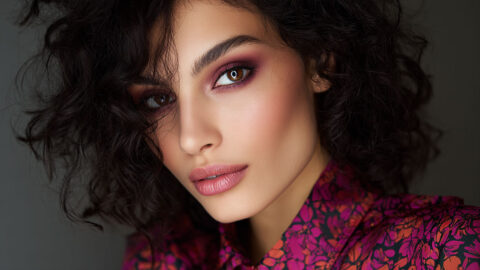
Natural-looking makeup mostly comes down to keeping every layer thin. A light base goes only where tone needs evening, and the edges get blended until no line is left. Color comes from cream products on the cheeks and lips, right where they flush on their own anyway.
A 2011 PLOS ONE study led by Nancy Etcoff rated the same 25 women’s faces bare and in three makeup looks. Viewers with unlimited time scored the natural look above the bare face for attractiveness, competence, likability and trust.
The glamorous look in that study scored lower on trust than the bare face, though. So the amount of product changes how a face is read, natural makeup included.
What Makes Makeup Look Natural?

Low coverage, mostly. The skin tone gets evened out, and the eyes, brows, cheeks and lips get defined with sheer, blended layers, so your skin texture and your own features still show.
It does not mean wearing nothing. Bobbi Brown told Prevention that teaching artists to look makeup-free often takes a fair amount of product, placed with care.
The amount in the bag is not the test. If a person notices your foundation before they notice your face, the layer is too heavy.
What keeps a look from tipping into overdone is mostly placement and texture:
- Product goes only where it is needed. Beautylish makeup artist Billy B advises starting in the center of the face and leaving clear areas bare.
- Cream and liquid beat heavy powder, since The Body Shop’s guidance is that a sheen reads closer to real skin than a flat matte.
- Edges get blended, with no line at the jaw, the hairline or under the eyes.
- Blush sits where your cheeks color up on their own, and tint sits where your lips do.
Coverage is what you control. Keep it sheer to light and build in thin layers instead of one thick pass.
These rules hold across the whole range of natural-looking makeup styles, from a skin tint and mascara to a full routine.
The Natural Makeup Routine in Order

Cream products go on first and powder goes on last. That order matters more than any single product you pick up. If you only do a few things, make them the base where it’s needed, blush and mascara.
- Start with skin prep, meaning moisturizer and then sunscreen. Never skip it.
- Base comes next, either a tinted moisturizer or a skin tint, placed only where tone needs evening. On clear, even skin you can leave it out.
- Concealer goes on spots and the inner under-eye. If the base already covers what bothers you, skip this one.
- Cream or liquid blush goes on the apples of the cheeks. Keep this step.
- Brush the brows up and fill any gaps lightly. Full brows can skip the filling.
- Curl the lashes and put mascara at the roots. The mascara stays no matter what.
- Lips get a tint or balm, pressed in with a fingertip.
- Powder is last, on the T-zone only, and dry skin can skip it.
Cream goes ahead of powder for a practical reason. L’Oreal Paris warns that liquid products layered over powder make it lift, and the makeup ends up cakey or uneven.
Why that sequence holds up is covered in more detail in this guide to the order makeup layers go on.
A routine this size is quick. CoverGirl’s own natural tutorial puts its look at 10 minutes or less.
How to Prep Skin for Natural Makeup
Cleanse, put on a light moisturizer, then sunscreen. Primer only comes in if your skin is oily or your pores show.
The American Academy of Dermatology recommends sunscreen with an SPF of 30 or higher, broad-spectrum and water resistant, applied about 15 minutes before going outside.
Use that window. Put the sunscreen on first, do something else for a few minutes (coffee, hair, whatever), and start makeup once the layer has settled.
Moisturizer is where sources split. Bobbi Brown tells people not to be afraid of it, while d’Alba’s guidance is to skip heavy creams right before makeup.
A light lotion, absorbed fully, satisfies both. A thick cream that is still tacky on the skin is what makes foundation slide and ball up.
The AAD also notes that tinted sunscreen with iron oxide protects better against dark spots. So a tinted formula can double as a sheer base for anyone who wants one product.
Primer is optional. Apply it only where it earns its place, which this guide to using makeup primer explains.
It earns that place on an oily T-zone, on visible pores, or on a base that slides off by midday. Dry or normal skin under a skin tint can leave it out.
For a fuller routine, see this walkthrough of prepping skin before makeup.
How to Find the Right Shade and Undertone

Match the base to the skin along the jawline and neck in daylight, then use undertone to choose between shades of the same depth.
Undertone is where most shade mistakes start, and it runs cool, warm, neutral or olive.
- Cool skin has a pink, red or bluish cast, and veins that read blue or purple.
- Warm skin leans yellow, peach or golden, with veins that look green.
- Neutral means no cast dominates and the veins read blue-green.
- Olive has a green or gray cast under the surface.
The vein test is a starting guess, not a verdict. Light and skin thickness change how veins look, and the test has no category for olive skin.
Confirm with a swatch. Draw three stripes along the jaw toward the neck, let them dry, and step to a window. The right shade disappears.
For more on the process, see this guide to matching makeup to skin tone.
Tutorials disagree on whether to buy a shade lighter, and the answer depends on the product. A base should match exactly, because a lighter one leaves a pale edge at the jaw. Under-eye concealer can go up one shade at most, enough to brighten without turning gray.
The Benchmarking Company’s March 2026 survey of more than 4,300 American women, reported by Cosmetics Observatory, found 66% blaming the wrong undertone when a shade failed. A shade that was too light was the next most common reason.
Fenty Beauty launched Pro Filt’r in September 2017 with 40 shades and had added 10 more by January 2019, after Rihanna’s team found people the original range did not cover.
Skin tone also shifts with the seasons, according to The Body Shop, so recheck the swatch each time the weather turns.
Under-eye concealer has its own rules, covered in this guide to picking a concealer.
Which Formulas and Tools Suit Your Skin Type?

Dry skin does best with cream and liquid formulas and a dewy to satin finish. Oily skin wants a light liquid, soft matte on the T-zone only. Normal or combination skin can go either way, and satin is the safe default.
| Skin type | Base formula | Finish | Tool |
|---|---|---|---|
| Dry | Tinted moisturizer or cream skin tint | Dewy to satin | Fingers or damp sponge |
| Normal and combination | Skin tint or light liquid foundation | Satin | Sponge or brush |
| Oily | Light, water-based liquid foundation | Soft matte on the T-zone | Brush, stippled |
Base options go from sheerest to most coverage:
- A skin tint is the lightest, and Glossier Skin Tint is the usual example.
- Tinted moisturizer blends in, evens tone, and commonly contains SPF.
- BB or CC cream gives light coverage, applied with fingers or a brush in small circles.
- Light foundation sits at the top end.
If the category is unfamiliar, this explainer covers what a skin tint is.
Technique counts as much as the tool. Press cream and liquid products in with fingertips or a sponge. To build thin layers, tap lightly (that’s stippling), then finish with small circles from a fluffy brush to blur the edges.
Applying with a damp sponge such as a Beautyblender makes skin look more hydrated, according to d’Alba. This guide to using a makeup sponge covers the technique.
Dry skin
Foundation clings to dry patches, which L’Oreal Paris names as a cause of cakey, patchy makeup. Hydrate first, then use the thinnest base that evens tone.
- Stick to cream or liquid formulas, pressed in with fingers or a damp sponge.
- Skip powder, or keep it to the center of the forehead.
Oily skin
A light, water-based liquid works best, since it blends into skincare instead of sitting on top of it.
Use a fluffy face brush (Real Techniques makes a common one), stippled and buffed rather than dragged.
Powder goes on the T-zone only. L’Oreal Paris advises powdering just where oil control is needed, typically the T-zone, and leaving dry areas alone, which includes the cheeks and the eye area.
Excess oil makes makeup separate, per L’Oreal Paris, so thin layers matter more here than anywhere else.
Normal and combination skin
Satin is the default, and it asks little.
Use one skin tint across the face, working outward from the center. Add powder to the T-zone only if shine shows by midday, and pick the sponge or the brush by speed.
How to Apply Base and Concealer Without Visible Layers
Dot base on the center of the face and blend outward until it thins to nothing. Concealer comes last, and only where a spot or shadow still shows.
Base
- Dot product on the forehead, nose, chin and the cheeks beside the nose.
- Press or buff outward toward the hairline and jaw, using the product left on the tool for the edges.
- Carry the blend onto the neck and around the hairline, as Beautylish’s Billy B recommends.
- Check in daylight before adding anything more.
If one patch still looks uneven, dab a small amount on that patch alone. Re-covering the whole face is how a thin base turns into a thick one.
For a closer look at technique, see this guide to applying foundation.
Concealer

For blemishes, place concealer directly on the spot, not around it, then pat the edge into the base.
Dark circles take color correction. Sephora UK’s under-eye guide pairs peach and pink correctors with blue and purple circles, and makeup artist Elizabeth Seropian reaches for green on red blemishes (Who What Wear).
Shape is where artists disagree. Seropian applies a triangle shape with a light hand, while Sephora UK notes artists moving toward smaller, targeted placement instead of covering the whole under-eye.
For a natural look, take the smaller route. A dab at the inner corner, extended only as far as the shadow goes, tapped in with a ring finger or a small brush. Cream formulas such as NARS Radiant Creamy Concealer suit the area.
Too much product is what makes concealer crease, which this guide to preventing creasing under the eyes addresses.
How to Add Color to Cheeks and Lips
Cream blush goes on after base and before any powder, dabbed on the cheeks and blended up toward the temples. Lip color gets pressed in as a sheer wash.
Celebrity makeup artist Nina Park dabs cream blush on the apples of the cheeks, then sweeps the color left on the brush across the bridge of the nose. That last pass makes the flush look more natural, according to Coveteur.
Gel-cream and liquid formulas both work, with Glossier Cloud Paint and Rare Beauty Soft Pinch as common examples of each.
Fingertips handle the blending, and this guide to applying cream blush covers the motion.
Bronzer is optional. Brushed lightly along the cheekbones and T-zone it reads as a tan, but applied heavily it looks harsh on pale skin.
Lip color is the step with the clearest source split. CoverGirl presses a tinted lip oil in with a fingertip, and Billy B buffs liner pigment matched to the natural lip into bare lips, with a touch of gloss at the center. One tutorial goes the other way and calls matte nude lipstick natural and longer lasting.
A sheer wash reads closest to skin. Matte works when it is thin and close to the natural lip color.
How a lip tint compares with lipstick is laid out in a separate guide.
How to Define Eyes and Brows Lightly
Brush the brows up and fill only the gaps. Lashes get curled, then mascara goes on at the roots. Everything past that is optional.
Brows need very little:
- Brush hairs up with a tinted gel, first with growth and then against it, as CoverGirl’s tutorial does (Benefit Gimme Brow+ is a common tinted option).
- Fill sparse spots with short, hairlike strokes.
- Use a pencil one shade lighter than the natural brow.
- Hard lines are out.
This explainer covers what brow gel is if the product is new to you.
On lashes, curl first, then work mascara through the roots in an upward motion and keep the tips light, which is Billy B’s approach. The result reads as thicker lashes, not as mascara.
For wand technique, see this guide to applying mascara.
Eyeshadow is optional. If you use it, stay in neutral shades close to skin tone.
Tightlining is where makeup artists and eye doctors disagree. The American Academy of Ophthalmology advises applying liner outside the lash line, away from the eye, to avoid blocking the oil glands of the eyelid.
Guides also define the term inconsistently. Some mean the inner rim of the eyelid, others the base of the lashes. The version that fits a natural look is a smudged line at the lash base on the outside, with nothing on the waterline.
The same academy advises discarding eye makeup three months after opening, because bacteria can grow in creamy and liquid formulas.
How to Set Natural Makeup Without Flattening Skin

Set only the areas that shine, with a light dusting of translucent powder or a fine mist, and leave the cheeks and cheekbones alone.
| Option | What it does | Best for | Downside |
|---|---|---|---|
| Translucent powder | Absorbs shine, locks cream layers | Oily or combination T-zone | Looks dry if overapplied |
| Face mist or setting spray | Melts layers together | Dry and normal skin | Does not control oil |
| Nothing | Keeps the dewy finish | Dry skin, short days | Wears off sooner |
Maybelline’s guidance on cakey makeup warns that too much powder makes a base look dry. The Zoe Report’s artists favor a light misting instead.
The finish follows the choice. Nothing or a mist leaves it dewy, and powder on the T-zone moves it toward satin or soft matte.
Powder formulas differ in how they sit on skin, which is the focus of this guide to choosing a setting powder.
For the mist route, this walkthrough on applying setting spray covers distance and technique.
Why Does Natural Makeup Look Cakey or Patchy, and How Do You Fix It?
Cakey or patchy natural makeup usually means too much product or too little blending. Powder in the wrong place does it too. The fix is to re-blend what is already there instead of adding more.
| Symptom | Cause | Fix |
|---|---|---|
| Thick, heavy base | Too much product, stacked layers | Press with a damp sponge, remove excess |
| Patches and separation | Dry skin or oil under the base | Mist lightly, re-blend |
| Lines under the eyes | Heavy concealer or powder in creases | Use less, tap in |
| Streaky blush | Cream left unblended | Buff the edges with a fingertip |
| Edge at the jaw | Blend stopped at the face | Buff down onto the neck |
Cakey and heavy base
Celebrity makeup artist Mylah Morales told The Zoe Report that cakey makeup comes from not blending enough.
Layering foundation over foundation makes it worse. d’Alba advises re-blending what is already on the skin with a sponge, spreading it into one even layer, and using less product in creases.
Tools count too. L’Oreal Paris ties clean brushes to even application, and Aston University researchers found 93% of blender sponges in their 2019 study had never been cleaned.
Patchy or separated makeup
L’Oreal Paris calls a face mist the number one fix, so mist first. Then press with a damp sponge, which re-blends what is already on the skin instead of rubbing it off. Product only goes back on bare spots, as a dab and never a layer.
For more repair options, see this guide to fixing patchy makeup.
When sheer coverage is not enough
Natural makeup stops where discoloration needs opacity.
- On dark spots and post-acne marks, a color corrector solves an undertone problem, not a coverage problem. Peach, orange or red-orange shades neutralize the mark before base (makeup.com).
- Severe hyperpigmentation is harder. Maybelline India says sheer foundation will not cover it, and layering sheer coats looks cakey.
Here two rules collide. Thin layers suit even skin, while a Dermablend artist argues one pigment-loaded foundation looks less caked than concealer, more foundation and powder stacked on top.
Photos are a second limit. The Benchmarking Company’s March 2026 survey found 51% of respondents saying a finish looks different in photos than in person.
For heavier discoloration, this walkthrough on covering hyperpigmentation with makeup goes beyond the sheer approach.
Natural Makeup FAQ
Where does natural makeup end and soft glam begin?
The line sits where the base stops letting skin show through. Soft glam adds more coverage and defined eyes. Natural keeps color sheer.
In the 2011 PLOS ONE study by Etcoff and colleagues, the looks were separated by luminance contrast between features and skin, with natural at the minimal end.
How can natural makeup last all day?
Thin layers last longest because there is less product to slip. A light dusting on the T-zone or a fine mist locks them in.
For touch-ups, pat a small dot of cream blush onto its original spot with a fingertip.
How often should sponges and brushes be washed?
Regularly, and each wash ends with a thorough dry. Aston University researchers pointed to damp sponges as the biggest contamination risk.
ABC30’s coverage of that study suggests washing brushes every two weeks.
Which products does a beginner need for natural makeup?

A skin tint or tinted moisturizer plus mascara covers the base of it, and a cream blush is worth adding for color.
Concealer and brow gel can come later, and a lip tint whenever you like. Adding them one at a time makes blending easier to learn.
Adjusting Natural Makeup as Skin and Light Change
Sheer layers have no coverage to hide a shift, so natural makeup needs a recheck whenever your skin or the lighting changes. The first recheck is the base shade, at every change of season.
Swatch the jawline in daylight first, because a shade mismatch shows as an edge at the jaw. Texture is next. Dryness shows up as patchiness, so adjust the weight of your moisturizer and how you set. Light comes last, and the thing to do is look at the finish where your day actually happens, since light only reveals what the first two left behind.
The trade-off is upkeep. A thick base ignores a changing complexion while a sheer one displays it, so the look costs a few minutes of adjustment each season.
The dry-skin end of that shift is covered in this guide to applying makeup on dry skin.

She started writing on the site after fielding the same questions from clients and friends often enough to just write the answers down: which red won't turn orange on a warm undertone, how to keep lipstick from feathering into fine lines, why a "12-hour" formula rarely survives dinner.
Every review on the site follows the same rule she uses with paying clients: wear it first, then decide if it's worth recommending.
- How to Make Eyeliner Last Longer Without Smudging - August 31, 2026
- How to Make Eyeshadow Last Longer All Day - August 29, 2026
- How to Find Your Undertone in 5 Easy Steps - August 27, 2026