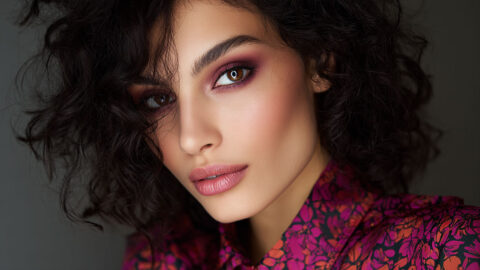
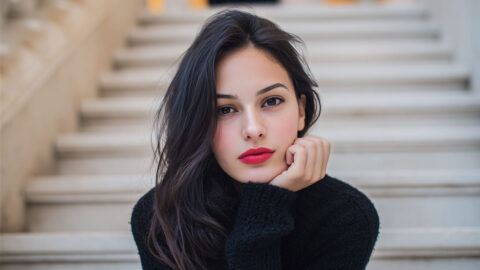
Covering more is the usual instinct, and it usually backfires. Heavy coverage and matte formulas cling to fine lines and dry out the surface of the skin, so the face ends up looking flatter than it did bare.
The way to apply makeup to look younger is thin, cream-based layers that even out the tone and bring color back to the cheeks and lips, with a little definition around the eyes.
What drives the effect is facial contrast, the color and brightness difference between the eyes, lips and brows and the skin around them.
In a 2017 Frontiers in Psychology study, faces from 4 ethnic groups looked younger to French and Chinese participants when that contrast was artificially increased, and older when it was decreased.
What Order Does Makeup Go On in for a Younger Look?

Skin first, color last, and everything in thin layers.
- Moisturizer on clean skin, then SPF 30 or higher once it has settled
- A light primer, only where texture or fine lines catch product
- A sheer base (tinted moisturizer, skin tint or light foundation) pressed on with a damp sponge
- Color corrector if dark circles need it, then concealer on the darkest spots
- Cream blush on the apples of the cheeks, blended up toward the temples
- Highlighter on the center of the cheekbones
- Powder or setting spray, kept to the areas that shine or crease
- Lash curler, mascara and soft brow filling
- Sheer rosy lip color or a satin gloss
Every layer sits on top of the one before it, so a heavy early step creases or cakes by midday. The logic behind the sequence has its own write-up on layering makeup in the right order.
Age drains that contrast. A PLOS ONE study that analyzed 289 photos of French Caucasian women aged 20 to 69 found it declines with age, and that faces with higher contrast were judged younger (Porcheron, Mauger and Russell, 2013).
Makeup raises that cue, along with skin evenness and apparent feature size. Russell and colleagues (2019) found that 40-year-old women, and 50-year-olds even more, looked significantly younger with makeup on.
The same experiments showed no age change at 30 and an older look at 20. So the benefit starts around the point where contrast has already started to fade.
Worth knowing that several co-authors, including Aurélie Porcheron, work for CHANEL’s research division, so the work has an industry connection.
Everything below follows from these two studies. Add contrast back where it has faded, and keep the film thin enough that the skin still shows through.
How to Prep Skin and Sunscreen Before Makeup

Moisturizer goes on first and sunscreen second, with primer as an optional third layer. Each one needs a minute or so to sink in before the next.
Moisturizer makes the base sit smoothly. Makeup artist La Sonya Gunter starts with a hydrating one to build a plump, dewy surface (Blavity), and a formula with hyaluronic acid suits dry skin because the ingredient binds water in the skin.
For sunscreen, the American Academy of Dermatology says to use a broad-spectrum, water-resistant formula of SPF 30 or higher as the last skincare step before makeup.
Skipping moisturizer is the classic slip. Matte products cling to fine lines on dry skin and turn chalky (W Magazine). For the skincare side in more detail, see this guide on prepping skin before makeup.
Primer is a judgment call. Sheerluxe lists skipping it among the habits that sabotage a youthful look, and Gunter uses a light layer to soften fine lines and pores. My own lean is to use it only where product actually catches, and where lines or pores do grab it, a thin coat of primer applied correctly smooths the surface first.
Makeup with SPF does not replace the sunscreen step. People wearing it apply about one-half to one-quarter of the amount used in the original SPF studies, and the numbers do not add up with the sunscreen underneath (Prevent Cancer Foundation).
bareMinerals says as much about its own SPF powder foundations, calling them backup protection rather than the main defense.
For reference, SPF 30 or higher is the AAD minimum for daily sunscreen, and SPF 30 blocks 97% of UVB rays (AAD). Actual habits lag behind. 56% of US adults surveyed use sunscreen regularly, and 20% do so on cloudy days (AAD, 2025).
Which Tools Keep Makeup Layers Thin?
A damp sponge lays down the thinnest, most even base. Fingertips warm cream products into the skin, and a stippling brush builds a light film in small dabs.
Gunter blends a lightweight foundation or BB cream into the skin with a damp beauty sponge, which keeps it from looking cakey. Squeeze the sponge out well, because it absorbs product, and follow a step-by-step sponge technique for pressing rather than dragging.
I’d use fingertips for cream blush and concealer, and save the stippling brush for a base that needs a lighter touch than a sponge gives.
A 2019 Aston University study in the Journal of Applied Microbiology found that 93% of beauty blenders had not been cleaned, and 64% had been dropped on the floor and used anyway. Sponges carried the highest bacterial levels of any product tested.
Sponges stay damp after use, which is why they breed bacteria so well. Wash them regularly and dry them thoroughly, following this guide to cleaning makeup sponges.
Whatever the tool, thin wins. Build foundation in thin layers until the coverage looks right, and stop there (Mineralissima, 2025).
Which Base Gives the Youngest Finish?

A sheer base with a satin or dewy finish looks youngest. Tinted moisturizer and skin tint are the easiest ways to get it, and a serum foundation works if you want a little more cover.
| Base type | Coverage | Finish | Where it fails |
|---|---|---|---|
| Tinted moisturizer | Sheer | Dewy to satin | Little cover for dark spots or redness |
| Skin tint | Sheer to light | Natural, skin-like | Needs concealer for discoloration |
| Serum foundation | Light to medium | Satin | Stacks up if layered thickly |
| Light-coverage foundation | Light to medium | Satin | Turns cakey when built up |
| Full-coverage matte | High | Flat matte | Clings to fine lines, looks chalky |
If a full base feels heavy, a skin tint evens out the tone with almost no film.
Celebrity makeup artist Mario Dedivanovic pushes older clients toward liquid formulas because skin gets drier with age. He names the No7 Triple Action Serum foundation for not migrating into lines near the mouth or eyes (PureWow).
Choosing a finish
Dewy suits dry or dull skin best, where it reads as plump and hydrated. Satin is the safest default, with enough sheen to reflect light and little enough to stay put.
Matte belongs on oily zones only. Powder foundations can make older skin look dry (Mineralissima), and matte bases cling to fine lines (W Magazine).
The drier the skin, the dewier the finish. That’s about as close to a rule as this gets.
Shade and undertone
Check the base along the jawline in daylight, not under bathroom lighting.
Your Life Choices, an Australian lifestyle site for people over 50, advises defaulting to a slightly yellow undertone because warmer shades tend to flatter as skin matures. Treat that as a starting point, since one outlet does not make a rule.
For the matching step itself, see this guide to matching makeup to your skin tone.
How to Place Concealer Without Creasing

Dab a thin layer of concealer, one shade lighter than the base, on the darkest points only, then blend the edges into the skin.
Makeup artist Rose-Marie Swift, founder of RMS Beauty, spot-conceals instead of stacking cover-up over the whole area. Too much product looks cakey or moves as the day goes on (W Magazine).
For the under-eye area specifically, there is a longer guide on how to prevent creasing under the eyes.
Artists pick a corrector by the color of the darkness, but they disagree on what to use for blue. Emma Peters, founder of Aleph Beauty, says blue-toned circles call for an orange or peach corrector (The Zoe Report).
Bobbi Brown sees it differently. Pink corrects purple and blue, she says, while peach handles brown, gray and green tones (Parade, June 2025).
Brown puts the corrector underneath the concealer. Whichever shade you pick, dab it only on the dark patch, and see this guide to applying a color corrector for the technique.
Color correction fixes pigment, not shadow. The Mayo Clinic notes that what looks like dark circles can be shadows cast by puffy eyelids or by hollows under the eyes that develop with aging.
Peters adds that volume loss under the eye causes more shadowing as we age. For those hollows, a lighter concealer does more than a corrector.
A makeup artist interviewed by The Zoe Report points out why a single shade fails here. One color over the whole area pushes puffy spots forward and leaves recessed spots looking dark.
Where the skin already looks even, leave concealer off.
Where Blush and Highlighter Go to Lift the Face

Press cream blush onto the round of the cheek and sweep it up toward the temple, then tap highlighter along the top of the cheekbone.
Placement carries the effect. A 2016 study in Body Image found that added redness made faces look healthier only on the cheeks, and added brightness helped only around the eyes (Jones and colleagues).
Color added elsewhere did not produce the same gain, so blush dragged down toward the jaw does less work than blush kept on the cheek.
Cream is the better formula here. It melts into skin and keeps a subtle sheen, which W Magazine says looks more youthful as skin matures. Powder blush sits on the surface, and the baked, powdery kinds look dry.
Sheerluxe says to skip contour when the goal is a younger look, and I agree.
To pick a shade, Stylist suggests pinching your cheeks and matching the flush, or matching the color your cheeks go after exercise.
MAC’s director of makeup artistry for the UK and Europe, Terry Barber, adds that blush makes skin look clearer and eyes brighter, so you can wear less makeup everywhere else.
For formula-specific technique, see this guide on how to apply cream blush.
Sources disagree on highlighter placement. Sheerluxe keeps it to the center of the cheekbone and blends it toward the temple, while WhatsUpMoms spreads it over several high points (cheekbone tops, nose bridge, above the brows, temples, around the mouth) to add back volume where skin has sunk.
Fewer points read as more natural. Add more only where the face has visibly lost volume.
A separate guide covers how to apply highlighter on mature skin.
Powder or Setting Spray for a Skin-Like Finish
Use a hydrating setting spray over the whole face, and keep powder to the T-zone and under the eyes, or skip powder entirely on dry skin.
Sources split on powder. Your Life Choices tells women over 50 to skip it because it looks dry and dusty, while makeup artist Ruby Hammer sets dry skin with minimal powder on the T-zone and finishes with a hydrating spray.
The disagreement tracks skin oil. A skin barrier review in the Journal of Cosmetic Science (published by the Society of Cosmetic Chemists) reports that sebum production in women drops sharply at menopause but does not fall significantly in men before age 80, so older skin has less shine for powder to absorb.
Powder absorbs oil, smooths the T-zone and locks foundation and concealer in place. The downsides are real, though. It looks dusty on dry skin, and a heavy hand lets it settle into lines.
Setting spray melds the layers into a skin-like finish and refreshes makeup during the day (Hammer), and it takes down a powdery or cakey look (Beautylish). What it won’t do is control oil on its own, so oily skin still needs powder.
Where powder does go, Beautylish starts with the T-zone and under the eyes, then around the nose. This guide to applying translucent powder covers the technique.
Charlotte Tilbury recommends a dewy setting spray for mature skin because matte makeup can accentuate fine lines.
If you use both products, powder goes first and spray goes last (Hammer). For the spray step itself, see how to apply setting spray.
How to Open Up the Eyes and Define Brows
Curled lashes and neutral matte shadow open the eyes, liner stays level at the outer corner, and soft, filled brows frame the whole thing.
Lashes and mascara
Eye makeup has a shelf life. The American Academy of Ophthalmology says to throw away eye makeup after three months, and at once after an eye infection.
Curl first, then coat (Sheerluxe). The blackest black mascara makes the whites of the eyes look clearer, and several coats bond the lashes into one fuller row (Wendy Rowe).
In practice that means curling before mascara, going for black in several light coats, and keeping sharp tools away from the lashes, since the American Academy of Ophthalmology advises against using them to pull clumps apart.
Shadow and liner

Warm, matte, neutral shades look well-rested (Mario Dedivanovic, PureWow). One or two colors are enough, because layering more creases the lid and draws attention to lines (Larry Yeo, Singapore Women’s Weekly).
Keep liner and shadow from dragging down at the outer corner, a habit that pulls the whole eye down (Chalene Johnson). Eldo Ray Estes goes further and skips liner under the eyes for older women.
A touch of highlighter in the inner corners makes eyes look bigger and brighter (Mineralissima).
Waterline liner is where sources split. Wendy Rowe lines the waterline with beige to make eyes look wider and brighter.
The American Academy of Ophthalmology says to apply eye makeup outside the lash line, away from the eye, so it does not block the oil glands of the lid.
Side with the eye doctors if your eyes run dry, since the academy also warns that glitter and flaking formulas can irritate the eyes. For a full routine at this age, see this guide on eye makeup for older women.
Brows
Brows thin at the ends with age, so filling them gives the face its frame back (Sheerluxe).
Brush the hairs up and out first, then fill with a pencil or kit and blend with the wand (WhatsUpMoms). Keep the shape soft, never blocky (Rowe), and do not draw the brow too low (W Magazine).
Finish by brushing through with a spoolie so the brow looks feathery (Dedivanovic). A clear or tinted brow gel holds the hairs in place once the shape is set.
Which Lip Color and Finish Look Younger?
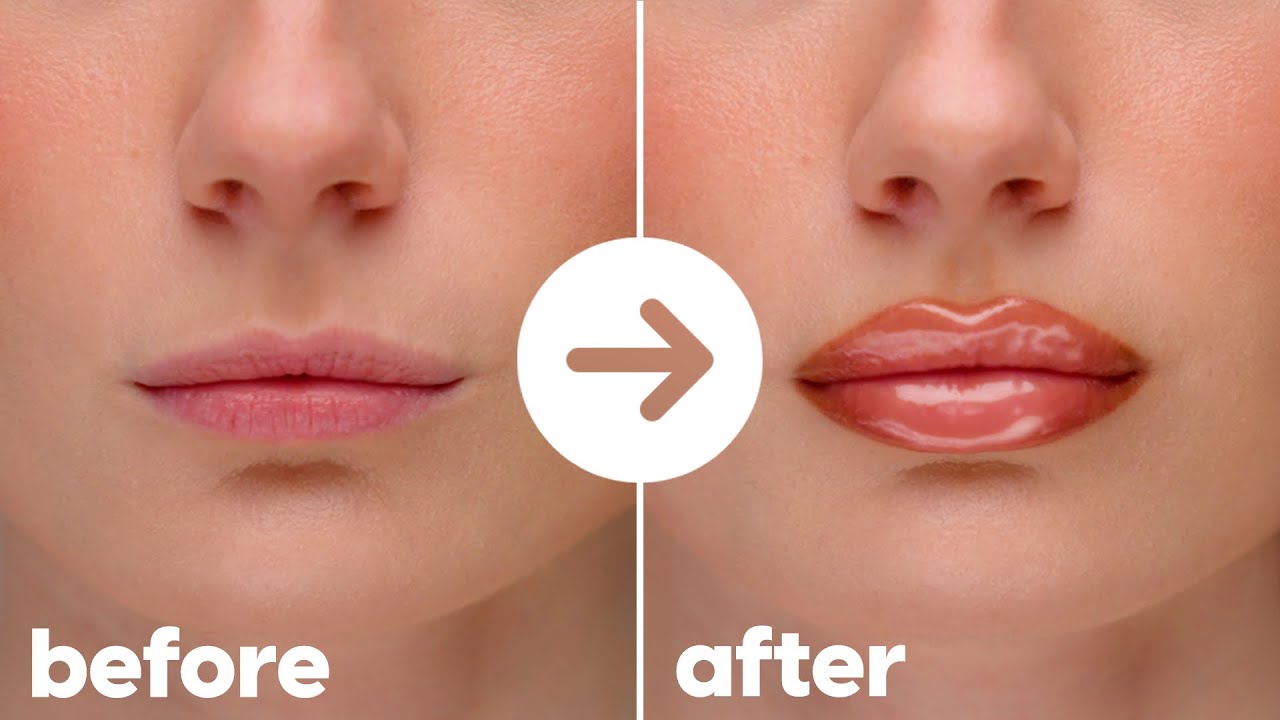
Sheer pink or rosy shades in a moisturizing or glossy finish look youngest, because dark colors thin the lips and matte formulas turn dry.
The reason is anatomy. Sforza and Ferrario (2010) studied 918 people aged 4 to 73 and found the visible red of the lip shrinks relative to total lip height with age, with lips thinner on average in older people.
A 2013 morphometric study in Revista Brasileira de Cirurgia Plastica found the opposite movement above it: the upper lip gets taller while upper vermilion height drops.
Together the two describe a shrinking red zone under a longer upper lip. A shade close to the natural lip color keeps that zone from reading as a thin line.
For lips that have lost visible volume, see this guide on lipstick for thin lips.
Pink and rosy beat red and berry for fullness (Sheerluxe). Moisturizing or shiny formulas look fuller than matte (Mineralissima).
A liner defines the lip and stops color from feathering (Sheerluxe), and it works best a tad darker than the natural lip and smudged toward the center (WhatsUpMoms).
Red is not banned, though Sheerluxe would swap it for pink. Melissa Yeo says red works when the eye makeup stays neutral and the blush stays light, so the face keeps one focal point (Singapore Women’s Weekly).
If you are weighing finishes, this comparison of matte versus satin lipstick sets them side by side.
Bobbi Brown offers a shortcut that ties lips to cheeks. Dab cream blush or a moisturizing lipstick close to your natural lip color on the lips, then use what is left on the cheeks (Stylist).
Why Your Makeup Still Looks Old and How to Fix It

Makeup ages the face when it adds weight, dryness or downward lines, so find the lowest layer that went wrong and change that one first.
| What you see | Layer to check first | Change |
|---|---|---|
| Heavy, cakey face | Base and concealer | Spot-conceal, thinner layers |
| Dry, dull skin | Powder and matte products | Cream textures, spray finish |
| Tired, messy eyes | Liner and shadow | One or two shades, lifted outer corner |
| Thin-looking lips | Lip shade and finish | Sheer rose, satin or gloss |
| Flat, washed-out face | Blush and brows | Cream blush on the cheek, filled brows |
Most of these trace back to overdoing it. Makeup artist Scott Barnes names overdoing everything as the mistake women over 40 make most (The Zoe Report), and Eldo Ray Estes says a routine carried over unchanged from age 18 needs a rethink at 40.
A base that turns patchy partway through has its own fixes, covered in this guide on fixing patchy makeup.
Makeup changes contrast and tone, and light to a degree. It does not change structure.
If the skin under just one eye darkens and keeps getting worse over time, see a healthcare professional instead of adding more concealer (Mayo Clinic).
Makeup for a Younger Look FAQ
Can the same routine work on hooded eyes?

Yes, with a lighter hand on the lid. Stick to one or two matte shades, because extra layers crease the lid (Larry Yeo, Singapore Women’s Weekly), and brighten the inner corners.
A separate guide covers makeup for hooded eyes in more detail.
How should I remove eye makeup before bed?
Take off all of it every night, mascara especially, since it sticks to the lashes. The American Academy of Ophthalmology also warns against letting remover get into the eye.
How many products does a younger-looking routine need?
Fewer than most people expect. A skin tint, cream blush, mascara and a sheer lip color cover the basics, applied after moisturizer and SPF.
Add concealer where dark circles show, and brow filler once the brows have thinned.
How do I reapply sunscreen over makeup?
A spray, stick or powder sunscreen tops up protection without smearing the base. Reapply about every two hours when you are outdoors for long stretches (Prevent Cancer Foundation).
Full steps are in this guide on how to reapply sunscreen over makeup.
Which skin concerns change the routine most after 40?
According to W Magazine, dryness, loss of volume and dark spots. Cream textures help with dryness, highlighter on the high points handles volume, and spot concealing deals with dark spots.
Where to Start With Makeup for a Younger Look
Start with cream blush on the cheek. It adds the most contrast with the least layering, so it pays off faster than anything else here. A thinner base comes next, then curled lashes and filled brows.
That order runs from the largest visual gain per product to the smallest.
Age-perception research points to the eyes, lips and brows, while color research points to the cheeks and the skin around the eyes, so the eye area is the one region both flag.
The trade-off is coverage. A thinner base leaves some discoloration visible, so spot concealing replaces an even mask.
As of October 2026, the age and health studies behind this advice rest on photographed faces, so research with live viewing would change how much placement matters.
Once the routine is set, wear time becomes the next problem, and this guide to making makeup last all day picks it up.

She started writing on the site after fielding the same questions from clients and friends often enough to just write the answers down: which red won't turn orange on a warm undertone, how to keep lipstick from feathering into fine lines, why a "12-hour" formula rarely survives dinner.
Every review on the site follows the same rule she uses with paying clients: wear it first, then decide if it's worth recommending.
- How to Make Eyeliner Last Longer Without Smudging - August 31, 2026
- How to Make Eyeshadow Last Longer All Day - August 29, 2026
- How to Find Your Undertone in 5 Easy Steps - August 27, 2026