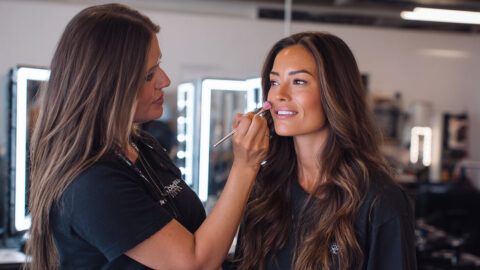
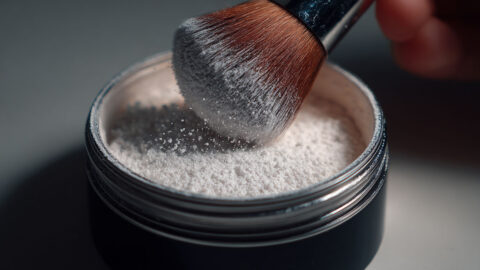
Most people swipe a makeup sponge across their face the way they would a brush, and that is usually why the foundation comes out streaky. Press it in instead. Bounce liquid or cream product into the skin with a sponge that is damp but not dripping.
Pressing works for foundation, concealer and cream blush alike, and it leaves a sheer layer you can build on. A brush sweeps the product across the surface, which gives a different result.
The tool itself is usually a teardrop-shaped polyurethane foam applicator. The rounded base covers the forehead, cheeks and chin, and the pointed tip gets into the eyes and nose.
The damp rule has exceptions. Beautyblender tells users to wet its sponge until it expands. Real Techniques sells its Makeupsaver sponge for dry use on liquid and cream formulas.
How to Apply Foundation With a Makeup Sponge

Dampen the sponge, squeeze it until it stops dripping, dot foundation on your face, and bounce the product in from the center outward. Press, lift, repeat. Dragging is the one thing to avoid.
The bouncing motion is a form of stippling, and honestly it matters more than which foundation you picked. Beautyblender’s usage guide makes the point that sweeping a sponge across skin only pushes foundation around, and that is where streaks and patches begin.
- Moisturize and let it settle. Add primer if you use one.
- Soak the sponge under lukewarm water until it expands, then squeeze out the excess and blot it on a towel.
- Dot foundation on the forehead, cheeks, nose and chin.
- Bounce the rounded base over each dot, starting at the center of the face and working outward.
- Switch to the pointed tip around the nose, the corners of the eyes and the jawline.
- Build coverage in thin layers, adding product only where skin still shows through.
Smoother skin gives you a smoother base, which is why prepping your skin before makeup is worth the extra few minutes.
If you use primer, it sits between moisturizer and foundation. There is a separate walkthrough on using makeup primer.
Loading the foundation: face, hand or sponge
Sources disagree on this part, and the choice changes how much product you burn through.
- Dotting it straight onto the face lets you see exactly where the product lands, then you bounce.
- Squeezing some onto the back of your hand and picking it up with the damp sponge in small amounts is what Beauty Bay recommends, for even coverage and less waste.
- Dabbing the sponge directly into the product is the route Beautyblender describes on its product page. It is the fastest way, and the easiest to overdo.
A sponge absorbs more product than a brush (makeup artist Neil Scibelli, quoted by Bustle), so start with less than you would use with a brush and build from there.
New to sponges? Use the hand method first. Switch once you know how much your base needs.
Should a Makeup Sponge Be Damp or Dry?

Damp for liquids and creams, dry for powders. Most brands agree on that, though a few don’t.
A dry sponge pulls foundation into its pores before it reaches your skin. A damp one is already full of water, so more product stays on your face (Beautyblender and 100% PURE both make this argument).
Beauty Bay’s guide to the Beautyblender adds what you would actually see, which is a cakey complexion if you use it dry.
The exception is the Real Techniques Makeupsaver Sponge, sold to be used dry. The brand says it absorbed 90% less makeup in a 30-day lab test with water-based makeup, though it does not name the sponge it was compared against.
That is a brand-run test of one design. Read it as a claim about that sponge, not a verdict on damp versus dry.
On finish, a damp sponge gives sheer to medium coverage with a dewy or satin look, and it absorbs the least product. A dry one gives fuller coverage and a matte finish, but standard foam eats more of the product along the way.
Real Techniques frames its Miracle Complexion Sponge the same way, with damp for a dewy glow and dry for full coverage.
How wet is damp?
Run the sponge under lukewarm water until it expands. A Beautyblender almost doubles in size, according to the brand’s own guide.
Squeeze it out, then press it into a towel until nothing drips. A sponge that still drips dilutes the foundation, and one that feels stiff needs another few seconds under the tap.
Powder products
Powder foundation and loose powder go on a dry sponge, which presses pigment into the skin and avoids clumping (100% PURE). The method for applying powder foundation goes deeper on technique.
Beautyblender dissents and uses a damp sponge for powders too. Real Techniques lands in the middle, with dry giving a matte look and damp giving a satin one.
Adjusting for dry and oily skin

If your skin is dry, soak the sponge well. A damp sponge smooths foundation over dry patches instead of catching on them (100% PURE), and the prep steps in the guide to makeup on dry skin help with the rest.
On oily skin, squeeze the sponge a little firmer so it adds less water to the base. That is common technique advice, not a tested effect.
Which Makeup Sponge Shape Fits Which Area of the Face?

The rounded base handles large areas and the pointed tip gets into tight spots. A flat edge, on sponges that have one, takes care of lines.
| Sponge part | Where it goes | Job |
|---|---|---|
| Rounded base | Forehead, cheeks, chin | Foundation and blush |
| Pointed tip | Under the eyes, around nose and mouth | Concealer, hard-to-reach spots |
| Flat edge | Around the eyes and nose | Edges and contour |
A Beautyblender is edgeless by design, so contour work uses its side. Real Techniques builds a flat edge into the Miracle Complexion Sponge.
For depressed areas of the face, Beautyblender recommends pressing the tip in with a stipple-and-twist motion.
Smaller sponges reach tighter spots. Sixty and Me demonstrates a mini sponge for under-eye concealer, and Beautyblender sells a Micro.Mini for hard-to-reach areas.
What makeup sponges are made of
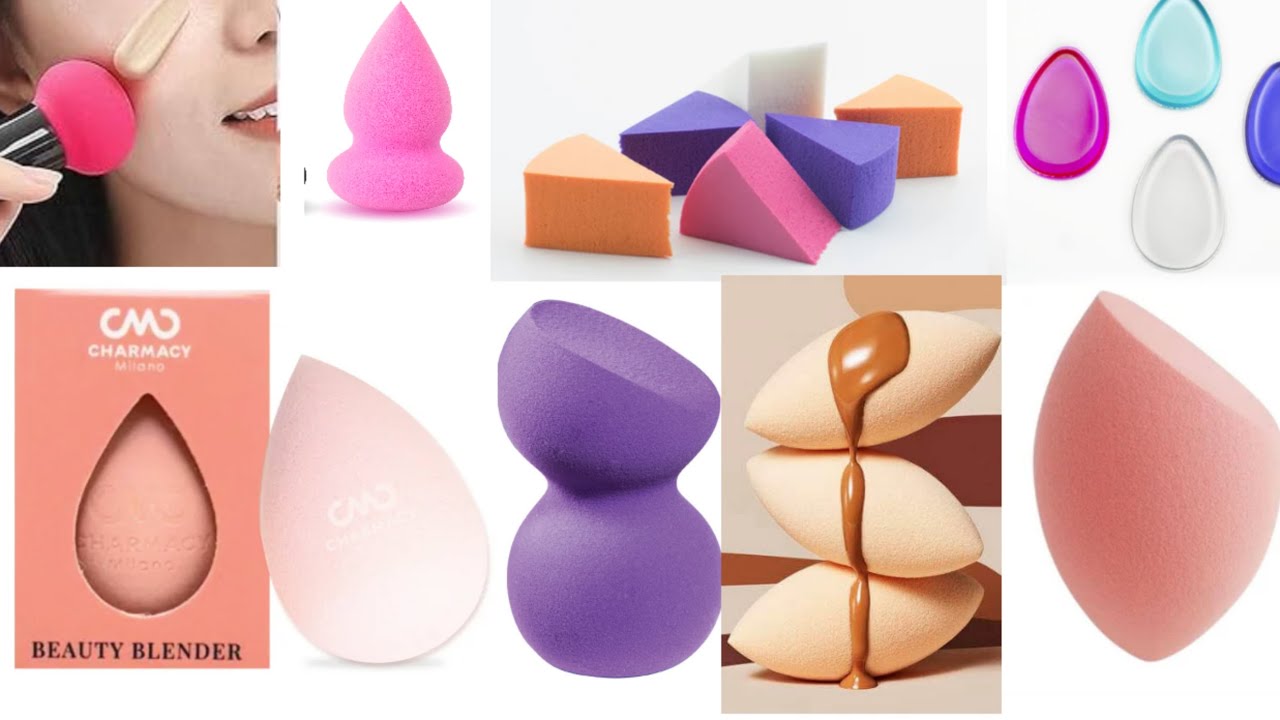
Most current sponges are hydrophilic polyurethane foam. Real Techniques lists the Miracle Complexion Sponge as 100% polyurethane, latex-free.
Hydrophilic foam takes up water fast and expands, which is what makes it soft and bouncy when damp. Latex-free matters if you have a latex allergy, and the material is not always on the label, so check before buying.
Wedge sponges are where to look twice. Graftobian markets its non-latex wedges specifically against latex competitors.
Using a Makeup Sponge for Concealer, Cream Blush, Contour and Setting Powder
A sponge works for all of these, from concealer through to setting powder, and the technique barely changes. Small amounts, pressed in, never dragged.
Concealer under the eyes and on blemishes

Beautyblender points its tip at the under-eye area, and Real Techniques aims its precision tip at blemishes.
Dot a small amount where you need it, press with the tip one tap at a time, then bounce the edges outward until the line disappears.
For the product side of the job, see the guide to using concealer.
Cream blush
Put the blush on the back of your hand, pick it up with the rounded end of the sponge, and press it onto the cheeks. Sixty and Me demonstrates this to keep the amount small.
Beautyblender’s instructions say to use the side of the sponge to blend cream blush out. Build slowly, since adding is easier than removing.
Contour and highlighter
Contour blends best with the side or flat edge of the sponge, the way Real Techniques uses the flat edge around the eyes and nose.
Highlighter goes on the back of your hand first, and then you lift it with the sponge. Intense formulas go on strong otherwise (Sixty and Me).
Setting powder
A dry sponge gives more control and a matte finish, according to e.l.f. Cosmetics. The Beautyblender approach is damp, and the pointed tip presses powder under the eyes to set it.
Pick based on the finish you want. Product choice and amount are covered in the guide to applying setting powder.
Makeup Sponge vs Brush vs Fingers: Which Applicator Fits Which Finish?
Brush for speed and fuller coverage, sponge for a diffused, buildable finish. Fingers are the quick, sheer option.
Makeup artist Valeria Ferreira says in Woman & Home that a sponge tends to give a more diffused, natural look, while a brush can create a more even, smooth finish. Part of the sponge effect comes from absorption, since Neil Scibelli, quoted by Bustle, notes that a sponge takes up more product than a brush.
| Applicator | Motion | Finish | Best for |
|---|---|---|---|
| Sponge | Bounce, press | Diffused, natural | Liquid and cream bases, building coverage |
| Brush | Buff, sweep | Even, smooth, fuller | Speed, thin liquids, powder foundation |
| Fingers | Press, warm | Natural, less even | Quick sheer coverage |
Pros and cons of a makeup sponge
A sponge gives a diffused, natural finish that builds in thin layers, and you get more control than with fingers. Slice notes that dampening it makes fuller-coverage foundation look natural.
The downsides are practical. Over a blemish, it keeps sheering the foundation out (Business Report, 2022). It is also slower than a brush, and it needs regular washing.
Pros and cons of a brush
A brush wins on speed. Slice calls it one of the fastest ways to apply foundation, and it layers easily when you want control over coverage.
Powder foundation is the clearest brush case, since L’Oreal Paris, citing makeup artist Sir John, says to reach for one. The trade-off is finish, and thin and thick formulas call for different brushes (Woman & Home).
Brush technique has its own rules, laid out in the guide to applying makeup with a brush.
Pros and cons of using your fingers
Body heat warms the product, so pump 1 to 2 drops onto the back of your hand first (Watsons). There is also no tool to wash afterward.
The cost is control. Streaks or uneven coverage are the usual result (Slice), and it is slow on a full face, according to makeup artist Larry Yeo.
Professionals mix tools. Yeo’s preferred combination is a brush to spread liquid foundation, then a sponge to pat over it and lift excess or layer more where needed (Women’s Weekly).
What Goes Wrong With a Makeup Sponge, and When to Skip It

Makeup artist Jonet Williamson names unprepped skin and dirty sponges as the most common causes of cakey makeup, with excess product close behind.
Streaky and patchy foundation
Flaky or dehydrated skin catches product, and dry patches show through the base (Faces Canada). Weak blending at the edges does the rest, and Revlon singles out the nose, chin and hairline as the places to blend most carefully.
Already streaky? The guide to fixing patchy makeup covers the repair.
Cakey foundation
Cakey makeup settles into fine lines and dry patches. A sponge can cause it and fix it.
- Mist a clean sponge with a hydrating spray or setting spray, then dab it over the cakey areas. It absorbs excess product and re-blends the base (Williamson).
- A damp sponge can also sheer the layer out. Coverage drops, but skin looks more even (Chanel Temple, Hourglass).
- Don’t add more product on top, which makes the cakey effect worse (Temple).
Prevention comes down to thin layers, and the guide to layering makeup sets out the order.
When a sponge is the wrong tool
Powder foundation splits the sources. 100% PURE and Real Techniques treat a dry sponge as workable (Real Techniques sells a separate velvet-fibre powder sponge), while L’Oreal Paris says a brush does better and 100% PURE notes some sponges lose product to powder.
Spot coverage is another weak point. A sponge over a blemish sheers the foundation out. Business Report (2022) says a stippling brush gives better coverage, and blending with it does not lift product off.
If you need full coverage in a hurry, a dense brush alone builds light layers until you reach the coverage you want (Woman & Home).
How Often Should You Clean and Replace a Makeup Sponge?
Wash a makeup sponge with soap at least once a week and replace it every 1 to 3 months. Brands and dermatologists differ on how often to clean, and the key study on sponge contamination did not test any schedule.
What the Aston University study found
Bashir and Lambert tested 467 used products donated by UK consumers (lipsticks, lip glosses, eyeliners, mascaras and beauty blenders) and published the results in the Journal of Applied Microbiology (online in 2019). Beauty blenders came out worst.
- Beauty blenders averaged more than 1 million CFU per ml of bacteria, against 100 to 1,000 CFU per ml in the other tested products.
- 93% of the beauty blenders had never been cleaned.
- 64% had been dropped on the floor and kept in use.
- Across all used products, 79 to 90% carried bacteria.
The researchers tie the sponge result to storage. Blenders are often left damp after use, which suits bacterial growth.
The study measured contamination in donated, used products. It did not set or test a cleaning schedule or a replacement interval.
How often to clean: the sources disagree
Beautyblender says to cleanse after every use with its own cleanser. Real Techniques says to rinse the Miracle Complexion Sponge with lukewarm water after each use and deep clean it once a week.
Dermatologists are less uniform. Dr. Hadley King, quoted by Makeup.com, says once a week for sponges used with cream, liquid and eye products. Dr. Debra Jaliman, quoted by Parade (via AOL), says many people wait weeks between cleanings, which she and Dr. Badreshia-Bansal call the top mistake. Both suggest cleaning after each use.
Frequent washing has a cost. Beauty Pie’s Lottie Winter says sponges need replacing more often than brushes because they withstand cleaning less well.
Taken together, weekly washing is the floor and rinsing after every use is the safer habit. Since the Aston researchers pointed at damp storage, drying fully between uses matters as much as the soap.
How to clean a makeup sponge

Wet it with warm water, work in a sponge cleanser or gentle shampoo, and squeeze and compress until it lathers. Beautyblender says to avoid twisting or pinching, which tears the foam.
Rinse until the water runs clear, press the water out in a towel, and leave the sponge to dry in a ventilated spot. For the full walkthrough, see the guide to cleaning makeup sponges.
Dish soap is a point of disagreement. Beauty Bay warns that washing-up liquid leaves residue that ends up on your face, while Cleveland Clinic dermatologist Dr. Melissa Piliang says mild soap, including dish soap or shampoo, works for makeup tools.
Shortcuts don’t fare well either. Dr. Badreshia-Bansal says water alone leaves oils and pigment trapped in the foam, and Dr. Jaliman says microwaving damages the sponge without killing all bacteria.
Never store a damp sponge in a closed bag or drawer. Beautyblender says the foam needs light and air to avoid mold.
The Conversation (2024) adds that applicators should be kept in a dry place away from water sources, and never shared.
When to replace a makeup sponge
e.l.f. Cosmetics says every 1 to 3 months, even with regular cleaning. Beautyblender says every 3 months. Real Techniques counts uses instead, at 30 for the Miracle Complexion Sponge.
With daily use, 30 uses is about a month, so the tightest brand figure and the 1 to 3 month range overlap.
Replace it sooner if you spot any mold, tears or cracks, an off smell, or stains that do not wash out. The same goes for a sponge that no longer springs back to shape after cleaning.
Makeup Sponge FAQ
What is a makeup sponge, and what else is it called?
It’s a soft foam applicator that presses liquid, cream and powder products into skin. Blending sponge, beauty sponge and foundation sponge all name the same tool.
Is a Beautyblender the same as a makeup sponge?
Not quite. Beautyblender is a brand, and makeup sponge is the category it sits in.
Its original is a pink, edgeless teardrop, and other brands such as Real Techniques and e.l.f. sell comparable sponges.
Can you dampen a makeup sponge with setting spray instead of water?
Yes, though water remains the standard. Haarspullen.nl suggests moistening the squeezed sponge with a little setting spray.
Makeup artist Jonet Williamson also dabs a sponge misted with hydrating spray or setting spray over cakey areas to re-blend them.
Can you use a makeup sponge for eyeshadow or lipstick?
Yes, with a small sponge. Sixty and Me applies liquid and powder eyeshadow with one and uses it to soften lipstick edges.
The guide to blending lipstick covers the lip side in more detail.
How Many Makeup Sponges Do You Need?
Most routines need two. A damp teardrop handles liquid and cream products, and a second one is for powder.
Residue from one product changes the color of the next, according to Bluemercury.
The teardrop comes first, since every later step sits on the base. The powder sponge is second, for setting a finished base. A mini sponge only makes sense if the tip feels too large under the eyes.
Replacement tracks use count. A sponge used daily reaches Real Techniques’ 30 uses in about a month, while a powder sponge used 3 times a week lasts about ten weeks, still inside e.l.f.’s 1 to 3 months.
The cost of a second sponge is twice the washing. This was last checked in October 2026, and it changes if a study tests cleaning schedules directly.
With the base in place, the next job is making makeup last all day.

She started writing on the site after fielding the same questions from clients and friends often enough to just write the answers down: which red won't turn orange on a warm undertone, how to keep lipstick from feathering into fine lines, why a "12-hour" formula rarely survives dinner.
Every review on the site follows the same rule she uses with paying clients: wear it first, then decide if it's worth recommending.
- How to Make Eyeliner Last Longer Without Smudging - August 31, 2026
- How to Make Eyeshadow Last Longer All Day - August 29, 2026
- How to Find Your Undertone in 5 Easy Steps - August 27, 2026