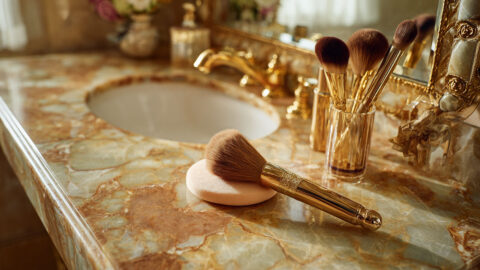
Most makeup sponges never get washed properly.
In the Aston University study published in the Journal of Applied Microbiology in 2019, 93% of the beauty blenders tested had never been cleaned, going by the donors’ own answers. The researchers tied the heavy contamination to sponges being left damp after use.
The fix is short. Massage a gentle cleanser through the foam for 15 seconds and rinse until the water runs clear. After that, the sponge needs to air dry completely.
Foam soaks foundation and skin oil into the core along with the water, so rinsing the surface never reaches what’s inside.
How to Wash a Makeup Sponge by Hand

All it needs is a bowl and a sink.
- Fill a bowl with warm water and add a few drops of liquid cleanser or soap as it fills.
- Press the sponge under until it sinks and expands, so the foam opens and releases product.
- Massage the soapy water through it with your palm or fingertips for 15 seconds.
- Hold it under warm running water and keep squeezing until the water runs clear and no lather is left.
- Press out the water, blot the sponge on a clean towel, and set it down to air dry.
Abrasive scrubbing pads snag and tear the foam (100% Pure). Silicone cleaning pads do damage too if you press them too hard, according to makeup artist Jenny Patinkin (mindbodygreen, 2025).
Soap left inside the foam is the other common slip.
Go by the lather when you rinse. Clear water can still hide soap in the core, and that leaves the sponge hard and dense. I’d rinse longer than feels necessary.
Brushes are a separate job. Water that reaches the ferrule can loosen the glue, which is why washing your makeup brushes has its own steps.
Which Cleanser Works Best on a Makeup Sponge?

For foam, a cleanser made for makeup tools is the safest pick. Anything gentle, fragrance-free and quick to rinse out will do the job.
| Cleanser | What it does well | Documented limit |
|---|---|---|
| Makeup-tool cleanser | Alcohol-free, made for foam (Beautyblender’s Rea Ann Silva) | One more product to buy |
| Fragrance-free cleanser or baby shampoo | Lifts product without fragrance that can damage foam (Patinkin) | Shampoos foam heavily, so rinsing takes longer |
| Dish soap | Cuts through foundation and oil | Foaming agents resist rinsing and can leave the foam stiff |
| Bar soap | Works if lathered in your hands first (MasterClass) | Can dry out the foam (Simple Green) |
Dish soap is where the sources split.
MasterClass and Shark Clean’s cleaning guide both list it as acceptable. Simple Green says dish and bar soap dry out the foam and damage the texture, and Makeup.com says harsh liquids break the foam down so you end up replacing it sooner.
Only the cautious sources say why, pointing to residue and foam breakdown. The ones that okay dish soap give no reason at all. I’d keep it for emergencies and rinse for a lot longer if you do use it.
Removing Stubborn Foundation and Oil-Based Makeup
Work a drop of olive oil or another oil into the stained area before washing, which helps break down oil-based makeup (MasterClass). Then wash with cleanser and rinse the oil out completely.
Faint staining left after a good wash is cosmetic. Dark stains that survive repeated washes mean it’s time for a new sponge, as one makeup artist told Essence.
How to Dry and Store a Makeup Sponge
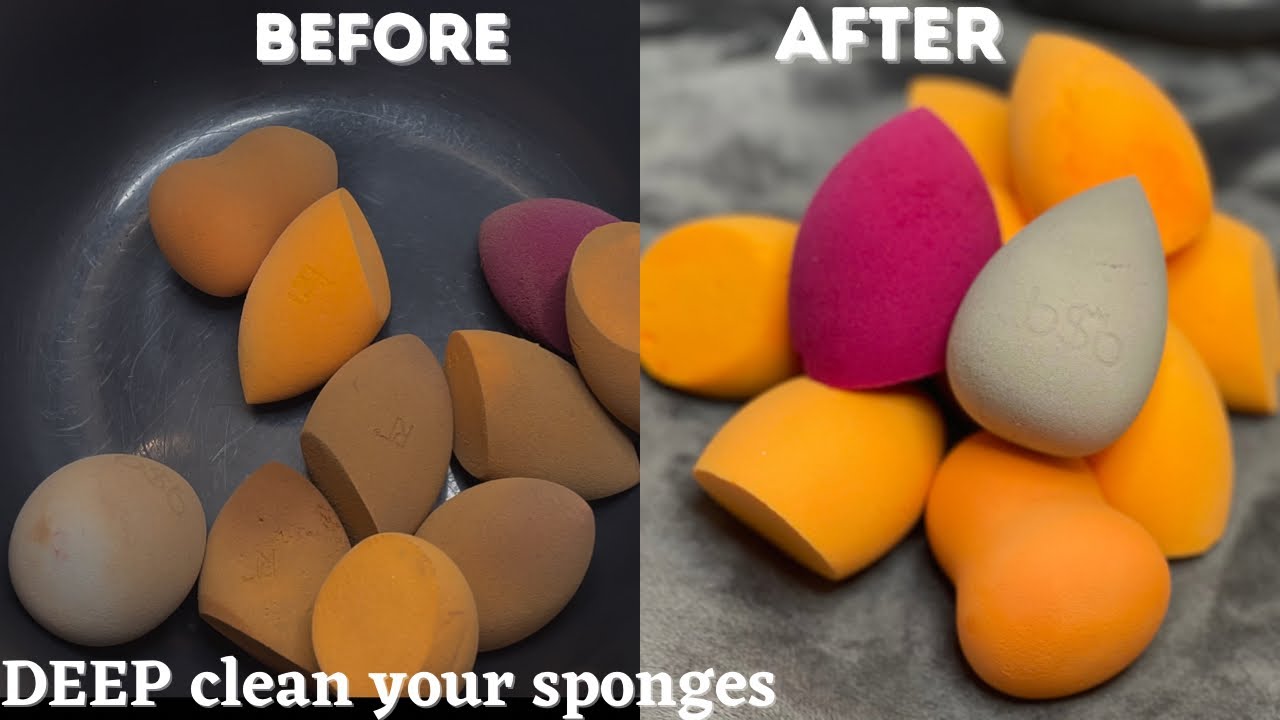
Air dry it completely, in open air, before it goes anywhere near a bag.
Bashir and Lambert’s work at Aston University ties the heavy contamination on blender sponges to being left damp after use (Bashir and Lambert, 2019).
Drying method
Start by blotting the sponge in a clean towel or washcloth to pull out excess moisture, as Rea Ann Silva recommends (mindbodygreen, 2025). Then set it on a clean paper towel or washcloth (Makeup.com), somewhere open, or in a raised holder so air reaches every side (Essence).
Drying time varies with the sponge and the room. Check the center rather than the surface.
Where drying goes wrong

The usual mistake is putting a damp sponge into a closed space. Makeup bags and lidded travel cases are the usual culprits, and zip pouches are no better.
Dampening a sponge before use is normal technique, and the guide to applying makeup with a sponge covers it. The hygiene problem only starts when the sponge gets put away still wet.
What Grows on a Dirty Makeup Sponge?
Aston University researchers Amreen Bashir and Peter Lambert found Staphylococcus aureus and Escherichia coli on used cosmetic products, beauty blenders included, along with Citrobacter freundii and fungi.
Their 2019 paper in the Journal of Applied Microbiology is the first to test beauty blenders as in-use applicators.
The sample was 467 used products donated by UK makeup users, and 79 of them were beauty blenders. Those blenders averaged more than a million colony-forming units (CFU) per millilitre, against 100 to 1,000 CFU per millilitre on the other products, as Bashir and Lambert wrote.
The donors’ answers about habits were grim too. 93% of the blenders had never been cleaned, and 64% had been dropped on the floor and still used.
Fungi showed up on about 57% of the blenders. Enterobacteriaceae, the bacterial family that includes E. coli, turned up on about 27%, which is more than a quarter. Bashir links E. coli to faecal contamination.
There’s a limit worth knowing about. The team counted microbes on products volunteers donated and never followed the users, so nobody knows who went on to get an infection. What the study shows is exposure.
The American Academy of Dermatology says dirty makeup brushes can cause acne breakouts and rashes, and skin infections too. Sponges stay damp longer, so they carry the same risk.
Most of the sponges in the study had never been washed, and the researchers blame damp storage. Washing clears out product and skin residue, and bacteria need moisture, which only drying removes. Skip either and the sponge becomes a growth medium.
How Often Should You Wash a Makeup Sponge?

After every use, if you go by dermatology advice. Across all the sources, the practical minimum is once a week.
Dermatologists Debra Jaliman and Sonia Badreshia-Bansal both suggest cleaning a beauty blender after each use (Parade), while Hadley King recommends once a week for sponges used with cream, liquid and eye products (Makeup.com).
Beautyblender founder Rea Ann Silva goes furthest and says daily, likening it to brushing your teeth (mindbodygreen, 2025). Makeup artist Jenny Patinkin says every 3 to 4 uses, with “at least once a week” as her floor. KIKO Milano’s guide says every 2 to 3 days, and Simple Green says rinse after each use and deep clean weekly.
Bluemercury’s guide is the odd one out, warning that washing too often damages the foam. The damage other sources document comes from harsh soap and scrubbing, so the washing itself isn’t really the problem.
Product type changes the answer too. Cleveland Clinic dermatologist Melissa Piliang singles out sponges used with liquid makeup, because the absorbed moisture can lead to bacteria and yeast overgrowth.
For daily wear, wash after every use and treat 3 to 4 uses as the outer limit. If you only wear it a few times a week, wash after each wear anyway, since residue sits for days between uses.
Infrequent use does not lower the bar.
Microwave and Alcohol Methods for Disinfecting a Makeup Sponge
Soap gets the product out, but it doesn’t count as disinfecting. Microwaving is the best-documented way to disinfect, and it was tested on kitchen sponges. Makeup foam was never part of it.
Microwave Method

Two minutes at full power killed or inactivated more than 99% of pathogens in wet kitchen sponges soaked in raw wastewater, and Bacillus cereus spores took four minutes (University of Florida researchers, Journal of Environmental Health, December 2006).
A USDA Agricultural Research Service test the following year found that one minute on a wet kitchen sponge cut bacteria by 99.99999%.
So separate tests in 2006 and 2007 both back heat on wet kitchen sponges, and neither touched makeup foam. Swiss retailer Galaxus still carries the Florida timing straight over to makeup sponges in its 2020 tutorial.
The upsides are a documented kill rate on wet kitchen sponges and no chemicals, and it takes only two minutes.
Fire is the big downside. The University of Florida warns of a fire risk when the sponge isn’t completely wet, and any metal content is a hazard. Silva set a blender on fire the first time she tried it (mindbodygreen, 2025). Patinkin adds that many sponges carry flame retardants, and heating could alter their chemistry.
Rubbing Alcohol
Alcohol kills germs, and it also breaks the foam down faster.
Makeup.com’s guide says dish soap or alcohol may kill germs, but the harsh liquids degrade the sponge and push you to replace it earlier.
Strength matters too. Celebrity makeup artist Scott Barnes told NBC News that 70% alcohol is his rule for tools, and that a 90% product dries too fast to disinfect (he was talking about brushes).
The wrong bottle evaporates before it does anything, and even the right one adds a step to a sponge that still has to be washed and dried. The one real advantage is no heat and no fire risk.
For foam, I’d skip both. Washing and drying properly, then replacing the sponge on schedule, is the better trade.
When a Makeup Sponge Is Past Cleaning

Sources disagree a lot here, anywhere from every 2 to 3 weeks to every 3 to 6 months.
| Source | Replace after | Basis |
|---|---|---|
| MasterClass | 3 to 6 months | Dermatologist recommendation |
| Readers Digest (Joshua Zeichner) | 3 to 4 months | Dermatologist |
| Shark Clean | 1 to 3 months | Depends on how heavily it is used |
| Essence | 2 to 3 weeks | Makeup artist, daily use |
Dermatologists sit at the long end, brands and makeup artists at the short end. If you wear liquid foundation every day, go short. Light use can stretch longer.
Replace it sooner if you see cracks or crumbling, pieces breaking off, a moldy smell, stiff foam that never rinses clean, or dark stains that survive washing.
Zeichner also says to toss a sponge that was used through a bad cold or an infection.
A sponge showing any of this goes in the bin. More scrubbing only tears foam that is already breaking down.
Silicone vs Foam Makeup Sponges and How Cleaning Changes

Silicone doesn’t absorb anything, so product stays on the surface and rinses off. Foam pulls product into the core, which is what makes it harder to clean (New Beauty).
Foam needs the full lather and rinse routine and gets replaced within weeks to months.
Silicone cleans up with soap and water, or even a makeup wipe (New Beauty). Makeup artist Robert Greene says it tolerates rubbing alcohol too (Essence), and L’Oreal Paris puts its lifespan at a year or more with cleaning after each use. Leave it unwashed and foundation builds up in layers on the surface, which turns the finish muddy (Greene).
Sources disagree on cleanser. New Beauty says most foam versions need a special cleanser, while MasterClass, citing dermatologists, lists ordinary liquid soap and facial cleanser, and baby shampoo as well. Ordinary soap does the job, and a dedicated cleanser is the lower-risk option for foam.
The hygiene case for silicone comes down to the non-porous surface. The Aston data covers foam blenders only, so it shows the risk for foam and doesn’t measure any advantage for silicone.
Choose silicone if the replacement schedule is the part you’ll skip.
Makeup Sponge Cleaning FAQ
Can you clean a makeup sponge with a cleansing mat?
Yes. LookFantastic notes that a silicone cleansing mat, designed for brushes, also works on sponges and speeds up the lather.
Press lightly, because makeup artist Jenny Patinkin warns that the nubs can tear the foam’s delicate surface (mindbodygreen, 2025).
Is it OK to apply makeup with a damp sponge?
Yes. Dampening is standard technique, and the trouble starts with wet storage afterward.
Patinkin also treats the feel as a cue. A damp sponge that squishes differently than usual is holding too much product inside.
Do UV sanitizing boxes work on makeup sponges?
Think of a UV box as an optional extra that doesn’t replace washing. Lamodespot suggests using one only after the sponge is washed and fully dry, and it cites no test on foam makeup sponges.
Can you wash a makeup sponge in the washing machine or dishwasher?

No. Bluemercury’s guide says makeup sponges need hand washing.
The dishwasher results on record come from a 2007 USDA test on kitchen sponges, and they say nothing about makeup foam.
How do you clean a makeup sponge between washes?
Makeup.com suggests spraying it with a makeup brush and sponge cleaner, then blotting it on a clean paper towel or washcloth and letting it dry before the next use.
It’s a travel stopgap. It takes off excess makeup, but it isn’t a full wash.
A Minimum Makeup Sponge Cleaning Routine for Daily Wear
If you only keep one habit, make it drying the sponge fully every time. Washing after each wear comes next, and replacing it on a calendar date after that.
Drying goes first because it costs nothing and takes away the moisture bacteria need. A wash followed by a damp bag achieves very little.
Do the math on a sponge washed daily and replaced every 1 to 3 months and you get roughly 30 to 90 washes before it retires. No single source states that count.
The trade-off is spend, since a short replacement cycle means buying more sponges per year.
As of October 2026, the contamination data is about foam blenders and the microwave data is about kitchen sponges. A lab test of heat on makeup foam, or of silicone applicators, would change this advice.

She started writing on the site after fielding the same questions from clients and friends often enough to just write the answers down: which red won't turn orange on a warm undertone, how to keep lipstick from feathering into fine lines, why a "12-hour" formula rarely survives dinner.
Every review on the site follows the same rule she uses with paying clients: wear it first, then decide if it's worth recommending.
- How to Make Eyeliner Last Longer Without Smudging - August 31, 2026
- How to Make Eyeshadow Last Longer All Day - August 29, 2026
- How to Find Your Undertone in 5 Easy Steps - August 27, 2026