Most brushes that die early die from the wash. Water gets into the ferrule, the glue loosens, and the bristles start turning up in your foundation.
The wash itself is simple. Gentle shampoo, lukewarm water, a lather worked into the bristles, a rinse that keeps going until the water runs clear, then each brush dries flat. It reaches the base of the bristles, where skin oil, dead skin cells and product residue settle, and a wipe on the surface never gets that far.
Cleveland Clinic (2025) goes by product. Foundation and concealer brushes get washed weekly, powder and blush brushes monthly, and eye brushes sit in between at every 2 weeks. The American Academy of Dermatology doesn’t split it up. It gives one interval for every brush, 7 to 10 days.
What Deep Cleaning Removes That Spot Cleaning Leaves Behind

Wiping a brush on a paper towel or spritzing it with daily cleaner only touches the tips. Pigment comes off the surface, and whatever has settled deeper in the brush head stays put. A deep clean, meaning shampoo and water all the way to the base of the bristles, is what gets that out.
A used brush holds foundation, concealer and powder residue, plus skin oil, dead skin cells and bacteria. Dust gets in as well when brushes sit in a cup on the counter or out in the open (Cleveland Clinic).
The American Academy of Dermatology (AAD) calls dirty brushes a breeding ground for bacteria and ties them to breakouts and rashes, along with infections like fungal infections, E. coli and staph.
Cleveland Clinic adds eye infections such as pink eye to the list, and its dermatologist Melissa Piliang says eyes are more prone to infection. Product sitting in a brush for months can lead to a bacterial infection if the skin has a cut, she adds.
Aston University’s study in the Journal of Applied Microbiology (published online in October 2019) often gets cited for brush hygiene, but it did not test brushes.
It tested 467 used products, among them lipsticks, lip glosses, eyeliners, mascaras and 79 beauty blenders. 93% of the blenders had never been cleaned, and 64% had been dropped on the floor at some point.
What the study supports is washing damp, handled tools. The brush advice rests on the dermatology guidance above, and sponges are a separate job, since cleaning makeup sponges properly follows its own routine.
How Often Should You Deep Clean Makeup Brushes?

The AAD says every 7 to 10 days, the same for every brush. Cleveland Clinic breaks it down by what’s on the brush, so wet products, eye brushes and dry powders each get their own timing.
| Source | Interval | Brush scope |
|---|---|---|
| American Academy of Dermatology | Every 7 to 10 days | All makeup brushes |
| Cleveland Clinic | Weekly | Foundation and concealer brushes |
| Cleveland Clinic | Every 2 weeks | Eyeshadow and eyeliner brushes |
| Cleveland Clinic | Monthly | Powder and blush brushes |
| Morphe artistry director | Every 2 weeks | Deep clean for all brushes, plus a quick clean 1 to 2 times a week |
Geisinger dermatologist Mary Brady gives the same 7 to 10 days as the AAD. The sources differ in scope: one blanket rule against an interval tied to product type and eye proximity.
Monthly is the loosest interval either source gives.
If you only want one number to remember, use 7 to 10 days for every brush. It’s easy and it’s the stricter of the two, so that’s the one I’d pick. Going by product means fewer washes overall: weekly for cream and liquid products, monthly for dry powder, and every 2 weeks anywhere near the eyes. And if your skin is breaking out, stay at the short end of the range, since MasterClass advises washing more often when skin problems show up.
Best Soaps and Tools for Washing Makeup Brushes
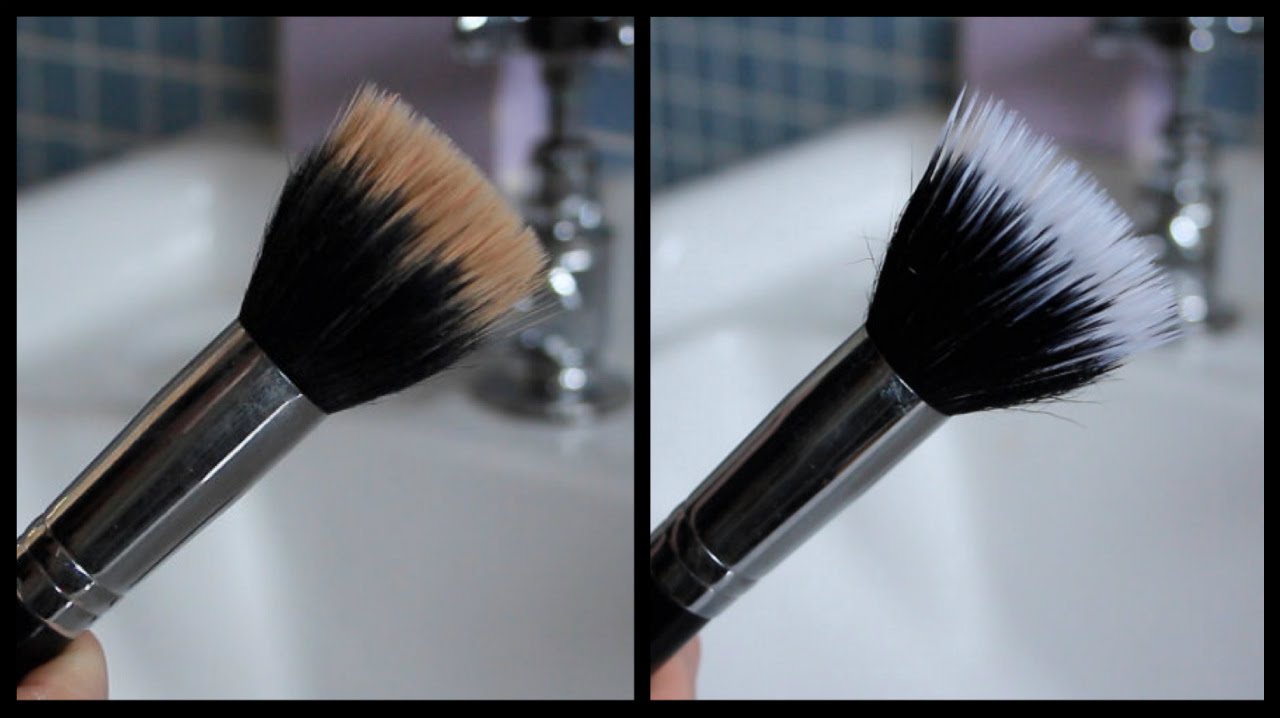
Gentle shampoo is the dermatology default. The AAD names gentle or clarifying shampoo, and Cleveland Clinic lists gentle soap such as baby shampoo or dish soap with warm water.
| Cleaner | Named by | Note |
|---|---|---|
| Gentle or baby shampoo | AAD (gentle shampoo), Cleveland Clinic (baby shampoo) | The AAD lists it first, at 1 tablespoon per bowl of lukewarm water |
| Clarifying shampoo | AAD | Aimed at heavier product buildup |
| Mild dish soap | Cleveland Clinic, Morphe artistry director | Degreases oily product, needs a full rinse |
| Liquid brush cleanser | Morphe artistry director | For quick cleans between washes, not a deep clean |
| Plain soap (castile, bar) | Neither AAD nor Cleveland Clinic | The AAD warns plain soap and water can dry out bristles |
The AAD’s drying warning sits awkwardly next to Cleveland Clinic’s dish soap suggestion. Shampoo is the safer first choice, and dish soap is the habit of working makeup artists.
Morphe’s Nicole Faulkner deep cleans with Dawn dish soap and keeps a brush cleansing liquid for quick cleans.
Clinical aesthetician Pamela Marshall uses Johnson’s baby shampoo, she told Marie Claire UK.
There isn’t much to buy. Your palm is the lathering surface both the AAD and Cleveland Clinic describe, a small bowl holds the lukewarm water and shampoo for swirling, and a clean towel or paper towel covers the rest. A silicone mat, a textured pad that does the palm’s job over a larger surface, is optional, and neither the AAD nor Cleveland Clinic mentions one.
Skip alcohol-heavy cleansers. BK Beauty’s care guide says alcohol dries out bristles and weakens the glue in the ferrule.
How to Deep Clean Makeup Brushes Step by Step

Water temperature and how far to wet the bristles
Sources split on temperature, and the gap is wider than most step guides admit.
The AAD says lukewarm, for both the rinse and the shampoo bowl. Cleveland Clinic says warm for the rinse and the wash. Marshall goes hotter, washing hers in hot water with baby shampoo (Marie Claire UK), while BK Beauty’s care guide says hot water can damage the glue inside the ferrule.
Lukewarm is the safe pick. It lifts product from the bristles and lowers the glue risk BK Beauty flags.
Wetting matters as much as heat. Hold the bristles pointing down and wet only the fibers, never the metal ferrule.
The AAD says submerging the whole brush head eventually dissolves the glue that joins it to the handle.
The washing steps
- Rinse the bristle tips under lukewarm running water, brush pointed down, until most of the product is out.
- Fill a bowl with lukewarm water and 1 tablespoon of gentle or clarifying shampoo (AAD). A drop of mild soap in your palm works too (Cleveland Clinic).
- Swirl each brush in the bowl, or massage it in your palm to build a lather. Keep the pressure light, since BK Beauty’s guide says to use its cleaning pad gently.
- Rinse the tips under running water.
- Repeat the lather and rinse until the water runs clear.
- Squeeze out excess water with a clean, dry paper towel and reshape the head.
- Lay each brush flat on a towel with the bristles hanging off the counter edge.
Rinse until the water is clear rather than for a set time. Dense foundation and kabuki brushes take more rounds than a thin eyeshadow brush.
How to Dry Makeup Brushes and How Long It Takes

Expect 4 to 24 hours of air drying, depending on how large and dense the brush is (e.l.f. Cosmetics).
Small eye brushes take 4 to 6 hours and medium face brushes 6 to 8. Dense foundation brushes need 8 to 12, and large powder brushes anywhere from 12 to 24.
MasterClass gives a range that starts lower, 2 to 12 hours or more, with thin fan brushes done in 2 to 3 hours (drying guide last updated March 2022). Both sources agree on what drives it. Density decides how long a brush takes.
When a brush has to be ready sooner, there are ways of drying brushes faster without heat.
A drying rack is the alternative to the counter edge. e.l.f. angles brushes at 45 degrees with the bristles clear of any surface and rotates them now and then, while MasterClass suggests a rack that dries them upside down, with the bristles facing down.
Location matters as much as position. MasterClass says to dry near a doorway or window, or in an air-conditioned room, and away from direct sun, which bleaches and warps brushes.
Marshall adds a rule: not in the bathroom, because an open toilet lid risks sending fecal plumes onto the bristles (Marie Claire UK, April 2026).
On heat, MasterClass says a blow dryer can warp the brush head and melt the glue, and e.l.f. says never to use heat tools. Marshall dries hers overnight off a counter edge, but turns a blow dryer on them when she needs them right away.
The glue takes the damage for that shortcut. Keep heat for brushes you can afford to lose.
By e.l.f.’s checks, a dry brush feels light and fluffy, gives off no cool sensation when touched, moves freely, has no musty smell and has its shape back. Fluff the head gently once it is dry to bring that shape back.
Do You Need to Sanitize Brushes With Isopropyl Alcohol After Washing?

No. The AAD and Cleveland Clinic both stop at washing and drying, and neither adds an alcohol step.
On a 7 to 10 day wash schedule, the dermatology sources do not require sanitizing. Alcohol is an optional extra, and the sources disagree on how safe it is.
BK Beauty’s care guide says to avoid alcohol where possible, because it dries out bristles and weakens the ferrule glue.
Manicare sells an isopropyl alcohol Brush Cleaner and Tool Sanitiser spray labeled safe for natural bristles and tells users to apply it weekly. That’s a brush maker against a sanitizer maker, so the opposite verdicts aren’t a surprise.
On the plus side, the spray dries in 1 to 2 minutes (directions for Glam by Manicare’s Pro Instant Brush Sanitiser) and needs no rinse, so it fits between washes. Handles can be wiped down separately once dry, according to an NBC Boston makeup-artist segment.
Against it, BK Beauty says alcohol dries out bristles and weakens the glue, Manicare’s own label warns that the spray is highly flammable, and neither the AAD nor Cleveland Clinic gives a set concentration or contact time.
The 70% figure that circulates comes from makeup-artist and retail guides, not from a dermatology source.
If you use alcohol, follow the method in Manicare’s Brush Cleaner directions. Spray a tissue and wipe the brush gently, don’t dip it, then rinse well and let the brush dry fully.
For a non-alcohol route, dermatologist Brendan Camp suggests a vinegar and water mix to disinfect after washing (Milk Paper, 2023), though he gives no ratio. Marshall sprays Clinisoothe between uses and washes weekly.
Natural Hair vs Synthetic Brushes: Where the Method Changes

Two things change: how often you wash and whether you condition. Lukewarm water, gentle shampoo and flat drying stay the same.
Natural hair brushes (sable, squirrel, goat) have cuticle-covered strands that pick up powdery pigment well (makeup.com). Beautylish’s natural-brush guide says to wash them every 1 to 2 months. A conditioning step after washing helps, since animal-hair brushes benefit from it (Red Apple Lipstick care guide). A little shedding when they’re new is normal.
Synthetic brushes (nylon, taklon, polyester) have smooth, less porous fibers that soak up less product, which suits liquid, cream and gel formulas (makeup.com). No cuticle means no conditioning step (Red Apple Lipstick care guide). Material doesn’t settle the alcohol question either, since Manicare labels its spray safe for natural bristles while BK Beauty advises avoiding alcohol.
The 1 to 2 month interval for natural hair sits well outside the AAD’s 7 to 10 days for every brush. The AAD makes no distinction by material, and the Beautylish guide does.
Beautylish softens its own rule with a no-rinse spray cleaner between washes, and calls that step crucial for oily or acne-prone skin. If your skin is breakout-prone, follow the dermatologists.
What Damages Brushes During a Deep Clean

The AAD, e.l.f. Cosmetics, BK Beauty and MasterClass all trace the common failures to one part: the glue inside the ferrule.
| Mistake | What fails | What you see |
|---|---|---|
| Soaking the brush head | Ferrule glue | Shedding (Milk Makeup’s artistry director, Sara Wren) |
| Hot water | Glue, plus lacquer on wooden handles (BK Beauty) | Shedding, worn handle finish |
| Drying with bristles up | Glue, as water runs down (AAD) | Gradual shedding |
| Heat drying | Glue and head shape (MasterClass) | Warped head, bristles falling out sooner |
| Direct sunlight | Color and shape (MasterClass) | Bleached, warped bristles |
Temperature is the one row where sources disagree. Marshall washes in hot water, while dermatologists Alexis Granite and Sidra Khan in the same Marie Claire UK roundup specify lukewarm.
Mildew is a separate problem. e.l.f. warns against drying brushes in a closed container, which can lengthen drying and create mold, and a musty smell means the brush is not dry yet. A few loose hairs from a new natural brush are normal (Beautylish), but steady shedding after washing points to the glue.
Once the brush is dry, storing makeup brushes properly keeps moisture and mold from coming back.
Deep Cleaning Makeup Brushes FAQ
Why does a brush still look dirty after one wash?
Silicone-based foundations and creams cling to the bristles, so a second pass is normal. BK Beauty calls a double cleanse completely normal for heavily soiled brushes.
Repeat the lather and rinse until the water runs clear.
Do makeup artists need to clean brushes between every client?
Yes. Makeup artist Patel says to clean brushes after every client to prevent cross-contamination (makeup.com).
The same guide’s dip-and-wipe method handles the quick clean between clients, with full washes on the usual schedule.
When is a brush too worn to keep cleaning?
Cleveland Clinic says to replace a brush once it frays or loses its shape.
Steady shedding is a second sign, since washing cannot repair loosened ferrule glue.
How do you clean the handle, and where should brushes be stored?
Wipe the handle with a cotton round or tissue soaked in 70% isopropyl alcohol once the brush is dry (NBC Boston). Keep water off wooden handles, since BK Beauty says hot water breaks down their lacquer.
Store dry brushes in a brush holder or makeup bag, never in a closed container while damp (e.l.f. Cosmetics).
Is it safe to share makeup brushes?
No. The AAD says never to share them, and Geisinger dermatologist Mary Brady advises avoiding sharing brushes to cut infection risk.
A shared brush carries another person’s skin oil and bacteria onto your face.
Which Makeup Brushes to Wash First, and When
Washing in timed batches, foundation brushes at night and large powder brushes on a weekend, gets every brush dry before its next use.
On the American Academy of Dermatology’s 7 to 10 day interval, one large powder brush spends up to a full day out of use per wash, since e.l.f. Cosmetics puts its drying at 12 to 24 hours.
Foundation and concealer brushes go in the evening and are dry within 8 to 12 hours. Eye brushes can be washed after morning makeup and are dry within 4 to 6 hours. Large powder brushes wait for the weekend, since they can take up to 24.
The catch is that you’ll want a spare for any brush shape you use daily. Washing everything weekly also exposes more ferrule glue to water, which is why Milk Makeup’s artistry director warns against frequent dish soap deep cleans.
This schedule was verified in October 2026 and changes only if the AAD revises its 7 to 10 day interval.

She started writing on the site after fielding the same questions from clients and friends often enough to just write the answers down: which red won't turn orange on a warm undertone, how to keep lipstick from feathering into fine lines, why a "12-hour" formula rarely survives dinner.
Every review on the site follows the same rule she uses with paying clients: wear it first, then decide if it's worth recommending.
- How to Make Eyeliner Last Longer Without Smudging - August 31, 2026
- How to Make Eyeshadow Last Longer All Day - August 29, 2026
- How to Find Your Undertone in 5 Easy Steps - August 27, 2026