Lukewarm water and mild soap do most of the job when you clean a powder puff, as long as you press the puff instead of rubbing it. Rinse until the water runs clear, then dry it flat.
It works for velour and cotton puffs, and for foam ones too, whether you use loose or pressed powder. Each material needs a few small changes.
Aston University researchers found the highest bacterial levels on beauty blenders, which stay damp after use (Journal of Applied Microbiology, 2020).
Fabric puffs weren’t part of that sample, so the makers’ own care instructions carry more weight for a dry-use puff.
How to Clean a Powder Puff by Hand

Wet the puff, lather a little mild soap into it, rinse until the water runs clear, and dry it flat. It takes a few minutes. Gentle handling matters more than the soap you pick.
- Tap out loose powder over a bin or sink.
- Wet the puff under lukewarm running water until the pile is soaked.
- Add a small amount of mild soap or baby shampoo.
- Press and squeeze the puff in your palm to build a lather. Don’t rub or twist it.
- Rinse under running water, squeezing as you go, until the water runs clear and no suds remain.
- Press out moisture against a clean towel and set the puff to dry (see the drying section below).
Morphe’s care card for its powder puffs follows the same order: hand wash with a mild cleanser and warm water, rinse, squeeze out extra moisture, air-dry.
Rosy Rosa warns that excessive force can damage the puff or its ribbon. Worth taking seriously, since a torn ribbon is the usual way these things die early.
Lukewarm or hot water?
Brand care pages disagree, and none of the ones I looked at give a temperature in degrees.
Morphe says mild cleanser and warm water. Typology says mild soap and warm water, then air dry flat. Rosy Rosa prefers lukewarm water, pressed gently, with the puff dried in shade.
Grimas goes the other way and says its velour puff can be washed in hot soapy water after each use. MyDr’s hygiene guide also calls for a very thorough hot-water rinse after bactericidal soap or alcohol, though that one is written for brushes and sponges.
Go lukewarm for routine washes. Hot water only makes sense when the maker says the puff is hot-wash safe, as Grimas does for its own.
Which Soap Works Best on a Powder Puff?

Mild soap or baby shampoo handles routine washing. Dish soap earns its place when the puff carries heavy oil, and a 70% alcohol spray is a disinfecting step, not a cleaner.
| Cleaning agent | Best for | Limit |
|---|---|---|
| Mild soap or baby shampoo | Regular washes | Needs a full rinse |
| Dish soap | Oily, caked-on product | Harsher, rinse until no suds remain |
| Brush cleanser spray | Quick refresh between washes | Surface treatment only |
| 70% isopropyl alcohol | Disinfecting after sharing or a drop | Evaporates fast, lifts no product |
Water alone is not enough. Dermatologist Sonia Badreshia-Bansal told AOL that plain water does not break down oils and pigments, so residue stays trapped in the sponge where bacteria can build up.
She was talking about sponges, but a puff’s pile holds product and skin oil the same way.
Spot cleaning between washes
If a puff isn’t dirty enough for a full wash, spritz it with brush cleanser, blot it on a clean towel and let it air dry. The cleanser you already use for washing your makeup brushes works here too.
Spot cleaning delays a wash. It doesn’t replace one.
When disinfecting is worth it
Disinfect after someone else has used the puff, or after it has hit the floor. MyDr’s guide lists bactericidal soap as an option, along with 70% ethanol or chlorhexidine solution, followed by a thorough rinse.
Wash first. Disinfectant performance drops when organic matter such as soil is present, according to the University of Alabama at Birmingham’s Environmental Health and Safety biohazard guidance.
Alcohol also evaporates quickly, and that limits how long it stays in contact with the surface (Infection Control and Hospital Epidemiology review of alcohols as surface disinfectants). A spritz that dries in seconds does less than a soaked one.
Do Velour, Cotton and Foam Puffs Need Different Care?

Yes, though the differences sit in handling and drying more than in soap. A velour puff takes a hand wash or a lingerie-bag cycle, while a foam or cushion puff holds water and product and needs a harder squeeze and a longer dry.
Sponge research doesn’t transfer cleanly to puffs, because a makeup sponge is foam used damp while a puff is a dry-use fabric applicator for loose and pressed powder.
Velour and cotton puffs
Laura Mercier says to wash with mild soap by hand, or machine wash in a lingerie bag. Danessa Myricks suggests gentle soap under warm running water, or a machine wash, then air dry.
Rosy Rosa lands in the same place: mild soap, pressed gently by hand, or a lingerie-bag cycle.
Cotton puffs share the pile-and-ribbon build, so the hand-wash method above applies to them as well. Velour puffs can pick up dye, so keep them out of loads with dark clothing (a retailer listing for a velour multipack on Walmart warns about this).
Foam and cushion puffs

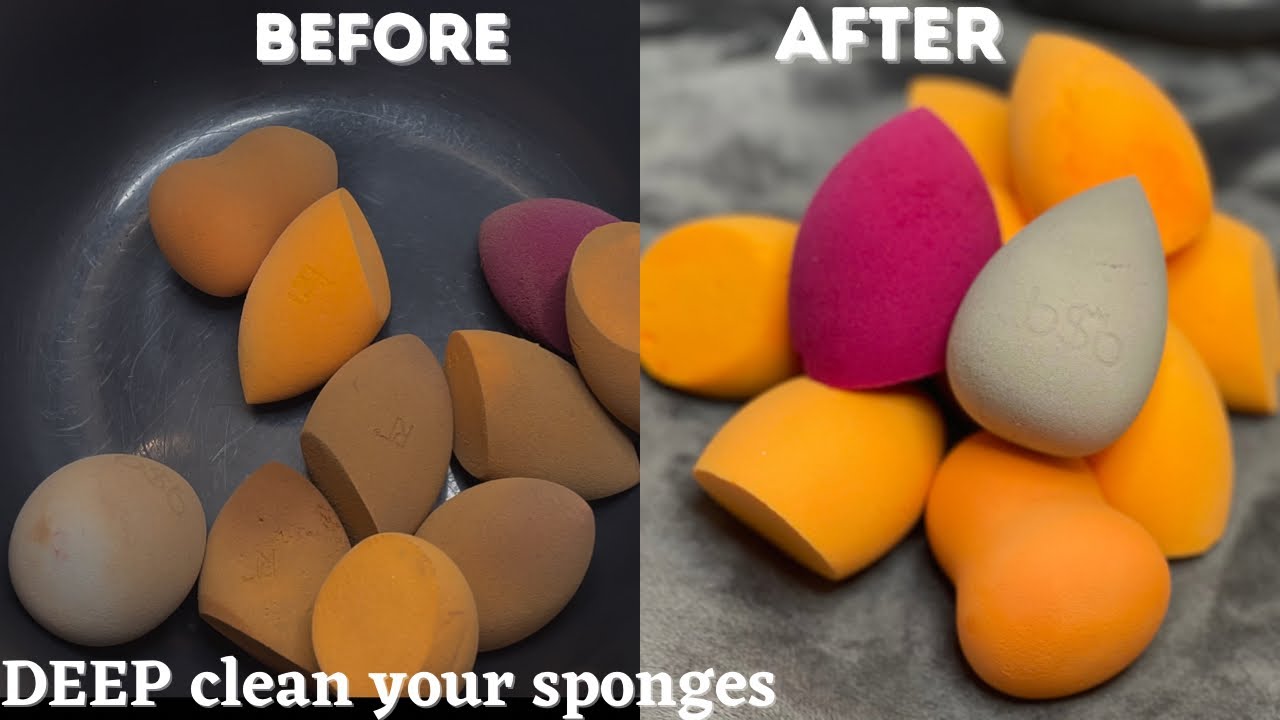
A foam puff behaves like a sponge, so treat it like one. The routine for cleaning a makeup sponge carries over almost step for step.
Material matters less than moisture. A 2003 study by Corazza and Virgili found that humidity and temperature favored bacterial growth more than the sponge material itself, comparing cellulose and nylon sponges.
Soko Glam’s method for cushion compact puffs shows the extra step foam needs. Work an oil cleanser into the puff first, add warm water and wash out the foundation gently, then follow with a drop of face wash and rinse again.
Machine washing in a mesh bag
Put the puff in a lingerie bag, and keep the ribbon from taking strain. Laura Mercier and Rosy Rosa both specify the bag.
Keep dark clothing out of the load and pick the gentlest cycle your machine has.
For a puff with a stitched ribbon, hand washing is the safer call. The machine is a convenience for velour puffs that brands already clear for it.
Drying and Storing a Washed Powder Puff

Lay the puff flat on a clean towel, or hang it where air moves and direct sun does not reach, and leave it until the pile is dry through to the base.
Typology’s care note says flat drying keeps the puff’s shape, and Rosy Rosa specifies a shaded spot.
The Aston University study in the Journal of Applied Microbiology (Bashir and Lambert, 2020) put the average bacterial load on used beauty blenders above 1 million CFU per ml, against 100 to 1,000 on the other product types. The researchers tied that to sponges being left damp after use.
That study covered foam blenders, not fabric puffs. It shows what damp storage costs, not a measured rate for velour.
Lying flat on a towel keeps the shape and lets air reach the underside. Puffs with a loop or strap can hang in airflow instead.
Skip the hair dryer or heater on foam, since 100% Pure notes that heat cracks sponge material over time. And don’t shut a damp puff into a closed compact or makeup bag, which invites mold and bacterial growth.
No brand page I reviewed gives a drying time in hours, so go by feel. The puff is ready when the base of the pile and the center have no cool, damp spot.
Wash it in the evening and it has a full night to dry.
For storage, makeup artist Hart told NBC Select he keeps sponges and puffs in a mesh bag so they stay aired out. Corazza and Virgili reached the same conclusion for sponges, which is to dry them completely and store them dry.
How Often Should You Wash a Powder Puff?

Once a week is the working rule for a puff used most days, and every two weeks is the floor for lighter use. The sources split on the top end, from after every use to once a week.
Wander Beauty says sponges should be washed after every use. NBC Select quotes makeup artist Hart saying puffs need washing at the same pace as sponges and brushes.
MyDr’s hygiene guide sets once a week as a goal, with heavier makeup users washing more often. IT Cosmetics gives a window of every 7 to 10 days for brushes, and advice quoted by Healthline for brushes and applicators puts the minimum at twice a month.
None of that guidance was measured on puffs. It is carried over from sponge and brush advice, so treat weekly as a cautious default and not a proven threshold.
What builds up between washes
Natural oils, dead skin cells, dirt and bacteria collect on a makeup tool and go back onto the skin with every use (Wander Beauty).
The Aston University team named Staphylococcus aureus, Escherichia coli and Citrobacter freundii as the main bacteria on used products. A 2025 survey-and-culture study of used brushes and blenders in Jeddah found Micrococcus and Staphylococcus most common (Attar and Imam, International Journal of Microbiology).
What the research says about frequency
- 79 to 90% of used cosmetic products in the Aston University sample carried bacteria (Journal of Applied Microbiology, 2020)
- 93% of the beauty blenders in that sample had never been cleaned (same study)
- In the Jeddah survey, 44.3% of 370 makeup users rarely clean their brushes (International Journal of Microbiology, 2025)
- Only 8.6% of that same group clean after every use
Sources quote the Aston range two ways, 79 to 90 and 70 to 90 percent. The journal abstract says 79 to 90.
Read together, the figures show that most people wash rarely and that the worst contamination sits on damp foam. Neither result is a measurement of a dry velour puff.
When to Replace a Powder Puff
Replace a puff every one to two months, or sooner when it shows wear, according to Morphe’s care card for its puffs.
Sponge guidance runs longer. L’Oreal Paris says every 3 months and Tom’s Guide says every 3 to 6 months. Brushes have no fixed timeline, and Hart tells NBC Select that well-kept brushes can last decades.
Puffs cost little next to brushes, which makes the short interval easy to follow. Condition beats calendar, though.
Signs a puff has worn out
- Stains that survive a wash (a makeup artist quoted by Essence retires a sponge when darker stains won’t lift)
- Pieces breaking off a foam puff
- A pile that has matted flat
- A loose or frayed ribbon
- A smell that comes back after washing
Only the first two come with a source. No study sets a threshold for matting or odor, so the rest are judgment calls.
Retire the puff when it fails that list, even if it is three weeks old. For everything else, set a reminder at the two-month mark.
When Washing Damages a Powder Puff or Does Not Help
Washing removes buildup. It does not repair a worn puff, and it does not promise clear skin.
Washing does not guarantee clear skin
In the Jeddah survey (Attar and Imam, International Journal of Microbiology, 2025), 27.8% of 370 users reported skin problems they suspected were linked to makeup. The authors found no statistically significant association between cleaning frequency and those problems (p = 0.698).
They point to storage and sharing habits, and how rarely tools get disinfected, as possibly bigger factors. The survey was self-reported and covered brushes and blenders, not puffs.
Dermatologist Debra Jaliman takes the opposite view for sponges, telling AOL that a dirty one can transfer bacteria and cause clogged pores and acne flare-ups. Both can be true. Dirty tools may contribute, and cleaning frequency alone may still fail to predict who breaks out.
Wash a puff for hygiene and cleaner application. Don’t count on it to fix a breakout.
When to retire a puff instead of washing it
Dermatologist Sonia Badreshia-Bansal says damaged sponges harbor more bacteria and are harder to sanitize. A damaged puff isn’t worth another wash.
Attar and Imam note that even thoroughly sanitized brushes and tools can pass on bacteria when they touch breaks in the skin. Use a fresh puff, or none, over cuts and open blemishes.
There is also a gap in the evidence. The studies cited here tested blenders and brushes, not fabric puffs, so any claim that a washed puff is clean enough rests on that gap.
Powder Puff Cleaning FAQ
Can you share a powder puff?
No. The FDA warns that another person’s bacteria may be hazardous to you, and MyDr’s hygiene guide notes that everyone carries different microbes on their skin.
Give each person a separate puff.
Why does a powder puff still smell after washing?
Moisture trapped in the pile or soap left in it is the usual cause. Rinse until no suds remain, dry the puff fully, and keep it out of a closed compact or makeup bag while damp (100% Pure notes that damp storage invites mold).
If the smell returns after a second wash, replace the puff.
Can a powder puff go in the dryer?
No. Typology, Morphe and Rosy Rosa all specify air drying, and none of the puff care pages reviewed approves a tumble dryer.
Skip the heat and lay the puff flat on a towel.
Do puffs for body powder or talc wash differently?
No, the method is the same. Retailer listings for velour puffs sold for talcum and body powder give the same hand-wash or machine-wash instructions as face puffs.
Larger body puffs hold more water, so squeeze them out well and allow longer to dry.
Keeping a Clean Powder Puff Ready Every Day
A second powder puff keeps a clean, dry puff ready every day, because one dries while the other is in use. Tom’s Guide gives the same advice for sponges, which take longer to dry than brushes.
Buy the second puff first, since a single puff leaves no dry option on wash day and a puff put back damp undoes the wash. After that, pick one wash day each week and swap puffs after every wash.
Counted at one wash a week, a 1 to 2 month replacement window gives a single puff roughly 4 to 9 washes before retirement. In rotation, each puff takes about half that.
The catch is a second puff to buy and keep clean.

She started writing on the site after fielding the same questions from clients and friends often enough to just write the answers down: which red won't turn orange on a warm undertone, how to keep lipstick from feathering into fine lines, why a "12-hour" formula rarely survives dinner.
Every review on the site follows the same rule she uses with paying clients: wear it first, then decide if it's worth recommending.
- How to Make Eyeliner Last Longer Without Smudging - August 31, 2026
- How to Make Eyeshadow Last Longer All Day - August 29, 2026
- How to Find Your Undertone in 5 Easy Steps - August 27, 2026