Most people have never cleaned their makeup. Only 6.4% of the 467 used products in an Aston University study had ever been cleaned, and none of the mascaras had (Bashir and Lambert, Journal of Applied Microbiology, 2019).
For pressed powders, lipsticks, cream products and pencils, fixing that takes a couple of minutes. Scrape off the top layer, wet the surface with 70% isopropyl alcohol, and let it dry on its own.
Mascara and other liquid eye products are a different story. Alcohol can’t reach the inside of the tube, so those get replaced on a schedule.
The Basic Sanitizing Routine, Step by Step

The same sequence works on nearly every solid or creamy product, and the order matters more than the brand of alcohol. Skip the scraping and the alcohol lands on a film of oil and skin cells instead of the product.
You’ll need 70% isopropyl alcohol in a fine-mist spray bottle, clean tissues or a lint-free cloth, cotton swabs, and a small cup for dipping.
- Remove the top layer. Scrape a thin layer off pressed powder with a tissue, or twist up a lipstick and wipe the bullet.
- Wet the surface. Mist powders and creams from a few inches away. Dip lipstick bullets and pencil tips briefly.
- Leave it alone. No blotting or rubbing while the surface is wet.
- Let it air dry completely. The alcohol evaporates on its own, and no lid goes back on until it has.
- Wipe the packaging. Run an alcohol-dampened swab over caps, nozzles and pot rims.
Wash your hands first. FDA’s eye cosmetic guidance points out that bacteria on your hands can cause an eye infection if they reach the eye, and that any tool used near the eye should be clean.
The most common slip is closing a palette over wet alcohol. That traps moisture inside the pan, which is the opposite of the goal.
What Bacteria and Fungi Live on Used Makeup?
Skin staphylococci turn up on used makeup, along with gut bacteria such as E. coli and Citrobacter freundii, Pseudomonas species and fungi. Most of it comes from the user’s own hands and face, or from the tools that touched them.
The strongest dataset is a 2019 paper by Amreen Bashir and Peter Lambert of Aston University, published in the Journal of Applied Microbiology. They cultured 467 donated products: 96 lipsticks, 92 eyeliners, 93 mascaras, 107 lip glosses and 79 beauty blenders.
Bacteria grew on 72% of used lip glosses and 92% of used beauty blenders, with the other three product types in between. Beauty blenders also averaged more than 1 million CFU per ml, against 100 to 1,000 for the other products, and 57% of them (56.96%) carried fungi.
On top of that, 93% of beauty blenders had never been cleaned, and 64% had been dropped on the floor and kept in use. Nobody should be surprised by those counts.
The researchers identified a long list of organisms. These are the ones worth knowing about:
- Staphylococcus aureus is a skin organism, and the paper ties it to conjunctivitis and impetigo through earlier work.
- Escherichia coli, a gut bacterium, was confirmed in beauty blenders and eyeliner. The authors read it as a sign of poor hand hygiene.
- Citrobacter freundii lives in water, soil and the gut, and it was detected in lipstick and lip gloss.
- Pseudomonas aeruginosa showed up in beauty blenders. It’s an opportunistic pathogen that can infect through cuts or skin abrasions.
- Fungi were present in every product type, including Candida glabrata in a lip gloss sample.
The team found no correlation between how long a product had been in use and how contaminated it was, so a young product is not automatically clean. Cleaning was rare, too. Only a small share of samples had ever been cleaned, and none of the mascaras had.
The study measured contamination, not illness. The authors also state that it did not test whether cleaning methods change microbial counts, so it makes the case for hygiene without validating any particular sanitizing method.
For eyes the stakes are higher. FDA says an infection from an eye cosmetic has, in rare cases, temporarily or permanently blinded users, and it tells anyone who develops an eye infection to discard the eye products they were using.
Which Alcohol Works Best, and How Long Does It Need to Sit?

Go with 70% isopropyl alcohol. The water in the mix helps alcohol denature microbial proteins and slows evaporation. The CDC puts the optimum range at 60% to 90% alcohol in water and notes that killing power drops sharply below 50%.
70%, 91% or 99% isopropyl alcohol
| Strength | Water in the mix | What the CDC says | Use on makeup |
|---|---|---|---|
| 70% isopropyl | About 30% | Inside the 60% to 90% optimum range | Default for sprays and dips |
| 91% isopropyl | About 9% | Just above the optimum range | Works if it is all you have, with less margin |
| 99% isopropyl | About 1% | Absolute alcohol is less bactericidal (shown for ethyl) | Skip for sanitizing |
The CDC explains the mechanism this way: proteins denature faster in the presence of water. A drugstore bottle labeled rubbing alcohol is usually the 70% version, so the default is easy to find.
Contact time and drying
In the CDC’s summary of suspension tests, ethyl alcohol at 60% to 95% killed Staphylococcus aureus in 10 seconds, and isopropyl alcohol was slightly more bactericidal than ethyl alcohol against E. coli and S. aureus. On a real surface it gets messier. Alcohol evaporates fast, and the CDC says that makes extended exposure difficult unless the item is immersed.
So mist until the surface looks wet, then leave it untouched until it dries. Pencil tips and lipstick bullets get dipped, since immersion gives the longest exposure.
The CDC guideline (2008, page last reviewed November 2023) sets no contact time for cosmetics. The seconds quoted in makeup guides are practice, not a tested standard.
Ethyl alcohol, commercial sprays and alcohol-free options
Ethyl and isopropyl alcohol both qualify under the CDC’s description. Ethyl alcohol at 60% to 80% also inactivates lipophilic viruses, including herpes simplex, though it does not reach hepatitis A virus or poliovirus.
Cold sore virus is the usual worry with shared lip products, and how long the cold sore virus survives on lipstick is a separate question from whether alcohol kills it.
Commercial makeup sanitizers are a mixed bag. One brand, Beauty So Clean, said in a 2013 interview that its formula blends alcohol with emollients because plain alcohol can dry creams and shift lipstick pigment. That is a manufacturer claim. Some users report that plain alcohol works fine on their makeup, and the sources reviewed hold no independent test either way.
The CDC places quaternary ammonium compounds in routine sanitation of noncritical surfaces such as floors, furniture and walls. They are not sporicidal and are not reliable against hydrophilic viruses, and no source reviewed validates them on product that touches lips or eyes. Reserve them for hard tools, not product.
How to Sanitize Powders, Creams, Lip Products and Pencils

Powders get a surface scrape and a light mist. For lipsticks it’s a wipe and a quick dip. Creams and pumps only get their surface misted and their nozzle wiped, and pencils are sharpened before any alcohol goes near them.
| Product | Method | Verdict |
|---|---|---|
| Pressed powder, eyeshadow | Scrape top layer, light mist, air dry | Sanitize |
| Lipstick, cream sticks | Wipe bullet, brief dip or mist, air dry | Sanitize |
| Cream pots, gel liners | Wipe or blot surface, light mist | Sanitize the surface only |
| Pump foundation, lip gloss | Wipe nozzle and cap with alcohol | Outside only, replace sooner |
| Pencils | Sharpen, then mist or dip the tip | Sanitize |
Powders and palettes
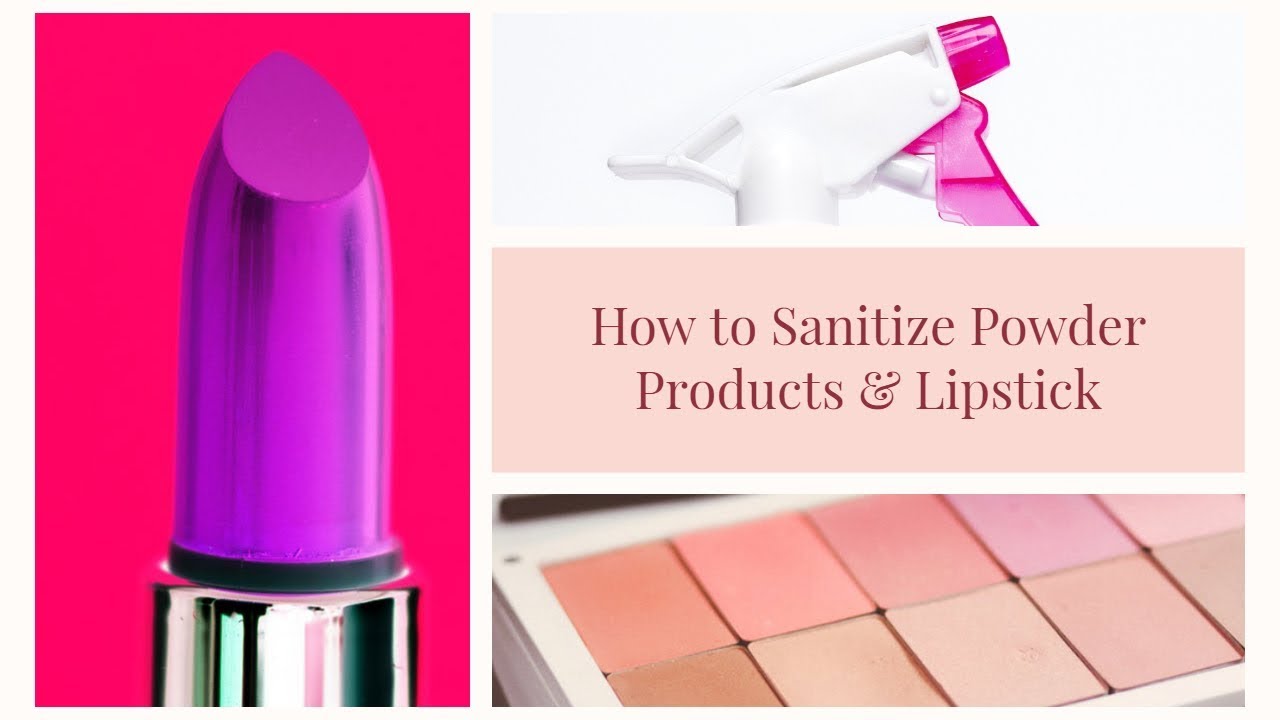
Scrape or wipe the top layer, hold the spray a few inches back, and mist lightly. Let the pan dry fully before closing it.
One Beautylish contributor argues dry powders need no alcohol at all, while L Makeup Institute and a New Beauty guide both treat powders as a regular sanitizing job. If you share makeup, work on other people’s faces or have been ill, spraying is the safer call.
Lipstick and cream sticks

Twist the bullet up and take the surface layer off with a tissue. Then give it a brief dip in a small cup of alcohol, which covers the whole bullet, or mist it if the shape is awkward. Let it air dry and wipe the tube and the inside of the cap.
Anyone who wants the full cup-and-bullet routine can follow a separate walkthrough on sanitizing a lipstick.
Cream pots, liquids and pumps

Alcohol cannot reach the inside of a tube or a pump bottle. For those, wipe the nozzle, cap and rim, and treat the product itself as something you replace rather than treat.
Lip gloss deserves extra caution. In the Aston study it carried the highest Enterobacteriaceae load of any product tested, and its contents cannot be sanitized from the outside.
Keep the alcohol on the surface and out of the formula. FDA warns that adding water to eye cosmetics brings in bacteria and dilutes the preservative, and the same logic argues against thinning any product with a sanitizer.
Pencils and sharpeners
Sharpen first. Then mist or dip the exposed tip, and wipe the sharpener blade with alcohol too.
Sharpening on its own does not sanitize a pencil, according to L Makeup Institute. It only removes the outer layer, so the alcohol step still has to follow.
Lip liners sharpen like any other pencil, and the right way to sharpen a lip liner has its own guide. Keep lip and eye pencils separate. FDA advises against using a lip liner as an eyeliner, since bacteria from the mouth can reach the eye.
Brushes, Sponges and Applicators Need Washing First

Tools get washed with soap and water first, then dried completely. Anything that touches eyes, lips or broken skin gets sanitized after that. Skip the wash and the alcohol has to work through a layer of product and skin oil.
A 2021 Journal of Cosmetic Science study tested reusable applicators and found that bactericidal soap cut bacterial colonies on sponge samples from 617 (water alone) to 3, and 70% ethanol eliminated 100% of bacterial growth.
Disinfection worked better on applicators used for dry product, such as a natural brush, than on sponges and synthetic brushes that carry wet product. Sponges are the hardest tool to get right and the cheapest to replace.
For brushes, rinse under lukewarm running water, lather with a brush cleanser or mild soap, rinse again, and dry flat with the tips hanging off the counter edge, as the American Academy of Dermatology advises. A final alcohol pass makes sense for lip and eye brushes and for any brush another person has touched, and a full guide to washing makeup brushes covers the technique.
Sponges get squeezed until the water runs clear, then dried fully. The Aston paper warns that warm soapy water encourages microbial growth if the sponge stays damp afterward, and there is a separate walkthrough on cleaning a makeup sponge step by step.
No regulator sets a replacement date. L’Oreal Paris advises swapping sponges every three months, other cleaning guides run from one to six months, and the Cleveland Clinic ties brush replacement to wear (frayed, worn or misshapen bristles go).
How Often Does Makeup Need Sanitizing?
No health authority publishes a sanitizing interval for makeup. The FDA and AAO pages reviewed set replacement dates only, so every schedule here comes from dermatologists, artists or brands.
Routine personal use
For products only you use, Project Vanity’s makeup sanitation guide says monthly. New Beauty says every few weeks for eye makeup. The founder of Beauty So Clean says every other day, which is a manufacturer’s recommendation.
Tools run on a tighter clock. The American Academy of Dermatology recommends washing brushes every 7 to 10 days and sponges after every use. The Cleveland Clinic disagrees on dry-product brushes, saying powder and blush brushes can wait a month while eye-area brushes need washing more often.
The sources overlap on one schedule: eye and lip products every few weeks to monthly, brushes every 7 to 10 days, sponges after each use.
Dermatologists in the AAD guidance also recommend closing caps and lids securely after every use. Heat and moisture do the rest of the damage, and FDA notes that heat breaks down preservatives, which is why storing makeup away from hot cars and steamy bathrooms stretches the time between sanitizing sessions.
After sharing or illness
Sanitize at once. Do not wait for the monthly cycle.
L Makeup Institute and New Beauty both single out sharing and illness as triggers. After a cold or stomach bug, wash tools and sanitize lip products and anything that touched your face.
Eye involvement changes the rule entirely, and the discard guidance below applies instead.
Sanitizing Makeup Between Clients

Professionals sanitize or replace anything that touched a face between clients. To avoid double dipping they use spatulas and mixing palettes, plus single-use applicators wherever possible.
| Item | Between clients | Basis |
|---|---|---|
| Spatulas, tweezers, curlers | Wash, dry, immerse in an EPA-registered disinfectant | California Title 16, Section 979 |
| Sponges, cotton pads | Single use, then discard | California Title 16, Section 981 |
| Lipstick, gloss | Spatula onto a mixing palette, lip brush to apply | Artist practice (James Vincent) |
| Mascara | Disposable wand, no double dipping | Artist practice (James Vincent) |
The California rules cover licensed establishments, current through March 2024. Other states write their own, so your state board of cosmetology is the reference that counts.
Shared kits show why the rules exist. Dadashi and Dehghanzadeh (Health Promotion Perspectives, 2016) sampled 52 in-use shared products from 10 salons in Tabriz, and every product carried bacteria while 19.2% carried fungi or yeast.
Professional guidance doesn’t fully agree with itself. James Vincent, writing on Beautylish, says sharpening a pencil between clients sanitizes it, while L Makeup Institute says sharpening alone does not.
Vincent also recommends isopropyl alcohol at 90% or higher for hard tools, against the 70% default used for product above. His 90% reaches the top edge of the CDC’s 60% to 90% optimum range, and anything higher falls outside it, so 70% remains the safer default.
UV cabinets do not solve it either, since California’s board states that it does not recognize UV sterilizer units as an approved disinfection method. Hard tools like curlers follow the same logic, and the steps for sanitizing an eyelash curler fit that routine.
When Sanitizing Does Not Work and Makeup Should Go in the Trash

Sanitizing stops working once the contamination is inside the product. It also struggles with organisms that alcohol handles slowly, and it’s no help after an infection has already taken hold.
Mascara and liquid eye products
Sources don’t agree on mascara. L Makeup Institute says to wipe the wand across an alcohol-soaked paper towel, and MasterClass says to avoid sanitizing wands directly. FDA says manufacturers usually recommend discarding mascara two to four months after purchase, a range that appears on both its eye cosmetic safety page and its shelf life page.
FDA’s reasoning favors replacement. Mascara wands are exposed to bacteria and fungi on every use, and alcohol on a wand never reaches the tube.
A Brazilian study of mascaras worn by university students (International Journal of Cosmetic Science, 2013) found Staphylococcus aureus in 79% of 40 samples.
Dry mascara goes in the trash, and FDA warns against adding water or saliva to revive it. The specifics of how long a tube of mascara lasts have their own breakdown.
What alcohol cannot do
The CDC states that alcohols do not destroy bacterial spores. Alcohol also cannot penetrate protein-rich material, which is why the top layer comes off first.
Fungi are another gap. The CDC guideline notes that the culture phase of several pathogenic fungi needed about 20 minutes of exposure to ethyl alcohol, against under a minute for the tissue phase, so a quick mist does not clear mold.
Preservatives are the last piece. Surface sanitizing lowers the microbe load but does not rebuild a preservative system. FDA says preservatives break down over time, and the Aston paper notes that expiry dates track how long the preservatives can control contamination.
Signs a product is done
- A change in smell, color or texture, which FDA ties to heat, sunlight and air
- Separated emulsions, or product that has dried and cracked
- Visible mold, such as mold on a lipstick bullet
- Any eye infection, after which every eye product in use goes
- Product that is past the period after opening (PAO) symbol
The PAO symbol is an open jar with a number and the letter M (3M, 6M, 12M, 18M, 24M or 36M) marking months of use after opening, per the Aston paper. The AAD notes that PAO information is not required on US cosmetics, and FDA confirms that no US law requires expiration dates, so many products carry neither.
Without a symbol, go by the intervals above and by the product itself.
Common Questions About Sanitizing Makeup
What is the difference between sanitizing, disinfecting and sterilizing makeup?
Washing takes off visible product and oil. Sanitizing lowers the microbe count on a surface, and disinfecting uses chemicals to destroy pathogens on tools. Sterilizing kills everything, spores included, and alcohol can’t reach that level because the CDC states that alcohols do not destroy bacterial spores.
Can you sanitize used makeup before selling or swapping it?
Yes, for most products. Swap communities such as r/makeupexchange recommend misting pressed powders and cream pans with 70% to 90% isopropyl alcohol, dipping lipsticks, and sharpening then dipping pencils.
Skip mascara, which sanitizing cannot reach. FDA also warns that resold products may be past shelf life, diluted or tampered with, so tell buyers what you did.
How should you handle lipstick testers in a store?
Keep them off your lips. FDA says store testers are more likely to be contaminated than the same products at home, and it advises applying with a new, unused applicator such as a fresh cotton swab.
Beautylish describes the counter routine as shaving the top layer, misting with alcohol and wiping, which is no substitute for a fresh applicator.
Does UV light sanitize makeup?
No source reviewed tests UV light on makeup. California’s Board of Barbering and Cosmetology does not recognize UV sterilizer units as an approved disinfection method for tools, so washing plus alcohol remain the documented routes.
UV also treats only the surfaces the light reaches.
How do you sanitize a makeup bag or case?
Empty it first, then wipe a hard case inside and out with a cloth dampened with 70% isopropyl alcohol and let it air dry. Wash fabric bags according to the care label.
The CDC notes that repeated alcohol use can swell or harden some rubber and plastics, so test a small corner of the case lining first.
A Realistic Routine for Sanitizing Makeup
Eye products come first. Mascara and liquid eye products should be replaced within two to four months of purchase, the range FDA says manufacturers usually recommend. Sponges and brushes get washed and dried completely, and lips and powders get sanitized monthly.
Eye products rank first because alcohol cannot reach the inside of a tube, and FDA notes that an eye cosmetic infection has, in rare cases, blinded users. Tools come second because they touch skin daily, and surface products come last because a mist and a wipe reach everything on them.
The trade-off is product. Each scrape removes a thin top layer, so the routine costs a little pigment along with a few minutes, and the only recurring supplies are 70% isopropyl alcohol, tissues and swabs.
This sequence rests on the CDC guideline (page reviewed November 2023) and FDA pages current as of February 2022 (shelf life) and June 2022 (eye cosmetic safety), verified in October 2026. A revised FDA or AAO interval for eye products would change the first step, and pencil and liquid liners follow their own timelines, covered in a guide to how long eyeliner lasts.

She started writing on the site after fielding the same questions from clients and friends often enough to just write the answers down: which red won't turn orange on a warm undertone, how to keep lipstick from feathering into fine lines, why a "12-hour" formula rarely survives dinner.
Every review on the site follows the same rule she uses with paying clients: wear it first, then decide if it's worth recommending.
- How to Make Eyeliner Last Longer Without Smudging - August 31, 2026
- How to Make Eyeshadow Last Longer All Day - August 29, 2026
- How to Find Your Undertone in 5 Easy Steps - August 27, 2026