A quart bag isn’t actually the hard part of packing makeup for a flight. Most of the damage happens afterward, once cabin pressure and a fully loaded suitcase start working on anything that wasn’t sealed properly.
TSA and your airline set the rules, but clearing the checkpoint doesn’t mean a container is safe for the rest of the trip. A bottle can pass screening without issue and still fail somewhere over the ocean.
A standard TSA-compliant liquids bag measures roughly 7 to 7.5 by 8 inches, according to travel-packing resources like ChoosePack. That’s smaller than it sounds once a couple of bottles, a compact, and a lipstick tube are all competing for space inside it.
What Packing Makeup for Travel Actually Involves

General toiletry packing doesn’t carry this same weight. A regular wash bag doesn’t have to deal with nearly as much glass, pressed powder, or heat-sensitive cream per square inch as a makeup bag does.
What actually shapes the packing decisions is a mix of things: how much TSA lets through in liquid form, what the airline allows in a carry-on, and whether a checked bag’s temperature swings will wreck a pressed compact before you land. None of those constraints work the same way twice.
The process branches depending on the trip. A long weekend with only a carry-on demands a different kit than a two-week trip where checking a bag was already part of the plan.
How the TSA Liquid Rule Applies to Makeup

Every liquid, gel, cream, or aerosol in your carry-on falls under the same cap: 3.4 ounces (100 milliliters) per container, all of it fitting inside one quart-size, clear, resealable bag. That’s the TSA 3-1-1 rule, and it’s the reason a bottle of foundation sometimes gets pulled at the checkpoint while a stick concealer sails through without a second look.
A few specifics are worth pinning down. The container limit is 3.4 ounces or less per item, the bag has to be quart-size and clear, and each passenger gets one liquids bag. The rule itself has been in effect at U.S. checkpoints since 2006, so it isn’t new, just easy to forget the exact numbers on.
TSA measures the container, not what’s left inside it. A half-used 6-ounce bottle of liquid highlighter gets pulled even with only an ounce left in it.
TSA PreCheck changes shoe and laptop screening. It doesn’t raise the liquid limit or remove the quart-bag requirement.
Checked luggage carries no 3.4-ounce cap at all. That’s why a full-size bottle of setting spray belongs in a checked bag, not squeezed into a carry-on quart bag.
Which Makeup Products Count as Liquids Under TSA Rules
TSA’s actual test has nothing to do with what a product looks like on the shelf. If you can pour it, pump it, or smear it onto skin, it counts as a liquid, gel, or paste.
Foundation, mascara, and lip products split hard along format lines. A tube of liquid lip color falls under the cap every time, no matter how small the tube is.
A cream-based lip color gets treated the same way, even when it comes packaged as a twist-up bullet that doesn’t look like a liquid at all.
| Product | TSA Status | Container Note |
|---|---|---|
| Liquid foundation | Counts as liquid | Must be 3.4 oz or less |
| Cream blush or highlighter | Counts as liquid | Gels and creams are treated the same as liquids |
| Pressed powder | Exempt | No volume cap applies |
| Stick foundation or concealer | Exempt | Solid format, any size allowed |
| Pencil eyeliner or lip liner | Exempt | Solid format, no cap |
Balm-based contour sticks cause more confusion than anything else in a makeup bag. If it smears onto a finger like a cream, treat it as though it counts toward the liquid cap. Better to be wrong and safe than wrong and stuck repacking at security.
Why Makeup Leaks or Breaks in Luggage
Most aircraft hold cabin pressure at the equivalent of 6,000 to 8,000 feet of altitude, well below sea-level pressure. That gap is what pushes trapped air out of a sealed bottle mid-flight.
A bottle capped at ground level holds air at ground-level pressure. As the plane climbs, that trapped air expands and pushes product past the seal, which is why a tightly closed lotion bottle can arrive half empty.
A few different things happen at once, and they compound each other. Pressure and temperature swings expand trapped air inside bottles and pressed-powder compacts. Weight from surrounding luggage compresses glass bottles and powder pans until they crack. And heat sitting on the tarmac, or inside a checked hold, softens cream and liquid formulas before the bag ever gets opened.
Checked bags absorb most of this risk, and it shows up in the industry’s own numbers. Damaged or pilfered items make up 18% of all mishandled bags industry-wide, according to SITA’s 2025 Baggage IT Insights report.
A cracked lipstick bullet is one of the more common casualties, and it doesn’t always mean the end of the tube. There are ways to repair a broken lipstick rather than replace it, worth knowing before you toss a snapped bullet in the hotel trash.
Best Containers for Packing Liquid Makeup
If there’s one upgrade worth making before a trip, it’s swapping factory bottles for something built to handle a pressure change. Silicone squeeze bottles are the most common fix. Magnetic capsule systems and PET travel jars solve for different product types entirely, and which one makes sense depends on what you’re actually packing.
Silicone squeeze bottles, like the ones made by GoToob, use a double-cap seal that holds up better under pressure change than a standard flip-top.
| Container Type | Best For | Leak Resistance | Typical Cost |
|---|---|---|---|
| Silicone squeeze bottles (GoToob) | Lotion, foundation, cleanser | High, double-cap seal | Mid-range, less than Cadence |
| Magnetic capsule systems (Cadence) | Decanted skincare and serums | High, magnetic snap seal | $14 to $16 per capsule |
| PET travel jars | Cream products, balms | Moderate, screw-top only | Budget |
| Store-bought travel minis (Muji, Target) | One-time or short trips | Moderate, factory seal | Budget |
Fill level matters as much as the container itself. Leave a small air gap in every bottle. One filled to the very top has nowhere for expanding air to go except out through the seal.
A single Cadence Capsule runs $14 to $16 apiece, according to a 2023 CNN Underscored review. That’s steep next to a multi-pack of GoToob bottles covering the same job. Reusable containers still pay for themselves after two or three trips, assuming you actually refill them from a full-size bottle at home instead of grabbing new minis every time you fly.
Swapping Liquid Makeup for Travel-Friendly Formats
Foundation is the easiest swap to make before a trip. Stick foundation skips the 3.4-ounce limit entirely and removes the leak risk that comes with a pump bottle, which makes it the obvious pick for anyone traveling carry-on only.
Powder works the same way, pressed instead of loose. No cap to worry about, and no dusting everything inside your bag if the compact happens to pop open.
Fragrance is a little different. A solid perfume or balm doesn’t spray, so it survives a cracked lid or a hard landing on a suitcase belt far better than a glass atomizer ever will.
Not every liquid has a solid equivalent worth using. Lip color is the easiest category to swap, since the different lipstick formats perform almost identically whether the product is a liquid, a cream, or a solid bullet.
Foundation is trickier in the other direction. A color-matched liquid or serum foundation often has no stick version in the same shade, and forcing the swap just to save space isn’t worth showing up with the wrong tone on your face.
Choosing a Toiletry Bag or Makeup Organizer for Travel

The right organizer depends on trip length and what your bathroom setup looks like at the other end: a hotel counter, a shared hostel sink, or a friend’s guest room with no counter space at all.
Water-resistant lining matters more here than in a general toiletry bag, since makeup breaks and leaks more often than shampoo does. The same logic that governs how you store makeup at home (upright, away from heat, sorted by type) carries over directly to how you pack it.
Hanging Toiletry Kits
These make the most sense for trips longer than four or five days, assuming you’ll actually have a counter or hook to use at the other end.
A hanging kit unfolds against a wall or door and keeps every product visible at once, which cuts down on digging through a bag half-asleep at 6 a.m.
The upside is real: everything’s visible, both hands are free, and there’s room for a full routine. The tradeoff is bulk. For a carry-on-only weekend, it’s probably more bag than you need.
Flat Zip Pouches
Flat zip pouches pack into any gap in a suitcase and cost less than a structured kit. The catch is that everything sits stacked in layers, so you end up digging for whatever’s at the bottom, usually right when you’re in a hurry. They work best for a minimal, carry-on-only routine, or as a dedicated second pouch that holds nothing but the TSA liquids bag.
CALPAK and Bagsmart both sell versions with a clear front panel, which solves some of the digging problem without adding bulk.
Brush Rolls
A brush roll really only solves one problem: it keeps bristles from bending against everything else packed around them.
It doesn’t hold liquid products at all, so most people pack one alongside a separate quart-size bag rather than relying on it for anything else.
The upside is real protection for brushes you probably didn’t buy cheap. The downside is it’s one more item competing for space in a suitcase that’s already tight.
Carry-On vs Checked Luggage for Makeup
Carry-on is where the irreplaceable stuff goes: anything high-value, color-matched, or capped by the TSA liquid rule. Backups and bulk restocking are a different story. Once you’re checking a bag anyway, there’s no volume limit stopping you from packing full-size everything.
| Factor | Carry-On | Checked |
|---|---|---|
| Fragility risk | Lower, you control the handling | Higher, subject to belt and loader handling |
| Value exposure | Stays with you the whole trip | Out of your hands from check-in to baggage claim |
| Space flexibility | Limited by TSA and airline size rules | Room for full-size and bulk items |
A mishandled bag costs airlines an average of $260 per incident, according to SITA’s 2026 Baggage IT Insights report. That figure reflects the airline’s loss, not yours, but it points to the same math: a checked bag sits outside your control for hours at a stretch.
Airlines like Delta, American, and United all enforce similar standard carry-on dimensions. The real limiting factor is still the TSA liquid rule, not the airline’s size chart.
Keep a minimal kit (a stick foundation, a cream blush, a lip color) in your carry-on regardless of what else you check. If your main bag gets delayed, you can still leave the hotel looking like yourself.
How to Pack Makeup for Travel Step by Step

The process runs in a fixed order: sort by TSA liquid classification, swap or decant where it makes sense, seal everything, then load into the right bag for carry-on or checked placement.
- Sort every product by whether TSA classifies it as a liquid, gel, cream, or solid
- Decant liquids into travel-size containers or swap to a solid format where a good one exists
- Seal every liquid container with a layer of protection, plastic wrap under the cap or tape over a pump
- Load liquids into the quart-size TSA bag and place it somewhere easy to reach at the checkpoint
- Pack the rest into your chosen organizer, then split the load between carry-on and checked based on value and volume
Skipping the sort step is the most common mistake here. Pack on autopilot and a liquid highlighter ends up buried at the bottom of a bag you now have to fully unpack at security.
How to Pack Makeup Brushes for Travel
Brushes travel best in a hard case or roll rather than loose in a bag, since loose bristles bend permanently against everything packed around them.
Wash your brushes before you pack, not after. Bristles need roughly 24 hours to fully air dry, and cleaning them the morning of a flight just guarantees they go into a closed case still damp.
A 2019 study published in the Journal of Applied Microbiology found that 79% to 90% of tested used cosmetic products carried bacterial contamination, including Staphylococcus aureus and E. coli. Packing a brush damp inside a sealed roll gives that bacteria exactly the environment it needs to multiply.
A full guide on how to wash makeup brushes matters more before a trip than it does on a normal week.
The same goes for knowing how to dry makeup brushes fast, since a rushed morning is exactly when brushes get packed still damp.
Metal ferrules are the other weak point. Packed damp and pressed against liquid containers, they rust, a separate problem from bristle bending and just as permanent.
How to Stop Makeup From Leaking in Your Bag
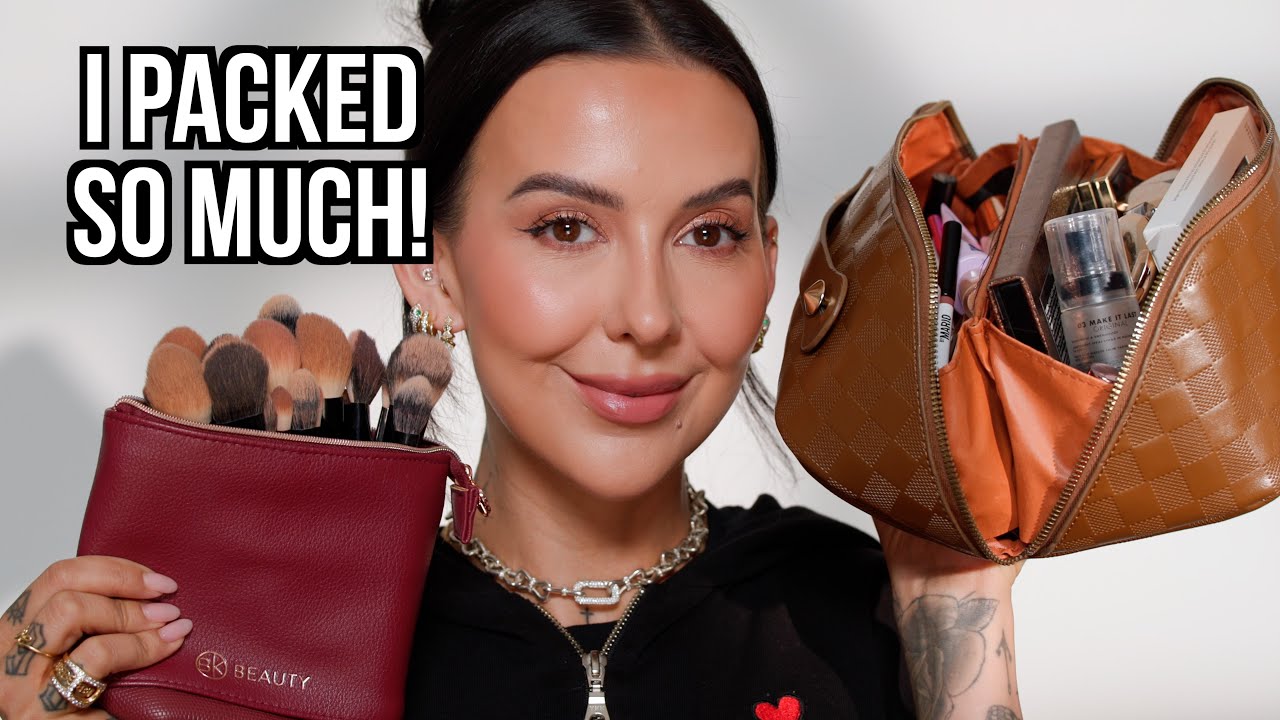
A handful of physical fixes handle most leaks before they happen, and none of them require buying anything expensive.
- Unscrew the cap, lay plastic wrap flat across the opening, then screw the cap back down over it
- Wrap a strip of tape around any pump or flip-top mechanism so it cannot trigger mid-flight
- Tuck a cotton pad inside pressed powder and eyeshadow compacts to absorb shock and catch shattered powder
- Place every liquid item inside a second sealed bag, even ones already inside a good container
The second sealed bag matters more than people think. A standard Ziploc freezer bag catches a leak that a cracked cap or a failed seal would otherwise send straight into your clothes.
Skipping this step is the single biggest reason a good container still fails. A double-cap silicone bottle with no backup bag is still just one drop away from ruining a white shirt.
Packing Makeup for International Flights
The EU’s 100ml liquid rule matches the TSA 3-1-1 rule closely enough that the same containers work in both directions, though the two are separate regulations enforced by separate authorities.
That default is shifting, unevenly. Following recertification of CT scanning equipment by the European Civil Aviation Conference in July 2025, airports with the new scanners can allow containers up to 2 liters instead of 100ml.
Heathrow, Rome Fiumicino, and a handful of other major airports have already made the switch. Most European airports, including major hubs in France and Spain, still enforce the 100ml cap.
The safe assumption, until you’ve checked both your departure and arrival airport, is the older, stricter rule. A duty-free liquid purchased after security stays exempt from the cap only if it remains sealed in its tamper-evident bag with the receipt visible.
Customs declaration applies separately from the security liquid rule. Carrying cosmetics in bulk, more than what reads as personal use, can trigger a declaration requirement even when every bottle sits well under the volume cap.
When Packing Makeup for Travel Goes Wrong
Even a careful packer runs into trouble somewhere, and it usually traces back to a step skipped earlier in this guide.
- A full-size liquid foundation gets left in a carry-on and confiscated at the checkpoint, usually because it was packed before the liquids sort, not after
- A leaked lip gloss ruins a shirt packed next to it, because the item skipped the secondary sealed bag entirely
- A lipstick bullet left in a damp toiletry bag for weeks between trips develops mold, since a closed, humid bag is exactly the environment mold needs
- A brush roll packed still damp leaves bristles bent and ferrules rusted by the time you unpack
- Extreme heat during a long tarmac wait softens cream products no container fully solves for
TSA screened roughly 906.7 million passengers in 2025, according to its own testimony to Congress on January 21, 2026. At that scale, a forgotten liquids bag is a routine event at every checkpoint, not a rare exception.
A leaked lip gloss is one of the more fixable items on this list. There are reliable ways to get lip gloss out of clothes if it happens before you have a chance to repack.
A lipstick that has gone moldy is not fixable the same way. Once you notice the signs of moldy lipstick, the bullet gets thrown out, not wiped off and reused.
A flagged quart bag slows down more than the person carrying it. Every alarm at the checkpoint holds up the line behind them too, the quiet cost of skipping the sort step in the first place.
FAQ on How To Pack Makeup For Travel
Should You Decant Makeup Into Travel Bottles or Buy Travel-Size Minis?
Decanting into reusable silicone bottles costs less over multiple trips and lets you carry exactly what you need.
Store-bought travel-size minis save time before a single trip but add up in cost and plastic waste if you travel often.
Is It Worth Packing Full-Size Makeup Instead of Travel-Size?
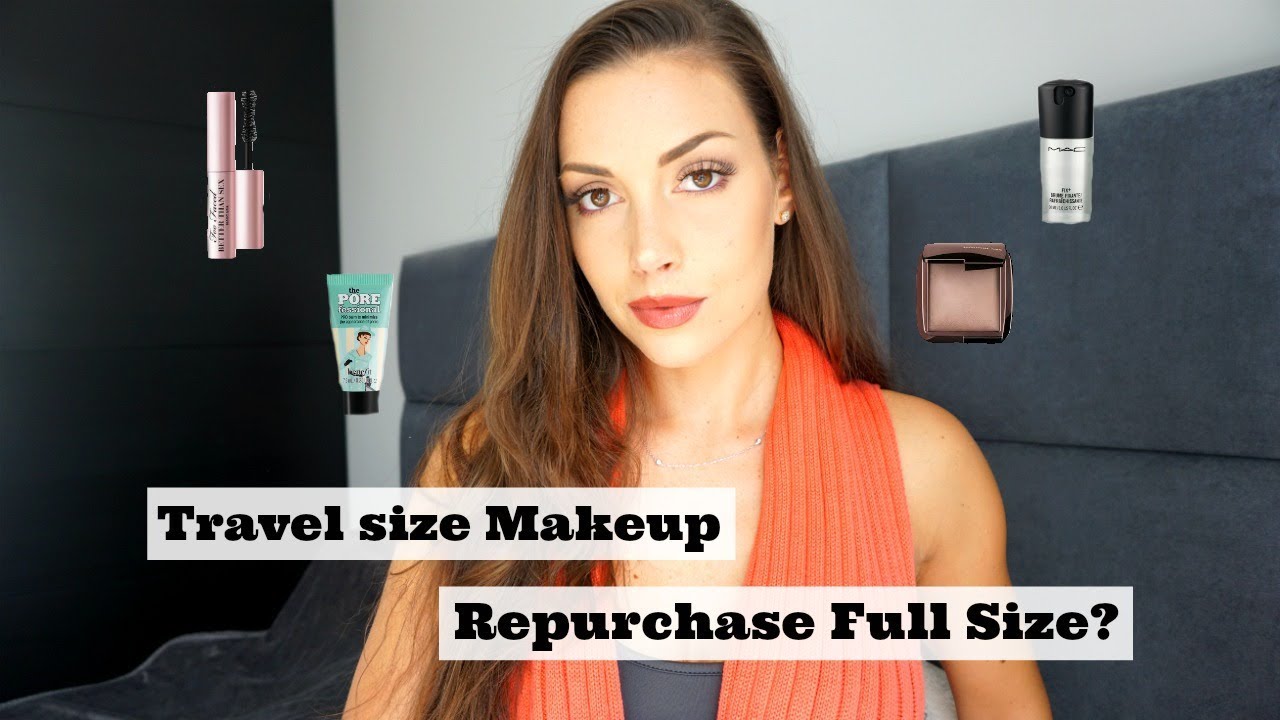
Full-size products make sense for extended stays or shades with no travel-size version, though they eat into checked-bag space and carry higher breakage risk.
Trips under two weeks are usually covered by travel-size or decanted containers instead.
How Long Can Makeup Stay Packed Before It Degrades?
Most liquid and cream formulas handle a week or two of packed storage fine, away from direct heat.
Left in a hot car or sun-baked suitcase for days, oils separate and preservatives break down faster than the label suggests.
Can You Bring Makeup on a Plane With No Checked Bag at All?
Yes, as long as every liquid, cream, or gel item fits the TSA 3-1-1 rule: 3.4 ounces or less per container, all inside one quart-size bag.
Solid formats like stick foundation or pressed powder carry no size limit at all.
What Happens If Your Makeup Bag Gets Flagged at Screening?
A TSA officer pulls the quart bag for a closer look, sometimes swabbing containers for an explosives trace test.
Oversized or unclear items get surrendered on the spot, so pack your liquids bag where you can reach it fast.
What Does Getting How To Pack Makeup For Travel Wrong Actually Cost?
Packing makeup for travel wrong costs more than a confiscated lipstick at the checkpoint. A mishandled checked bag now carries a real dollar cost that airlines track and travelers absorb through delays and replacement purchases.
The industry revised its own baseline in 2026, replacing a long-used $150 estimate per mishandled bag with a new $260 figure, according to SITA’s 2026 Baggage IT Insights report.
Liquid classification matters most, and it has to happen before anything else touches the bag. After that, the container seal is worth checking twice, not once. Carry-on placement comes last, once the first two are already sorted.
Getting the order backward is the tradeoff most travelers accept without noticing: chasing a nicer bag before the seal that actually protects it.
Once you land, sanitizing makeup that traveled through security bins and cabin heat is the logical next step before daily rotation resumes.

She started writing on the site after fielding the same questions from clients and friends often enough to just write the answers down: which red won't turn orange on a warm undertone, how to keep lipstick from feathering into fine lines, why a "12-hour" formula rarely survives dinner.
Every review on the site follows the same rule she uses with paying clients: wear it first, then decide if it's worth recommending.
- How to Make Eyeliner Last Longer Without Smudging - August 31, 2026
- How to Make Eyeshadow Last Longer All Day - August 29, 2026
- How to Find Your Undertone in 5 Easy Steps - August 27, 2026