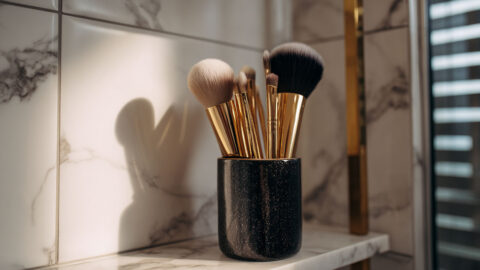
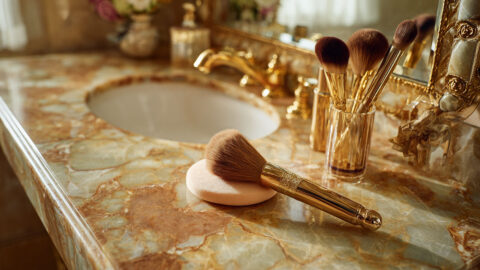
Press as much water as you can out of a washed brush with a towel, then hang it bristles-down where air can reach it. Those two things do most of the work. Heat is the other option and the riskier one, since too much of it breaks down the glue that holds the bristles in the ferrule.
Plain air drying takes 4 to 24 hours depending on the brush (e.l.f. Cosmetics, 2026), from 4 to 6 hours for small eye brushes up to 12 to 24 hours for the large powder ones.
How to Remove Water From Makeup Brushes Before Drying

A brush that goes into drying with less water in it has less to evaporate, and less water working its way toward the ferrule. The way you wash your brushes matters here too, since one rinsed bristles-down shows up at this stage with a drier ferrule.
- Close clean fingers around the bristles and squeeze gently. Never pull.
- Wrap the head in a clean towel, one brush at a time, and press.
- Lay the head on a fresh towel or paper towel and blot until little moisture transfers.
- Smooth the damp bristles back into their original outline with your fingertips.
MasterClass and e.l.f. Cosmetics describe the same sequence, though e.l.f. adds that extra blotting pass on a clean towel after the squeeze.
Microfiber gets a nod from both Sigma Beauty and e.l.f. Cosmetics for squeezing out excess water, and both brands also accept a paper towel, which at least doesn’t need laundering afterward. Sephora UK asks for a lint-free cloth, so any towel that sheds fibers into the bristles is out.
Dense heads hold more water, so they get a second press.
Gentle is the whole technique. e.l.f. Cosmetics warns against wringing or twisting the bristles, and Beautylish brush designer Sonia G. adds that putting pressure on a brush that is not completely dry can alter the stability of the glue area.
Which Drying Position Works Fastest Without Damaging the Ferrule?
Bristles down, or hanging past an edge, with the head sitting lower than the handle. Water runs out through the tips instead of into the ferrule, and every side of the head stays open to moving air.
Sephora UK, makeup.com, e.l.f. Cosmetics and Sigma Beauty all land on this position. Some of them cite airflow for speed, others cite gravity for protecting the glue.
Counter-edge setup and drying rack

The counter version needs a clean towel on a flat surface, handles resting on the towel, and the bristle heads hanging past the edge (makeup.com). A rack does the same job with the brushes at a 45-degree angle and nothing touching the bristles, according to e.l.f. Cosmetics, and MasterClass describes racks that hold brushes bristles-down. Lily Lolo’s care page prefers laying them flat on the side so water does not run into the ferrule.
MasterClass frames the rack as the answer to limited counter space, which is a fair read. A folded towel and a counter edge do the same job for nothing.
Rotate the brushes now and then so no side stays wet.
Why upright drying fails

BK Beauty’s care guide says to lay brushes flat on a towel to dry overnight and never to dry them upright while they are wet.
A brush standing head-up in a cup sends water down the bristles and into the ferrule. That water loosens the glue that holds bristles and handle together and leads to shedding, per makeup.com. Closed containers and makeup bags are no better while the brush is still damp, and e.l.f. Cosmetics adds that closed containers may lengthen drying time and could even create mold.
There is one documented exception. Sigma Beauty states that its patented glue-free construction lets the whole brush be fully saturated. Brushes with a glued ferrule still need the angle.
Once a head is completely dry it can stand upright again, and there are better ways to store makeup brushes so the shape you just saved holds up.
Fast Drying Methods Ranked by Speed and Risk
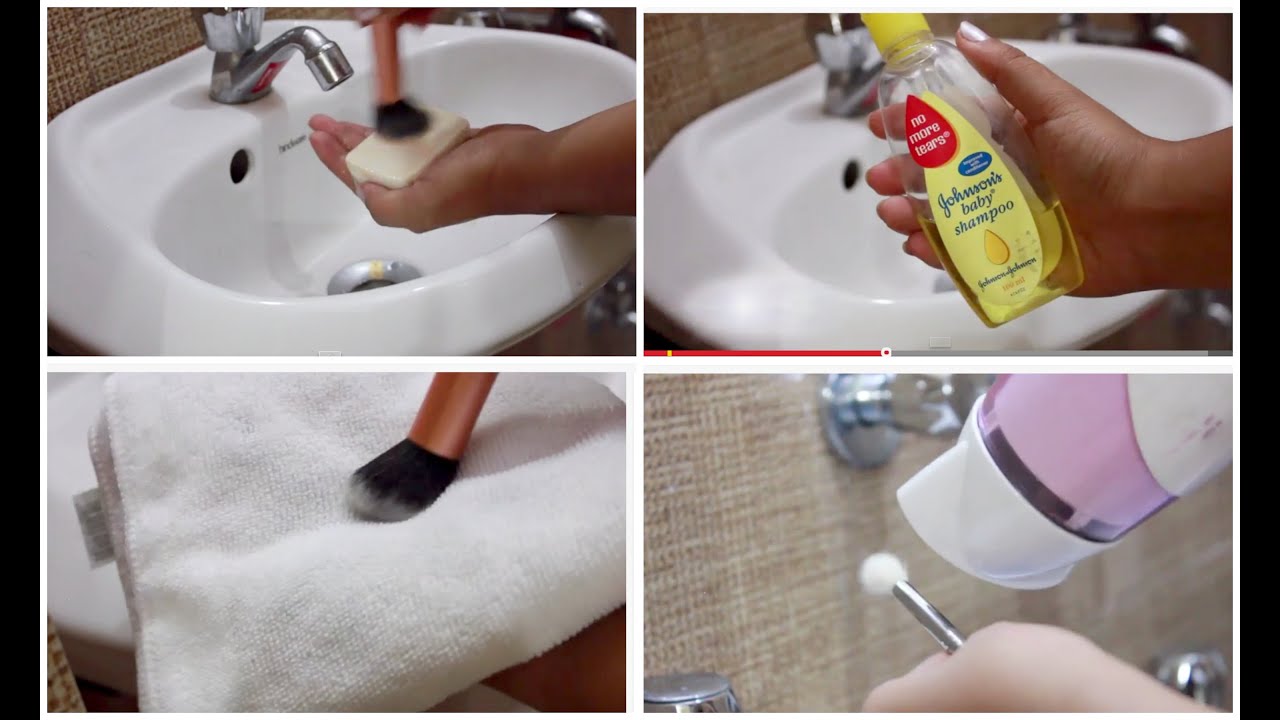
Towel press plus steady airflow ranks first. It costs nothing and risks nothing, and it covers what decides drying speed, which is how much water is left and how much air reaches the head.
| Method | Relative speed | Risk to brush | Best for |
|---|---|---|---|
| Towel press plus fan or open window | Fast | Low | Most rushes |
| Bristles-down rack, ventilated room | Moderate | Low | Small counters |
| Counter-edge towel setup | Moderate | Low | No equipment |
| Hair dryer, cool setting | Fast | Highest (heat) | Contested, verdict below |
Speed here is relative. No brand or publication in the sources measured minutes per method, so the ranking follows how each one describes the mechanism: airflow, evaporation, or heat.
Still air is what defeats the towel-plus-airflow combo. MasterClass points to a doorway, a window, or a room with good air conditioning for the fastest result, and a desk fan covers the same ground.
A rack only works if the bristles stay clear of it and of any wall, since e.l.f. Cosmetics says to keep them off all surfaces. On the counter edge the head has to hang past the edge. If it rests on the surface, the airflow makeup.com is after is gone. As for the hair dryer, it goes wrong the moment heat gets near the ferrule or the glue.
Skip direct sunlight and heating vents as shortcuts. A brush manufacturer’s care page (tmakeupbrushes.com, 2025) recommends a cool, ventilated spot out of direct sun and warns that excessive heat degrades the glue.
A fan and a towel beat buying anything.
Can You Use a Hair Dryer on Makeup Brushes?

Not by default. Most of the guidance says no, and the one page that allows it limits the use to the coolest air and the lowest speed.
| Source | Verdict | Stated reason |
|---|---|---|
| e.l.f. Cosmetics brush guide (2026) | Never | Listed under drying “don’ts” |
| Women’s Weekly (Singapore) | Never | Heat damages synthetic bristles and loosens the glue |
| tmakeupbrushes.com, how-to page (Feb 11, 2025) | Occasionally, coolest air, lowest speed | Saves time when brushes cannot hang |
| tmakeupbrushes.com, warning page (Feb 11, 2025) | Never | Splits fibers, heat-styles the shape, degrades the glue |
The same manufacturer blog dates both of its verdicts to the same day, which tells you how unsettled the advice is.
The stakes are lopsided. A hair dryer saves time once, while a softened glue bond costs you the brush.
If you use one anyway, keep to these rules.
- Set it to the coolest air and the lowest speed.
- Rotate around the outside of the head and never down its center, which splays the fibers.
- Pause often to reshape the bristles and let the brush cool.
- Keep the airflow away from the ferrule.
The first three come from the manufacturer page that permits it. The fourth follows from the glue warnings on the pages that forbid it, and it differs from that page’s own instruction to blow air down the brush from the handle to the tip.
Reserve it for brushes you can afford to replace.
How Long Makeup Brushes Take to Dry by Brush Type and Room Conditions

A thin eye brush dries in hours and a large powder brush takes close to a full day. Head size and density set that spread, and fiber type and the room move it further.
Small eye brushes need 4 to 6 hours and medium face brushes 6 to 8 (e.l.f. Cosmetics, 2026). Dense foundation brushes take 8 to 12 hours, and the large powder brushes 12 to 24.
MasterClass gives a lower span, two to twelve hours or more, and neither source publishes how it measured. If the brush matters, plan around the e.l.f. numbers, since they run longer and split by brush type.
Natural versus synthetic bristles

Natural hair is more porous than synthetic fiber, according to both makeup.com and David Klasfeld, CEO of Obsessive Compulsive Cosmetics, in a Beautylish interview.
More pores means more places for water to sit, which pushes a natural head toward the slow end of its size bracket. No brand publishes drying times split by fiber, so read that as a direction, not a number.
Net-a-Porter’s brush guidance says to reshape a natural-bristle brush before drying and keep the ferrule dry. Synthetic fibers are less porous, so expect the fast end of the bracket.
A dense natural powder brush is the worst case. No source times that combination, so give it the overnight slot.
Humidity and airflow
Moist air slows evaporation. The same brush takes longer on a humid day or in a steamy bathroom.
Net-a-Porter advises against storing brushes in the bathroom because the damp environment encourages bacteria, which argues for drying them in a drier room too. A room away from the shower, with air moving through it, is the safer bet, and in humid climates Makeup Atelier Training Center suggests a dehumidifier.
Slow drying gives bacteria and mildew more time. Faster drying prevents both, according to a brush manufacturer’s care page (tmakeupbrushes.com, 2025).
What to Do When Makeup Brushes Must Be Ready in Under an Hour

Skip the water. Washed brushes need hours, not minutes, in every published estimate, so the fast answer is a dry-clean method or a second brush.
| Time available | Brush | Move |
|---|---|---|
| Under an hour | Any brush | Dry-clean the head, or switch to a second brush |
| Several hours | Small or thin synthetic brush | Towel press, then bristles-down with airflow |
| Overnight | Dense, large or natural-hair brush | Full wash, then counter-edge or rack |
A dry-clean method handles the surface, and the deep clean your brushes still need can wait until the evening.
Dry-cleaning options that skip the wait
Textured pads and rough sponges lift pigment without soaking the head, and wipes suit travel and color changes. Quick-drying spray or foam works too if you blot the head on a cotton T-shirt afterward.
Pads and sponges lift pigment but do not disinfect, according to The Zoe Report (2017), while sprays and foams disinfect the surface only.
Napoleon Perdis tells users of its isopropyl alcohol Instant Clean Brush Cleaner to spray, wipe the brush on a tissue, and let it dry. The brand’s own pages give that drying time as anywhere from a few seconds to one minute.
Morphe’s Director of Global Artistry, Nicole Faulkner, splits her routine the same way, with cleansing liquid for quick cleans and a full wash plus an overnight air dry for deep cleans (Russh).
Brushes that cannot be rushed
Dense heads and natural-hair brushes are the ones to protect from shortcuts. Dense heads sit in the slowest e.l.f. brackets, and no source offers a safe way to hurry them.
The sources disagree on alcohol. Napoleon Perdis and Manicare label their isopropyl alcohol sprays safe on natural bristles, while BK Beauty’s care guide warns that alcohol cleansers can weaken the glue, and GladGirl’s brush blog says alcohol damages natural bristles.
The label directions have you spray a tissue or the bristles and wipe the brush clean, while the warnings concern soaking that reaches the ferrule. Spray or dip only the tips, and keep liquid away from the ferrule.
Sephora UK recommends owning more than one brush set, noting that rotating sets gives each brush the 24 hours it needs to dry fully. For a natural-hair brush, a second set is the only fix that works in under an hour.
Common Questions About Drying Makeup Brushes
How can you tell a makeup brush is fully dry?
It feels light and fluffy, the bristles move freely, and there’s no cool sensation when you touch it. e.l.f. Cosmetics also lists the absence of a musty smell among its signs of proper drying, so a musty smell suggests moisture is still trapped.
Check the base of the head too, since the glue area has to be dry before the brush goes back into use.
Should you wash makeup brushes at night and let them dry overnight?
Yes, for most of them. makeup.com recommends washing before bed so the heads dry while you sleep.
The largest powder brushes can outlast a night, so give those a full day.
Is it safe to use a makeup brush that is still damp?
No. e.l.f. Cosmetics lists using a brush before it is completely dry among its drying “don’ts.”
When time runs out, switch to a second brush or a dry-clean spray instead of a half-dry head.
Can makeup brushes dry in direct sunlight or near a heater?
No. Sun, heating vents and hot cars carry the same heat risk as a hair dryer, with no control over it at all. A brush manufacturer’s care page (tmakeupbrushes.com, 2025) says to protect brushes from extreme heat in all three places.
A Washing Routine That Leaves Brushes Time to Dry
Evening washing and a second brush set remove most occasions that call for drying makeup brushes fast.
The slowest brushes set the schedule, so dense and natural-hair heads get washed first because they need the longest window. Thin synthetic brushes can go after them, since they catch up quickly. On the days in between, spray-clean between colors.
The trade-off is cost and bench space. A second set costs money, and a spray treats only the surface, so the full wash stays on the calendar.
This sequence reflects brand guidance verified in October 2026, and a measured drying test from a brush maker would change the order.

She started writing on the site after fielding the same questions from clients and friends often enough to just write the answers down: which red won't turn orange on a warm undertone, how to keep lipstick from feathering into fine lines, why a "12-hour" formula rarely survives dinner.
Every review on the site follows the same rule she uses with paying clients: wear it first, then decide if it's worth recommending.
- How to Make Eyeliner Last Longer Without Smudging - August 31, 2026
- How to Make Eyeshadow Last Longer All Day - August 29, 2026
- How to Find Your Undertone in 5 Easy Steps - August 27, 2026