Placement does most of the work here. Line a hair outside the natural lip line, at the center of each lip only. Then fill with a soft or mid-tone color and put some light on the middle of the lower lip.
Coverage alone doesn’t do the job. Two photo studies, one with 44 women and one with 32, found that full-face makeup that included lipstick left perceived mouth size unchanged (Jones, Porcheron and Russell, Psychology of Aesthetics, Creativity, and the Arts, 2017). A third analysis, run on spatially filtered versions of the second set of photos, found only a slight increase.
None of the people applying makeup in those studies aimed to change feature size. So deliberate liner placement, shade and highlight never got tested.
Applying lipstick on thin lips, step by step

The order runs prep, line, fill, light. The effect comes from contrast and reflected light, not from extra size.
- Smooth on a lip balm first, since dry lips look flatter and less plump.
- Tap a little concealer around the outer border. It blurs the edge and gives the color a blank base.
- Draw the outline a hair outside the natural lip line, then soften it so no hard edge shows.
- Fill in with a lip brush, working from the center outward.
- Press the lips together and smudge the liner edge into the lipstick.
- Dab a little gloss on the center of the lower lip and on the Cupid’s bow.
- Blot once on a tissue, then add a thin second layer.
The sequence draws on routines published by L’Oreal Paris and M.A.C, with the concealer step taken from makeup artist Morgane’s advice to Refinery29.
Restraint matters more than any single step. In a study co-authored by Sebastian Cotofana of the Mayo Clinic (Plastic and Reconstructive Surgery, 2022), a photo of a face with natural lip volume scored 4.56 out of 5, while the same lips digitally enlarged to 130% scored 1.56.
That was an image test, not a makeup study, but the lesson carries over. A lift people can barely name looks better than an obvious redraw.
How should thin lips be prepped before color?
Balm first. Buff away flakes only if the lips are actually dry, then blur the outer border with concealer before any liner goes on.
Lip skin leaves little margin. Its outer layer averages 3 to 5 cell layers, against 15 to 20 on typical skin, according to a 2023 Skin Inc. article by cosmetic chemist Kelly Dobos.
Lips also have no hair follicles or sweat glands, and oil glands are rare, limited to Fordyce spots on the upper lip of some people. Flakes and dry patches show straight through color, and on a narrow lip there is nowhere for them to hide.
After the balm and the concealer, RMS Beauty suggests a talc-free powder along the outer edge to set the line and smooth texture.
Dermatologist Suzanne Friedler told Healthline that healthy lips don’t need exfoliating, but on dry, flaky lips a light buff lets lip cosmetics go on more evenly. A simple routine for exfoliating lips at home with sugar and a little oil is enough, once or twice a week at most.
Lips that stay rough even with daily balm need more than a pre-makeup fix. A proper care plan for dry lips comes before any color.
Concealer is the step most people skip. Morgane says it cancels redness around the edge and makes lipstick look seamless, and makeup artist Nolwenn Quintin told Grazia that blurring the border this way keeps a later overline from looking drawn on.
Which lipstick shades work best on thin lips?
Light-reflecting and nude-leaning shades are the easiest wins. Dark and bold colors can work too, as long as a deeper liner frames a lighter fill.
Soft and mid-tone shades
M.A.C’s Ocea McKenzie points to soft frost shades such as Frost Lipstick in Angel, because the reflective particles make lips look fuller. Quintin goes the other way and favors second-skin nudes so the overline stays invisible.
Max Factor’s old advice for making lips look smaller is a useful mirror image. Experts at Max Factor called for dark matte reds, burgundies and browns, and warned against light or pearlised finishes because shimmer emphasises size (Hello!, 2011).
For thin lips, flip it. Lighter and brighter reads bigger.
A dedicated roundup of lipstick ideas that suit thin lips goes shade by shade.
Do dark and bold shades work?
Faces Canada steers thin lips away from deep purple, brown and rainbow lipsticks, saying they can emphasize thin lips. Makeup.com’s guide to bold lipstick for thin lips (2021) disagrees and says deep shades can work once the method changes. Its routine is liner just outside the lips, a bold fill, then a blend by going over the liner and rubbing the lips together.
Honestly, both can be true. A dark fill with a crisp, unblended edge shrinks the shape. Put the dark in the liner instead, with a lighter fill, and it reads as shadow at the border. British makeup artist Caroline Barnes describes the same idea as building a natural contour (Woman & Home).
The same Makeup.com guide, for instance, pairs L’Oreal Paris Age Perfect Anti-Feathering Lip Liner in Perfect Burgundy with Maybelline Super Stay Matte Ink in Ruler.
Pulling off a deep color involves more than lip size, and a broader guide to wearing dark lipstick covers skin tone and outfits.
Matte, cream, satin or gloss: choosing a finish
Cream and satin lift thin lips with the least effort, and gloss does it too if you can put up with the stickiness. Matte gives the sharpest edge but needs smooth, hydrated lips and a steady liner hand.
| Finish | Effect on thin lips | Trade-off |
|---|---|---|
| Matte | Crisp definition, flat surface | Drying, harder to apply |
| Cream | Smooth, hydrating color | Less shine than gloss, softer edge than matte |
| Satin | Soft sheen that blurs flaws | Less defined than matte |
| Gloss | Lit center looks fuller | Short wear, can feel sticky |
The sources don’t fully agree here. RMS Beauty’s Rose-Marie Swift avoids matte on thinning lips because it exaggerates dryness. Faces Canada is less absolute. It says matte gives a more defined look, but very drying mattes make lips look thinner, so it favors creamy matte or satin.
Lip condition decides it, not lip size. Skin Inc. (2023) notes that many long-wearing lip colors aggravate dryness, so smooth, hydrated lips can take matte and chapped ones should go cream or satin.
M.A.C’s McKenzie recommends satin and creamy textures for a thin top lip.
Layering splits the difference. Set a matte base, dab clear gloss or balm on the center, and you keep the staying power plus the lit middle. The trick is covered in turning a matte lipstick glossy.
Keep shimmer light. Max Factor suggests a gloss with only a slight pearlised finish and warns against too much shimmer.
If matte and satin are the two you’re stuck between, a comparison of matte and satin lipstick settles most cases.
Lip liner placement and how far to overline
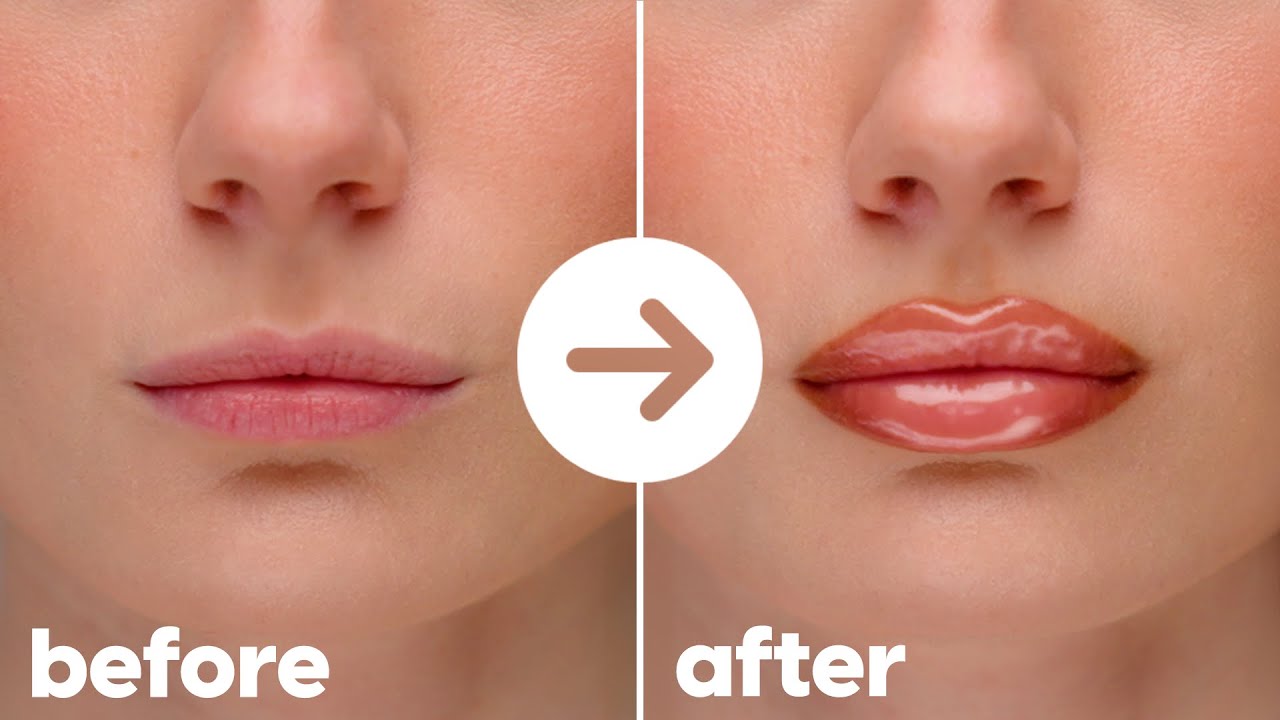
Trace the vermilion border (the edge where lip color meets skin), then step just outside it at the center of each lip. Leave the outer corners on the natural lip line.
Makeup.com by L’Oreal (2026) and makeup artist Ruby Hammer give a similar rule, which is to extend the line at the Cupid’s bow and the middle of the lower lip and keep the outer corners on the natural line.
On distance, sources differ by a millimeter. Makeup.com by L’Oreal (2026) advises no more than 1 mm for a natural look, while Iba Cosmetics (January 2026) allows 1 to 2 mm.
Both numbers are artist guidance, not measured outcomes. Start at 1 mm and treat 2 mm as the ceiling.
Liner depth is where the advice gets messy. Makeup.com by L’Oreal (2026) says to go one to two shades deeper than the natural lip color, but never lighter than the lipstick. Iba Cosmetics (2026) says to match the natural lip color or go one shade deeper. Christina Flach (2022) says that after 40 the liner should be no darker than the lipstick.
The rules clash because they measure from different points. Going deeper than the natural lip color adds shadow. Comparing the liner to the lipstick matters for another reason, which is what shows once the lipstick wears off.
For lips with fine lines, or lipstick that fades fast, match the liner. Otherwise go one shade deeper and blend.
If the natural lip color is hard to read, a guide to choosing a lip liner shade narrows it down.
Whatever the shade, blur the edge afterward with a fingertip or small brush, as both Makeup.com and Iba advise. The full technique, from grip to pressure, is covered in a walkthrough on applying lip liner.
Color and highlight placement for a thin upper lip, lower lip or both

Put the extra line where the thinness sits: the Cupid’s bow for a thin upper lip, the underside of the center for a thin lower one. When both are narrow, do both centers. A little highlighter and a touch of shadow finish it.
| Thin-lip pattern | Liner goes | Light and shadow |
|---|---|---|
| Thin upper lip | Just above the bow peaks | Highlighter on the bow |
| Thin lower lip | Just under the center | Shadow below, light on top |
| Both lips thin | Bow and lower center only | Highlight bow, gloss the middle |
| Uneven bow | Higher side on the line, lower side slightly over | Keep highlight centered |
Thin upper lip
Lift the bow and keep the corners on the natural line.
Kendall Jenner’s makeup artist Mary Phillips starts at the mouth corners, staying closest to the natural lip line, then extends slightly at the top and bottom and brings the Cupid’s bow up a little higher. She smooths it with a soft brush so no hard line shows.
Beautycrew’s write-up of the technique features Charlotte Tilbury’s Pillow Talk Lip Cheat in Medium.
Thin lower lip
Draw just under the center of the lower lip. Etienne Ortega traces the underside of the natural line and goes over it only slightly (Who What Wear). A small mirror held under the bottom lip makes the line easier to see, a trick Georgia May Jagger credits to makeup artist Val Garland.
For shadow, Iba Cosmetics (2026) blends a little bronzer or contour powder below the center of the lower lip, so the lip looks like it casts a shadow. Faces Canada describes the same trick as making that area recede.
Both lips thin
The center-only rule still applies to both lips. Two liner shades then add dimension on top of it.
- Overline the bow and lower center with the deeper liner.
- Run a slightly lighter liner just inside that line.
- Blend where the two meet.
- Fill with lipstick.
Makeup.com by L’Oreal (2026) calls this ombre lip lining, and Iba Cosmetics (2026) describes the same gradient as double-lining. A separate guide shows the steps for creating ombre lips.
Defining the Cupid’s bow

Charlotte Tilbury’s makeup guide (May 2025) recommends a crescent-shaped bow for thin lips or lips without a defined bow. A crescent is a pointed shape that dips in the center, like a crescent moon. Bow-shaped lips have rounded arches with a shallow V in the center, and domed lips are rounded with no definition in the center, which suits round lips without a defined bow.
Michelle Spieler fixes a bow with one higher side by lining the higher side right on the natural lip line and overlining the lower side slightly to even it out.
Makeup.com’s beauty hack places two small vertical lines above the peaks before blending, which creates the illusion of a shorter philtrum. Keep any highlighter on the bow light, because Iba warns that too much shimmer looks unnatural.
Lip brush, bullet or liner pencil: which tool does what
The pencil sets the shape and a lip brush fills and blurs. The bullet is for quick swipes where the edges matter less. A lip brush earns its place on thin lips because every edge shows.
The liner pencil draws the overline and the bow. A lip brush fills from the center outward, reaches the corners and blends the liner edge. Bullets give fast, dense color with less control at the edges. For cleaning up mistakes, a square concealer brush does the job (Morgane, Refinery29).
Makeup artists disagree on the default. Lan Nguyen-Grealis told Glamour South Africa that straight from the bullet is generally best for density and speed, but that a brush gives a more defined finish, with the tip filling corners and shaping the Cupid’s bow.
Thin lips tip the choice toward the brush, since definition matters more than speed when the shape is narrow.
Makeup.com names NYX Professional Makeup’s Slim Lip Pencil for easy outlining. It also points to Valentino Beauty’s Rosso Valentino lipstick, whose V-shaped bullet defines the lips without a separate pencil.
Sharpen the pencil before each use, because Makeup.com calls for a sharp liner and a blunt tip draws a thick, obvious line. A guide to sharpening lip liner covers the details.
Setting is the last tool step. Morgane’s method for Refinery29 is to split a tissue to one ply, lay it on the lips, dust translucent powder through it with a small brush, remove the tissue and add another coat. A longer walkthrough on setting lipstick with powder goes further.
What makes lipstick on thin lips go wrong?
Most failures come from lining the whole outline, overlining past a millimeter or two, or a liner that shows once the lipstick fades. Color creeping into fine lines and lips that are too dry for the formula cause the rest.
| Problem | Likely cause | Fix |
|---|---|---|
| Drawn-on look | Outline traced all the way round | Overline the bow and lower center only |
| Visible ring after wear | Liner far from the lipstick shade | Match natural lip color, fill the whole lip |
| Feathering | Fine lines or oil at the lip line | Line first, set the perimeter with powder |
| Patchy color | Dry, unprepped lips | Prep, then switch to a creamier formula |
Makeup by Mario’s Mario Dedivanovic says lining the entire lip shape, outer edges included, drags the face down instead of making lips look bigger (via South China Morning Post).
The fading line is the other giveaway. RMS Beauty’s Rose-Marie Swift says the bright pencil line left behind as lipstick wears off is very aging on thinning lips, and she recommends a pencil that matches the natural lip color.
Revlon names two causes of feathering, fine lines around the mouth and excess oil along the lip line. For oil, setting the skin around the lips with translucent powder before lining creates a dry barrier, and the rest of the fixes sit in a guide to stopping lipstick from feathering.
Patchy color on a thin lip usually means the surface was unprepped. When balm and buffing are not enough, a walkthrough on applying lipstick on dry lips picks up from there.
The method does have a limit, and it shows up when little red lip is left to trace.
In a study of 918 people aged 4 to 73, the ratio of vermilion height to cutaneous lip height fell with age, from about 43% at age 4 to 28% in the eighth decade, and in a 40-person subgroup older lips were thinner (Sforza and Ferrario, Italian Journal of Anatomy and Embryology, 2010).
The authors describe a redistribution of volume rather than simple loss. With a narrower red band, an overline lands on skin more easily, so the line needs to be subtler and the edges blurred harder.
Common Questions About Applying Lipstick on Thin Lips
Can you wear lipstick on thin lips without lip liner?
Yes. Dot the lipstick in the center of each lip, blend it outward with a cotton bud or fingertip, then press the lips together, as makeup artist Morgane advises Refinery29 readers.
Expect a softer edge, since lipstick straight from the bullet is hard to control unless the lips are well defined.
How do you make lipstick last longer on thin lips?
Fill the whole lip with liner before the lipstick, blot after the first coat, then add a second thin layer. Iba Cosmetics (2026) lays out that routine, and Corrie Dubay adds that the liner underneath still colors the lips if the lipstick wears off.
A guide on how to make lipstick last longer adds more methods.
Are thin lips the same as small lips?
No. Merle Norman treats them as separate cases with separate liner advice.
For thin lips it says to draw just outside the natural lines and blend well. For small lips it adds a slight extension at the corners to create balance, the opposite of keeping the corners on the natural line.
Does a lip plumper help under lipstick?
Yes, as an optional finishing step. A dab of plumper on the center of the lips builds fullness the way gloss does (Who What Wear).
A separate guide explains how a lip plumper works.
Which lipstick formulas suit thinning lips with age?
Hydrating, blurring formulas suit thinning lips best. Michelle Spieler calls a blurring lipstick her favorite lip product, finishes with a hydrating one, and notes that a sharp line looks dated.
Rose-Marie Swift applies lipstick with a firm lip brush so the color sits on the lips instead of catching on texture.
Where to Start When Applying Lipstick on Thin Lips
One change improves things fastest, and that’s a center-only overline at the Cupid’s bow and the middle of the lower lip. Faces Canada calls overlining the most effective single trick for a naturally fuller look, on the condition that it stays subtle.
If you only have a couple of minutes, put balm on, tap concealer at the edge, overline the bow and lower center, and finish with gloss on the middle of the lower lip.
Prep goes first because Iba Cosmetics notes that flaky lips make liner skip. Gloss goes last because it sits on top of everything and wears off first.
The short version trades dimension for speed. Without a two-liner gradient or highlighter, the result reads as a refined version of the natural lip, not a visibly larger one.
As of October 2026, the sequence rests on makeup-artist guidance. A controlled test of deliberate overlining is the evidence that would change it.

She started writing on the site after fielding the same questions from clients and friends often enough to just write the answers down: which red won't turn orange on a warm undertone, how to keep lipstick from feathering into fine lines, why a "12-hour" formula rarely survives dinner.
Every review on the site follows the same rule she uses with paying clients: wear it first, then decide if it's worth recommending.
- How to Make Eyeliner Last Longer Without Smudging - August 31, 2026
- How to Make Eyeshadow Last Longer All Day - August 29, 2026
- How to Find Your Undertone in 5 Easy Steps - August 27, 2026