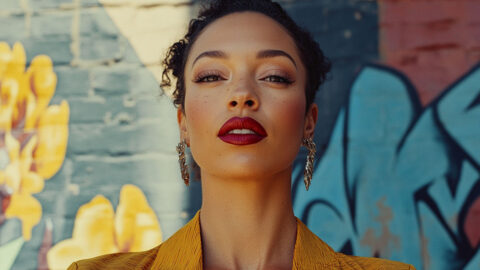
Two lipsticks, one blurry line between them, and somehow it never looks like the tutorial.
Almost all of the trouble lives in one narrow band on the lip. That strip where the dark border runs into the lighter middle is called the transition zone, and learning how to do ombre lips is mostly learning to control it.
Lip liner sales grew 28% year-to-date as of October 2025, per Circana. The gradient lip is a big reason.
What Is an Ombre Lip?
Two or more shades sit on the mouth at the same time, blended until nothing obvious separates them. That’s the whole idea.
Standard direction is dark on the perimeter, light through the center. Reverse it if you want, plenty of people do.
The look came from two places that had nothing to do with each other. Korean gradient lips pushed color inward, toward the middle. The 90s liner-and-nude thing pushed color outward, toward the border, and it looked completely different because of it.
Circana data reported by Glossy shows lip liner sales climbed 28% year-to-date as of October 2025. Circana analyst Natallia Bambiza put the split at 28% growth in prestige and 36% in mass through September 2025, and lip liner closed the year as one of the top-gaining prestige makeup segments. The gradient technique sits at the center of that growth.
Worth separating early, because the search results mix them constantly: ombre lip makeup washes off at the end of the day. Ombre powder lips are a tattoo.
Ombre Lips vs. Gradient Lips vs. Two-Tone Lips
| Look | Color placement | Edge finish |
|---|---|---|
| Ombre lip | Dark border into light center | Fully blended, no visible line |
| Korean gradient lip | Stain concentrated at inner lip | Undefined outer border |
| Two-tone lip | Two shades kept distinct | Visible break by design |
People use these terms interchangeably. They are not the same thing, and if you want two clearly separated shades on the lips, that is a different application entirely.
What Tools and Products Are Needed for Ombre Lips?
Two lip liners, one lip color for the middle, and something to blend with. That’s the kit.
Your first liner goes deeper than your natural lip and draws the outer border. The second one should land within 2 shades of your natural lip, and its only job is softening the inward edge so the jump between colors isn’t so abrupt. Center color can be a lipstick or a gloss, as long as it reads lighter than both liners. Keep concealer and a small angled brush nearby for cleanup, because you will need them.
The global lip liner category was valued at $1.21 billion in 2024 and is projected to reach $1.75 billion by 2033 at a 4.5% CAGR, with M.A.C., ColourPop, Givenchy, NARS, and Urban Decay among the leading players, according to Verified Market Reports.
Fenty Beauty entered the category in July 2024 with the Trace’d Out Pencil Lip Liner, its first liner launch, debuting in 10 shades online on July 12 and in stores on July 19.
Choosing the Right Liner Format
IndexBox data on the US market breaks liners into four formats. Wooden pencils remain the volume leader at roughly 50-55% of unit sales, while mechanical retractables and liquid/gel liners together accounted for an estimated 35-40% of 2025 unit sales, with dual-ended pencils making up a small but fast-growing remainder.
Wooden pencils give you the firmest tip for the border. They also demand tip maintenance to stay precise, which is the part I’m bad at.
Retractables stay blunt. Fine for filling, useless for a crisp cupid’s bow.
If you are new to the category, start with the basics of what a liner actually does before buying two of them, and let shade selection guidance narrow the options down.
Formulas That Blend and Formulas That Don’t
Creamy pencils blend. MAC Lip Pencil, NYX Slim Lip Pencil, and Charlotte Tilbury Lip Cheat all stay movable for roughly 30 to 60 seconds after application, which is your whole working window.
Long-wear liquid mattes don’t. The formulas built to set on contact give you nothing to work with.
Spate reported in January 2025 that Sacheu’s Lip Liner Stay-N, NYX’s Suede Matte Lip Liner, and Make Up For Ever’s Artist Color Pencil were among the sector’s top performers.
Blending Tools Ranked by Control
| Tool | Control level | Best for |
|---|---|---|
| Flat synthetic lip brush | Highest | Precise transition work |
| Small dense concealer brush | High | Wider diffusion |
| Clean fingertip | Medium | Cream formulas |
| Damp sponge tip | Low | Very soft, blurred looks |
Finish matters as much as the tool. A matte center flattens the gradient. Satin holds dimension. Gloss pushes it further than either. Reading up on how those two finishes behave differently saves you a wasted purchase.
Grand View Research put shimmer lipsticks at a 37.2% revenue share in 2024, and shimmer through the middle is the quickest way to fake depth when your two shades are too close together. Broader knowledge of the finish categories available helps here.
How Do You Prep Lips Before an Ombre Application?
The American Academy of Dermatology notes that chapped lips can affect anyone at any age, with cold or dry weather, sun damage, and lip licking among the most common triggers. Dry patches grab pigment unevenly. On a gradient, that reads as a broken border.
A 2024 PoweredXBeautyBuddy survey found dryness ranked as the top lip concern for 87% of respondents, followed by chapped lips at 61% and cracking or peeling at 57%, with 62% already using a lip scrub.
Order matters here:
- Exfoliate with a scrub or a damp cloth
- Apply balm and wait 5 to 10 minutes
- Blot the balm off completely with tissue
- Optional: sheer concealer over the natural lip color
Nobody blots. That’s the step everybody skips, and an oily lip surface repels pencil pigment, so the border goes patchy within minutes.
Concealer over the lip mutes your natural color, which raises the contrast between your two chosen shades. Skip it if your lips are already pale.
Physical scrubbing on already-cracked lips makes things worse. Gentler exfoliation methods handle flaking without tearing the vermilion, and a consistent daily lip care habit means less prep work before every application.
How Do You Do Ombre Lips Step by Step?
Outline with the dark liner, fill the center with the lighter shade, blend the strip where they meet, then set and clean the edges.
Three to five minutes once you know the motion. Blending is where the result is decided, and it happens fast.
Building the Dark Outer Border
Trace the perimeter with the darker liner, following your natural lip line or sitting 1 to 2 millimeters outside it.
Then fill inward. Not the whole lip. Roughly one third of the depth from the border toward the center, leaving the middle bare.
Short strokes hold a cleaner edge than one continuous line. Proper liner technique carries most of the weight here.
Filling the Center with the Lighter Shade
Keep the light shade inside that bare middle, not touching the dark filled area. One thin layer is enough, since a thick center resists blending. Leave a 1 to 2 millimeter gap between the two colors.
The gap sounds wrong. It isn’t. Blending pulls the colors toward each other, so starting them apart is what stops the middle turning muddy.
Gloss over a cream base needs its own timing, and layering shine on top of color works better as the last move than the first.
Blending the Transition Zone
Short patting motions along the border between the shades. Never dragging.
Work outward to inward, then stop. Overworking the area pulls dark pigment into the center and kills the gradient you just built.
Blend within 30 seconds of applying the second shade, before either formula sets. That number is not a guideline, it’s the actual window on most creamy pencils.
The motion takes practice, and the mechanics of moving color across the lip transfer to every gradient variation.
Setting and Cleaning the Edges
Tissue over the lips, then a light dusting of translucent powder through the tissue. Powder setting locks the border without dulling the center highlight, as long as you keep it off the middle.
Load a small angled brush with concealer and trace just outside the lip line. It erases the pigment fuzz sitting outside the border and sharpens the outer edge at the same time. Concealer application basics apply here too.
How Do You Do Ombre Lips Without a Lip Brush?
Body heat softens cream formulas faster than any brush can. A fingertip warms the product while it moves it. A brush only moves it.
Patting along the transition zone with a fingertip is the version I use most. Lip pressing works too: apply both shades, then press your lips together 5 to 8 times. A cotton swab rolled along the border sits somewhere between the two for control.
Lip pressing gives the softest result and the least control. Good for a diffused everyday look, bad for anything photographed close up.
Formula decides whether any of this works. Bullet lipsticks and emollient cream formulas forgive finger blending. Anything that sets in under 15 seconds does not.
You lose precision at the border. I use fingers more often than brushes on weekdays and I’ve made peace with that.
What Are the Main Ombre Lip Styles?
Korean cosmetics production data reported by REACH24H shows lipsticks and lip liners posted 13.5% output-value growth in 2025, the highest of any makeup sub-category, which tracks with how many gradient variations are circulating right now.
| Style | Color placement | Best for |
|---|---|---|
| Classic ombre | Dark border, light center | Everyday wear |
| Reverse ombre | Light border, saturated center | Editorial, photography |
| Korean gradient | Stain at inner lip only | Soft, natural looks |
| Vertical ombre | Upper lip darker than lower | Adding dimension |
The Korean gradient skips liner entirely. You pat a pigmented stain into the middle and let it fade outward on its own, which is why it reads so much softer than the Western version. It belongs to a broader family of K-beauty makeup approaches built on looking undone.
Sacheu Beauty built a $12 peel-off liner around a similar stain effect, and by YipitData’s SKU-level ranking of US lip liner sales it was the number one lip liner in the country for 2025.
Matte Ombre vs. Glossy Ombre
Matte flattens the gradient, so you need a wider shade gap between your two colors before the transition registers at all. Glossy does the opposite, bouncing light off the center and exaggerating depth even when the shades sit close together.
Mordor Intelligence put stick formats at 58.95% market share in 2024 while liquid formats are forecast to grow at an 8.34% CAGR. Stick formulas remain easier to blend, whatever the growth curve says.
For a flat, velvet gradient, matte formulas deliver it. For dimension, high-shine finishes do more work with less blending.
Which Lip Colors Blend Well Together for an Ombre?
Two shades sitting 2 to 3 steps apart in the same color family blend cleanly. Push them 5 steps apart and you get a visible line no amount of patting fixes.
Undertone matters more than depth. Warm with warm, cool with cool. Mix the two and you get grey-brown mud at the transition, every time.
| Border shade | Center shade | Result |
|---|---|---|
| Chocolate brown | Warm nude | 90s neutral |
| Plum | Cool pink | Soft romantic |
| Brick | Coral | Warm daytime |
| Black | True red | High contrast, editorial |
MAC’s July 2025 collaboration with rapper JT, released for National Lipstick Day, packaged this exact logic into a $52 kit: Lip Pencil in Chestnut, MACximal Silky Matte Lipstick in Snob, and Clear Lipglass on top.
Pairings That Fight Each Other
Orange-red over blue-red. Cool mauve over warm terracotta. Both turn muddy the second you blend them, and you’ll only notice once it’s too late to fix without starting over.
When your two colors sit too far apart in depth or undertone, add a third mid-tone shade between them as a bridge.
Knowing which shades read warm and which read cool removes most of the guesswork before you buy anything.
Shade Families That Blend Easily
Intel Market Research found 72% of new liner launches in 2024 introduced extended color options, with reds still leading penetration and browns and plums growing fastest.
Brown liners forgive almost anything in the center. Nude, peach, caramel, soft pink, even a muted rose all sit comfortably against a brown border.
Pairing a brown border with a well-matched nude center is the most reliable place to start, and shade selection against your skin tone settles the rest.
How Does an Ombre Lip Change for Different Lip Shapes?
The gradient itself doesn’t change. What changes is how wide the dark border sits and how much bare center you leave for the lighter shade.
Thin lips need a narrow border with a generous middle. On full lips you can widen the border and pull the highlight in.
| Lip shape | Border width | Adjustment |
|---|---|---|
| Thin | Narrow | Overline cupid’s bow, widen light center |
| Full | Wider | Restrain the center highlight |
| Uneven | Variable | Correct with liner placement before blending |
| Downturned corners | Lifted at edges | Darken outer corners, angle liner upward |
The American Society of Plastic Surgeons recorded 1,449,565 lip augmentation procedures with injectable materials in 2024, roughly 1% more than 2023, making it the third most common minimally invasive procedure in the US.
Plenty of people are chasing the same volume with makeup instead. The gradient does that job for free.
Thin Lips and the Overline Question
Sit the border 1 to 2 millimeters outside the natural line, and concentrate it at the cupid’s bow and the middle of the lower lip. Leave the corners alone. Overlined corners are the first thing that reads as drawn on.
What creates the illusion of volume is a wider light center, not a thicker dark edge. Most people get this backwards and end up with a smaller-looking mouth.
Application technique for narrower lips and shade choices that add apparent fullness both matter more than how far outside the line you draw.
Full Lips, Uneven Lips, and Filler Considerations
Full lips carry a wider dark perimeter without looking heavy. Keep the center highlight small, or the whole thing goes glossy and shapeless.
For asymmetry, build the liner border on the smaller side first, then match the larger side to it.
In its 2024 report, ASPS characterized injectable demand as favoring personalization and subtle results rather than dramatic volume. The gradient suits that direction.
Anyone with recent injections should check the waiting period before lip products go back on before attempting any of this.
What Mistakes Ruin an Ombre Lip?
Bad ombre lips fail in predictable ways. A visible hard line at the transition. A muddy middle. Patchy color that lifts in flakes. A formula that sets before you can touch it. Liner pushed too far inward, so there’s no room left for a gradient. And skipped cleanup, which undoes good work at the very last step.
| Problem | Cause | Fix |
|---|---|---|
| Hard line at transition | Blending after product set | Blend within 30 seconds |
| Muddy center | Overblending, dragging inward | Pat, then stop |
| Patchy color | Dry lips or unblotted balm | Exfoliate, blot fully |
| No gradient at all | Liner filled too far inward | Stop at one third depth |
The 2024 PoweredXBeautyBuddy survey found 57% of respondents deal with cracking or peeling lips, which is the single biggest cause of patchy gradient work.
The Formula Trap
Mordor Intelligence reported satin finishes held 43.41% of the 2024 lipstick market, and satin blends far better than long-wear liquid matte does.
A formula that sets in 10 seconds leaves you no window. What you get is two blocks of color sitting next to each other.
Maybelline’s Lifter Liner paired with Super Stay Vinyl Ink is one of the combinations circulating on TikTok. The liner is the creamy, blendable half of that pairing, so build and blend the border before the longwear liquid color goes on top.
Dry Lips Sabotage Everything
Flaking lifts pigment off in patches. No blending technique fixes a surface problem.
Color over untreated dryness also makes the border look serrated rather than smooth, which is harder to spot in the mirror than in a photo.
Working color onto compromised lips takes a different approach, and treating chronic dryness at the source removes the problem entirely.
Skipping Cleanup
Pigment fuzz outside the lip line is what separates a finished ombre from a smudged one. Two minutes with concealer on a small angled brush, traced just outside the border, and it’s gone.
Feathering into the fine lines around the mouth happens for a separate reason, and stopping color from migrating past the border requires a primer or powder barrier, not just cleanup.
How Long Does an Ombre Lip Last and How Do You Keep It Blended?
Wear time splits by layer. The liner border holds 6 to 8 hours in a matte formula, while the center fades in 1 to 2 hours if it’s gloss.
Lipseek’s 12-hour wear test found matte formulas run 6 to 8 hours without reapplication and transfer-proof options stretch to 10 to 12.
The same testing found a single-swipe application fades within 1 to 2 hours, while a layered application (apply, blot, reapply) holds 4 to 6 hours minimum before visible center fading starts.
Advanced Dermatology’s September 2024 survey of 993 Americans put average daily time spent on appearance at 30 minutes overall, and 39 minutes for women. Watching the center vanish by 11 a.m. wastes a chunk of that.
Touching Up Without Wrecking the Gradient
The center always goes first. Blot the lips, then reapply to the middle third only.
Never re-line during a touch-up. Fresh liner over a settled border creates a hard edge in exactly the place you spent time softening one.
Liner wear time runs longer than lipstick wear time, which is why the border usually survives a full day. Extending that further comes down to prep, not product.
Setting Methods That Actually Hold
- Tissue over the lips, powder dusted through it
- A light mist of setting spray held at arm’s length
- The blot-and-layer method between coats
Oily food is the top performance killer per Lipseek, breaking down even long-wear formulas faster than anything else. Pizza will beat your $40 liner.
Managing that means eating around the color or committing to a transfer-resistant setup from the start.
Removing an Ombre Lip Without Staining
Oil-based cleanser or micellar water on a cotton pad, pressed and held for 10 seconds before you wipe.
Wipe immediately and you drag pigment across the lip border into the surrounding skin, which is where the stain shows up the next morning.
Deep liner shades (plum, brick, black) leave the most residue. Matte removal and liquid formula removal each need their own approach.
Color migrating outward during the day is a separate issue from removal, and stopping feathering starts before application, not after.
How Do Ombre Lip Makeup and Ombre Powder Lips Differ?
One of them comes off with a cotton pad. The other one is a tattoo you live with for years.
Ombre powder lips are a permanent makeup procedure where a licensed artist deposits pigment into the upper layers of the lip with a machine, creating a gradient that typically lasts 2 to 3 years.
| Factor | Ombre makeup | Ombre powder lips |
|---|---|---|
| Application time | 3 to 5 minutes | 2 to 3 hours |
| Duration | 4 to 8 hours | 2 to 3 years |
| Cost | $20 to $60 in products | Commonly $300 to $800 per session; US average around $590, with premium artists charging $1,000+ |
| Reversibility | Immediate | Laser removal only |
Allied Market Research valued the permanent makeup market at $154.2 million in 2023, projecting $332.6 million by 2033 at an 8% CAGR, with microblading holding the largest procedure share and lip micropigmentation among the named growth techniques.
What the Procedure and Healing Involve
The session runs 2 to 3 hours, with numbing cream applied first and reapplied partway through. Then 7 to 10 days of peeling and flaking on the surface.
Final color settles at roughly 6 to 8 weeks, and there’s a stretch in the middle where the pigment looks like it disappeared entirely. Touch-up appointments are usually booked 6 to 12 weeks out.
DAELA Cosmetic Tattoo instructs clients to avoid all lip makeup for a full week, using only the supplied healing balm, and to keep exfoliants, retinols, glycolic acids, and AHAs off the area for 30 days.
Who Each Option Suits
Powder lips make sense for pale or unevenly pigmented lips where daily color already feels mandatory rather than optional. If you’re reaching for liner every single morning anyway, the math starts to work.
Makeup makes sense if you want a different combination on Tuesday than on Saturday. Permanence buys time and costs variety, and that’s the actual decision.
Anyone working with naturally deep pigmentation should look at how color layers over a darker natural lip before committing to a tattoo that locks in one result.
FAQ on How To Do Ombre Lips
Can you do ombre lips with only one lip liner?
Yes. Line the perimeter with the liner, then fill the center with a lipstick or gloss at least 2 shades lighter.
The gradient still works. You lose the softer middle step that a second liner provides.
How long does an ombre lip take to apply?
Three to five minutes once the motion is familiar. First attempts run closer to 10.
Blending is the only step where speed matters, since both formulas need to stay movable.
Why does my ombre lip look muddy in the middle?
Overblending. Dragging the brush inward pulls dark pigment into the center instead of softening the border.
Pat along the transition zone, then stop. Leave a small gap between shades before you start.
Do ombre lips make lips look bigger?
Yes, when the light center stays wide and the dark border stays narrow.
A lighter middle catches light and reads as volume. Widening the dark edge does the opposite.
What lip colors work best for beginners?
A brown liner with a nude or peach center. Brown forgives almost anything placed against it.
Keep both shades in the same undertone family, warm with warm, cool with cool.
Can you do ombre lips with matte lipstick?
Yes, though matte flattens the gradient. You need a wider shade gap between border and center for the transition to register.
Avoid long-wear liquid mattes that set on contact.
How do you stop the hard line between shades?
Blend within 30 seconds of applying the second color, before either formula sets.
Short patting strokes along the border. Work outward to inward, never side to side.
Do you need a lip brush for ombre lips?
No. A clean fingertip blends cream formulas well, since body heat softens the product.
You trade precision for speed. Brushes still win for anything photographed up close.
How long do ombre lips last?
The liner border holds 6 to 8 hours in a matte formula. A gloss center needs reapplying every 1 to 2 hours.
Blot and reapply only to the middle third.
Are ombre lips and ombre powder lips the same thing?
No. Ombre lip makeup washes off the same day.
Ombre powder lips are a permanent makeup procedure where pigment is deposited into the skin, typically lasting 2 to 3 years.
Conclusion
The whole thing comes down to one decision: when you stop filling with the darker liner and let the lighter center take over. Get that boundary right and the blending motion handles the rest.
Undertone matching beats shade depth. A warm brick over a cool mauve fails no matter how carefully you pat the border.
Prep decides more than technique does, which nobody wants to hear. Exfoliation, blotted balm, a clean surface. Those prevent the patchy edges that no brush corrects afterward.
Start with the classic version. Reverse ombre, vertical placement, and the Korean gradient stain all build on the same foundation, so there’s no reason to attempt them first.
Then start swapping shades around. Shade pairing is where the technique stops being a tutorial and starts being yours.

She started writing on the site after fielding the same questions from clients and friends often enough to just write the answers down: which red won't turn orange on a warm undertone, how to keep lipstick from feathering into fine lines, why a "12-hour" formula rarely survives dinner.
Every review on the site follows the same rule she uses with paying clients: wear it first, then decide if it's worth recommending.
- How to Make Eyeliner Last Longer Without Smudging - August 31, 2026
- How to Make Eyeshadow Last Longer All Day - August 29, 2026
- How to Find Your Undertone in 5 Easy Steps - August 27, 2026