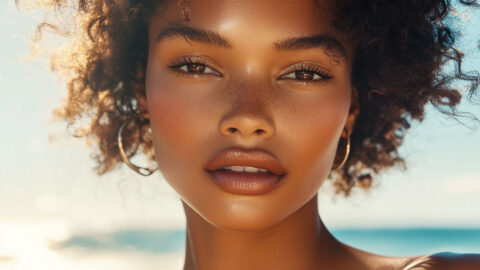
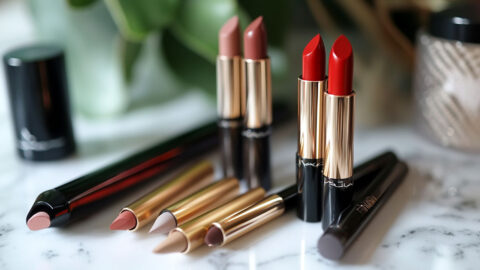
Warm undertones suit shades with orange, yellow or brown in the pigment, which means coral, peach, terracotta, brick red, orange-red, warm nude and rust. A blue base cools the same color down, and that’s often why a shade that looked right in the tube goes wrong on the face.
Your own lips matter too. MAC’s artists note that a shade like Velvet Teddy can read warm or cool depending on the natural tone of the lip, so what’s underneath changes the final shade.
How can you tell if your undertone is warm?

Look for a yellow, golden, peachy or olive cast under the surface of your skin. It stays put when a tan or a breakout changes the color on top.
Tone and undertone get mixed up a lot. Tone is how strong the color looks (light, tan, medium, dark), and undertone is the subtle hue underneath, which is how Mented’s lipstick guide frames it.
The table below covers the home checks. Run at least two of them, in daylight, on a bare face.
| Test | How to run it | Warm result | Where it fails |
|---|---|---|---|
| Vein test | Check inner wrist veins in daylight | Green-leaning veins | Thin skin, tan, surface redness |
| Jewelry test | Hold gold and silver against bare skin | Gold looks better | Near-neutral skin shows no winner |
| White paper test | Hold plain white paper beside the jaw | Skin looks yellow or golden | Tinted or cool lighting |
The vein test is the one I’d trust least. Sterling Style Academy argues that vein color reflects how light travels through skin rather than a genetic undertone, and that skin thickness and transparency skew the result.
Judge the jewelry test by how your skin looks, not by which metal you like more.
Olive skin and near-neutral skin are where the tests disagree most. Mented counts yellow-green olive among warm undertones, though its olive-skin guide notes that olive is sometimes treated as neutral. A split result on olive skin still leans warm but can sit close to neutral.
If two tests point warm and one points cool, you may be in the neutral range. In that case, lipstick shades built for neutral undertones are worth testing alongside the warm families below.
Undertone is the first filter when you pick a lipstick color. Skin depth and finish come next, and your own lip pigment gets the last word.
Two tests that agree are worth more than one test you feel sure about.
Which lipstick colors suit warm undertones?
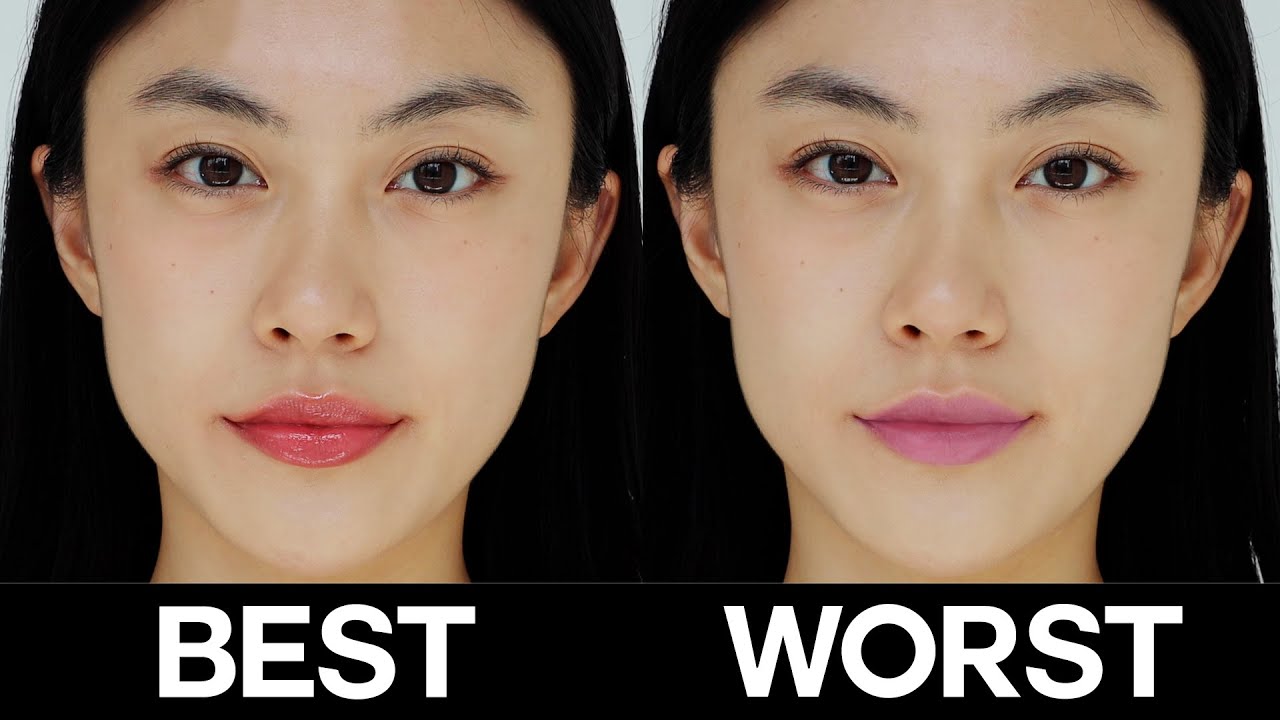
Pigment base does the sorting. On the color wheel, orange and yellow sit on the warm side and blue on the cool side, so Red Apple Lipstick notes that an orange-based red stays warm while a blue-based red turns cool.
| Family | Pigment base | Reference shade | Watch-out |
|---|---|---|---|
| Brick red | Red-orange | MAC Chili (matte) | Heavy on very fair skin |
| Orange-red | Orange | NARS Mad Rush (Air Matte) | Brightest family in the set |
| Coral | Orange with a pink touch | Revlon Coralberry (creme) | Pink lips pull it rosier |
| Terracotta and rust | Orange-brown | MAC Marrakesh (matte; swatch to confirm the tone) | Sallow on cool-leaning skin |
| Peach nude | Peach with brown | Mented Peach Please (creamy) | A pink or purple tilt turns it cool |
Reds and oranges
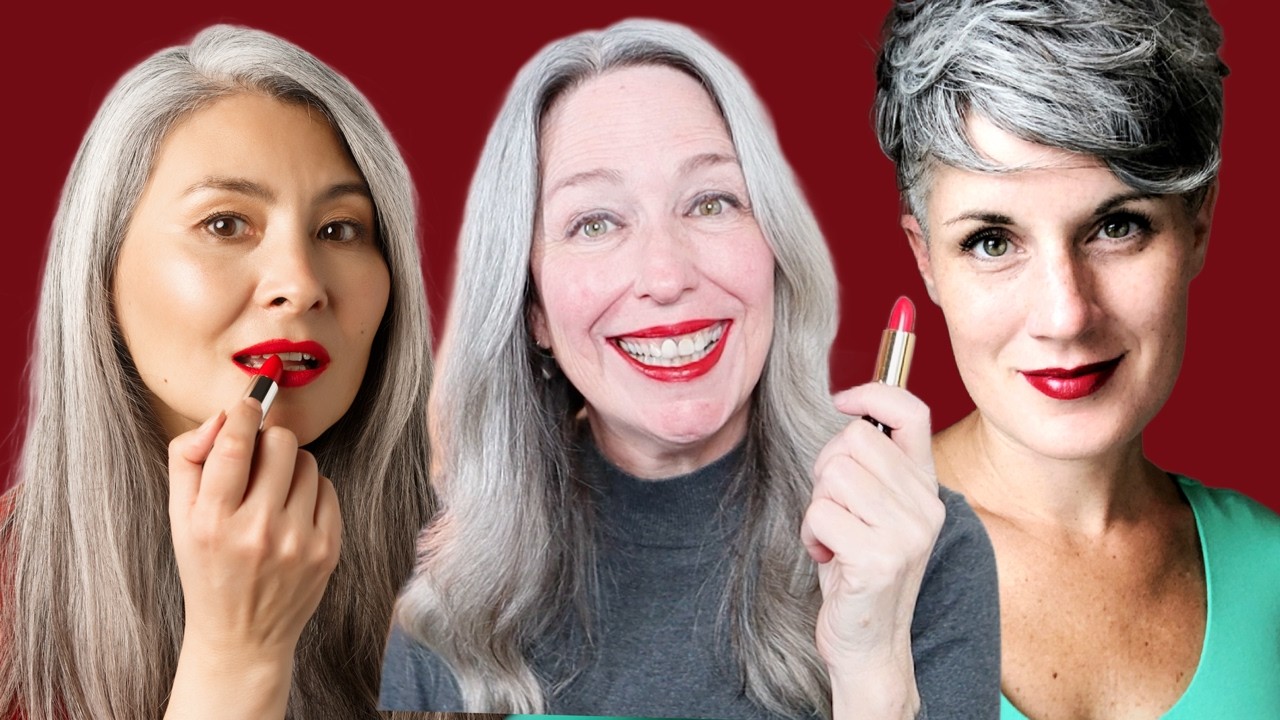
MAC describes Chili as a full-coverage brick red with a matte finish, and it calls Chili its number one lipstick in the world.
NARS lists Pin Up in its Air Matte Lip Color range as a brick red. Retailers and reviewers describe Mad Rush, a shade sold as part of the same Air Matte line, as an orange-red.
Telling a warm red from a cool one takes practice, and a breakdown of how cool and warm reds differ speeds that up.
A dense matte brick can overpower very fair skin, so if that’s you, start with a softer formula.
Pinks, corals and berries

Warm pinks carry coral, peach, orange or brown undertones (Red Apple Lipstick). Revlon’s Super Lustrous Coralberry is a creme-finish coral. Warm berries run to raspberry, plus burgundy and maroon, again per Red Apple Lipstick.
Coral reacts to natural lip color more than most families. A Beautylish reviewer found Coralberry looks orange in the tube but pulls rosier on pink lips.
Nudes and browns

With nudes, the question is how much pink the shade carries.
Mented tells warm skin to skip nudes with too much pink or purple, and points to creamy peach shades such as its Peach Please instead. Picking a nude lipstick comes down to reading those tones before the shade goes on.
MAC describes Velvet Teddy as a balance of pink, peach, brown and nude tones. That mix puts it between warm and neutral, so swatch it before committing.
Browns work best when they lean orange. MAC Marrakesh (matte) is a candidate in this family, but MAC’s product page gives no color description, so swatch it to check that it leans orange.
Which warm shade fits each skin depth?
The deeper the skin, the more saturated the warm shade can be. Lighter skin wears soft peaches and corals best. Deeper skin can carry rust and brick, or a rich brown.
Red Apple Lipstick follows the same logic for pinks, matching lighter shades to lighter skin and deeper, bolder ones to darker skin. The named shades below show what each family looks like, not a brand’s depth rating.
Fair and light skin
Soft, light-leaning warm shades keep fair skin from being overpowered. The full range is covered in a guide to lipstick colors that suit fair skin.
Think soft peach nude, light coral, or a warm pink if you want more color. Mented Peach Please, a creamy peach nude, is a shade of this type.
Medium and tan skin
On medium skin, richer and deeper warm pinks and corals work (Red Apple Lipstick).
Tan skin is where orange-reds, brick and rust hold their color against more depth, and a set of tan skin lipstick colors shows how far the range stretches.
MAC Chili and Revlon Coralberry sit in these families.
Deep skin
Deep skin carries saturation well.
Red Apple Lipstick suggests deeper, bolder pinks for darker skin and lists burgundy and maroon among its warm berry shades. Orange-leaning browns belong in the same range, and MAC Marrakesh is one to swatch.
Pale peach and light nudes are the ones to be careful with, since they can look chalky against deep skin.
Do warm spring and warm autumn palettes need different lip colors?
Yes. Warm spring runs clear, light and fresh, which means coral and peach. Warm autumn is muted and earthy and wants terracotta, cinnamon, rust or brick red.
Carole Jackson’s Color Me Beautiful (1980) put the four-season system in front of a mass audience. Spring and autumn are the warm pair, and summer and winter are the cool ones.
For warm spring, the Color Me Beautiful brand describes the palette as warm, light and fresh, with peach, coral and poppy pink lip shades that feel lively rather than deep or muted. Its guide calls warm autumn warm, rich and earthy, with lipstick in terra cotta, spiced cinnamon, rust and brick red.
If clear, light shades flatter you, lean spring. If depth and muted richness work better, lean autumn.
The brand’s own lipstick pairings follow that split. Its blog lists Mango Punch for Spring and Spice for Autumn, though its product pages tag both shades for both seasons.
The system has limits. Wikipedia’s entry on color analysis notes that analysts need no standard training or degree, and consultants split seasons into sub-variants such as early spring or metallic autumn, so two warm people can land on different lipsticks.
Which lipstick colors clash with warm undertones, and when does that rule fail?
Blue-based pinks and fuchsia clash with warm undertones, and purple-leaning mauves do too, because the cool pigment competes with the yellow in the skin instead of blending into it.
Which shades clash and why
Mented’s guide says colors on the cool end of the spectrum contrast with warm skin and compete with its tone.
A blue base cools the whole lip, and warm skin can read ashy next to it. Fuchsia, a saturated blue-pink, is the most obvious mismatch on yellow-leaning skin. Mauves lean cool as well, including pink-purple shades such as Fenty Beauty’s Stunna Lip Paint in Uncuffed, which the brand lists as a rosy mauve.
Shades built for cool undertones use these same bases on purpose, and a guide to lipstick colors for cool undertones shows the full range.
When the clash rule does not apply
Red Apple Lipstick and Mented tie the shade family to the undertone, so warm skin gets warm shades.
Some brands push back on that. Huda Beauty says its Liquid Matte shades were created with neutral undertones to guarantee they look great on everyone, and Maybelline New York says Color Sensational Made For All was tested on 50 diverse skin tones.
Both claims come from the brands selling the shades, and the sources reviewed show no independent test of either. Treat a universal shade as a lower-risk bet, not a guarantee.
The rule loosens for neutral undertones, which sit between warm and cool. It also loosens when you counterbalance on purpose, such as with a taupe with brown and red-purple notes (Mented), and with sheer formulas, where the lip’s own color does most of the work.
A warm base layer can also rescue a cooler shade. MAC’s artists suggest covering the whole lip with a warm-toned pencil such as Spice before the lipstick to push the result warmer.
How does finish change the warmth of a lipstick?

Finish controls how much pigment shows and how much of your own lip color shows through, so one warm shade can read stronger or softer depending on the formula.
Matte puts full-strength pigment on the lip with no shine, so an off base shows most. MAC notes matte formulas are naturally more opaque. Its Powder Kiss formula is a hazy matte with sheer-to-medium buildable coverage, which is a gentler way into the finish.
Estee Lauder describes its Pure Color Creme as a dimensional creme finish that feels smooth. Laura Mercier compares its matte and satin finishes to velour versus satin fabric, which puts satin on the smoother, shinier side. At the sheer end, retailer LookFantastic describes MAC’s lustre finish as sheer to medium color with a semi-gloss finish, so natural lip color shows through.
Shine bounces light off the lip and softens the color, while matte holds it flat. The coverage-versus-comfort trade is laid out in a comparison of matte versus satin lipstick.
Sheer finishes forgive a borderline shade. A sheer lipstick deposits less pigment, so the lip’s own tone does part of the work.
If you are unsure about a shade’s base, try it sheer first and move to matte once it proves itself.
How to test a warm shade before buying
Swatch the shade on your own lips in daylight, because natural lip pigment adds a layer that changes the final color.
Celebrity makeup artist Pati Dubroff, quoted by Beautycrew, says lip pigment affects how a lipstick reads and that light changes the outcome in photos and in life.
MAC adds that skin pH, which it puts at 4.5 to 5.5, can shift a lipstick’s color once it sits on the lip.
- Remove other lip product, apply a thin layer of balm and blot it
- Swatch the shade directly on the lips, not the hand or wrist
- Check it by a window, then under indoor light
- Compare it with your natural lip color (for an everyday nude, MAC suggests one or two shades deeper)
- If it reads too cool, put a warm-toned liner or base under it
- Look again after an hour, because the shade can shift on wear
For the liner step, e.l.f. recommends a nude liner close to your natural lip or skin tone, or one slightly darker than your natural lip color. A guide to choosing a lip liner covers the rest of the range.
To see a shade at its true color, The Beauty Department’s four-step method stipples foundation over the lips with a sponge, taps on powder, fills the lips with liner, then applies lipstick. Filling the whole lip rather than outlining it is covered in a walkthrough on applying lip liner.
Sources can disagree on a shade’s temperature. MAC product copy lists pink among Velvet Teddy’s tones, yet MAC’s artists call the shade primarily warm and say it can read cooler on some lips, which is why testing on your own lips settles it.
The usual mistakes are judging the shade in the tube, trusting a single swatch, skipping daylight, and ignoring the shift after an hour.
FAQ About Lipstick Colors for Warm Undertones
Is olive skin warm or cool?
Olive skin usually leans warm for lipstick purposes, though it is sometimes treated as neutral. Mented lists yellow-green olive among warm undertones, and MAC’s artists suggest a red or berry shade that adds warmth to the lip.
Can a neutral undertone wear warm lipstick?

Yes. Neutral skin carries both warm and cool tones, so warm shades work alongside cool ones, as Huda Beauty notes.
Let finish and your own lip color decide between them.
Does a tan change your undertone?
No. Sterling Style Academy describes undertone as consistent through sunburn, acne and complexion changes.
A tan deepens the surface color and can throw off the vein test, so retest on untanned skin.
Which drugstore lipsticks work for warm undertones?
Revlon’s Super Lustrous lipsticks come in dozens of shades across creme, pearl and matte finishes, which gives a mass-market range that includes coral shades such as Coralberry.
Check the pigment base of each shade instead of trusting the brand name.
What blush goes with warm lipstick shades?
Warm coral and peach blushes keep the face on one temperature. For deeper autumn lip shades, earthier terracotta or soft melon blushes carry the same warmth.
Which Warm Shade to Buy First
The safest first purchase among lipstick colors for warm undertones is a satin coral or warm nude.
A wrong guess costs least when the formula is lightest, and pigment load climbs as you move through the families. I’d buy in this order: satin coral or warm nude for daily wear, then brick red or orange-red for occasions. Rust or warm berry can wait until you want more depth.
A collection built only from warm families gives up cool pinks and mauves entirely, which narrows the range.
Drop any shade that swatches pinker on the lips than its name suggests, however popular it is. Brands rename and reformulate shades, so retest a repeat purchase (position verified October 2026).
Once a shade passes, applying lipstick with a clean edge and an even base is the natural next step.

She started writing on the site after fielding the same questions from clients and friends often enough to just write the answers down: which red won't turn orange on a warm undertone, how to keep lipstick from feathering into fine lines, why a "12-hour" formula rarely survives dinner.
Every review on the site follows the same rule she uses with paying clients: wear it first, then decide if it's worth recommending.
- How to Make Eyeliner Last Longer Without Smudging - August 31, 2026
- How to Make Eyeshadow Last Longer All Day - August 29, 2026
- How to Find Your Undertone in 5 Easy Steps - August 27, 2026