Lipstick fades during a meal no matter what you wear. What changes is how it fades. With some prep it thins out evenly, and without it you end up with a ring of liner around a bare middle.
A granted patent for long-wear lipstick (US 10,076,487) lists the kiss test as one example of how transfer resistance gets rated. So a transfer-resistant label says very little about surviving a greasy plate.
Why does lipstick come off when you eat?

Grease from food breaks down the wax and oil that hold the color on, and then chewing wipes away whatever survived.
The European patent application on lipstick composition (EP 0508591) describes a stick as a wax framework with oils and colorants suspended inside it. The waxes, oils and pigments in a lipstick formula are there for smooth glide, which is exactly what a greasy bite attacks.
Oil does the most damage. Friction from chewing and talking comes next, and the middle of the lips takes the brunt of it (Faces Canada). Glass rims and forks lift color straight off. Mugs are worse, especially when you drink without a straw.
Long-wear formulas work differently. A volatile solvent carries a film-forming agent, and once the solvent evaporates the film stays on the lips (US patent 7,261,877).
Oil breaks these down too. Faces Canada says oil-based foods break down lipstick formulas faster than anything else.
The industry is careful with its wording. Cosmetics & Toiletries reports that Revlon pushed the term “transfer resistant” over “transfer proof” after a dispute with a competitor, since “proof” suggests the color could never come off.
No lipstick is food-proof. A slow, even fade is the realistic goal.
Which lipstick formulas last through a meal?

According to Faces Canada, matte liquid formulas and lip stains last longest through a meal, and cream lipsticks need refreshing afterward.
| Formula | Wear through a meal | Trade-off |
|---|---|---|
| Liquid matte | Longest wear | Drying, can feel tight |
| Bullet matte | Outlasts shiny finishes | Can dry the lips |
| Cream | Shortest, refresh after eating | Kinder to dry lips |
| Lip stain or tint | Leaves a tint after eating | Sheer color, no full finish |
That solvent-and-film design is the core of what sets a liquid lipstick apart from a bullet.
A lip stain goes another way. It leaves a sheer tint behind instead of a layer of color sitting on top.
Now the downside. Patent filings on liquid lipstick call silicone resins, the usual long-wear ingredient, very drying (US 10,688,034).
Don’t put balm or gloss over a long-wear lipstick. Daily Vanity and Into The Gloss both warn against it, and one Who What Wear tester traced mug transfer to gloss layered over a liquid formula.
Into The Gloss reviewed Hourglass Rouge Liquid Lipstick in 2014 and found it still intact 13 hours after application, through snacks and dinner. That’s a single reviewer’s account, so treat it as an anecdote and not a benchmark.
How to prepare and apply lipstick before eating

Order matters more than any one product here. Prep comes first, then liner, thin layers with blotting, and a powder set at the end.
- Exfoliate the lips gently, then apply lip balm.
- Blot the balm off with a tissue.
- If the lips look uneven, dab concealer or foundation over any cracks (optional).
- Line the lips and fill them in completely with a liner close to the lipstick shade.
- Apply a thin first layer of lipstick and blot. Add a second thin layer and blot again.
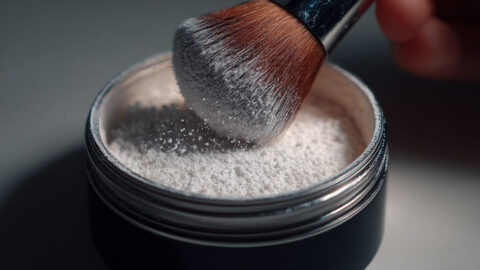
- Lay a single ply of tissue over the lips, dust translucent powder through it, and lift the tissue away.
Lip prep
Lip skin is much thinner than skin anywhere else on the face. The outer layer averages three to five cell layers, against 15 to 20 in typical skin, and water loss through the lips runs three times higher than through the cheek (Skin Inc., October 2023).
Lips also have virtually no oil glands to make up the difference. Dry, peeling lips make an even application hard, so a mild lip exfoliation routine before color goes on pays off.
Then blot the balm off. Faces Canada lists unblotted balm as a common cause of lipstick slipping.
Liner and layers
Outline-only liner leaves a visible ring behind once the lipstick wears. A full fill leaves color on the lips even after the lipstick fades, and Beautylish members who wear matte formulas swear by it.
Liner also holds the edges, which cuts bleeding and feathering (Daily Vanity). Keep the coats thin and blot between each one.
Blot and set
Powder through a tissue is the most repeated trick in the forum threads.
Separate a two-ply tissue so you have one thin sheet, rest it on the lips, and brush translucent powder over it. The full technique is broken down in this guide on setting lipstick with powder.
One catch. Powder turns any finish matte, so a glossy lipstick loses its shine.
Which foods and drinks wear lipstick off fastest?
Oily foods wear lipstick off fastest. Anything slurped, bitten whole, or sipped from a rim comes right after.
| Food or drink | What it does to the color | Fade risk | Adjustment |
|---|---|---|---|
| Pizza, tacos, fried food | Oil breaks down the wax and oil base | High | Wear a stain or plan a touch-up |
| Noodle soup, ramen | Slurping rubs the center of the lips | High | Small forkfuls, no slurping |
| Burgers, sandwiches, whole fruit | Big bites smear color and leave a rim on the food | Medium | Cut into smaller pieces |
| Hot coffee in a mug | Dulls the finish and leaves a mark on the cup | Medium | Finish the cup, then apply |
| Salad with grilled chicken, quinoa | Little oil to break down the base | Lower | Few changes needed |
Spoon University’s contributor says noodle soups are certain to rub color off near the middle of the mouth. Who What Wear’s writer, after testing five lipsticks against coffee, says she would be shocked to find one that never marked a mug.
Formulators test under gentler conditions than a restaurant table. One patent filing (US 9,351,919) has subjects drink through straws and eat only non-greasy foods before wear is scored.
Another (US 8,658,142) puts a panel of six through two kisses, a warm and a cold drink, and a small meal of two bites of a sandwich plus an apple.
Read a long-wear claim as covering light eating, not a plate of tacos.
How to eat and drink without leaving lipstick behind

Keep food off the lips, drink through a straw or from one spot on the glass, and dab with a napkin instead of wiping.
Bites and utensils
- Cut sandwiches and fruit into pieces that fit past the lips
- Load forks and spoons lightly
- Put food on the tongue instead of pressing it against the lips, and pause between bites to talk
- Skip the slurping
None of this is a tested protocol. The sources agree on the principle (less contact, less friction) and publish no numbers for it.
Glasses and straws
A straw is the only option that takes the rim out of the equation. L’Oreal Paris recommends drinking through one so the color stays on the lips.
Stuck with a glass? Sip from the same place every time so it carries a single mark, per Food & Wine as relayed by Tasting Table.
VinePair described touching the sip spot with a moistened lip first, because fats and water do not mix. Beautylish members note the catch, which is doing it discreetly.
Napkins and teeth
Napkin advice splits a little. Faces Canada says to dab the lips after eating to lift food oils, while the Etiquette Ladies (via Reader’s Digest Canada) say a napkin is for dabbing the mouth only, never for removing lipstick.
Both agree on dabbing. Blot the color with a tissue when you apply it, and the napkin stays clean.
For teeth, the finger test does most of the work. Slide a clean finger between closed lips and pull it out, so excess color lands on the finger (L’Oreal Paris, 2019).
Makeup expert Deanna Melluso, quoted by Refinery29, blames dryness (in the mouth or on the teeth) or color applied too close to the inner lip rim. The Beauty Department adds a note on finish. Matte formulas rarely reach the teeth, while satin and liquid lacquer finishes are the usual culprits.
More fixes are in this guide to keeping lipstick off your teeth.
What to do after the meal: touch-up timing and kit
Check the lips in a mirror first, then pick the fix by how much color is left.
If most of it is still there, blot with a tissue and add a thin layer only where the color has faded. Nykaa’s reapplication guide points to the center of the lips, which fades first.
If it’s patchy or clumped, clean the lips and reapply in light layers. Red Apple Lipstick suggests water on a finger or a gentle wipe, and Beautylish members strip everything off and start again with liner.
The meal does half the removal for you, since food oils already lift product. Temptalia notes that reapplying is easier once most of the color has faded than over uneven leftovers.
For the bag, bring the lipstick and lip liner you wore, a thin tissue, and a lip brush (Temptalia suggests carrying one). A cotton swab with a little makeup remover or a damp wipe is worth adding, plus concealer.
A cotton swab dipped in makeup remover cleans color that has bled past the lip line. Concealer sharpens blurry edges (Temptalia).
If the edges blur after every meal, the cause usually sits in the application, which this guide on how to stop lipstick from feathering covers.
When skipping lipstick or switching to a stain is the better call

Long-wear lipstick is the wrong pick on chapped lips, and on shades that show every smear. It’s also a poor habit if you wear it most days without prep. A stain or a cream formula works better in those cases, or you can just apply after the meal.
Dermatologist Debra Jaliman advises avoiding long-lasting formulas on dry, chapped lips (Dermstore). Dermatologist Morayo Adisa says matte lipsticks, long-wear ones especially, dry the lips out with consistent use unless they are moisturized first.
Bright reds and pinks with blue undertones tend to show smudging more than warm nudes, so those are the shades to be careful with.
Dermatologists draw the line in slightly different places. Jaliman says avoid long-wear formulas on chapped lips outright, while Adisa says prep makes regular wear tolerable.
Skin Inc.’s cosmetic chemist Kelly Dobos lands closer to Jaliman, advising that long-wearing lip color be used sparingly when the lips are chapped (October 2023). A 2023 pilot survey in CosmoDerma, small by its authors’ own account, listed dryness and lip cracks among common reactions to lipstick.
A stain is not a free pass either. Dermatologist Shereene Idriss, quoted by Huda Beauty, says stains and matte lipsticks can dry the lips over time.
A cream lipstick gives up wear time for comfort, which is the right trade on rough lips. If you still want color on flaky lips, a separate guide covers applying lipstick on dry lips.
If you will be eating and talking a lot, mid-tone shades look softer as they wear and are easy to refresh, according to Red Apple Lipstick.
Wearing nothing through the meal and applying afterward is a legitimate answer.
Eating With Lipstick FAQ
Can you reapply lipstick at the table?
Sometimes. The Emily Post Institute says a quick application is fine with close friends or family, outside business settings and at a non-deluxe restaurant, with no mirror.
Skip wands, pencils and brushes, and when in doubt, leave it for the restroom.
How do you get lipstick off a cup or glass?
Run it through a hotter, longer dishwasher program. Beko’s support guidance says colored stains like lipstick can survive a normal cycle.
Worn surfaces hold stains in pores or dents, so keep those items out of the dishwasher.
Is it safe to swallow lipstick while eating?
In the small amounts that reach the mouth during a meal, yes. The FDA concluded in December 2011 that lipstick is swallowed only in tiny amounts and did not consider the lead levels it found a safety concern.
The Campaign for Safe Cosmetics disputes that, citing lead buildup over time.
Does licking your lips help lipstick stay on?
No. Dermatologist Debra Jaliman says licking dries the lips as the moisture evaporates (Dermstore).
Dry, flaky lips also make an even application harder, according to Skin Inc.
Building a Default Routine for Eating With Lipstick
It works best as a fixed order. Pick the formula for the meal first, since that caps what prep can do, and prep in turn caps what a touch-up can rescue.
For a light meal that usually means a liquid matte or a lip stain, followed by the liner fill, thin layers and powder. The lip brush, tissue and concealer go in the bag for later.
The price is extra minutes before leaving, and that’s about it.
A liquid formula that held through lunch still has to come off at night, and the guide to removing liquid lipstick covers that step.

She started writing on the site after fielding the same questions from clients and friends often enough to just write the answers down: which red won't turn orange on a warm undertone, how to keep lipstick from feathering into fine lines, why a "12-hour" formula rarely survives dinner.
Every review on the site follows the same rule she uses with paying clients: wear it first, then decide if it's worth recommending.
- How to Make Eyeliner Last Longer Without Smudging - August 31, 2026
- How to Make Eyeshadow Last Longer All Day - August 29, 2026
- How to Find Your Undertone in 5 Easy Steps - August 27, 2026