Trying to stop foundation from oxidizing is a bit misguided, because the pigments mostly aren’t doing the oxidizing. Most of the 32 shades in a four-brand study darkened on an inert opacity chart with no skin involved, and the iron oxide and titanium dioxide pigments are already in stable oxidized forms (Yolanda et al., Scientific Reports, 2025).
Skin oil then piles onto that baseline shift. On oily and combination skin, it’s why one bottle can hold its color on one face and drift orange on another.
Which is good news, since oil and application are the parts you control.
How can you tell foundation oxidation from a wrong shade?
Timing gives it away. A shade that looks orange from the first blend is a mismatch, while real darkening builds slowly after the foundation has dried.
Ulta Beauty’s beauty education guide draws the same line. An orange cast that appears immediately points to an undertone mismatch, not a formula that changed on your skin.
| Pattern | When it shows | Quick check |
|---|---|---|
| Wrong shade or undertone | Right away, and it stays | Orange against the neck in daylight |
| Normal dry-down | First few minutes after blending | Color settles, then stops moving |
| Sebum-driven darkening | Over the first hours of wear | Oily zones darker than the cheeks |
| Product interaction | Depends on the combination | Wear it over bare skin on one side |
What the shift looks like also depends on how deep your shade is. Light and medium-light shades drift redder, which reads as orange or pink. Medium and deep shades go the other way, turning paler and less saturated, so they look flat or ashy instead of orange. The deepest shades hold their lightness best.
That pattern comes from Yolanda and colleagues, who tracked 8 shades per brand in Scientific Reports (2025).
Paula’s Choice puts the usual onset at 1 to 3 hours after application. Some wearers see nothing until the end of the day.
Run a wear test before changing anything
Blend a swatch along the jawline at the start and compare it with your neck. Check again after 2 hours, in daylight and not under a bathroom bulb. Then look at the 4 and 6 hour marks, comparing the forehead, nose and chin with the cheeks.
The Scientific Reports team measured color at application and every two hours up to eight, and most of the change in their data landed in the early intervals.
Only the oily zones moving points to sebum. An even shift across the whole face is more likely the shade or the formula.
What causes foundation oxidation?

Foundation darkens mainly because sebum mixes into the wet film and the carrier dries down, not because the pigments change chemically. The iron oxides and titanium dioxide that color most liquid foundations already exist in stable oxidized forms (Yolanda et al., Scientific Reports, 2025), so the apple-browning comparison doesn’t fit.
Sebum

Zhang and colleagues added artificial sebum at rising concentrations to a base liquid foundation. The film turned more translucent, and the darkening tracked that rise closely (R-squared of 0.852, p under 0.01, International Journal of Cosmetic Science, 2024).
Powders that disperse well in sebum were less affected. Balanced solvent volatility and swapping in oil-fixing powders cut the darkening further.
Oily and combination skin loads the film with sebum fastest, so those skin types report the problem most.
Drying and evaporation
Solvents leave the film within the first few minutes, which is why a layer looks different dry than it did wet. Chen’s team found that faster-evaporating bases darkened more (R-squared of 0.83, p under 0.01).
The surface treatment on the pigments matters too. In Chen’s silicone-based test foundations, silicone-coated pigments darkened less than uncoated ones. And under the microscope, the brand that darkened most had rougher-looking surfaces, which the authors say may increase light scattering, though they call that link qualitative and exploratory.
Chen and colleagues (Skin Research and Technology, 2023) tested on inner forearm skin because it makes far less sebum than the face. Their most stable commercial product moved about 1 delta E unit in 120 minutes, below the 2.3 level commonly cited as the just-noticeable difference.
A 2026 in vitro study in the International Journal of Cosmetic Science sprayed artificial sebum onto three lab-made foundations at 0, 1, 3 and 5 hours. Most of the visible shift came during early drying, and sebum added only minor variation whenever it arrived.
Skin pH, air and layered products
Natural skin surface pH sits at about 4.7 once the skin has gone 24 hours without water or cosmetics (Lambers et al., International Journal of Cosmetic Science, 2006). That acidic film, the acid mantle, is the usual suspect in beauty articles, but none of the foundation studies above measured its effect on color.
Air exposure fares no better as an explanation, since the main pigments are already oxidized.
Layered products are a separate case. Paula’s Choice names moisturizer oils mixing into the foundation as a common trigger.
Where the sources disagree
Zhang ties darkening to sebum, and a Society of Cosmetic Chemists meeting paper (Huang et al., 2022) ranked sebum above sweat and light. The 2026 in vitro model and Chen’s forearm work see it differently, placing most of the change in the film itself with sebum as a smaller add-on.
The studies test different things, so both can hold. Dry-down sets a baseline shift for every wearer, and sebum adds to it on oily skin. The routine below goes after both.
How to stop foundation from oxidizing, step by step
None of this needs special products. It does need a little patience in a couple of places, mostly the waiting.
- Cleanse and pat dry, so no old oil sits under the base.
- Apply a light moisturizer and wait until the surface feels dry.
- Add sunscreen and let it set the same way.
- Smooth primer over the oily zones and let it dry down.
- Build foundation in thin layers with a sponge or brush.
- Set with translucent powder or setting spray, then blot oil through the day instead of adding more foundation.
Skin prep before foundation

Foundation sits on whatever your skin and skincare left behind. Maybelline India notes that applying foundation straight after skincare changes how it sits.
Moisturize even if your skin is oily, just keep it light, and skip heavy oils and balms on the forehead, nose and chin. If you’re switching to a new sunscreen, wear it with your foundation for a full day before trusting the pair.
Primer by skin type

Primer acts as a buffer between sebum and pigment. Even so, the way you use makeup primer decides whether the buffer holds, because a wet layer under foundation just moves around.
Oily skin does best with an oil-absorbing primer containing silica or kaolin, concentrated on the forehead, nose and chin. For combination skin, mattifying primer goes in the T-zone only and a hydrating one on the cheeks. Dry skin gets a hydrating primer and no mattifying product anywhere.
Let it dry fully before the foundation touches it, as Makeup.com advises. No lab study retrieved tests primers directly, so the barrier effect is sound reasoning from the sebum data, not proven fact.
Applying and setting foundation

Thin layers beat one thick coat.
A heavy layer holds more oil and more pigment to drift. Build coverage only where you need it, and use the areas that change first as your guide (Ulta Beauty suggests targeted application there).
Setting powder adds an oil-absorbing layer on top, and how you apply setting powder matters. Press it into the zones that shine first instead of sweeping it over the whole face. Zhang’s lab put oil-fixing ingredients inside the formula, and powder on top follows similar logic, but no study retrieved tests it directly.
On dry skin, a setting spray is the gentler choice, since powder can dull the finish.
When shine appears, blot. Foundation layered over oil looks darker and thicker, according to Ulta Beauty.
Which foundation formulas resist oxidation?

Formula type narrows the risk but never removes it. A label that says oil-free, matte or long-wear predicts very little on its own.
Yolanda and colleagues tested 32 shades from four best-selling lines, all marketed as long-wear, oil-free and matte (Scientific Reports, 2025). One brand stayed under a delta E of 2.2 in every shade, while most shades from the other three passed 3.0, a change the eye sees easily.
| Formula type | Oxidation risk | What the evidence says |
|---|---|---|
| Matte, oil-free | Lower, not zero | Oil-fixing ingredients cut darkening in formulation tests |
| Dewy, emollient-rich | Higher | Authors link more oil to more drift, untested |
| Silicone-based (dimethicone) | Brand-dependent | All four tested lines listed dimethicone, results still varied widely |
| Long-wear | Not a predictor | All four tested lines were marketed as long-wear |
No controlled study retrieved compares water-based and silicone-based carriers directly, so neither label gets a ranking here.
Do iron oxides and titanium dioxide cause it?
MODA Brush makeup artist Dominique Lerma told Makeup.com to avoid titanium dioxide, zinc oxide and iron oxide because they can raise the chance of a shift. The Scientific Reports team sees it differently. They describe iron oxides and titanium dioxide as already stable and oxidized, and note that red, black and yellow iron oxides commonly set the shade.
Avoiding them means avoiding most of the color. How well the pigments are dispersed and coated looks like the better lever: Zhang found that powders with higher sebum dispersibility held up better against sebum, and Chen found that pigment coating changed how much a foundation darkened.
Do antioxidant ingredients help?
Unproven.
A dermatologist quoted by Makeup.com recommends foundations with strong antioxidants for stability. No controlled study retrieved tests vitamin C or E against foundation darkening, and with the pigments already oxidized the mechanism is unclear.
Treat them as a harmless bonus, not a reason to buy.
How much does shade depth matter?
In every brand tested, shades 5 and 6 of eight drifted the most, while shades 7 and 8 kept their lightness best. Light and medium-light shades moved redder, and medium and deep ones lost saturation.
Mid-range shades carry the highest risk, so test those for six hours before committing. Start with a matte, oil-free formula, then let your own wear test overrule the label.
How to test a foundation shade before you buy it
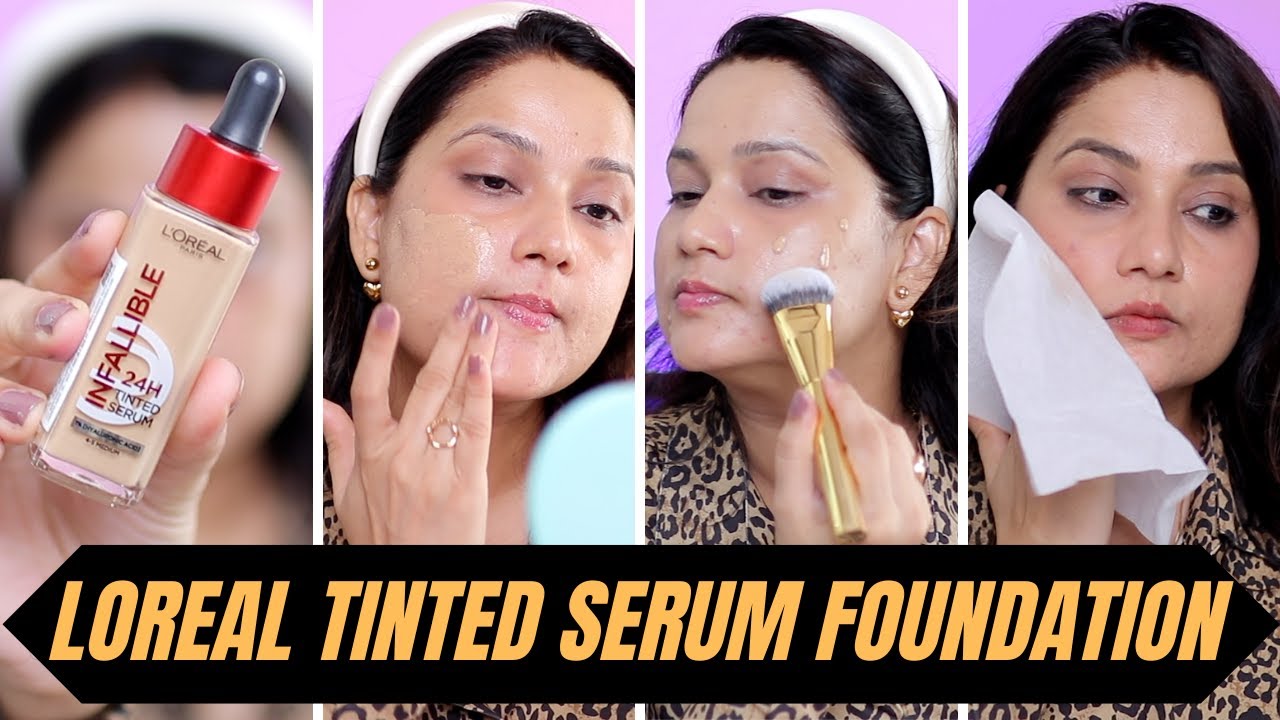
Swatch two neighboring shades along the jawline, let them dry, then judge them in daylight. Ulta Beauty’s 2026 guide prefers the jaw to the hand because a hand often differs from the face in depth and undertone.
Swatch, wait, then judge
Put a second dab of the same shade on a clean, nonporous surface to act as a control. Then wait at least 15 minutes before choosing (Ulta Beauty, 2026), ideally in indirect daylight, and photograph the swatches without a filter.
A jawline swatch that moves much more than the control means skin oil or your base products are driving the shift. Both deepening points at the formula drying down.
Brands and retailers disagree on the wait. L’Oreal Paris says a few minutes, Ulta says at least 15, and Maybelline India says 20 to 30. Take the longer one.
Undertone before depth
A correct depth with the wrong undertone still looks off. Reading your undertone first makes the swatch test faster, and a guide to matching makeup to your skin tone covers the basics.
A warm formula on cool or neutral skin reads as orange from day one, which is easy to mistake for oxidation (L’Oreal Paris). Brands also label undertones differently, so read each line’s key before comparing shades.
NARS marks undertones with letter suffixes, and Ulta’s advisors suggest starting with C (cool) or N (neutral) shades if foundation keeps reading orange on you.
Should you buy a shade lighter?

Makeup.com says to buy slightly lighter than your skin. Faces Canada says half a shade lighter when a formula keeps pulling warm by midday, and Ulta warns against going much lighter.
The upside is that it offsets steady darkening through the day, and it costs nothing extra if the wear test confirms the pattern.
The downsides are real, though. It looks too light at first, and since it does nothing about the cause, oily zones still move. Really it hides a mismatch instead of fixing it.
Treat half a shade as the ceiling, and only after a wear test shows even darkening with no change in hue.
How to fix oxidized foundation and store it properly
Oxidized foundation cannot be reversed on the skin, only masked or removed. The cheapest fix happens before you start. Build the base first, then wait before adding anything on top.
Quick fixes during the day
- Apply foundation, wait a few minutes, then add concealer and powder, so a bad shift costs only the base (L’Oreal Paris, 2019).
- A brightening concealer matched to your undertone can lift a darkened area.
- Press a face powder slightly lighter than your skin over the spot and blend it onto the neck.
- Buffing the foundation down the neck softens the line, though that only hides the mismatch.
- Some people mix a lighter shade from the same line into the bottle. It’s a common workaround, and none of the studies above test it.
If the cast is clearly orange, you can apply a color corrector sparingly. A blue-leaning one sits opposite orange on the color wheel, but it adds another layer over a base that is already shifting, so keep it to small areas.
Storing foundation to limit air exposure

Ulta Beauty’s storage guide blames heat, light, humidity and air for product breakdown. A bedroom drawer beats a bathroom shelf, and the habits in storing makeup properly apply to the rest of the bag too.
Pump bottles stay cleaner than open applicators, because fingers and sponges carry bacteria in. Keep the cap closed as well, since a loose cap or damaged pump lets in air and dries the texture. Room temperature away from sunlight is best, as heat separates oil and water components and cold thickens the formula.
Ulta puts opened liquid foundation at 6 to 12 months. The FDA’s shelf-life guidance calls expiration dates rules of thumb, and says improperly stored cosmetics can deteriorate well before the date.
Labels vary by market. Under Regulation (EC) No 1223/2009, Article 19, an EU product with minimum durability over 30 months carries a period-after-opening symbol, while shorter-life products show a best-before date instead. The open-jar number you are hunting for may simply not be on your bottle.
One more distinction. If a foundation looks different from how it once did but stays stable on your face, it may have changed inside the bottle (L’Oreal Paris), and Ulta says to stop using a product whose smell, consistency or appearance has changed unexpectedly.
When foundation oxidation prevention does not work
Even a careful routine fails sometimes.
| Failure mode | What happens | What to do instead |
|---|---|---|
| Heat and sweat overload | Oil and moisture outpace primer and powder | Lighter coverage, blot, carry powder |
| Clashing layers | Skincare, SPF or primer mix into the base | Change one layer at a time |
| Dry-skin settling | Pigment pools over dry patches | Hydrate, then thin the layer |
| Unstable formula | Shifts regardless of routine | Swap the product |
Heat, sweat and humidity
Yolanda and colleagues kept their test room at 27 degrees Celsius and 46% humidity, a standard indoor summer setting, and held both fixed (Scientific Reports, 2025).
So the lab data stops where a hot commute starts. Ulta Beauty (2026) ties heat, exercise and humidity to extra oil and sweat on the skin, which makes the sebum route the likely one.
The routine slows the shift in heat. It does not stop it.
Layers that fight each other
Rich or still-damp skincare can mix into foundation instead of staying underneath it, according to Ulta. Clashing layers also make the base pill, and stopping makeup from pilling takes different fixes than color control.
Silicone primers can change coverage depending on the foundation above them (Beauty Bible). When you’re troubleshooting, swap one product at a time, not several at once.
When to swap the formula
Some formulas shift whatever you do.
L’Oreal Paris recommends switching to a different formula once a product starts to oxidize on you. The harder part is finding a replacement, because retailer roundups label products non-oxidizing without showing the measurements behind it.
Ulta Beauty’s 2026 guide names five foundations that way and cites no color measurements for any of them. Your own wear test is the only verification.
How much shift counts as failure
Yolanda et al. treat a delta E of about 1.0 as the smallest visible change, a stricter threshold than the 2.3 level commonly cited as the just-noticeable difference.
For everyday wear, I’d go by a simpler test. If you can see the line against your neck in daylight, the formula failed, whatever the number says.
Foundation Oxidation FAQ
Why does foundation oxidize more on the nose and forehead?
Sebum collects in the center of the face first. Ulta Beauty (2026) notes that color changing mostly around the forehead, nose and chin suggests oil may be playing a bigger role than air alone.
A shiny finish in those areas is a second clue.
Does powder foundation oxidize?
Yes, on oily skin, though not through dry-down. The lab studies cited above tested liquid formulas only, so no measurement exists for powder.
Powder skips the wet stage, but it still sits on sebum, so oily zones can look deeper by evening.
Does concealer oxidize the same way?
Yes. Ulta Beauty says concealer can look darker or warmer after it sets, especially where oil, moisture or layered skincare sit.
Test it on the exact area you plan to wear it, because under-eye skin can react differently from the center of the face.
Does oxidation mean my foundation is bad or expired?
No. Maybelline India’s guide notes that a color shift does not make a formula poor quality.
The real warning signs are smell, texture and separation. A bottle that smells off or will not re-blend belongs in the bin, whatever the color does.
Is a color change the same as an allergic reaction?
No. A color shift alone is not an allergic reaction.
Burning, swelling, hives or persistent irritation are. Ulta Beauty advises removing the product, stopping use, and seeking professional guidance if symptoms are severe or do not settle.
Where to Start With Foundation Oxidation
Sort the cause first, then change one layer at a time. Sebum and plain dry-down need different fixes, and a wrong shade needs neither.
When only the oily zones deepen, start with an oil-control primer, then go thinner on the foundation layers, and only then switch formula. That order climbs in cost and permanence, so the cheapest reversible change gets tested first. If the whole face shifts evenly, start with the formula, since primer acts on sebum only.
The trade-off is finish, since oil-absorbing products dull dry patches. Even the most stable line in the lab data shifted visibly in every shade but its deepest, so aim for a shift invisible against the neck.
The order reflects evidence verified in October 2026, and a controlled trial showing primer fails to slow the shift would change it.
Once the base holds its color, making makeup last all day covers wear time.

She started writing on the site after fielding the same questions from clients and friends often enough to just write the answers down: which red won't turn orange on a warm undertone, how to keep lipstick from feathering into fine lines, why a "12-hour" formula rarely survives dinner.
Every review on the site follows the same rule she uses with paying clients: wear it first, then decide if it's worth recommending.
- How to Make Eyeliner Last Longer Without Smudging - August 31, 2026
- How to Make Eyeshadow Last Longer All Day - August 29, 2026
- How to Find Your Undertone in 5 Easy Steps - August 27, 2026