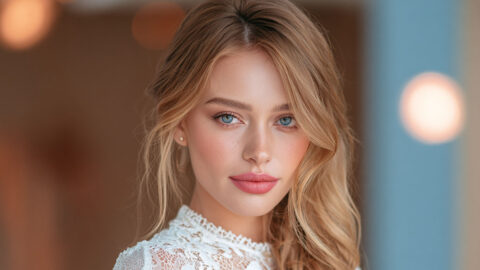
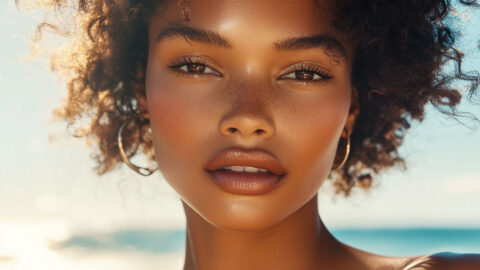
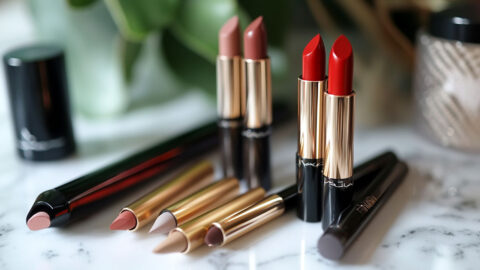
Spring 2027 runways went bright pink at Ralph Lauren and glossy red at DVF (PureWow, 2026). Good to look at. But a trending lipstick and one that suits your face are often two different things.
Charlotte Tilbury’s 2026 color guide is the more useful reference here. It sorts the Spring palette into Light, True and Bright, and each type gets its own lipstick. Soft coral goes to Light and warm peach to True, while Bright gets a clear warm red.
Undertone and skin depth do most of the deciding after that.
Which Lipstick Shades Count as Spring Colors?

Color Me Beautiful draws the line at weight. Spring lip color should read fresh and light, not heavy, and a hint of golden warmth keeps it that way.
Pretty much everything sold as a spring lipstick sits in coral, peach, pink, berry, red or nude.
- Coral is orange-leaning pink, and Color Me Beautiful, Bluemercury and The Handbook all name it.
- Peach runs softer and warmer than coral. Retailers often sell it as peachy pink or peachy nude.
- Pinks stretch from ballet-slipper pastels through bubblegum, magenta and fuchsia.
- Berry means raspberry and strawberry tones, lighter than winter plum.
- The reds that suit the season are clear and warm, like orange-red or chili red.
- Nude here means rosy or peachy beige.
Coral turns up in all three of those sources, which makes it the safest first pick. I’d start there. Styling a coral lip in daylight mostly means keeping the eyes quiet so the color carries the look.
Nudes are the hardest family to get right. Faces Canada advises staying within one or two shades of your natural lip color, so choosing a nude that fits your own mouth beats choosing by swatch.
Cool blue-pink and deep plum fall outside the core set, according to Color Me Beautiful.
Spring 2027 Lip Color Trends From Runways and Pantone
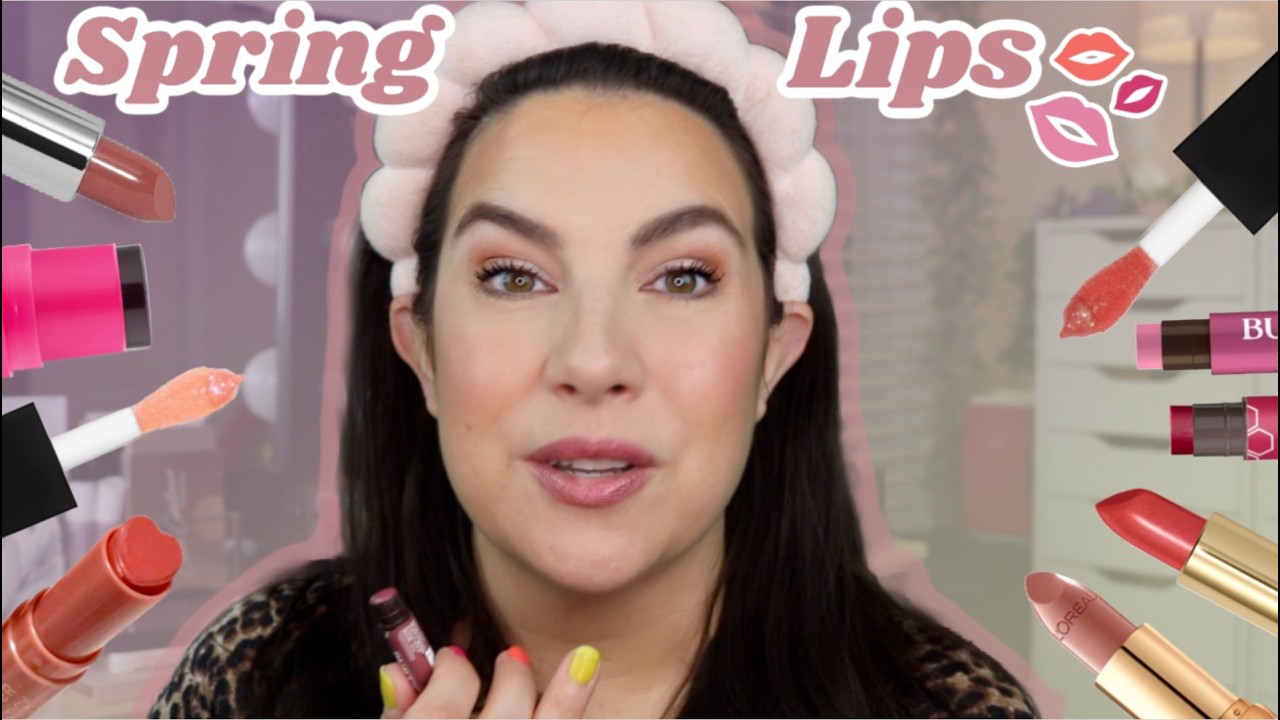
Spring 2027 runways pushed lip color toward bright pink and glossy red, per PureWow’s September 2026 report from New York Fashion Week.
Bright pink appeared at Ralph Lauren, Tory Burch, Conner Ives and Tommy Hilfiger. Christian Siriano and Tory Burch chose rosy bubblegum over the peach usually expected for spring.
DVF went glossy red and Thom Browne showed fuchsia, indigo and plum (PureWow, 2026), while Lanvin used bright red in Paris (Coveteur, 2026).
Not every one of those looks survives a Tuesday. Carrying a bright lip works best when only one feature does the talking.
Pantone’s NYFW report for the same season lands in a similar place, with loud reds and orange sitting next to pale botanical tones. It pairs 10 shades named for NYFW collections with 5 seasonless neutrals (Pantone, reported by FashionUnited, September 2026). The Fashion Color Trend Report comes out twice a year and covers New York and London.
The shades that matter for lips are these:
- Rosy Future 15-1910, a light pink
- Langoustino 16-1440, a warm coral
- Dragon Fire 16-1460, an intense orange
- Hibiscus 18-1762, a vivid red
- Chili Pepper 19-1557, a dark red
Pantone splits red in two. Chili Pepper is the dark, heated one. Hibiscus runs brighter with a slightly cooler cast (FashionUnited’s summary), so whether a red leans cool or warm decides who it flatters.
Consumer guides still lead with peach and coral, and Pantone’s own list includes a coral and an orange. Runway pink is show styling, so a sheer or satin version of the same pink is the easier translation for daily wear.
Runway pink signals where next spring is heading. Coral stays the safer buy.
How to Match a Spring Lipstick Color to Your Undertone and Skin Depth
Undertone comes first and depth adjusts it. Peach, coral and warm pink go with warm undertones, raspberry and blue-leaning pinks with cool ones, and depth sets how bright or dark the shade can get before it creates harsh contrast.
Undertone
The hue sitting under the surface of the skin stays put while tanning and redness come and go.
A yellow, golden or peach cast means warm undertones, and peach, coral and warm pink flatter them. A separate breakdown of shades that suit warm undertones goes deeper than this list.
Skin with a pink, red or blue cast reads cool. Raspberry and cool pinks are the usual matches, and options for cool undertones cover the berry end too.
Neutral skin carries a bit of both casts, which means depth and finish steer the choice more than temperature does.
Maybelline lists four at-home checks, the vein test, the jewelry test, the white cloth test and the cream test. Green-tinged veins and gold jewelry point warm, while blue-tinged veins and silver point cool.
Run at least two in daylight. When they disagree, treat the undertone as neutral.
Skin depth

Depth controls contrast, and contrast is where spring shades go wrong.
| Skin depth | Shades that flatter | Shades to skip |
|---|---|---|
| Fair, cool undertone | Tangerine red, cotton-candy pink, raspberry, dusty pink | Very dark or heavy red |
| Light-medium | Pinkish red, peachy nude | Blue or gray tones such as lavender |
| Medium | Almost every shade, warm ones best | None flagged |
| Deep-medium | True red, berry burgundy | Ashy tones |
| Deep | Pastels to deep plum with a subtle blue cast, berry, deep pink | None flagged |
Rows draw on The Zoe Report’s skin tone guide (2016) and Jordan News (2026).
The two sources split on fair, cool skin. The Zoe Report points to saturated tangerine red and cotton-candy pink, while Jordan News calls for muted dusty pink and lavender.
Both avoid harsh contrast. Pick by how much color you want on the lip, not by one rule.
Do Light, Warm and Bright Spring Palettes Need Different Lipsticks?
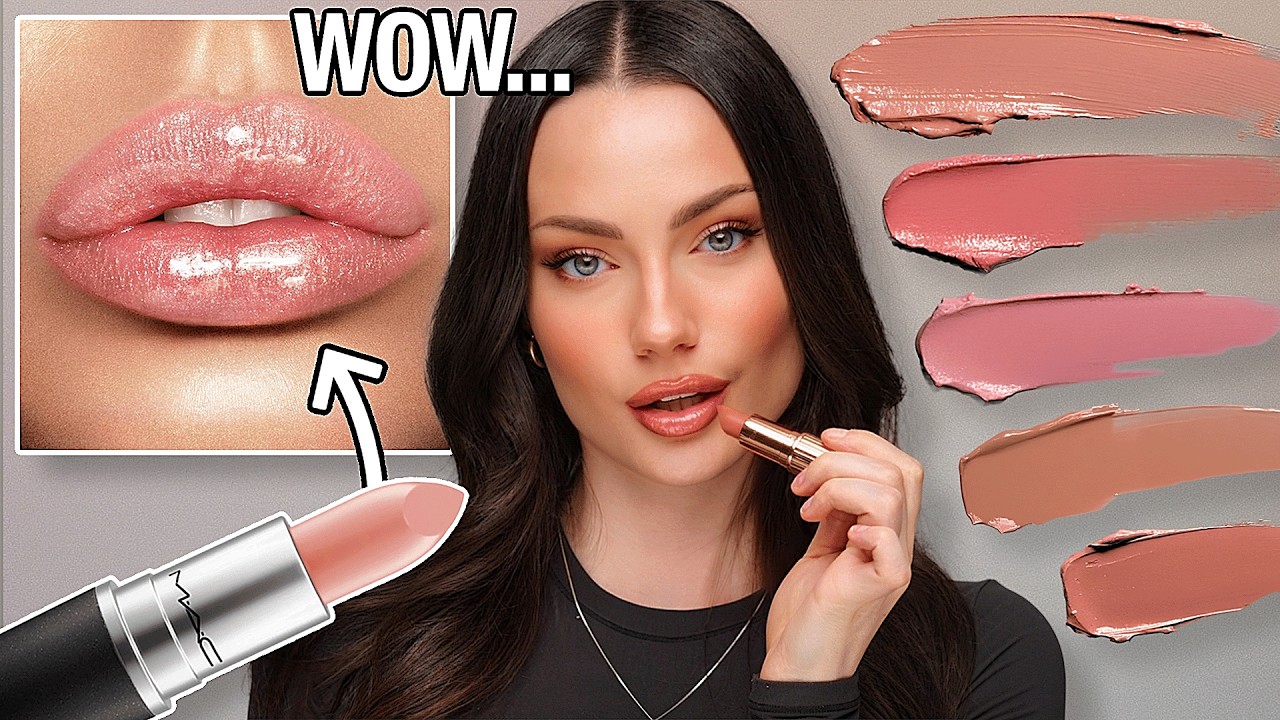
Yes, they do. Charlotte Tilbury (April 2026) gives Light Spring soft pinks and a glowing coral. True Spring, which some people call Warm Spring, gets peach and warm pink. Bright Spring is the one that can handle clear warm reds and punchy pinks.
Chroma is what separates them. Saturated colors point to Bright Spring, muted ones to Light Spring, and the middle ground to True Spring.
Light Spring does well in light pink, a warm nude pink or a soft coral like Charlotte Tilbury’s Stoned Rose. A statement red or electric pink overpowers that low-contrast coloring.
True Spring coloring runs golden, so warm-leaning lipstick shades like peach, warm pink and a sheer cherry tint fit best. Blue-based pinks look drab on it.
Bright Spring can take bold, vivid color. Orange-red, chili red and warm pinks all suit it, while cooler taupe or beige nudes can turn ashy.
When Color Season Rules and Trends Disagree
Color Me Beautiful tells Spring palettes to skip very muted or dusty colors, yet Charlotte Tilbury builds Light Spring around muted ones. Her examples are pastels (butter yellow, lilac, ballerina pink), so muted there means soft, not greyed.
Jordan News (2026) lists dusty rose and muted mauve among the season’s picks, which cuts against the Spring palette rule. A Spring palette can pass on dusty mauve even when trend reports push it.
The fuchsia and plum Thom Browne sent down the runway match what Color Me Beautiful lists for a Winter palette, though Charlotte Tilbury names fuchsia and red for Bright Spring. Light Spring is the palette that should pass on electric pink.
Spring the season and Spring the palette are separate things. A Winter palette still wears lipstick in April.
Spring Lipstick Finishes and Formulas Compared
Stains wear the longest. Liquid and matte lipsticks come next, cream and satin bullets are the most comfortable, and sheer tints, balms and glosses give the lightest color but fade first.
| Formula | Finish and color | Wear | Downside |
|---|---|---|---|
| Bullet lipstick | Cream to matte, medium to full pigment | Medium to long | Wear sits below a stain |
| Liquid lipstick | Matte to satin, highest pigment | Long | Matte versions want hydrated lips |
| Lip stain | Soft, natural wash | Longest | Needs an oil-based remover |
| Tinted balm | Sheer, hydrating | Shorter than a stain | Light payoff |
| Lip oil or gloss | Sheer shine | Shortest | Can feel sticky |
Rows draw on guidance from NYX Cosmetics, Bluemercury, Henne Organics and Maybelline.
NYX Cosmetics lists up to 16 hours of fade-resistant wear for its Lip Lingerie Matte XXL Liquid Lipstick. That is a brand claim, not a lab result.
Makeup artists do not agree on the longest-wearing formula. NBC Select’s panel of 10 split on it, with Lucas Dean Bowman backing stains and the artists in Makeup.com’s guide favoring matte.
Matte wears longer than cream or gloss, while satin and cream give some of that comfort back. So the choice between matte and satin mostly tracks how dry your lips run.
Sheer formulas suit the season best. Scripps News’s 2024 spring roundup flagged a barely-there lipstick look and named Clinique Almost Lipstick among its examples.
Lip stain sits between a tint and a lipstick, with more pigment than a tint and less than a bullet (Henne Organics). Maybelline Super Stay Matte Ink works as a hybrid, a liquid lipstick that leaves a slight stain, according to TODAY.
For a stain with shine, TODAY’s editors picked Rare Beauty Soft Pinch Tinted Lip Oil.
It helps to know how a lip stain works in practice. The pigment stays on the lip after the surface layer wears off, and a balm pressed over it softens the finish (Bluemercury).
How to Apply and Pair Spring Lip Colors
Lips need prep before any of this works, so the routine starts there.
- Exfoliate and hydrate the lips, then blot off the extra balm.
- Line and fill the whole lip with a liner, not just the edge.
- Dab on a thin first coat of lipstick.
- Blot with a tissue.
- Add a second coat for saturation.
- Press a tissue over the lips and dust translucent powder through it.
Liner does the heavy lifting in step two because it gives the color something to grip and sharpens the edge. A walkthrough on applying lip liner covers the technique in detail.
Artists disagree on layering depth. Jenny Patinkin says thinner layers wear longer, while Makeup.com’s Sesnek names too few coats as a common mistake.
Both blot between coats, so blotting is the safe part.
Blush
Match the lip and cheek by family, not by exact shade.
Faces Canada warns that an identical pink on lips and cheeks can look flat. Smashbox’s Lori Taylor Davis suggests related colors or complementary ones on the color wheel, such as a dark violet lip with an orange-peach blush.
She says you may want to skip blush entirely under a high-impact lip like electric pink-coral, so the mouth stays the focus.
Spring 2027 reports split on cheeks. Who What Wear has warm-brown blush replacing last season’s bubblegum cheeks. Hypebae expects anti-blush to have more impact than saturated pink, and eCosmetics says visible cheek color keeps gaining ground.
Bluemercury’s guidance holds across all of them, since soft coral blush sits well with peach, rose, caramel and neutral lips.
Eyes and outfit colors
A bright lip pairs with understated eye makeup (Catrice), and fuchsia in particular suits spring whites. Colorful shadow is returning at New York Fashion Week (eCosmetics), so a quiet eye is now a choice, not a default.
The color wheel gives the rule for outfits, because complementary tones sit opposite each other. That puts coral lips against a teal or sky-blue top, and matching a lip color to an outfit gets easier once you think in opposites and neighbors.
When a Spring Lipstick Shade Looks Wrong
A bad lipstick day usually means the shade is wrong for the face or the technique is wrong for the lip. Which one it is decides the fix.
Shade problem or technique problem?
If the color looks off across the whole face and changing the finish changes nothing, the shade is the problem. Move the shade, or soften it with a sheer or stain version of the same color (Bluemercury).
Color that creeps past the lip line, patches or fades by midday points to technique. Revlon calls feathering typically a technique issue, so a new shade will not cure it.
No technique rescues a shade that fights the undertone.
Fixes by symptom
| Symptom | Likely cause | Fix |
|---|---|---|
| Color creeps into lip lines | Dehydrated lips, fine lines, oil at the lip line | Liner across the full lip, powder, matte or satin finish |
| Fades by midday | Creamy or glossy formula | Stain or transfer-resistant liquid base |
| Patchy matte | Unprepped, dry lips | Exfoliate, balm first, blot |
| Looks too harsh | Too much pigment for the look | Dab on with a fingertip, or switch to a sheer stain |
Feathering mostly comes from dehydrated lips and fine lines around the mouth (Giorgio Armani Beauty’s Beck Morgan, via Makeup.com), and excess oil at the lip line adds to it (Revlon).
The fix is a sequence of liner, powder and a matte or satin finish, which is why stopping lipstick from feathering is mostly a technique job.
Midday fade is usually a formula problem. Making lipstick last longer starts with a stain or a transfer-resistant liquid, since Maybelline notes that tints and liquid lipsticks are often built to resist transfer.
Spring Lipstick Colors FAQ
Which spring lipstick colors suit olive skin?
Olive skin has more leeway with makeup shades than most, so nearly every spring color works, and berry is the bolder pick (The Zoe Report, 2018).
Temptu groups olive under neutral undertones, which keeps both warm and cool shades in play.
Are there good drugstore spring lipsticks?

Yes. Scripps News’s 2024 spring roundup named Milani Color Statement in Rose Hip, CoverGirl Exhibitionist Cream in Orange AF and Revlon Super Lustrous in Lovers Coral among its picks.
Maybelline’s own spring guide points to Super Stay Ink Crayon for matte long wear.
Is red lipstick okay for spring daytime?

Yes, when the red is clear and warm. Color Me Beautiful lists clear reds among its Spring picks.
Charlotte Tilbury suggests a sheer cherry tint for True Spring, since it adds a juicy pop without overpowering soft features.
Can berry, plum or burgundy work in spring?
Yes, depending on skin depth and palette. The Zoe Report pairs deep-medium skin with berry burgundy, and Saint Laurent sent burgundy lips down its Spring/Summer 2027 runway (Who What Wear UK).
A Spring palette is the exception, because Color Me Beautiful lists deep plum as a miss.
Does lip liner have to match the lipstick?
No, and artists split on it. Huda Beauty and Napoleon Perdis advise a liner that matches the lipstick, while RMS Beauty’s Rose-Marie Swift prefers a pencil in your natural lip color.
A matching liner keeps the shade consistent if the lipstick fades, and a natural one blends into bare lips.
Which Shade Belongs in the Bag First?
Among spring lipstick colors, a sheer coral or rose tint is the lowest-risk first purchase, because a sheer wash lets more natural lip color show through (Bluemercury).
Confirm undertone in daylight with two tests first. Then buy one sheer coral or rose in a tint or stain, and add a bold shade once that one fits.
Starting sheer puts the cheapest mistake first. A full-coverage bright bought before the undertone is confirmed carries the highest risk of looking wrong.
The catch is wear time. Sheer tints and balms fade sooner than stains, so touch-ups come with the choice.
The same undertone-first order works for the rest of a lipstick wardrobe, and a guide on picking a lipstick color carries it past spring.

She started writing on the site after fielding the same questions from clients and friends often enough to just write the answers down: which red won't turn orange on a warm undertone, how to keep lipstick from feathering into fine lines, why a "12-hour" formula rarely survives dinner.
Every review on the site follows the same rule she uses with paying clients: wear it first, then decide if it's worth recommending.
- How to Make Eyeliner Last Longer Without Smudging - August 31, 2026
- How to Make Eyeshadow Last Longer All Day - August 29, 2026
- How to Find Your Undertone in 5 Easy Steps - August 27, 2026