You reapply sunscreen over makeup by pressing a thin layer of SPF powder, mist or lotion onto your face about every 2 hours. Use a brush, puff or damp sponge so the foundation stays put, because rubbing drags it around.
The 2-hour gap comes from measurement. In a group of 20 outdoor workers who applied 2 mg/cm2 in the morning, facial sunscreen coverage dropped by a mean of 18.31% within 2 hours and by 31.63% at the 8-hour mark (Kobwanthanakun et al., Health Science Reports, 2021).
A full face of makeup doesn’t change that clock.
How Often Should You Reapply Sunscreen When You Are Wearing Makeup?

Every 2 hours, and sooner after swimming, heavy sweating or towel drying. Makeup sitting on top of the sunscreen doesn’t change the interval.
The American Academy of Dermatology gives the same two-hour rule for outdoor days, foundation or no foundation.
The FDA’s OTC monograph M020 (September 2021 version) ties the rule to the water resistance claim, and the label wording follows from that.
- A product labeled Water Resistant (40 minutes) needs reapplying after 40 minutes of swimming or sweating.
- Water Resistant (80 minutes) products get 80 minutes.
- With either claim, reapply right after towel drying and at least every 2 hours.
- If the label makes no water resistance claim at all, reapply at least every 2 hours, and switch to a water resistant product for swimming or sweating.
A higher SPF number doesn’t buy extra time. The AAD says a higher SPF doesn’t let you stay out longer without reapplying (AAD, 2016). SPF rates UVB protection and says nothing about how long the layer stays on your skin.
Foundation doesn’t count as a top-up either. It goes on thinner than the dose used to test sunscreens, so its protection is probably far below the number printed on the bottle (Jungman and Maibach, Cosmetics & Toiletries, 2010).
Set a recurring alert for the 2-hour mark. On outdoor days, go by the clock and not by how your face looks.
Which Sunscreen Formats Work Over Makeup?
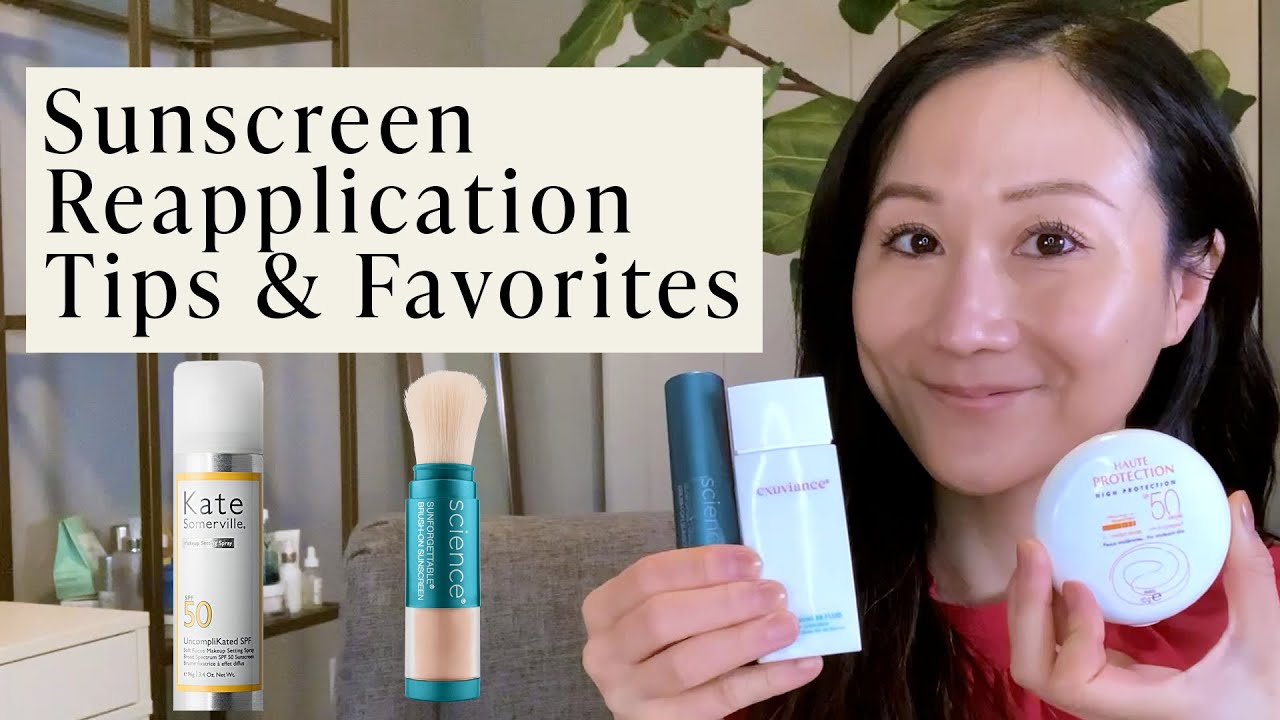
Powder, mist, setting spray, stick, cushion compact and regular lotion all work. They just trade coverage against disruption in different ways. Powders and mists disturb makeup least, while lotions deliver the most product and move the most foundation.
| Format | How it goes on | Makeup disruption | Main limit |
|---|---|---|---|
| Powder | Brushed or tapped on | Very low | Small deposit per pass |
| Mist or setting spray | Misted onto a sponge or hands, pressed on | Low | Uneven coverage, inhalation and flammability |
| Stick | Swiped on, then tapped | Moderate | Spot coverage, needs overlapping strokes |
| Cushion compact | Pressed on with a puff | Low | Thin layer, one tint per compact |
| Lotion or serum | Pressed on with a damp sponge | Highest | Needs careful technique, pilling risk |
Powder and Brush-On Formats

Powder disturbs makeup less than anything else on the list. The Skin Cancer Foundation (2025) calls powder sunscreens useful for layering over makeup and for touch-ups. The AAD adds a catch: use powder only to reapply over a lotion or cream, because it’s hard to apply enough to protect fully.
Self-dispensing brushes such as the Colorescience Sunforgettable Total Protection Brush-On Shield release powder when tapped, which keeps the top-up quick at a desk.
The downside is dose. A brush leaves a small amount per pass, so powder works as a top-up and never as the base layer.
Mists and Setting Sprays

A mist covers the whole face fast and leaves makeup alone if you apply it gently. Some setting sprays include SPF, so a single pass sets the look and tops up protection together.
Mists suit humid days, full-face touch-ups and combination skin. Coverage tends to be patchy, though, and since the mist dries clear, missed spots are hard to see (Barr, 2004, as reviewed in Cosmetics & Toiletries, 2010). Avoid inhaling it and keep it away from flames.
That last point isn’t paranoia. The FDA warned in 2013 that some spray sunscreens contain flammable ingredients, commonly alcohol, and can ignite near a flame even after the skin feels dry.
Sticks and Cushion Compacts
Sticks work best on high points like the nose, cheekbones and forehead. The Skin Cancer Foundation advises overlapping each stroke slightly so you don’t leave gaps.
A cushion compact presses a thin layer on with a puff, the same motion you’d use to touch up foundation. Makeup.com’s dermatologist panel suggests swapping foundation for a tinted compact, such as the Skinbetter Science Sunbetter Tone Smart SPF 68, on days outdoors beyond 2 hours.
A stick only patches. If you want the whole base redone, the compact is the one that does it.
Lotions, Serums and Tinted Fluids
Your morning lotion can double as the top-up if you press it on with a damp sponge, and it delivers more product than any other format here. You don’t have to buy anything new, and the filters match your base.
The catch is that lotion is the format most likely to move your foundation, and switching to a different base type can cause pilling.
La Roche-Posay Australia suggests a tinted sunscreen in place of foundation, so reapplying repeats the base itself instead of covering it.
How Much Protection Does a Top-Up Actually Deliver?
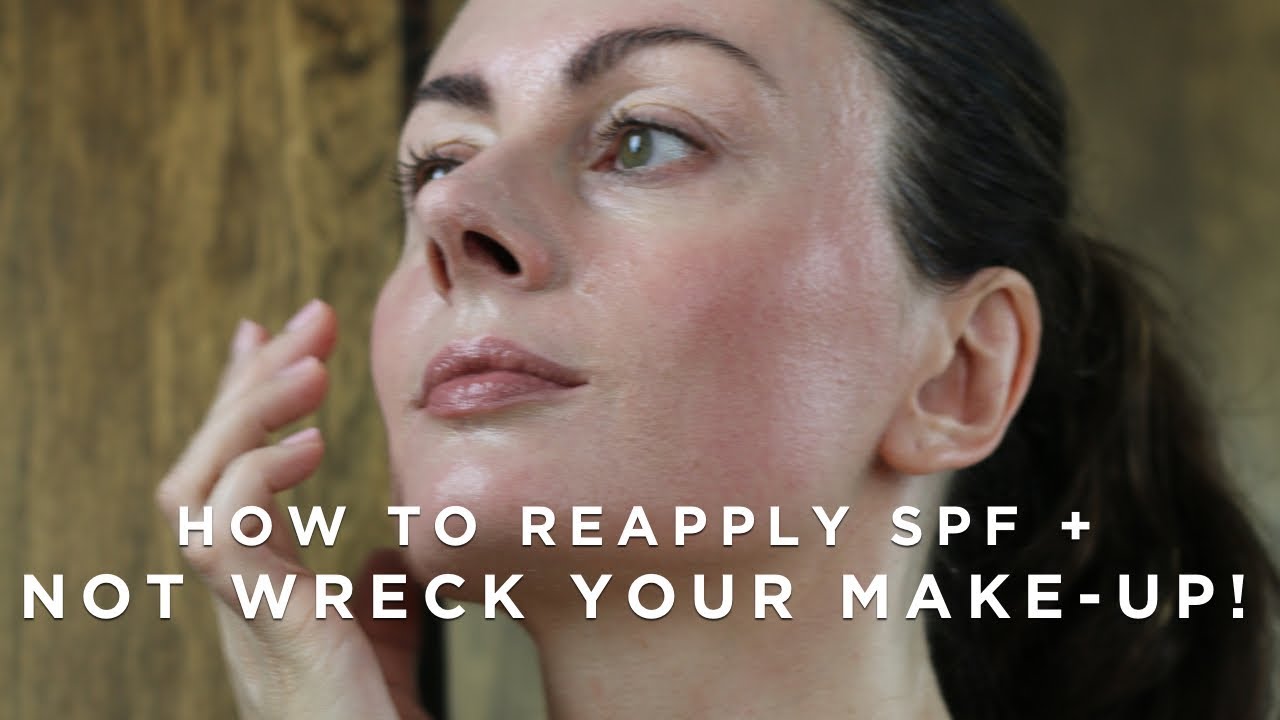
Less than the label promises. SPF is earned at 2 mg/cm2, and almost nobody applies that much, least of all in a quick touch-up.
The label test dose is 2 mg/cm2 of skin (Jungman and Maibach, Cosmetics & Toiletries, 2010). Real use looks different. Among ten women, the median amount applied was 0.5 mg/cm2, and the median at the temples, ears and the sides and back of the neck was 0 (Azurdia et al., British Journal of Dermatology, 1999).
That matters because of how SPF responds to dose. SPF falls by about a square root at 1 mg/cm2 and a fourth root at 0.5 mg/cm2 (Faurschou and Wulf, British Journal of Dermatology, 2007). For the face, the Skin Cancer Foundation (2025) recommends a nickel-sized amount.
Under that curve, halving the dose from 2 to 1 mg/cm2 takes a label SPF down to roughly its square root.
Dose studies disagree on the slope. Stenberg and Larko, cited in a 1996 Journal of the Society of Cosmetic Chemists paper, found self-applied cream at about 1 mg/cm2 gave roughly half the labeled SPF, a gentler drop than the square-root curve.
The sources don’t agree on the exact slope, only on the direction, which is that less product gives a lower SPF.
Every study above measured lotions and creams. Extending the curve to a powder or mist is an inference, not a measurement.
In practice, a powder or mist pass adds product to what remains of the morning layer and does not rebuild a full dose. The Skin Cancer Foundation notes that people cover more missed areas on a second application, so two thin passes beat one.
I’d keep powder for the 2 p.m. top-up and never use it as the 8 a.m. base.
How to Reapply Sunscreen Over Makeup Step by Step

The order of the steps matters more than which product you pick. Blot first, press the product on, check for gaps, and set it at the end.
- Blot sweat and oil with blotting paper, patting instead of wiping.
- Choose a format. Powder or mist suits the full face, and a stick suits the high points.
- Put a little product on the back of your hand or a damp sponge, or load the brush.
- Press it on one small section at a time. Dot it on, don’t drag.
- Check the temples, hairline, ears and sides of the neck, since the dose studies found those areas missed most often.
- If you used lotion, let it settle until it no longer feels wet, then dust translucent powder over shiny areas.
- Outdoors, add a second thin pass over the nose and cheekbones.
Pressing a Lotion or Serum With a Damp Sponge

Put a small amount of lotion on the back of your hand, load a slightly damp sponge, and press it onto one section of the face at a time. La Roche-Posay Australia says to dot, not drag, because dragging wipes foundation away.
The motion is the same as patting on foundation with a sponge, only with less product per pass.
A sponge that has carried a day of sweat and residue shouldn’t go back onto a clean face, so build in regular washing of your makeup sponges.
This method gives the best dose of any here, and it also causes the most disruption.
Brushing On Powder
- Tap the brush until a little powder releases.
- Sweep lightly across the face.
- Go over each area a second time rather than pressing harder.
Powder over a freshly applied lotion works. Powder over wet lotion clumps, so wait until the surface feels dry.
Misting, and Using a Stick on High Points
Mist
Spray onto a damp sponge or into your palms, then press. The Skin Cancer Foundation (2025) advises against spraying directly onto the face, and the AAD advises against inhaling the mist.
Some editorial guides recommend spraying from 10 to 12 inches away with your eyes closed. That puts more mist near the nose and mouth than the sponge method does.
The Skin Cancer Foundation also advises rubbing a spray in until it’s even. Rubbing is what shifts foundation, so over makeup, press with a sponge instead.
Stick
Swipe along the nose, cheekbones and forehead with slightly overlapping strokes, then tap the area with a fingertip or sponge.
Whichever format you pick, pressing beats rubbing.
Do Mineral and Chemical Filters Behave Differently Over Makeup?
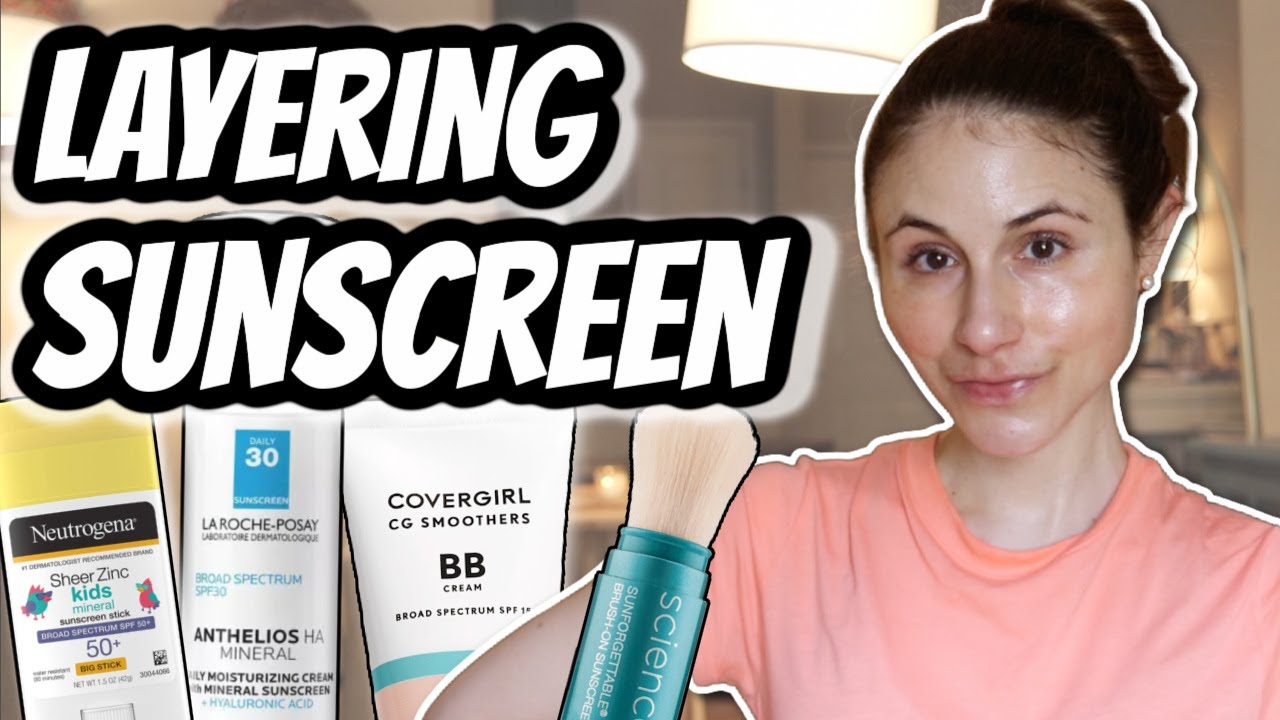
Yes. White cast, spreading, pilling and wear after water all differ between the two, and neither type comes out ahead on every count.
| Trait | Mineral (zinc oxide, titanium dioxide) | Chemical (avobenzone and others) |
|---|---|---|
| Finish over makeup | Can leave a visible cast | Goes on clear |
| Spreading | Harder to spread thin | Spreads more easily |
| Wear after water | Held up better in one 2023 trial | Dropped further in the same trial |
| FDA safety status | Proposed as generally recognized as safe and effective (2021 proposed order, not yet final) | Avobenzone: the 2021 proposed order says more safety data are needed, though it remains legally marketable under the current monograph |
White Cast
A mineral top-up over foundation is where the cast shows first, and it shows unevenly across skin tones.
In a study of 96 women presented at the American Academy of Dermatology and summarized in the Journal of Clinical and Aesthetic Dermatology (2023), mineral sunscreens whitened dark skin 2.95 times more than light skin.
Tint is the usual fix. A 2026 Cutis analysis of 23 broad-spectrum sunscreens found iron oxide tracked with lower near-visible UVA transmittance (r = -0.67), while SPF did not.
That test ran on PMMA plates, not skin, so read it as a screening result.
Spreading
Mineral formulas resist spreading, and people apply less of them. Diffey and Grice (British Journal of Dermatology, 1997) recorded a median of 0.94 mg/cm2 for a physical SPF 25 sunscreen against 1.48 mg/cm2 for a chemical one.
Work a mineral top-up in slowly and in small sections.
Pilling
Sunscreen is the main trigger. Liu and colleagues (Skin Research and Technology, 2024) logged 655 pilling events after sunscreen against 35 after foundation in 528 Chinese women, and foundation fixed sunscreen pilling in 98.9% of cases.
That study put sunscreen under foundation. A top-up reverses the order, so the 98.9% is a reason to keep the morning layer under your makeup, not proof that a top-up will behave.
If a top-up balls up anyway, the fixes for makeup that pills apply: fewer layers, less friction, more drying time.
Wear After Water
The usual claim is that chemical filters bond to skin better while mineral films wash off. A 2023 randomized trial in JMIR Dermatology found the opposite.
In 22 swimmers after 1.5 hours, the mineral cream fell from a median SPF 27 to 12.3 and the chemical cream from 30 to 9.9 (P=.02 for the difference in drop).
Both creams used film-forming polymers and the trial was multicenter, with swimmers training at more than one site, so the result holds for those formulas, not for every product.
Where the FDA Stands on Filters
On the regulatory side, the FDA’s final order of June 10, 2026 (OTC000039) added bemotrizinol to the sunscreen monograph, the first new active in more than 20 years, effective August 9, 2026. FDA has found bemotrizinol generally recognized as safe and effective (GRASE) by final order. Zinc oxide and titanium dioxide are the only other filters FDA has proposed as GRASE, in a 2021 proposed order that has not been finalized. FDA said in 2019 that missing data on the remaining filters does not mean they are unsafe.
Which Top-Up Suits Oily, Dry, Sensitive and Acne-Prone Skin?

Match the format to the skin. Powder suits oily skin, a pressed lotion or hydrating mist suits dry skin, and mineral filters suit sensitive skin. Acne-prone skin needs a non-comedogenic formula.
Oily Skin
SPF powder soaks up shine while it protects. NBC Select (2025) named Brush on Block’s mineral powder its best overall pick for oily skin.
Dry Skin
A lotion pressed on with a damp sponge, or a hydrating mist. Powders dry to a matte finish, which works against dry skin.
Sensitive Skin
Go with mineral filters. Dermatologist Blair Murphy-Rose says a pure mineral powder may suit people who struggle to find a sunscreen that does not irritate.
Sensitive skin reacts to the rest of the face too, so makeup that suits sensitive skin matters as much as the sunscreen on top of it.
Acne-Prone Skin
Look for oil-free, non-comedogenic and fragrance-free formulas, per the dermatologists NBC Select interviewed. Dermatologist Hadley King calls SPF powder a great option for acne-prone, oily skin.
Office Days
Keep a powder or a clear stick in the desk drawer. W Magazine’s dermatologist panel prefers a clear stick over foundation because it disturbs the base less. If you’d rather not touch the stick to your face, apply it to clean fingers and press it in.
Outdoor Days
Carry a powder for quick passes and a mist or lotion for the pass after sweating.
When Should You Remove Makeup and Start Fresh Instead of Topping Up?
Start fresh when the base layer is gone, not when it’s merely tired. A top-up repairs a worn layer and can’t replace a missing one.
- After a swim or heavy sweat, water and sweat strip the sunscreen and the makeup together. Wash, dry, apply a full dose of a water resistant sunscreen, then rebuild the makeup.
- If the face turns cakey after a second top-up, the stacked powder, mist and lotion have left an uneven film, and an uneven film leaves gaps. Wash and redo.
- If you skipped sunscreen this morning, a top-up over bare skin and foundation is the only protection you have, and no format is built to be that.
- Powder shouldn’t be your only layer. The FDA’s 2019 proposed rule and its 2021 proposed order both said more data were needed before powder sunscreens could be included in the monograph.
Manufacturers say the same. Dr. Emi Skin states that its SPF 30 powder is a makeup product, not a sunscreen on its own, and does not recommend it as a replacement.
Sources disagree on rubbing. Eucerin warns that rubbing sunscreen over makeup will likely wipe the makeup off with it, while Providence dermatologist Tanya Nino (2023) rubs hers in when needed and calls the result “better than skin cancer.”
Pressing keeps the makeup intact. Rubbing at least gets protection on when nothing else is available, though a face that’s already cakey is better off washed and redone.
No cleanser at your desk? There are ways to take makeup off without a makeup remover.
Once the face is clean, prep the skin before makeup as you did in the morning, put the sunscreen on first, and let it settle before the base goes back on.
Reapplying Sunscreen Over Makeup FAQ
Is SPF in foundation enough to skip reapplying sunscreen?
No. The Skin Cancer Foundation notes that SPFs do not stack. An SPF 30 moisturizer under an SPF 30 foundation does not give SPF 60, and you mostly get the protection of the highest-SPF product.
Treat foundation SPF as a bonus under a dedicated sunscreen.
Should sunscreen go on before or after makeup in the morning?
Before. Make broad-spectrum sunscreen the last skincare step, then give it a few minutes to set before foundation, as Eucerin advises.
FDA labeling directs applying it 15 minutes before sun exposure.
Do I need to reapply sunscreen if I am indoors all day?
Usually no. In a 20-person trial, indoor workers who applied a full dose in the morning lost 28.2% of facial coverage by hour 8, and the authors judged reapplication may be unnecessary (Rungananchai et al., Journal of Dermatological Treatment, 2019).
Time outdoors changes that.
Can topping up sunscreen over makeup clog pores?
Only when the formula or the tools are the problem. Dermatologists interviewed by NBC Select (2025) recommend oil-free, non-comedogenic, fragrance-free formulas for acne-prone skin, and Curology lists coconut oil, lauric acid and isopropyl palmitate as ingredients to avoid.
Wash sponges and brushes between uses.
Reapplying Sunscreen Over Makeup Across a Full Day
Over an 8-hour day, the plan is a full-dose base plus top-ups at hours 2, 4 and 6, and the first top-up carries the most weight.
In the Kobwanthanakun trial, the first 2 hours produced 18.31 of the 31.63 points of facial coverage lost over 8 hours, about 58% of the total.
So put the real effort into the full-dose base before makeup and the hour-2 top-up, which you shouldn’t skip. Later top-ups can follow how much sun you’re getting.
Once the schedule runs, making makeup last all day keeps the base presentable through each top-up. This advice holds as of October 2026 and changes if testing shows an SPF powder reaching its labeled protection at the dose people actually brush on.

She started writing on the site after fielding the same questions from clients and friends often enough to just write the answers down: which red won't turn orange on a warm undertone, how to keep lipstick from feathering into fine lines, why a "12-hour" formula rarely survives dinner.
Every review on the site follows the same rule she uses with paying clients: wear it first, then decide if it's worth recommending.
- How to Make Eyeliner Last Longer Without Smudging - August 31, 2026
- How to Make Eyeshadow Last Longer All Day - August 29, 2026
- How to Find Your Undertone in 5 Easy Steps - August 27, 2026