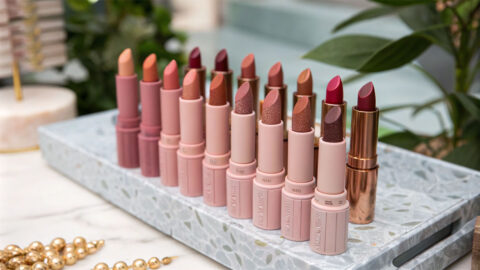
A shade that reads almost black in the bullet can go grey the second it lands on the lip. It happens often enough on deep skin that plenty of people quietly decide matte just isn’t for them.
Usually the formula is what failed.
Picking a matte lipstick for dark skin that actually holds its color comes down to pigment load and which way the undertone runs, and neither of those things is printed on the front of the box. Titanium dioxide lightens. Iron oxides deepen. That one distinction sits behind most chalky results.
If undertone is where you keep getting stuck, shade selection for deep complexions is the place to start.
What Is a Matte Lipstick for Dark Skin
Depth on its own qualifies nothing. A bullet can look like burnt wine in the tube and still turn dusty once it’s on.
The ones that work are heavily pigmented, low in shine, and opaque enough to sit above your natural lip color rather than mixing into it. Most failures trace back to a single thing, which is not enough saturation to cover the melanin already in the lip.
So read the pigment side of the ingredient list. Iron oxides build the brown, brick, and earth-toned bases. Red 7 Lake supplies the saturated red character that mineral pigments never quite reach on their own.
Then there’s titanium dioxide. Formula Chemistry’s published reference lipstick formulation places titanium dioxide at 3%, iron oxides at 4%, and Red 7 Lake at 5%. In that formula titanium dioxide is doing two jobs, adding opacity and controlling how deep the shade reads. The second job is what leaves an ashy cast on deeper skin.
Mica sits at 8% in the same reference formula, where it smooths texture and, at higher loads, acts as a filler that pushes the formula toward matte. Worth saying that this is one published reference formulation and not an industry standard. Handy context if you’ve ever read what goes into a lipstick bullet before buying.
How Matte Differs From Satin, Cream, and Gloss on Deep Complexions
Finish decides how much light bounces back off the lip, and on deep skin that changes how the color reads far more than it does on fair skin.
| Finish | Light behavior | Result on deep skin |
|---|---|---|
| True matte | Minimal reflection | Sharpest color, flattest texture |
| Satin | Soft sheen | Softens pigment edges |
| Cream | Moderate slip | Comfortable, less opaque |
| Gloss | Full reflection | Dilutes shade depth |
Mordor Intelligence data shows satin and cream finishes held 44.34% of the 2025 lipstick market, while matte is forecast to grow fastest at a 7.59% CAGR between 2026 and 2031.
The gap between a matte and a satin finish matters most on shades within two steps of your natural lip tone. Go deeper than that and the two read pretty similarly.
Why Natural Lip Pigmentation Changes the Result
Deep complexions often carry a natural lip tone somewhere in the brown-plum to deep berry range. Everything you apply lands on top of that. Nothing lands on neutral.
Which is why a mid-tone pink straight onto an unprimed lip pulls mauve, a cool nude pulls grey, and a true red pulls brick. Buildable formulas cope with this better than one-stroke ones.
MarketIntelo reports liquid matte formats command 38.5% of the matte category as of 2025, with wear times of 12 to 16 hours. Cream mattes take 31.2% at 6 to 10 hours, and stick mattes 22.4% at 4 to 8 hours. That density is the reason liquid mattes cover natural lip pigmentation in one pass where bullets need two.
Across the different lipstick categories, matte and liquid matte carry the highest pigment loading per gram.
Which Undertone Rules Govern Shade Selection on Dark Skin

Warm golden, olive, neutral, cool. Each one pairs with a lipstick undertone family, and the pairing isn’t complicated once you know which camp you’re in. Blue-based shades read cleanest on cool and neutral skin. Orange and brown bases belong on warm and golden skin.
McKinsey’s 2022 report on the beauty industry, produced with its Institute for Black Economic Mobility, found Black consumers are 3 times more likely than non-Black consumers to be dissatisfied with their options across hair care, skin care, and makeup. Narrowed to color cosmetics specifically, Black customers were found to be 5.7 times more likely than white customers to be dissatisfied with product specialization. Undertone mismatch accounts for a good chunk of that.
Ignore the wrist vein test. On deep skin the veins rarely show clearly enough to call anything either way.
Swatch three candidates along the jawline in daylight instead, then look at which one hasn’t turned grey after 60 seconds.
| Skin undertone | Lipstick direction | Reads wrong |
|---|---|---|
| Warm golden | Brick, terracotta, copper-brown | Blue-based mauve |
| Olive | Plum, deep rose, cocoa | Bright orange |
| Neutral | Berry, true red, chocolate | Very few misses |
| Cool | Blue-red, aubergine, blackberry | Yellow-toned nude |
Warm and Golden Undertones
Golden and bronze skin carries yellow and red underneath the surface. Shades holding orange in the base sit flush against that.
- Terracotta and burnt orange
- Brick red with brown depth
- Copper-toned nudes
- Warm cinnamon-brown, which is underrated and reads as a neutral on most warm deep skin
What misses is ash-brown and cool mauve. Both flatten warm skin into a grey cast within minutes.
More on picking shades when your skin runs warm if the swatch test keeps giving you mixed answers.
Olive and Neutral Undertones
Olive skin has a green cast sitting under the surface pigment, and it’s the most misdiagnosed undertone on deep complexions by a wide margin.
Plum, deep rose, cocoa, and muted berry all work. Heavy orange fights the skin here, because orange amplifies the green rather than covering it.
Neutral undertones take the widest range of anything. Neutral-skinned wearers pull off blue-reds and brick reds both, without either one reading off.
Cool and Red Undertones
Cool undertones on deep skin show blue or red beneath the surface, usually easiest to spot around the inner arm and under the eye.
Blue-based pigment is the anchor. Blackberry, aubergine, and a true blue-red all sit clean on it.
Yellow-toned nudes and warm caramel browns are the ones to skip. They turn sallow within about an hour of wear.
The full logic behind cool undertone shade selection applies at every depth, though the pigment threshold rises as skin gets deeper.
Reading Undertone Against Foundation Match
Your foundation already answered this question. A W, G, N, or C code on the bottle carries exactly the information you’re hunting for.
So match lipstick undertone to foundation undertone rather than to skin depth.
Anyone still working out how makeup shade matching maps to skin tone will get there faster from the foundation label than from any online quiz.
What Are the Best Matte Lipstick Shades for Dark Skin

Deep berry, brick red, blue-toned red, chocolate brown, terracotta, plum, and a properly calibrated nude. Those are the families that keep performing on deep skin, and what they share is full opacity over natural lip pigmentation without white pigment taking over the mix.
Lip was the top-performing prestige makeup segment in 2024, growing 19% according to Circana. That growth came mainly from hybrid products combining color with skincare benefits, lip oils and balms especially.
| Shade family | Undertone | Strongest on |
|---|---|---|
| Deep berry | Cool-neutral | All deep skin tones |
| Brick red | Warm | Golden, bronze |
| Blue-red | Cool | Cool, neutral |
| Chocolate brown | Neutral-warm | Everyday wear |
| Terracotta | Warm | Golden, bronze |
| Plum and aubergine | Cool | Olive, cool |
| Deep-calibrated nude | Varies | Everyday wear |
Browsing the wider matte shade families helps once you know which of these you keep reaching for.
Deep Berry and Blackberry
Highest contrast payoff of any family here. Berry pigment carries enough blue to stay clean without going flat.
MAC Sin sits in this range as a matte bullet, a blackened blue-red. Fenty’s Stunna Lip Paint in Underdawg is a deep burgundy in liquid form.
The color comes from a heavy load of red lakes and iron oxides. Most commercial deep shades still contain titanium dioxide for opacity, Underdawg included, so the presence of white pigment isn’t the problem. Its share relative to the pigments carrying the shade is.
Wears from morning through evening without shifting.
Brick Red Versus Blue-Toned Red
These two get treated as interchangeable on the shelf, and they are not.
Brick red has orange and brown in the base. MAC Chili is the reference point most people already know, and it belongs on warm and golden undertones, nowhere else.
The blue-red side runs cool with no orange in it at all. MAC Ruby Woo in the Retro Matte line is the classic version, and Pat McGrath Labs’ MatteTrance line carries blue-red options at the prestige end if you want the same character with more slip. Cool and neutral skin.
The difference between a cool red and a warm red is probably the single most useful distinction in this whole category. Get it wrong and the shade argues with your skin all day.
Building your first red? The process of selecting a red goes much faster with the warm-cool call made first.
Chocolate and Cocoa Brown
The everyday workhorse. Brown mattes do the job on deep skin that a mid-pink does on fair skin.
- Cocoa, which is lighter and more neutral
- Toffee, sitting between the two and easier to wear than either
- Chocolate, deeper and warmer
- Espresso, close to black depth
Iron oxides carry brown pigment, so these formulas generally need less white pigment to reach depth than a pale nude does.
The brown matte range covers more variation than most shoppers expect.
Terracotta and Burnt Orange
Warm-skin territory, and one of the strongest summer options on bronze and golden complexions.
Orange-based mattes need a full opaque application. Sheer coverage reads muddy every time. Build in two layers with a blot in between.
Plum and Aubergine
Cool depth without berry’s brightness. Aubergine holds more brown and black in the base than plum does.
MAC Diva sits at the burgundy end of this family.
One warning. Plum pulls grey faster than anything else on this list when the formula is under-pigmented.
Anyone new to wearing purple-family lip color gets a cleaner result starting at aubergine rather than a true violet.
True Nudes for Deep Skin
Nude means one step off your natural lip tone. It does not mean beige, and the industry spent years pretending otherwise.
Mented Cosmetics, founded in 2017 by KJ Miller and Amanda E. Johnson, built its entire launch around that gap, starting with nude lipsticks formulated for deeper complexions.
The range to aim for is warm caramel, deep rosewood, milk chocolate, and muted terracotta-brown.
The nude matte category shifts completely depending on skin depth, which is why a shade named “nude” tells you nothing on its own.
Fuchsia and Magenta
Brightness that holds against deep melanin instead of vanishing into it.
These lean on heavy lake pigment for saturation, and that’s what keeps them vivid rather than dusty.
Wear them with a bare eye and a sharp brow.
Which Matte Lipstick Brands Formulate for Deep Skin Tones

Fenty Beauty, Pat McGrath Labs, MAC Cosmetics, Juvia’s Place, The Lip Bar, Mented Cosmetics, Black Radiance, and Danessa Myricks Beauty all have genuine deep-skin matte coverage. Shade count is not the marker anyone should be using. Deep-calibrated nudes are.
Uoma Beauty, founded by Sharon Chuter in 2019, belongs on any historical list of inclusive matte ranges, though the brand nearly folded in 2023 and its assets were bought by MacArthur Beauty that December. Check current stock and retailer availability before planning a purchase around it.
Per McKinsey’s 2022 analysis, Black consumers drive 11.1% of total US beauty spending, while Black-owned and Black-founded brands account for 2.5% of industry revenue. Only 4% to 7% of beauty brands carried by specialty beauty stores, drugstores, grocery stores, and department stores are Black-owned or Black-founded.
NielsenIQ found the average Black consumer spent $284 on beauty and skin care across the 52 weeks ending in December 2021, against $269 for the total US consumer. More recent NIQ data puts Black consumers at 12.8% of beauty and personal care dollar sales, with spending up 9% to $16.2 billion in the latest year measured.
Brands With Dedicated Deep-Skin Nude Ranges
Fenty Beauty currently lists Stunna Lip Paint in nine liquid shades at $29, Underdawg among them. Mattemoiselle launched in December 2017 with 14 bullet shades and has grown to roughly two dozen since, including Griselda, a bold burgundy with cool undertones.
Juvia’s Place was founded on deep-complexion pigment standards across both lip and eye. The Lip Bar does vegan liquid mattes at drugstore pricing and had deep shade parity from launch. Mented runs nude-first with no beige defaults anywhere in the lineup.
Rihanna’s 40-shade foundation launch on 8 September 2017 reset retailer expectations across the whole category, and the lip lineup followed the same logic.
Legacy Brands Worth Keeping in Rotation
MAC’s Retro Matte and Matte bullet lines carry the deepest back catalogue of any legacy brand. Ruby Woo, Diva, Sin, and Chili have held shelf space for decades.
Pat McGrath Labs MatteTrance sits at the high-pigment end of the prestige tier.
In July 2025, MAC released a $52 limited-edition lip kit with rapper JT, pairing the Lip Pencil in Chestnut with the matte lipstick in Snob, a neutral pink, plus a clear lip gloss in a branded carrying case.
NARS Powermatte and Charlotte Tilbury Matte Revolution both carry deep shades, though the ranges thin out past the mid-depths.
Comparing formulas across tiers helps when you’re working out which matte formula performs best for your wear conditions.
How to Test a Matte Lipstick Shade Before Buying
Test on the lip or the jawline, in daylight. Never the inner arm. Arm skin runs a different depth and undertone from facial skin on most people, which is how you end up with a false match. Virtual try-on narrows the field but doesn’t confirm anything.
Mintel data indicates 53% of Black consumers have difficulty finding beauty products that match their skin tone. Testing method closes part of that gap.
Industry benchmarks put the purchase-likelihood lift from virtual try-on at roughly 2.4 times, with reported return reductions ranging widely from about 20% to 40% depending on the study and category. Google’s foundation try-on uses 148 diverse model examples spanning a wide range of skin tones and ages, selected using Google’s 10-shade Monk Skin Tone Scale rather than the Fitzpatrick scale.
Third-party case studies commonly cite a 35% conversion increase on Sephora online orders using virtual try-on, though Sephora has not published that figure itself, and other published estimates for the same tool run considerably higher.
In store, swatch on the lower lip rather than the hand. Check it in daylight inside 60 seconds, then wait ten minutes and check again for grey shift.
Store lighting runs warm and yellow, which flatters brick and terracotta while hiding the ashiness in cool shades. Step outside before you decide.
Buy minis first where the brand offers them. A $9 mini answers a question that a $24 to $29 full size makes expensive.
The daylight rule applies just as broadly to choosing any lipstick color, matte or otherwise.
What Application Steps Make Matte Lipstick Sit Cleanly on Dark Skin
Exfoliate, prime with balm and blot it off, fill the whole lip with liner, then build color in two layers. Order matters here. Skipping the liner base is the most common reason pigment comes out patchy.
Circana reported that lip liner was among the top-gaining prestige makeup segments in 2025, and that lip was the fastest-growing makeup segment in the mass market that year, driven by lip liner and lip treatments.
A full walkthrough of matte lipstick application technique covers the tool choices this section skips.
Lip Prep and Exfoliation
Twice weekly, not daily. Over-exfoliating lip tissue causes exactly the flaking that matte formulas magnify.
Balm goes on ten minutes before color and gets blotted off completely. Leave any behind and the pigment slips, edges go uneven, and you’ll be fixing it by lunchtime.
Several gentle lip exfoliation methods work without a commercial scrub.
Liner Placement and Shade Matching
Fill the whole lip. Outlining alone throws away the wear benefit entirely.
Go one step deeper than the lipstick and match the undertone. A warm liner under a cool lipstick corrects grey, and a cool liner under a warm lipstick mutes it.
Chestnut, cocoa, and deep berry liners cover most of the range on deep skin.
Correct liner application extends matte wear, and picking the right liner shade matters more than the lipstick itself in some looks.
The Blot and Layer Method
Thin first layer. Blot with a single-ply tissue. The second layer builds to full opacity, and you get there without the thick, cakey surface that one heavy application leaves behind.
Three layers is the practical ceiling. Past that the formula starts lifting at the inner lip.
When a Concealer Base Helps and When It Hurts
Concealer neutralizes natural lip pigmentation before color goes down, which is useful under fuchsia and bright coral.
Under berry, plum, chocolate, or anything deep, leave it out. It mutes the pigment and adds a chalky layer underneath. Concealer under a deep matte is the fastest route to a lip that looks dusty.
How to Stop Matte Lipstick From Looking Ashy or Chalky

Ashiness is white pigment sitting too high in the mix. Titanium dioxide lightens shade depth while adding opacity, and high kaolin and silica loads flatten the finish further on top of that. You fix it with a warm liner base, or by switching to a formula where iron oxides and lake pigments dominate the color.
Formula Chemistry’s reference formulation places titanium dioxide at 3% and mica at 8%, against iron oxides at 4% and Red 7 Lake at 5%. The ratio between them decides whether a shade reads clean. Not the presence of titanium dioxide by itself.
Which Shade Families Go Grey Most Often
The risk isn’t spread evenly.
- Cool mauve, the highest failure rate of anything
- Dusty pink
- Pale nude
- Berry and chocolate, which rarely fail at all
The pattern is straightforward enough. Lighter and more muted means more titanium dioxide needed to reach that depth.
Correcting an Ashy Shade Without Replacing It
Two fixes, both fast.
A chestnut or brick liner filled across the whole lip pulls the grey out of a cool shade. Most reliable correction available, and it costs you nothing you don’t already own.
The other is a single dot of clear balm at the center of the lower lip, pressed rather than spread. Adds dimension without killing the matte finish.
Working out how to add shine to a matte formula uses the same principle at higher intensity.
Formula Screening Before Purchase
Position on the ingredient list is what to read. Nearly every opaque lipstick contains titanium dioxide, so seeing it there tells you nothing. Where it falls does. Listed ahead of the iron oxides and lakes, and you’re probably looking at a lighter, chalk-prone formula.
Iron oxides and Red 7 Lake ahead of titanium dioxide is the sign you want.
Liquid mattes generally carry less white filler than bullets at the same shade depth.
Natural lip pigmentation compounds all of this, which is why applying color over naturally deep lips follows a different sequence than standard application.
Which Matte Formulas Cause Dryness and How to Prevent It
Matte formulas carry less oil and more wax than creams or glosses, and that’s the whole mechanism. Liquid mattes go further by adding volatile solvents that evaporate on contact, which is where the tight feeling at the 20 to 30 minute mark comes from. Hydrating mattes push back with squalane, shea butter, and jojoba.
Huda Beauty’s own guidance on lip dryness, published alongside advice from dermatologist Shereene Idriss, points at the low oil content in matte formulas as the direct cause. Richer color, less hydration. It’s a trade, not a defect.
Read a liquid matte label and the first ingredient is often isododecane. Fenty’s Stunna Lip Paint lists it first, followed by dimethicone and trimethylsiloxysilicate. Maybelline’s SuperStay Matte Ink is built on a comparable volatile base.
Those solvents carry pigment onto the lip and then evaporate off. What’s left behind is a film with no moisture in it.
Liquid Matte Versus Traditional Bullet
| Liquid matte | Bullet matte | |
|---|---|---|
| Wear time | 12 to 16 hours | 4 to 8 hours |
| Transfer | Minimal once set | Moderate |
| Comfort | Tight after 30 min | Comfortable throughout |
| Touch-up | Requires removal first | Layer directly |
MarketIntelo puts liquid matte wear at 12 to 16 hours without touch-up, against 4 to 8 for stick mattes and 6 to 10 for cream mattes, which is exactly why the liquid format leads the category. The tradeoff is real though. Bullets stay kinder to the lip and rebuild without a reset.
Understanding how liquid lipstick formulas are built explains most of the comfort gap between the two.
Ingredients That Reduce Tightness
Squalane, shea butter, jojoba oil, castor seed oil, and vitamin E are the ones worth looking for. Isododecane, dimethicone crosspolymer, silica silylate, and high alumina loads are the ones that will leave your lips tight by mid-morning.
Castor seed oil is the traditional workhorse emollient in lipstick, used to disperse pigment and keep the film flexible on the lip.
Huda Beauty built its Liquid Matte Ultra-Comfort formula around its Lip L.O.V.E. Complex of lycopene, olive oil, vitamins A and E, and essential fatty acids for the same reason, marketing an eight-hour wear without flaking.
The Overnight and Weekly Routine
Prevention happens off the lip, not on it.
An occlusive balm overnight, every night, does more than anything you apply in the morning. Swap the sugar scrub for a gentle chemical exfoliant twice a week. And balm ten minutes before color, blotted before application, every single time.
The general dermatological advice, echoed by Idriss, is to load hydration onto the lips well before any matte color goes near them.
A steady lip care routine matters more than the formula you pick, and anyone already dealing with chronically dry lips gets a better result from fixing the base first.
Detailed tactics for keeping lips hydrated under a matte finish cover the balm timing in more depth.
How to Pair Matte Lipstick With the Rest of a Makeup Look

A high-pigment matte lip on deep skin carries the whole look on its own. Keep the eye neutral, match blush undertone to the lip family, and pull highlighter back to the high cheekbone. Dewy skin against a matte lip is where the preference sits right now.
Circana data shows blush sales climbing double digits through 2024, with jelly and liquid formats leading. Milani launched its Cheek Kiss Liquid Blush + Glow at $12.99 in September 2024 into that demand.
Blush Pairing by Lip Family
A deep berry lip wants plum or wine blush. Coral is wrong with it, always.
Brick and terracotta lips take warm bronze or brick blush. Chocolate brown goes with soft rosewood or deep peach. With fuchsia, match the magenta and apply it lighter than you think you need to.
The undertone logic behind blush selection against a red lip transfers directly to berry and plum.
Eye Balance Against a Bold Lip
One focal point per face. That holds at every skin depth.
A bold matte lip goes with a defined lash line and a groomed brow, nothing more. Skip the shimmer lid.
Reverse it when the eye leads. Drop to a deep nude or cocoa lip and let the smoke do the work.
Broader makeup technique for deep complexions handles the pigment-density question across products, not just lips.
Skin Finish and Highlighter Placement
Matte lip, dewy skin. That contrast is what stops a deep matte flattening the whole face.
Highlighter belongs on the high cheekbone and nowhere near the mouth. A highlighted cupid’s bow next to a matte lip is a visible texture clash.
A fully matte base plus a matte lip reads dry in photographs, which is worth knowing before an event rather than after.
Brown lip pairings show this well, and looks built around a brown lip almost always run a luminous base underneath.
Day to Night Within One Shade Family
Shift depth, not family. A cocoa lip at 9am becomes a chocolate-plum at 7pm off one liner change.
Fastest version is a deep berry liner over the existing cocoa, blended inward, then color layered at the center.
Full-intensity evening options sit in the glam looks built for deep skin range.
What Shade Choices Suit Different Occasions and Seasons

Occasion sets depth. Workday wear lives in cocoa, muted brown, and deep rose. Evening moves to blackberry, blue-red, and aubergine. Summer runs terracotta and fuchsia, and the cold months belong to burgundy, wine, and chocolate plum.
Spate’s 2025 trend forecast flagged rising search volume for brown and dark lip liners, a signal that deep-shade demand keeps climbing rather than cycling out.
| Context | Shade direction | Finish |
|---|---|---|
| Office | Cocoa, muted brown, deep rose | Soft matte |
| Evening | Blackberry, aubergine, blue-red | True matte |
| Summer | Terracotta, coral-brown, fuchsia | Buildable |
| Winter | Burgundy, wine, chocolate plum | Velvet matte |
Workday and Interview Wear
Deep rose and cocoa read polished without pulling focus in a conference room.
Stay within two shades of your natural lip tone for professional settings and you’ll stop thinking about it entirely.
Soft matte holds up better than true matte across a long day of talking.
The same restraint applies to interview makeup, where the lip supports rather than leads.
Evening and Event Shades
This is where the deep families earn their keep.
- Blackberry for maximum contrast
- Aubergine for cool undertones
- Blue-red for classic drama
- Espresso brown for understated depth
Evening shades need the full liner base. Nothing shows a worn edge faster than a deep matte at hour six.
Working out how to carry a genuinely dark lip comes down to precision at the lip line.
Seasonal Rotation
Warm months pull the range toward orange. Cold months pull it toward blue and black.
Summer means terracotta, burnt orange, coral-brown, and magenta. Autumn brings brick, cinnamon, deep rust, and muted burgundy. Winter is wine, blackberry, chocolate plum, and aubergine.
Seasonal breakdowns for autumn shade rotation and winter lip color map cleanly onto deep complexions, since both seasons favor high-pigment depth anyway.
Wedding and Photography Shades
Cameras read matte pigment with less color shift than glossier finishes, because there’s less reflection to blow out under flash.
Deep berry, brick red, chocolate, and blue-red all photograph well. What doesn’t is any shade where white pigment dominates the mix, since it catches flash and reads chalky.
Bridal parties on deep skin do well anchoring to one family across the group. Guidance for wedding day makeup and shoot-specific makeup both prioritize matte for the same reason.
How to Make Matte Lipstick Last Through the Day
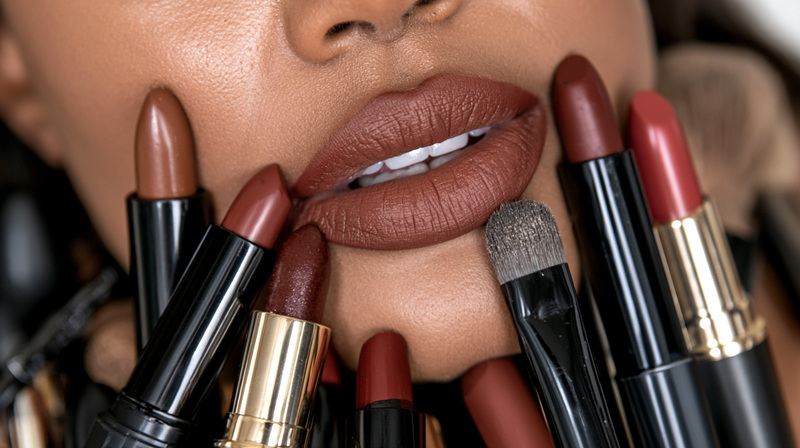
Full liner base, thin first layer, a powder set through tissue, and touch-up discipline. Apply it that way and a bullet matte holds toward the top of its 4 to 8 hour range while a liquid matte holds 12 or more.
Lip liner was among the fastest-growing prestige makeup segments in 2025 according to Circana, and the wear-extension benefit is part of the reason.
For the set, lay a single-ply tissue over the lip and dust translucent powder through it with a fluffy brush. One pass. Two cakes the surface and you’ll see it in photos.
Eating and Drinking Without Losing the Edge
Oil is the enemy. Fried food, butter, and creamy sauces break the film faster than anything else you’ll put in your mouth.
Drink through a straw where you can. Bite food rather than pressing your lips onto it. And blot, never rub, which is the part most people get wrong at the table.
The centre goes first. That’s normal, and it’s why touch-ups target the inner lip only.
Practical tactics for eating with lipstick on save a full reapplication at dinner.
Preventing Bleed and Buildup
Deep matte shades show feathering more visibly than light ones, purely because the contrast against skin is higher.
Liner as a full base fixes most of it, plus a thin ring of concealer traced outside the lip line and pressed in.
Touch up at the center only. Reapplying across the whole lip builds a ridge at the border by mid-afternoon.
Techniques for stopping lipstick from bleeding matter more with berry and plum than with nudes.
Transfer, Teeth, and Liner Longevity
Blotting is what makes a matte transfer-resistant. Not the claim on the box.
For teeth, insert a clean finger, close your lips, then pull it out. The excess pigment comes off on your finger instead.
Liner typically outlasts lipstick, which is why a full liner base leaves you with a wearable stain rather than a patchy lip.
More on making lipstick transfer proof, keeping color off your teeth, and extending liner wear.
Removal Without Damaging the Lip Barrier
Scrubbing a set matte off with a dry wipe strips the lip. Every single time.
Use an oil-based balm cleanser, thirty seconds of gentle pressure, a damp cloth, then balm straight after.
Micellar water alone rarely lifts a 12-hour liquid matte and mostly just encourages rubbing.
Step-by-step approaches to taking off matte lipstick and removing liquid formulas differ enough to be worth reading separately.
What Budget Matte Lipsticks Perform Well on Deep Skin
Drugstore matte formulas match prestige pigment payoff on deep skin far more often than the price gap suggests. NYX, Maybelline, Wet n Wild, Black Radiance, and e.l.f. all carry deep shades with full opacity. Where the gap shows is comfort and shade-range depth, not color intensity.
Only 14% of US beauty buyers believe higher prices indicate a better-quality product, according to Circana’s 2025 analysis. Mass beauty sales reached $72.7 billion in 2025, growing 5%.
Mordor Intelligence puts mass-priced products at 62.19% of 2025 lipstick revenue.
| Product | Format | Deep-skin strength |
|---|---|---|
| NYX Soft Matte Lip Cream | Liquid | Broad range, deep nudes present |
| NYX Lip Lingerie XXL | Liquid | 26 shades listed, up to 16-hour wear |
| Maybelline SuperStay Matte Ink | Liquid | Up to 16-hour wear claim |
| Black Radiance | Bullet and liquid | Formulated for deep tones |
Where Drugstore Formulas Match Prestige
Pigment load. That’s the honest answer.
The same iron oxides and Red 7 Lake turn up across every price tier because the FDA approves a short list of lip-safe colorants. Everyone works from it.
Maybelline SuperStay Matte Ink claims up to 16 hours of wear and is a fixture in professional makeup-artist roundups for long shoot days.
Removal is the tradeoff. It takes an oil cleanser, and taking off SuperStay Matte Ink specifically needs a different method than a standard bullet.
Where the Quality Gap Actually Shows
Prestige mattes tend to carry more emollients per gram, so drugstore liquids often run drier on the lip. Mass ranges also thin out fastest at the deepest end, which is exactly where deep-skin shoppers need them not to.
Cheaper formulas break unevenly at the center too, rather than fading down gracefully.
Black Radiance and The Lip Bar sidestep that last problem by formulating against deep skin from the start instead of extending an existing range outward.
Price Per Wear Compared
Rough math. A $9 liquid matte worn twice a week for 18 months costs about 6 cents per wear. A $29 prestige bullet at the same rate runs about 19 cents.
Which is not really the point. A $29 shade sitting unused because it turns grey costs far more per wear than a $9 one you actually finish.
Buy cheap while you’re learning your undertone. Spend once you know it.
FAQ on Matte Lipstick For Dark Skin
Why does matte lipstick look ashy on dark skin?
White pigment. Titanium dioxide is in the formula to add opacity and lighten shade depth, and when it takes up too much of the pigment mix it leaves a grey cast over deeper melanin. Nearly every opaque lipstick contains some, so what you want is a formula where iron oxides and lake pigments carry the color and sit ahead of titanium dioxide on the label.
What matte shade suits every deep skin tone?
Deep berry. It carries enough blue pigment to stay clean on warm, cool, olive, and neutral undertones without shifting grey. Blackberry and chocolate brown get close, though both lean slightly one way.
Should I use lip liner under matte lipstick?
Yes, and fill the whole lip instead of outlining. A full liner base extends wear, corrects an ashy shade if you pick a warm liner, and leaves a wearable stain once the lipstick fades.
How do I find my undertone on deep skin?
Skip the wrist vein test. Check your foundation code, since W, G, N, and C markings already answer it. Failing that, swatch three shades along the jawline in daylight and see which one stays clean.
Is liquid matte better than bullet matte for dark skin?
Liquid matte covers natural lip pigmentation in one pass and holds 12 to 16 hours. Bullets are far more comfortable, run about 4 to 8 hours, and rebuild without removal. Liquid for events, bullet for everyday.
Do nude matte lipsticks work on deep complexions?
Yes, when they’re calibrated properly. Nude means one step from your natural lip tone, which on deep skin lands in caramel, rosewood, and milk chocolate. Beige reads chalky every time.
How do I stop matte lipstick from drying my lips?
Balm ten minutes before color, blotted off completely. Look for squalane, shea butter, or castor seed oil in the formula. Overnight occlusive balm does more than any daytime fix.
Which drugstore matte lipsticks work on dark skin?
NYX Lip Lingerie XXL, Maybelline SuperStay Matte Ink, Black Radiance, and The Lip Bar all carry deep shades with full opacity. Pigment load matches prestige. Comfort is where the gap shows.
Can I wear bright colors like fuchsia on deep skin?
Fuchsia and magenta hold brightness against deep melanin better than they do on fair skin, because the saturated lake pigments behind them stay vivid against a dark background. Pair with a bare eye and a sharp brow.
How do I make matte lipstick last all day?
Full liner base, thin first layer, blot, then set with powder through single-ply tissue. Touch up at the center only. Reapplying across the whole lip builds a visible ridge.
Conclusion
Buying a matte lipstick for dark skin gets easier the moment you stop shopping by shade name and start reading the pigment block on the back of the box.
Build a rotation rather than a collection. One brick or blue-red, one cocoa for weekdays, one aubergine or blackberry for evenings, and a chestnut liner that corrects all three of them.
Fenty, Pat McGrath Labs, Mented, and Black Radiance sit at different price points and all clear the pigment threshold.
Test in daylight. Blot between layers. And when a shade turns dusty, blame the formula, not your skin.
Working out which nude actually reads as nude on you is usually the hardest purchase of the lot. Start there and the rest of the wardrobe falls into place.

She started writing on the site after fielding the same questions from clients and friends often enough to just write the answers down: which red won't turn orange on a warm undertone, how to keep lipstick from feathering into fine lines, why a "12-hour" formula rarely survives dinner.
Every review on the site follows the same rule she uses with paying clients: wear it first, then decide if it's worth recommending.
- How to Make Eyeliner Last Longer Without Smudging - August 31, 2026
- How to Make Eyeshadow Last Longer All Day - August 29, 2026
- How to Find Your Undertone in 5 Easy Steps - August 27, 2026