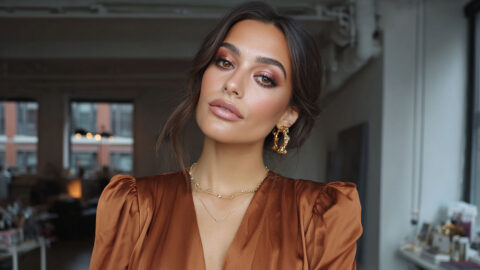
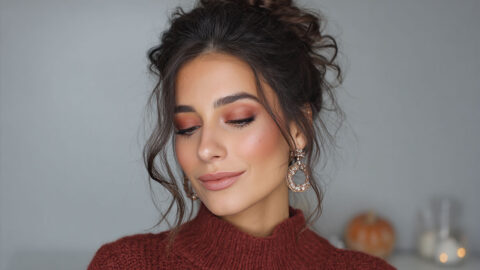
Makeup looks for green dress are a styling method that matches eyeshadow, lip, and skin-tone choices to the exact pigment of a green gown through complementary color pairing, not generic event makeup advice.
Makeup artists apply this logic across five distinct dress tones (emerald, olive, sage, forest, and mint), since each one calls for a different balance of warm and cool pigment.
Forty-seven percent of women report needing help finding the right lipstick shade, according to a Boots Retail USA survey conducted by Ipsos (2025), the exact kind of color decision a green dress forces into sharper focus.
Skin undertone decides which complementary shade, copper, gold, or plum, actually reads as flattering rather than clashing.
What Makeup Looks Work With a Green Dress

Makeup looks for a green dress follow one governing rule: shades that sit opposite green on the color wheel read as the sharpest, most flattering pairing.
That principle, first mapped out by Swiss color theorist Johannes Itten, puts copper, bronze, gold, plum, and terracotta directly across from green on the wheel.
This guide covers five distinct dress shades: emerald, olive, sage, forest, and mint.
Skin undertone and the occasion (a wedding, a prom, a Tuesday at the office) decide which of those complementary shades actually works on a given face.
Key figures:
- Pantone’s official Emerald swatch is registered as PMS 17-5641 TCX, the reference code fashion and beauty brands use to match the shade exactly (Pantone)
- The commonly cited emerald hex value is #50C878, used across design and color-reference tools (Canva)
- Emerald green was named Pantone’s Color of the Year in 2013, a milestone that cemented it as the reference point for this entire dress category
How Skin Undertone Changes Green Dress Makeup Pairing
Undertone decides which complementary shade actually flatters, more than the dress color itself does.
The fastest check is the vein test method: green-tinted veins on the inner wrist point to a warm undertone, blue or purple veins point to cool, and a mixed or hard-to-call result points to neutral.
Nearly 80% of clients could not correctly identify their own undertone during in-person skin consultations, according to dermo-cosmetic advisors at Inoya Laboratoire (2025).
That gap is exactly why the shade-matching step below matters more than most people assume.
Warm Undertone Pairing
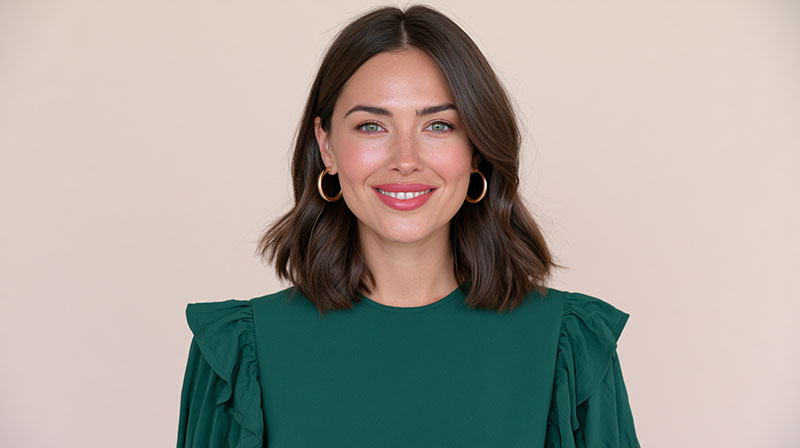
Warm undertone signals: golden, peachy, or yellow-based skin, green-looking veins, and a natural tan rather than a burn.
- Copper and terracotta eyeshadow
- Bronzer over blush
- Gold-flecked highlighter
Warm-undertone skin generally leans toward lipstick shades built for warmer undertones, brick and terracotta tones that echo the eyeshadow family above.
Cool Undertone Pairing
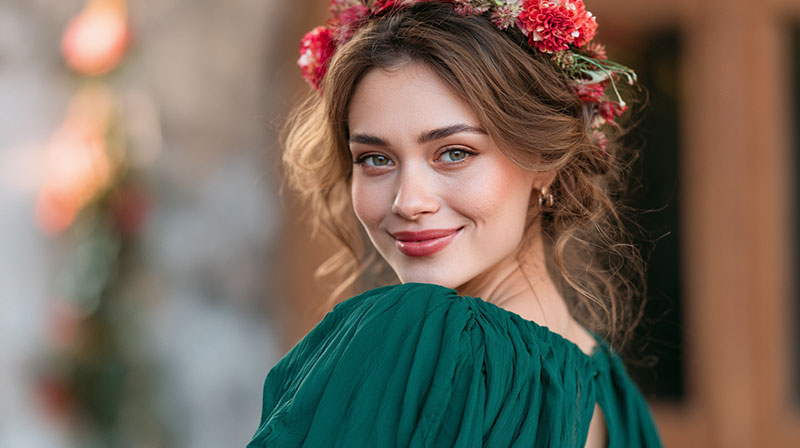
Cool undertone skin reads best in plum, berry, and rose-based shades rather than anything orange-leaning.
Blue or purple veins, a preference for silver jewelry, and skin that pinks rather than tans are the usual tells.
- Plum or aubergine eyeshadow
- Rose-toned blush
- Berry lip
This skin type pairs naturally with lipstick shades made for cooler undertones, which lean into the same plum and berry family already flattering the eye.
Neutral Undertone Pairing
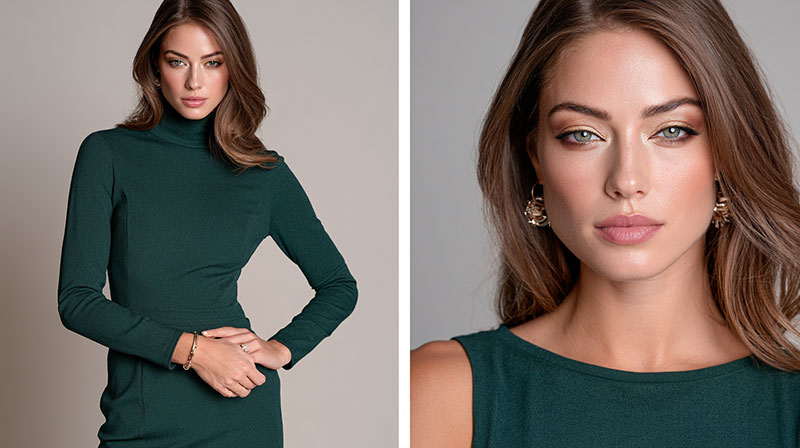
Neutral undertone: both gold and silver jewelry look equally good, and veins read as a blend rather than clearly blue or green.
Gold and champagne eyeshadow sit in the safest zone here, since neither pulls the face too warm or too cool against any of the five green dress shades.
Dark Skin Tone Considerations
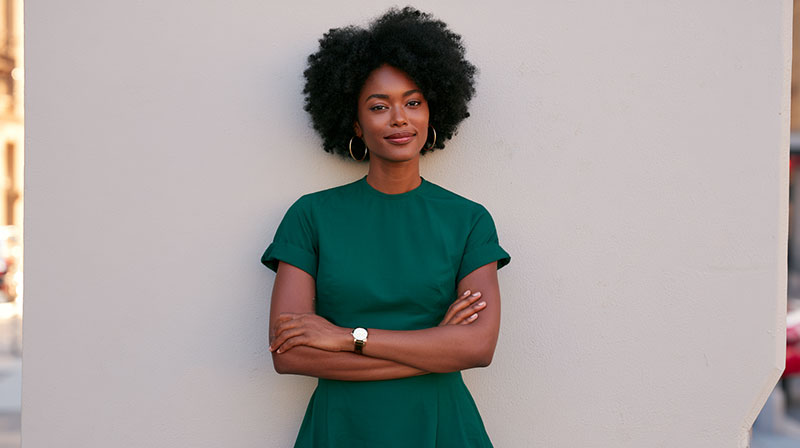
Undertone still applies on deep skin, though pigment concentration changes how it shows up.
The Fitzpatrick scale, the six-point system dermatologists use to classify skin’s reaction to sun exposure, is often used alongside undertone testing on deeper skin because surface color alone can mask the signal.
- Richer pigment means shimmer reads more subtly and needs less product to show
- Matte copper and bronze tend to show truer than sheer, frosted formulas
- Fenty Beauty’s expanded foundation range, one of the first built around shade depth alongside undertone, made this matching step realistic for darker skin
Which Eyeshadow Shades Complement a Green Dress

Three eyeshadow families do the heaviest lifting against a green dress: copper and bronze, plum and berry, and gold and champagne.
Each one reads differently depending on undertone, event lighting, and how bold the look needs to be.
Copper and Bronze
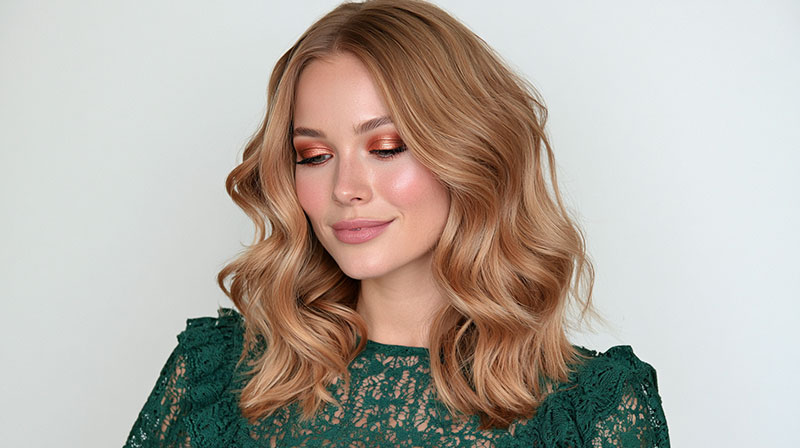
Copper and bronze eyeshadow sit closest to true complementary contrast against most green shades, especially emerald and forest green.
- Best for warm undertones
- Best for daytime and outdoor events
- Reads as approachable rather than dramatic
Urban Decay’s Naked Heat palette, built almost entirely around copper and terracotta, is a common starting point for this exact pairing.
Plum and Berry Tones
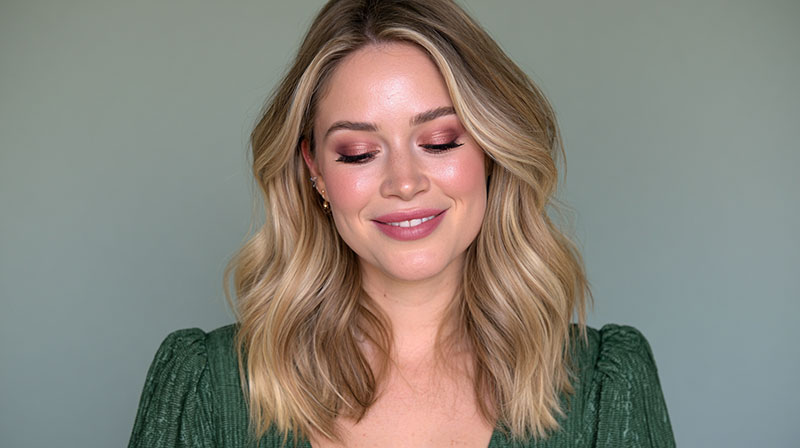
Cool-undertone pairing: plum, aubergine, and deep berry eyeshadow.
These shades carry more visual weight than copper, which makes them the stronger choice once an event moves indoors or after dark.
A plum crease paired with a soft champagne lid is one of the most repeated formulas for evening wear against emerald and sage green alike.
Gold and Champagne Tones
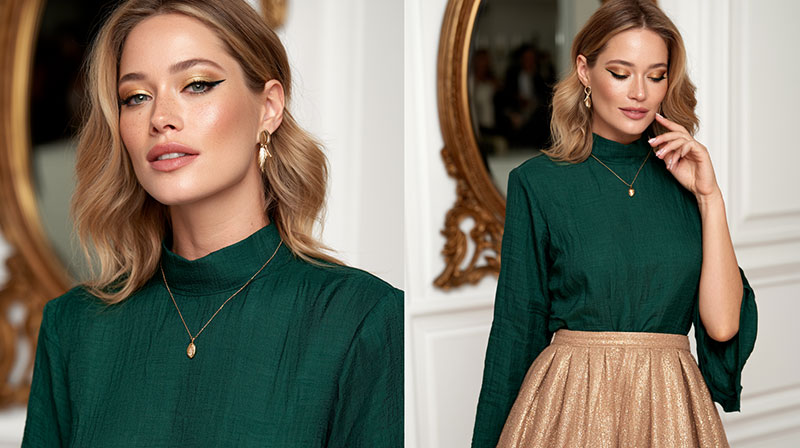
Gold and champagne eyeshadow suits neutral undertones and photographs well under flash, which is why it shows up so often in bridal and red carpet looks.
- Neutral undertone
- Flash photography and stage lighting
- Bridal and red carpet events
Huda Beauty and MAC Cosmetics both built entire palette lines around this warm-metallic family.
The trade-off: gold pushes a look toward full glam fast, so an everyday version needs a much lighter hand.
Eyeliner shape works independently of shade family. A winged liner extends the eye and pairs with any of the three groups above, and the full step-by-step build for that liner shape appears later in this guide.
| Shade family | Works best when | Watch out for |
|---|---|---|
| Copper and bronze | Warm undertone, daytime | Can look flat under harsh indoor light |
| Plum and berry | Cool undertone, evening | Too much reads as heavy on smaller eyes |
| Gold and champagne | Neutral undertone, photography | Shifts casual looks toward full glam fast |
Which Lip Colors Pair With a Green Dress

Lip color decisions for a green dress come down to four realistic options.
- Red: the strongest contrast against emerald and forest green
- Nude: keeps the focus on a bolder eye look
- Berry: suits cool undertones, works daytime through evening
- Brown-toned: suits warm undertones, especially olive green
Red is the default choice for weddings, galas, and anything photographed under flash.
Getting a red lip right matters more here than with most other dress colors, and wearing red lipstick well mostly comes down to temperature: a red that leans too orange fights the green rather than complementing it.
Nude keeps attention on a bolder eye and works best for daytime events or photography where the makeup already has one strong focal point.
Cross-checking which lipstick color actually pairs with a green dress against the specific shade of green, not just “green” as a category, prevents the most common mismatch on this list.
Emerald, Olive, Sage, and Mint Green Makeup Compared
The four dress shades do not take the same makeup, even though they all fall under “green.”
Emerald: the highest-contrast shade, and the one that can carry the boldest pairing: copper or gold eyeshadow with a red lip.
Olive: warmer and more muted than emerald, so it pulls toward terracotta and brown-toned looks rather than anything cool-leaning.
Amal Clooney wore an olive green dress in Lake Como, styled with understated, warm-toned makeup rather than a bold eye, according to Forbes (2025).
Sage: cooler and paler than olive, so plum and rose read as flattering without overwhelming the dress the way they might against a darker green.
Mint: the palest of the four, and the one that needs the lightest hand. Saturated copper or plum overwhelms it; soft peach or a sheer wash of copper works better.
| Dress shade | Eyeshadow | Lip | Best undertone fit |
|---|---|---|---|
| Emerald | Copper or gold | Red | Warm or neutral |
| Olive | Terracotta or bronze | Brown-toned | Warm |
| Sage | Plum or soft rose | Berry | Cool |
| Mint | Soft peach or sheer copper | Nude or soft pink | Neutral or cool |
For olive specifically, wearing a brown-toned lipstick well reinforces the warmth already built into the dress, which is why it repeats across most olive-green looks.
Makeup Looks by Occasion
The same green dress calls for a different intensity of makeup depending on where it’s being worn.
Formality, lighting, and how long the makeup needs to last all shift the choice.
Bridal
Bridal approach: a soft copper or champagne eye, skin-first base, and a lip that photographs well under both flash and daylight.
The goal is longevity through a full day of ceremony, photos, and reception, not the boldest possible look.
Most wedding-day makeup built around green favors this restrained approach, since the dress itself is already carrying the visual weight.
Prom and Red Carpet
Emerald green searches and sales for prom dresses rose 58% year over year heading into the 2026 season, according to Nathan Tailors (2026).
That kind of visibility calls for makeup built for stage lighting and flash photography rather than soft daylight.
- Higher-saturation plum or gold eyeshadow
- Bolder liner
- A lip strong enough to hold up in photos taken from a distance
Prom looks built around a green dress tend to push saturation higher across the board compared with a bridal or wedding guest version of the same shade.
Wedding Guest
Wedding guest makeup for a green dress sits between bridal restraint and prom intensity.
Gigi and Bella Hadid wore olive green dresses to a Los Angeles wedding, styled with soft, warm-toned makeup rather than anything overpowering, as Forbes reported in 2025.
Guest-appropriate balance: a moderate eye, a red or berry lip, and nothing bold enough to compete with the wedding party.
Everyday
Everyday version: one shade of eyeshadow swept across the lid, no liner, tinted balm on the lips.
This is the version built for speed rather than standing out, and it works with any of the four dress shades compared above.
Blush and Highlighter Placement for a Green Dress
Blush and highlighter finish the look, and shade choice here follows the same undertone logic used for eyeshadow.
Blush Shade and Placement
Warm undertone: peach blush, placed high on the cheekbone for evening events and blended lower and softer for daytime.
Cool undertone: rose blush, placed the same way.
NARS’ Orgasm shade, a peach-pink that flatters most undertones, is one of the most repeated blush picks for this exact pairing.
Getting blush placement right for your particular face shape matters more against a green dress than a neutral one, since a small shift in placement changes how warm or cool the whole face reads next to the dress.
Highlighter Shade and Placement
Bronze highlighter suits warm-undertone pairings, while champagne or rose gold highlighter suits cool-undertone ones.
Heavy highlighter competes with a shimmer-heavy eyeshadow, so one or the other carries the shine, not both.
- Cheekbones
- Bridge of the nose
- Cupid’s bow
Reviewing how to work with a cream highlighter is worth doing before an event where the eyeshadow already carries heavy shimmer, since cream formulas are easier to control than powder in that situation.
Jewelry Tone and Hair Pairing for a Green Dress
Makeup sets the base, but jewelry tone and hairstyle finish the overall picture.
Both follow the same undertone logic already used for eyeshadow and blush, with one 2026 twist worth knowing about.
Jewelry Tone

Warm undertone: gold-tone jewelry, which echoes the copper and terracotta already on the eyes.
Cool undertone: silver-tone jewelry, which echoes plum and berry-based looks.
Mixed-metal jewelry searches rose 22% year over year, according to Professional Jeweller (2025), signaling that the old rule against combining gold and silver on the same person no longer holds the way it used to.
Ralph Lauren and Bottega Veneta both showed mixed-metal jewelry on their spring 2026 runways, which means pairing a single warm or cool metal is now a style choice rather than a fixed requirement.
Hairstyle Pairing
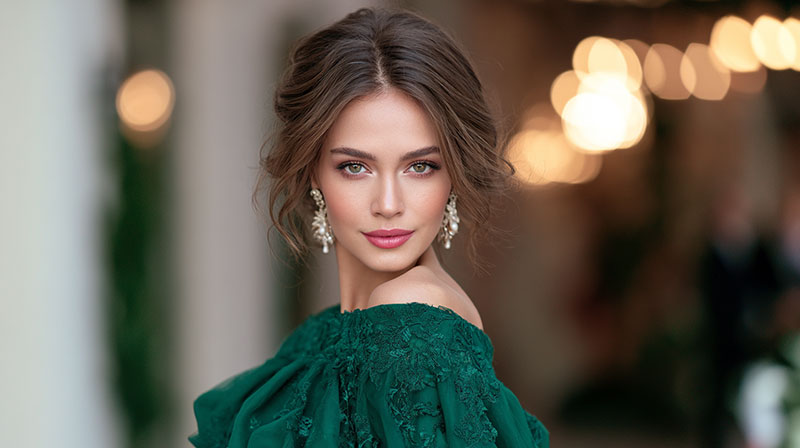
Hair choice follows the same formality scale used for the makeup intensity itself.
- Updos for red carpet and bridal looks, since they keep statement earrings visible
- Loose waves for everyday and wedding guest looks, paired with lighter makeup
- A middle option, a low bun or half-up style, for prom and evening events that sit between the two extremes
The heavier the jewelry gets, the simpler the hairstyle needs to be, so the two elements do not compete for attention.
How to Build a Bronze Smokey Eye for a Green Dress

This is the flagship eye look for a green dress: a bronze smokey eye, built in order from lightest to darkest.
The sequence matters more than any single product choice.
- Prime the lid with a thin layer of eyeshadow primer to stop the bronze tones from creasing by midday
- Set a light copper wash across the entire lid, from lash line to brow bone, as a base
- Apply a mid-tone bronze to the crease and blend in windshield-wiper motions until the line disappears
- Deepen the outer corner with the darkest shade in a small V shape, then blend it back toward the crease
- Line the lash line and build a winged eyeliner shape that extends slightly past the outer corner
- Add mascara or lashes, focusing on the outer lash line to open the eye further
- Set the under-eye with translucent powder before applying the rest of the base makeup, so fallout doesn’t sit on foundation
A full walkthrough of the base smokey eye technique covers blending order in more depth for anyone building this for the first time.
The most common mistake: applying liner before the crease is fully blended, which drags bronze pigment into the liner line and smears both.
Palettes built specifically around this warm range, such as Anastasia Beverly Hills’ Modern Renaissance palette, remove the guesswork of matching copper, bronze, and deep brown in one place.
When Green Dress Makeup Pairings Do Not Work
The pairing logic in this guide covers emerald, olive, sage, forest, and mint. It does not hold up the same way against every green.
Neon and Fluorescent Green
Neon or chartreuse-leaning green dresses reject most of the copper and gold logic built for the five shades above.
Balenciaga, Valentino, Alaïa, and Prada all showed a neon, chartreuse-and-lime green on their spring 2026 runways, according to Marie Claire (2026), styled with equally high-saturation makeup rather than a muted complementary shade.
A soft copper eye reads as underwhelming next to this level of dress saturation. It needs an equally bold pairing (bright metallics or a graphic liner) to hold its own.
Heavy Shimmer Under Flash Photography
Loose glitter and frosted eyeshadow overexpose under direct flash, creating a washed-out white cast rather than the rich metallic finish gold and champagne shadow deliver as a pressed, foil-based formula.
Flash and strobe lighting also desaturates blush and bronzer, so photographers recommend pigment applied roughly 30% bolder than what looks correct in a mirror, according to Studio Newport RI (2026).
This matters most for bridal and red carpet looks, where flash is guaranteed and a washed-out cheek reads as unfinished in every photo.
Matching the Lip Too Closely to the Dress
A lip shade pulled from the exact same family as a sage or mint dress reads as costume rather than styling.
The contrast built into this entire guide exists precisely to avoid that effect, and a near-identical lip and dress color removes the contrast the pairing logic depends on.
Low Light Against Dark Forest Green
Forest green, the darkest of the five shades covered here, absorbs more light than emerald or sage under dim venue lighting.
- Standard pigment intensity reads as flat rather than defined
- Copper and bronze need a heavier hand than the daytime version of the same look
- A cream-based product outperforms powder, since powder textures lose definition faster once the light drops
FAQ on Makeup Looks For Green Dress
Should You Prioritize Skin Tone or Dress Shade When They Conflict?
Prioritize skin undertone over the dress shade itself. A green dress sets the general direction, warm-leaning or cool-leaning, but undertone decides which specific copper, gold, or plum tone actually flatters the face rather than fighting it.
Is Bold or Natural Makeup Better for a Green Dress?
Neither is universally better. The right intensity depends on lighting and formality, not the dress color. A soft copper wash suits daytime, while a deeper plum or gold smokey eye suits evening or photographed events.
What Tools or Products Are Commonly Used for These Looks?
A blending brush for eyeshadow transitions, a small angled brush for the winged liner, and a damp sponge for cream blush and highlighter form the core kit. A neutral-toned setting powder keeps color payoff intact through a full event.
What Should You Fix First in Makeup Looks For Green Dress?
Makeup looks for green dress break down fastest at the undertone match, not the eyeshadow shade, so fixing undertone first solves most pairing mismatches before lip color or blush ever need adjusting.
Three fixes carry the pairing, in this order:
- Undertone match, confirmed before any product goes on
- Eyeshadow and lip balance, so neither competes for focus
- Blush and highlighter placement, adjusted last to finish the face
Most people misjudge their own undertone, and lipstick shade causes the most reported color confusion among makeup categories; together, these two patterns point to one conclusion. An undertone error shows up on the lips before it shows up anywhere else on the face.
Fixing that single decision first prevents a green dress look from needing a full redo later. A deeper resource on matching makeup to skin tone covers the undertone step in more depth than a single dress-color guide can.

She started writing on the site after fielding the same questions from clients and friends often enough to just write the answers down: which red won't turn orange on a warm undertone, how to keep lipstick from feathering into fine lines, why a "12-hour" formula rarely survives dinner.
Every review on the site follows the same rule she uses with paying clients: wear it first, then decide if it's worth recommending.
- How to Make Eyeliner Last Longer Without Smudging - August 31, 2026
- How to Make Eyeshadow Last Longer All Day - August 29, 2026
- How to Find Your Undertone in 5 Easy Steps - August 27, 2026