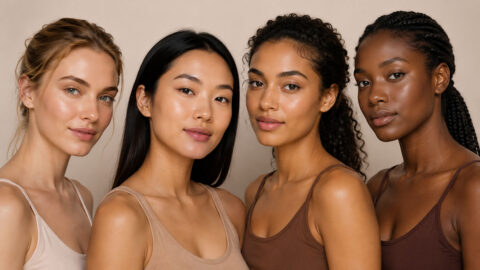
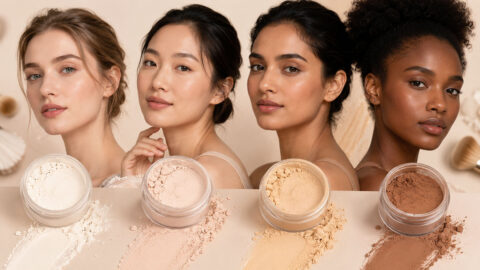
Undertone trips people up more than depth does. In a March 2026 survey of more than 4,300 US women, 66% said the wrong undertone made a product fail, against 52% for a shade that was too light (The Benchmarking Company, 2026).
So work out your undertone first. Then swatch a few shades along the jawline in daylight, and go with the one that vanishes into both face and neck.
That rule covers foundation and concealer, which have to disappear into skin. Color products like blush and lipstick only need to complement it, and undertone steers those choices too.
What Does Matching Makeup to Skin Tone Involve?

Two things get blurred together here: how light or deep your skin is, and the color running underneath that. Brands treat them separately, and so should you. Then there’s the color sitting on the surface right now, which moves around with sun and irritation. Get any of them wrong and the product goes ashy or orange (pink isn’t unusual either), whatever the shade name promises.
Skin depth and how scales measure it
How light or deep your skin looks is its depth. Brands sort it into fair, light, medium, tan and deep, though the names shift from one brand to the next.
The Fitzpatrick scale is the older one and sorts skin by how it reacts to sun. Monk’s scale looks at how skin actually appears, which is closer to what you need at a foundation counter.
The figures behind both scales, and behind brand ranges, run like this.
- The Fitzpatrick scale has six types sorted by sun reaction. It was proposed as sun-reactive skin typing in 1975 and detailed in Archives of Dermatology in 1988 (Fitzpatrick).
- The Monk Skin Tone Scale has 10 shades. Harvard sociologist Ellis Monk built it with Google, and it was released openly in May 2022 (Google, 2022).
- Google surveyed around 3,000 people in the US, and many said a 10-tone scale matched their skin as well as a 40-shade palette (Reuters, 2022).
- Fenty Beauty launched with 40 Pro Filt’r Soft Matte foundation shades in 2017, later extended to 50. The line is being retired in favor of the 50-shade Pro Filt’r Fluid Flex (Cosmetics Business, 2026).
Brand ranges slice much finer than either scale, so where you land on one only narrows things down. The swatch settles it.
Undertone
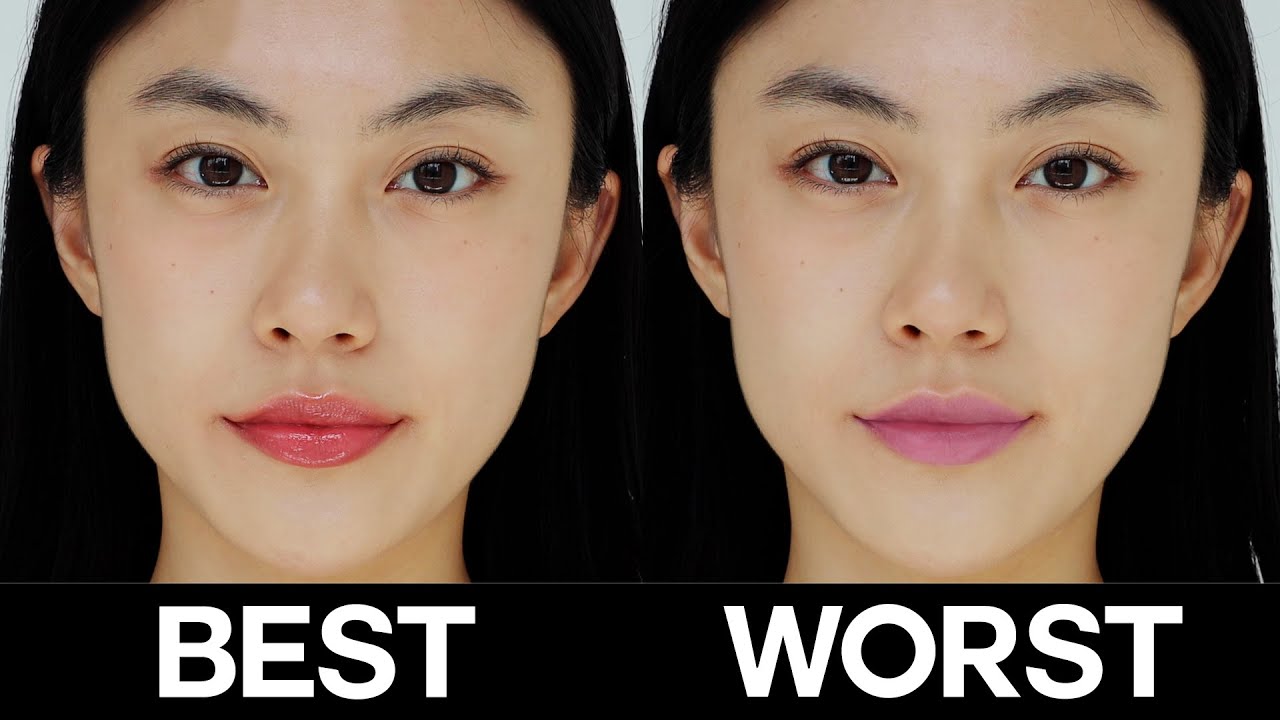
Under the surface sits a quieter color, and that’s your undertone. It has nothing to do with whether your skin is light or deep.
Ulta Beauty’s undertone guide (August 2026) sorts people into cool, warm, neutral and olive. Cool skin leans pink or red, sometimes bluish, and warm skin leans golden or yellow, sometimes peach. Neutral is a balance where neither side stands out. Olive is the odd one out, with a green or gray cast or a muted gold, and depending on the brand it gets labeled warm, neutral or cool olive.
Those descriptions are starting points, not strict rules, and brands label the same family in different ways.
Skin color has several sources feeding into it. Melanin does most of the work. Carotenoids add some, as do blood flow and hemoglobin oxygenation (Fabbrocini et al., Journal of Plastic Dermatology, 2012).
Depth tells you nothing about undertone. Trinny London points out that dark skin can run cool or warm, and plenty of it is neutral. A base that gets the depth right but misses the undertone ends up ashy or orange.
Overtone
What’s on the surface today is overtone, and it changes while undertone stays put. Redness and irritation shift it, and so do a summer tan, dark spots and self-tanner.
Ulta Beauty’s guidance says these change how your face looks without touching the underlying undertone. Read your color from the jawline and neck, with the upper chest as a backup, instead of from the reddest patch.
How Do You Find Your Undertone?

Don’t lean on a single test. Ulta Beauty’s guide (August 2026) recommends several clues over one, since every test has a blind spot. Run a couple, look for agreement, then confirm with a swatch.
| Test | How to do it | Result pattern | Where it fails |
|---|---|---|---|
| Vein | Check the inner wrist in daylight | Blue or purple points cool, green points warm, mixed points neutral | Vein color depends on vessel depth and skin optics |
| Jewelry | Hold gold and silver against bare skin | Gold looking better points warm, silver looking better points cool | Taste skews it, and neutral skin has no clear winner |
| White paper | Hold plain white paper beside your bare face in daylight | Skin that looks yellow leans warm, skin that looks pink leans cool | Redness reads as pink, and tinted paper shifts the read |
| Sun reaction | Recall how your skin responds to sun | Tans easily, leans warm. Burns first, leans cool | Sun history and a current tan muddy the answer |
The vein test needs the most caution. Kienle and colleagues showed in Applied Optics (1996) that vein color depends on how skin scatters and absorbs light, blood oxygenation, vessel diameter and depth, and visual perception.
Undertone isn’t on that list. Treat a green or blue wrist as a hint, not an answer.
If the tests agree, that’s your working undertone. If they split, the next section covers why, and a swatch will break the tie.
When Do the Standard Undertone Tests Fail?
They fail where the signal is muddy or the surface hides it, which mostly means olive and neutral skin, and anything prone to redness. Vein and jewelry reads also drift with factors that have nothing to do with undertone.
Olive skin carries a green or gray cast, or a muted gold, and the standard tests rarely pick that up. Brands label olive shades warm, neutral or cool olive, so the label alone won’t place you (Ulta Beauty, 2026).
Neutral skin gives no clear winner on any test, which is the whole problem. If every neutral shade you try looks orange, those shades probably run too warm or too saturated, and sometimes too deep. Cool-neutral, olive-neutral or muted shades are the next thing to try (Ulta Beauty, 2026).
A flushed face reads pink, which tempts a cool label. Ulta Beauty advises using the jawline and neck as references instead, and the upper chest if you can see it.
Vein reads drift because vessel depth and diameter change the color you see, so two people with the same undertone can read differently (Kienle et al., 1996). The jewelry test measures taste as much as color, and neutral skin has no clear preference to measure. Honestly, it’s the weakest of the lot.
When none of that settles it, stripe shades and judge them against the neck. It works on every undertone.
- Grab a handful of shades at one depth, covering warm, cool and neutral, and add an olive or muted option if the rest look orange or overly bright
- Swipe each in its own stripe from jaw onto neck, leaving a gap between stripes
- Go with the stripe that leaves no pink, yellow, orange or gray line against the neck
Nothing beats that comparison. Placement and lighting come next.
How to Test a Foundation Shade on Your Face

Put stripes of a few shades along the jawline and look at them in natural daylight. The one that disappears into both face and neck wins. Maybelline New York calls the jawline the most accurate test zone, ahead of the back of the hand.
- Remove old makeup, apply only the moisturizer and sunscreen you normally wear, and let both settle.
- Pick a few shades at your depth. If undertone is still unclear, take one warm, one cool and one neutral.
- Swipe each shade as a separate vertical stripe from the jaw onto the neck, with gaps between them.
- Blend the edges of each stripe the way you normally apply foundation, so the test matches how it will wear.
- Walk to a window or open shade with a hand mirror. Maybelline India notes that indoor lighting can make a shade look lighter or warmer than it is.
- Judge in a full-size mirror against the neck (Trinny London). Dior pro makeup artist Jamie Coombes also tells Marie Claire UK to check the decollete, since the face should match the body.
- Leave the stripes on and look again after the wait described next.
Testing on the hand or wrist is the classic error, and judging under store lighting only to find the mismatch outdoors is a close second. Then there’s trying one shade with nothing lighter or deeper beside it.
Ulta Beauty’s advice is to compare one shade slightly lighter and one slightly deeper in the winning undertone. That catches the right undertone at the wrong depth.
How Long Should You Wait Before Judging a Swatch?
Wait at least 15 minutes, and longer on oily skin or with long-wear formulas. A swatch that looks right in the first minute can change as it dries and meets skin oil.
Ulta Beauty (September 2026) says to wait at least 15 minutes and then view the jawline swatch in indirect daylight. Maybelline India (August 2026) wants 20 to 30 minutes before you check in natural light.
The gap makes sense. Ulta puts dry-down in the first several minutes, and Maybelline’s longer window is meant to let visible oxidation show.
Use 15 minutes as the floor and 30 for oily skin. For a shade you plan to buy in full size, recheck after a few hours of wear, which is the longer test Ulta suggests.
Telling oxidation from a wrong shade is easy enough. A wrong shade looks off right away, while one that matches at first and darkens over the following hours is oxidizing (Maybelline India, 2026).
Ulta says the same from the other side: an orange cast that appears immediately points to an undertone mismatch. The two retailers disagree on the wait but agree on this test.
Oil speeds the shift up most, mostly across the T-zone, with heat, sweat and humidity close behind. Moisturizer or sunscreen that hasn’t absorbed does it too. High-pigment, full-coverage and long-wear formulas shift faster than light ones.
A few ways to stop foundation from oxidizing cut down the shift, like thinner layers and a primer, or blotting oil instead of piling on more product.
Primer won’t stop oxidation completely, so the wait stays necessary (Maybelline India). Keep prepping skin before makeup the same way each time so your tests stay comparable.
Skip the shortcut of buying a much lighter shade to offset suspected oxidation. Ulta advises against it, because the makeup starts too light and the cause stays unfixed.
How to Read Shade Codes and Match Across Brands
Most shade codes pair a number for depth with a letter for undertone, but each brand writes its own system. Read the chart behind the code before trusting the letters.
Estee Lauder’s 3W1 stacks a depth digit and an undertone letter (C, N or W), then a second digit for intensity within that range. Ulta’s Double Wear answers show 3W2 Cashew keeping the undertone of 3W1 Tawny at a deeper intensity.
MAC uses four color groups, NW, N, NC and C, with numbers that rise with depth, so a lower number is lighter (MAC shade finder, accessed October 2026). Some L’Oreal Paris shades carry an N for neutral or a W for warm.
Estee Lauder lists 70 Double Wear shades on its US brand site (accessed October 2026), and UK retailers list 60 for the same reformulated line, so the final digit matters.
Here’s where it gets awkward. MAC expands NC as Neutral Cool, yet MAC’s Australian shade finder describes the NC and C groups as golden.
Read as plain warm and cool, those letters point the wrong way. Go by the brand’s color descriptions, not the abbreviation.
Depth numbers only mean something inside one brand’s chart, so crossing brands takes a tool or a swatch. As of October 2026, the tools below handle most of it.
| Tool | What you give it | Where it falls short |
|---|---|---|
| Findation, Ulta Shade-to-Shade Finder | Shades from other brands that already matched you | A wrong reference shade carries over |
| MAC Foundation Finder | Your shade from another brand | Returns MAC formulas only |
| Ulta virtual shade match (app) | Your skin tone and undertone | Self-assessed inputs carry any earlier error |
| Sephora Color IQ | An advisor’s scan of face and neck | In-store only |
Sephora relaunched Color IQ in September 2021 with an algorithm that weighs depth, undertone and saturation, and factors in redness and imperfections (Digital Commerce 360, 2021).
Online guessing has one built-in flaw. Findation says on-screen swatches often do not match the real-life shade, because every screen shows color differently.
Treat any tool’s answer as a shortlist. Swatch the top two on your jawline before buying.
Foundation Looks Pink, Orange or Gray: What Should You Change?

Read the color cast first, then change undertone, depth or both. Ulta Beauty’s undertone guide (August 2026) ties each cast to a likely cause.
| What you see | Likely cause | What to change |
|---|---|---|
| Pink or red | Cooler or rosier than your skin | Try a warmer or more neutral shade at the same depth |
| Yellow or golden | Warmer than your skin | Try a cooler or more neutral shade at the same depth |
| Gray or ashy | Too light, too cool or too muted | Try a deeper or warmer shade, then recheck in daylight |
| Peachy | More red and yellow than your skin needs | Move toward a neutral or olive option |
| Orange and dark | Depth and undertone both off | Go lighter and into a less warm family |
Depth and undertone can be wrong together. Ulta says a swatch that looks orange and noticeably dark needs a lighter shade in a less warm family, so there’s no single fix.
Opposite colors on the color wheel cancel each other, which is why a color corrector works at all. It treats local discoloration, so a mismatch across the whole face still needs a new shade.
Green cancels redness from breakouts, rosacea or irritation (NYX Professional Makeup). Peach to orange counters blue and purple under-eye circles, with peach on lighter skin and deeper orange on deeper skin (e.l.f. Cosmetics). Yellow balances purple discoloration such as bruising and visible veins (NYX Professional Makeup).
Green has a documented downside. Makeup.com quotes artist Hart saying green can leave a gray cast, which is why she prefers yellow for redness.
Keep the layer thin, a less-is-more rule from the same guide, and follow a walkthrough on how to apply color corrector so it stays on the discoloration only.
Project Vanity’s oxidation guide lists lightening adjusters, such as BYS’s Foundation Adjuster Lightener, as a fix for formulas that darken. An adjuster is the lighter-shade workaround in a bottle, so it carries the same risk Ulta flags.
Matching Concealer, Powder, Blush, Bronzer and Lipstick

Base products should disappear into your skin. Color products only have to flatter it, and they take their cue from undertone instead of an exact shade.
Base products that should disappear
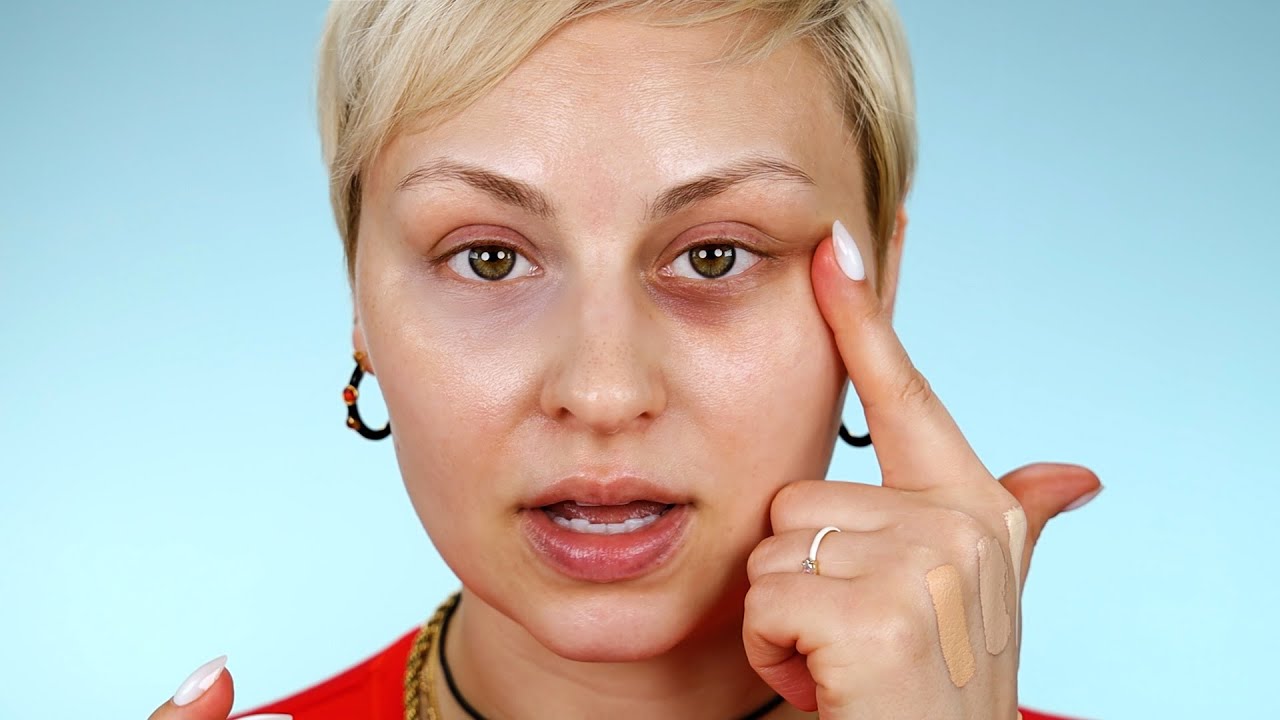
Concealer has two jobs, and the match rule changes with the job.
Estee Lauder says to match concealer exactly to foundation for uneven skin tone and to go slightly lighter under the eyes. Ulta’s guide (August 2026) draws the same split: concealer on spots stays near foundation depth and undertone, while under-eye shades may shift to brighten or balance discoloration.
Two brands, one rule. Choosing a concealer starts with which of the two jobs it has to do.
L’Oreal Paris offers the shortcut: buy foundation and concealer from the same line and they stay close.
Translucent powder sets without adding color, so there’s no shade to match (L’Oreal Paris). Tinted powder carries pigment and follows the foundation rule, and powder foundation such as MAC Studio Fix Powder Plus is shade-matched like a liquid.
Color products that should complement

Blush takes its intensity from depth and its color family from undertone. Warm undertones suit peach-based pinks or soft coral (Maybelline Australia), and fair skin with cool undertones suits baby pink or carnation (L’Oreal Paris).
For bronzer, go one to two shades deeper than your skin with a matching undertone (Ulta Beauty). A warm bronzer on cool undertones can read orange, per Coco and Eve.
Lipstick gets judged against the skin around the lips, not the cheeks (Maybelline India).
The shortcuts conflict. L’Oreal Paris calls peach the most universally flattering blush, while NYX Professional Makeup says neutral undertones should shop by depth: pale mauve for light skin, salmon or raspberry for medium, vivid berry for deeper.
Peach is a safe first try, not a guarantee.
Maybelline India keys lipstick to depth, with warmer shades for wheatish skin and cooler ones for paler skin. That’s a different lever from the undertone rule behind blush, and this guide on picking a lipstick color goes deeper on options.
Adjusting Your Shade as Your Skin Changes With the Seasons
Your undertone stays and your depth moves. Stay in the same brand and go up or down one to two shades within the same undertone family as the seasons change (L’Oreal Paris).
Summer sun deepens skin tone and winter often lightens it, so a single shade rarely matches all year (L’Oreal Paris Canada).
One route is two bottles, a paler one for winter and a warmer one for summer, one shade apart in the same undertone, as L’Oreal Paris Canada makeup artist Jodi Urichuk advises. The cost is that second bottle.
The other route is one step deeper in the same undertone letter. Answers on Ulta’s Double Wear listing point a tanned 1W2 Sand wearer to 2W1 Dawn, and a 3W1 Tawny wearer facing a spray tan to 3W2 Cashew. The warm family stays put.
A deeper bronzer over foundation is the quickest summer patch, according to Faces Canada.
Sheer formulas bend furthest. L’Oreal Paris says its tinted serum shades flex between seasons, and a skin tint shows enough of your own color to do the same.
Before a spray tan, Maybelline suggests bringing your foundation so the technician can match the glow to it.
Ulta’s guide (August 2026) lists redness, tanning and self-tanner as surface-color changes that leave undertone alone. Hold off on a new shade until a flare-up settles.
Matching Makeup to Skin Tone FAQ
Do sheer or tinted formulas make shade matching easier?
Yes. Sheer formulas let more of your own skin show through, so a slight mismatch looks less obvious than it does under full coverage (Ulta Beauty, 2026).
A close match still keeps a tint consistent from face to neck.
Is the same shade identical across every formula from one brand?
No. Pigment load and finish change how a shade looks, so two products labeled with the same depth can differ on skin.
Ulta Beauty (2026) says long-wear claims do not predict shade shift either way, so test each formula on its own.
How accurate are AI shade finders and virtual try-on tools?
Accuracy depends on the photo you feed them. Camera flash, room lighting and phone processing shift color, so Ulta Beauty (2026) suggests shooting in indirect daylight without a beauty filter.
A selfie taken under a bathroom bulb hands that error to the recommendation.
Is it worth getting samples before buying a full-size foundation?
Yes, when the store allows them. A sample lets you wear the shade with your own skincare through a full day, which a jawline swatch can’t show.
Ulta says trying several shades in store carries no purchase commitment.
When a Professional Shade Match Is Worth It

Get professional help once two rounds of jawline swatches in daylight still leave a pink, orange or gray cast. Before that, a self-swatch answers the same question for less.
Swatch three shades at your depth first. If that fails, book an advisor scan or artist consult, and recheck whatever wins in daylight.
Google’s survey found people matched 10 tones about as well as 40 shades, while Estee Lauder lists 70 Double Wear shades in the US. Many neighboring steps in a range that long are hard to rank by eye, which is where a measured scan earns its place.
The trade-off is a store visit and one more opinion that still has to pass your daylight check. With the shade settled, applying makeup is the natural next step.

She started writing on the site after fielding the same questions from clients and friends often enough to just write the answers down: which red won't turn orange on a warm undertone, how to keep lipstick from feathering into fine lines, why a "12-hour" formula rarely survives dinner.
Every review on the site follows the same rule she uses with paying clients: wear it first, then decide if it's worth recommending.
- How to Make Eyeliner Last Longer Without Smudging - August 31, 2026
- How to Make Eyeshadow Last Longer All Day - August 29, 2026
- How to Find Your Undertone in 5 Easy Steps - August 27, 2026