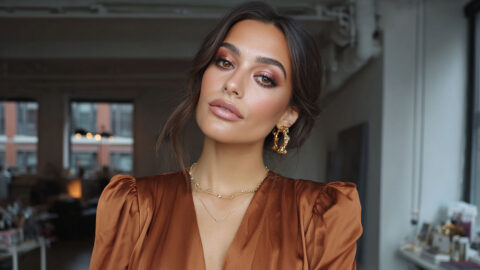
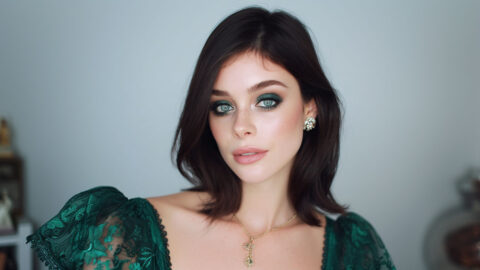
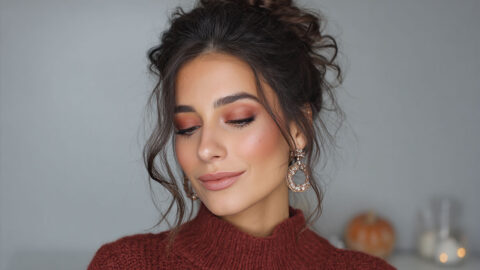
Most makeup looks with pink lipstick come down to how much you put around the pink. A pale one can take a stronger eye. A bright one usually can’t.
Pink is also the most popular lip shade in the UK prestige market, at over a quarter of sales in the first half of 2025 (Circana, 2025).
The range runs from baby and nude pink through coral and hot pink to fuchsia, so one lipstick category covers everything from a quiet office face to a Barbiecore look.
Pink lipstick shade families, from baby pink to fuchsia

Each group asks something different of the rest of the face.
| Group | How it reads | Example shade |
|---|---|---|
| Pale and baby pink | Soft, youthful | Charlotte Tilbury Red Carpet Pink |
| Nude and dusty pink | Natural, close to bare lips | Charlotte Tilbury Pillow Talk, MAC Mehr |
| Coral pink | Warm, fresh | Revlon Pink in the Afternoon |
| Hot pink and fuchsia | Loud, one focal point | MAC Candy Yum-Yum |
A nude lipstick that leans pink sits closest to bare lips. Charlotte Tilbury builds Penelope Pink from pink pigment plus beige, nude and peach tones, and sells it as the natural-look option.
Dusty pinks like Mehr (listed as a mid-tone mauve pink) give up some brightness and look more finished for it. Revlon’s Pink in the Afternoon is a soft coral pink, so it adds warmth without shouting.
Bright pinks go the other direction. MAC sells Candy Yum-Yum as a neon pink matte, and the usual rules for wearing bright lipstick apply (quiet eyes, one loud feature).
Inside one group, plenty of shades are nearly the same, so don’t agonize over them.
Which pink lipstick suits your skin tone and undertone?
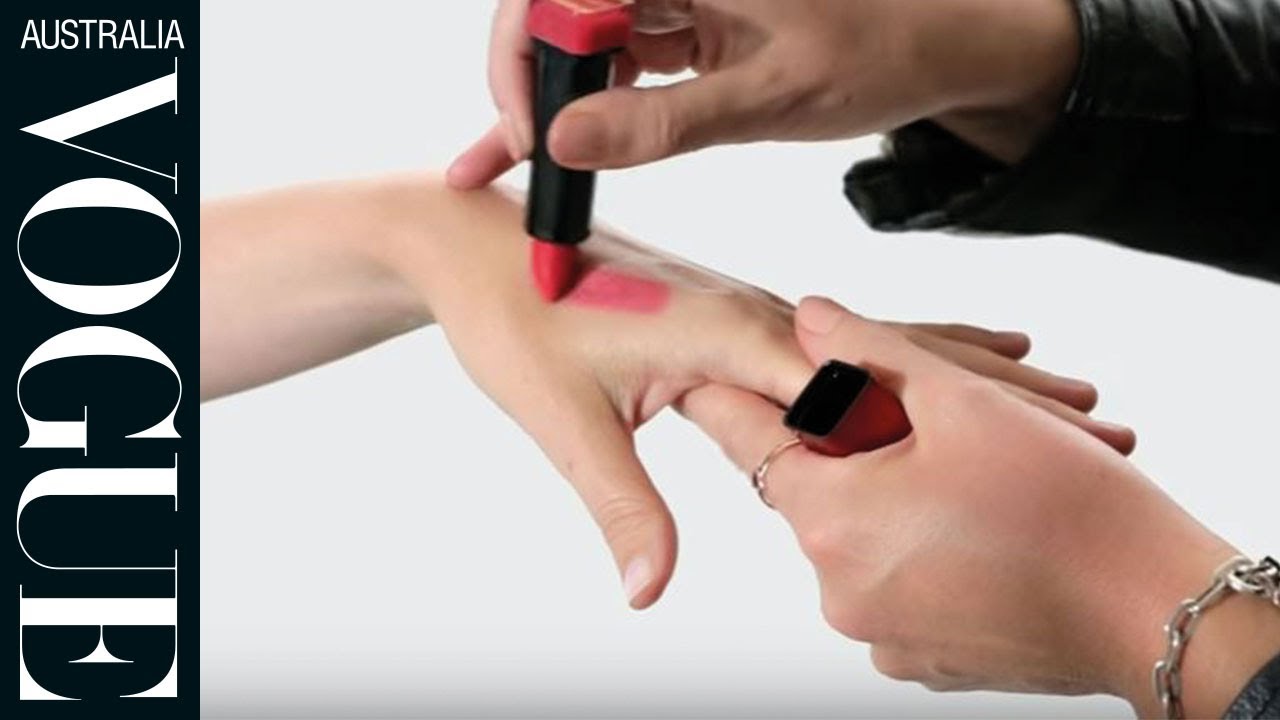
Undertone comes first. Blue-based pinks tend to suit cool undertones, and coral or peach pinks suit warm ones. Maybelline’s undertone guide says neutral undertones can wear either cool or warm products.
Cool undertones read pink, red or blue in the skin, and lipstick shades for cool undertones run toward berry and blue-pink. Skin depth is a separate thing from undertone.
How to test your undertone
Start with your wrist veins. Blue or purple points cool, green points warm, and a mix points neutral. Jewelry works the same way: gold looks better on warm skin, silver on cool, and neutral skin can wear both.
If you want a third opinion, hold a white tee or a sheet of paper up to your face and see whether your skin turns rosy or golden.
Maybelline’s guide covers the vein and jewelry tests. None of them is exact.
Sterling Style Academy, a color analysis school, points out that skin thickness and transparency change how veins look, so it argues the vein test can’t be relied on alone.
Warm undertones read yellow, golden or peachy, which is where warm-undertone lipstick colors like coral pink come in. If the tests disagree, call yourself neutral and judge by the lipstick on your face.
Pink shades for fair, medium and deep skin
A University of Leeds master’s thesis (Chen, 2024) tested 15 participants and found that lipstick color significantly shifted how light and how red facial skin looked, with minimal effect on how yellow it looked.
Earlier work by Stephen and McKeegan (2010) found that participants raised lip redness contrast to make female faces look more attractive.
Read together, the two findings explain the shade advice. The lip moves redness and lightness, so the pink needs enough contrast against your skin, and undertone decides whether that contrast looks flattering or harsh.
The Leeds sample is small, so treat it as a direction, not a rule.
For fair skin, MAC points to light pink, dusty rose, pink-tinged mauve and coral. Medium and olive skin can wear most pink bases, though makeup artist Lisa Caldognetto told Marie Claire UK that a strongly blue base can wash you out. Deep skin suits dark pink, deep berry and pink-purple, again per MAC.
W Magazine’s Benjamin Puckey puts it more simply, with lighter pinks for pale skin and bolder hues for darker skin.
Charlotte Tilbury covers the whole span in one range. Pillow Talk comes as Fair (cool-toned pink), Original (nude-pink), Medium (berry-pink) and Intense (deep rosewood brown-pink).
How lipstick finish changes a pink look

Matte gives you full color payoff and long wear (Maybelline rates Super Stay Matte Ink at up to 16 hours, per its product page), and it holds crisp edges, which helps a defined bold pink. The downside is that it looks flat on its own and shows dry patches.
Dry lips are the usual complaint, and there are fixes for keeping lips moisturized under matte lipstick.
Satin is more comfortable and leaves a soft sheen, but it has less pigment punch and doesn’t last as long as a liquid matte. If you are still choosing between the two, this breakdown of how matte and satin lipsticks differ helps.
A sheer tint is an easy flush, and Dior’s Addict Lip Glow claims up to 48 hours of hydration (Dior product page, as of October 2026). The color reacts to the pH of your lips, though, so the pink varies from person to person and won’t carry a bold look.
Gloss makes lips look fuller and layers over lipstick, which Fenty Beauty recommends for Gloss Bomb. It also softens a precise lip line, so skip it if the edges are the point.
Sources disagree on where the shine belongs. W Magazine’s Puckey says all-matte pink goes flat and suggests gloss on lids and lips with a satin cheek, while SheerLuxe’s expert prefers a velvety, softly diffused lip.
Both hold up, honestly. It comes down to whether you want the lip to be the shiny part of the face or the soft part.
What eye makeup goes with pink lipstick?
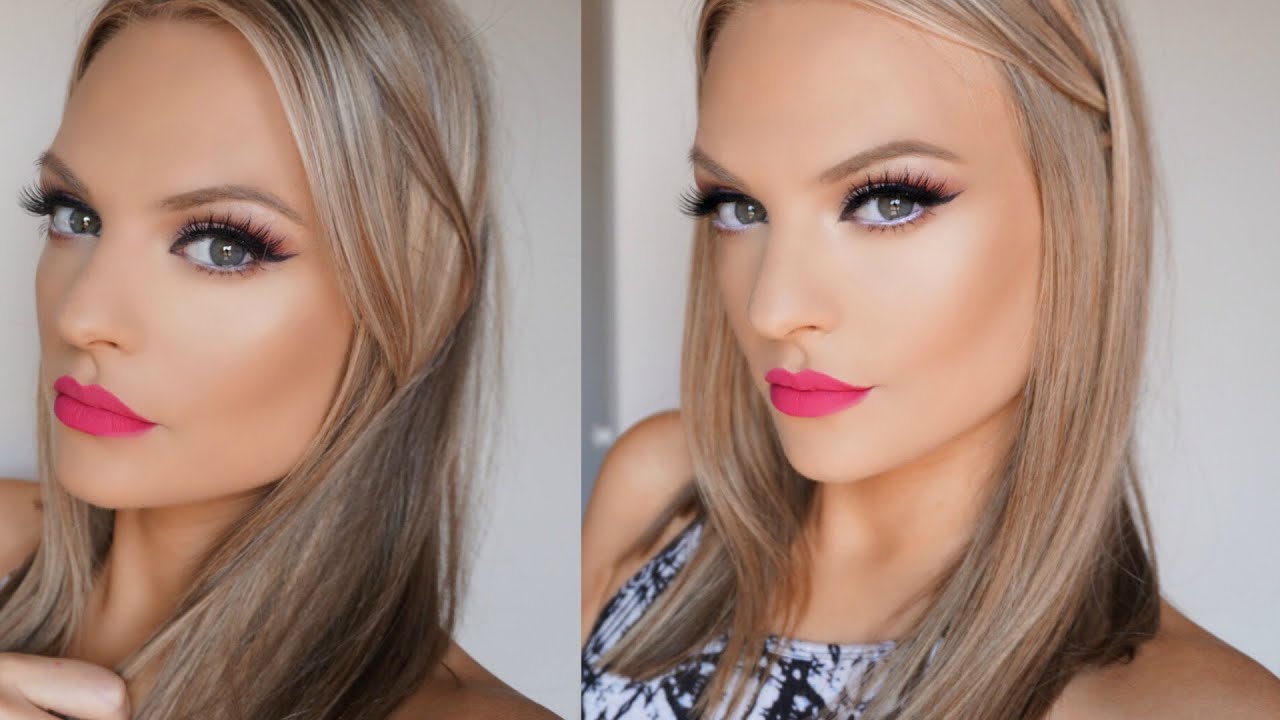
Neutral browns and taupes are the safe default. A pale pink lip can take a stronger eye, a bright pink wants quiet ones, and then there’s the option of putting pink on the lid as well.
Neutral and smoky eyes
Balance is the rule. The quieter the lip, the stronger the eye can be.
With a quiet pink lip, go for a smoky or winged eye and defined brows. A loud pink lip does better with a neutral brown or taupe lid, mascara, groomed brows and a pop of blush.
Trinny London says a very light pink, or one close to your natural lip color, pairs well with a bold eye, and a smokey eye look is the obvious choice.
A defined wing is the quickest way to build a stronger eye, and the winged eyeliner technique is worth practicing before a night out.
Pink and shimmer eyes
Pink lids scare people. Adore Beauty’s editor admits she avoided pink eyeshadow for fear of looking like she had an eye infection.
Glamour’s version is to sweep pink lipstick over the moving lid and stop at the crease, while Adore Beauty uses one pink across the whole lid. W Magazine goes a different way, with gloss on the lid and a satin cheek.
Brown mascara instead of black keeps a pink lid soft, SheerLuxe’s expert says, and it suits daytime best.
Pairings by eye color
Eye color changes which pink makes the eyes stand out.
In Marie Claire, makeup artist Caitlin Wooters pairs brown eyes with a deep pink or a soft nude, and blue eyes with a light dusty pink. For green eyes the pick is a bright pink.
Eye color is a nudge, not a rule. If a pick fights your undertone, the undertone wins.
Blush and base choices that match a pink lip
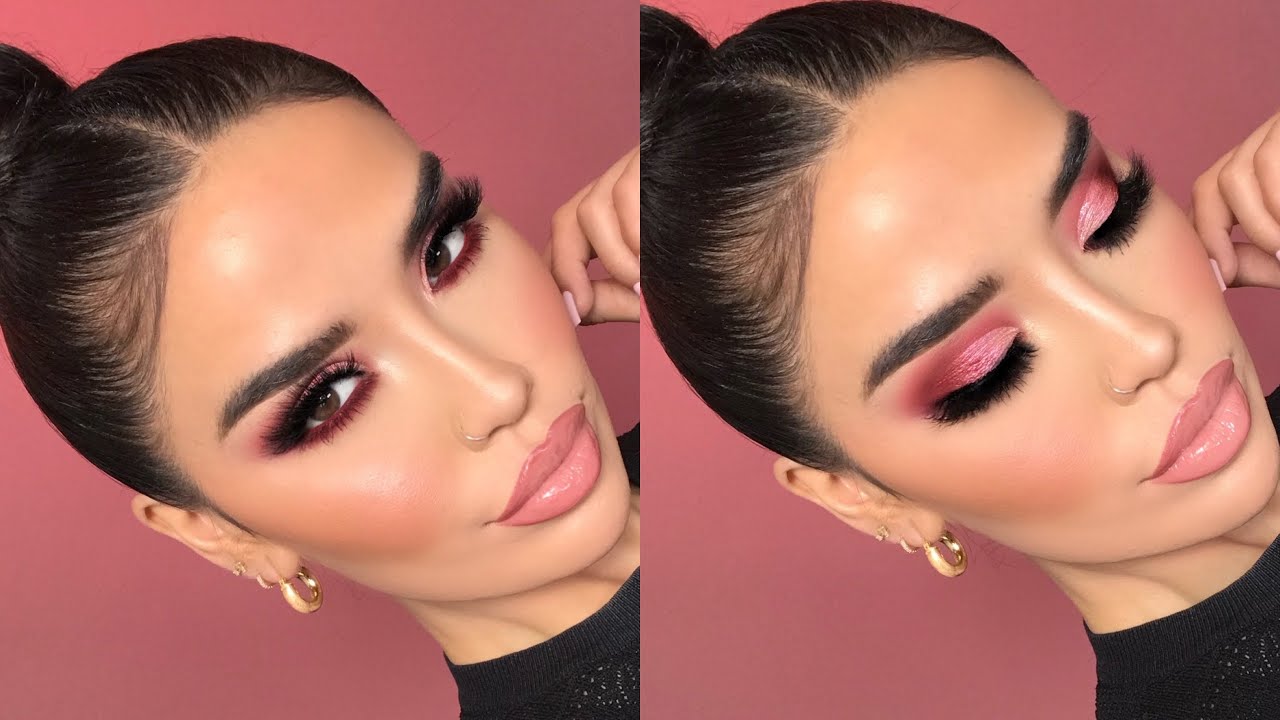
Blush temperature should follow the lip. Cool pink blush goes with blue-based pinks, and peach or peachy pink goes with coral and warm pinks. A natural base keeps attention on the lip and cheek.
In Rare Beauty’s Soft Pinch Liquid Blush, Happy is listed by the brand as a cool pink and Encourage, from the same line, is a soft neutral pink. Joy is a muted peach, a match for coral pink lips. NARS Orgasm sits further toward warm, a peachy pink that retailers describe as having golden shimmer.
Rare Beauty says Soft Pinch was made for layering over liquid and powder formulas, so it sits on foundation without lifting it. If you want the method, here is how people go about applying Rare Beauty blush.
Sources disagree on quantity. Space NK’s product guidance for Rare Beauty’s pigmented liquid blush is one or two dots per cheek, while Chantecaille’s Ernesto Alvarado told Bloomberg Businessweek (2013) that most women wear too little and should use a bit more than feels right.
The gap is formula pigment, not taste. A dense liquid needs restraint, and a sheer powder forgives more.
Cream and liquid formulas follow the same pat-and-blend routine as applying cream blush. Alvarado’s tip for shade is to match the pinkness of your palm.
Manila-based makeup artist Mickey See told Allure Philippines (2025) that the base has to look natural whatever the trend.
A dewy base suits gloss and satin pinks. With a matte base and a matte lip, a dewy blush adds texture, and Rare Beauty sells both finishes. On bronzer and highlighter, See says to pick one shimmer focal point.
Makeup looks with pink lipstick by occasion and style

How much eye and cheek color a pink needs depends on where you’re wearing it.
| Look | Pink and finish | Eyes | Cheeks |
|---|---|---|---|
| Everyday and office | Sheer brownish or mauve pink | Mascara, groomed brows | Blush matched to the palm |
| Soft glam | Soft pink or nude, satin | Blended neutrals | Rosy, glowy |
| Wedding | Rosy pink, gloss or velvety matte | Light definition, lashes | Pink flush |
| Barbiecore | Hot pink, matte or glossy | Neutral, or a matte pink wing | Cool pink |
| Y2K | Frosted pink, lined and glossed | One shimmer focal point | Peachy pink, natural base |
Everyday and office

The workday pink is the one closest to your own lip color, only a little deeper.
Wardrobe Oxygen’s Ask Allie column recommends a brownish pink with mauve or dusty tones for conservative offices, and saves bright shades for after hours.
Sheer beats opaque. Alvarado described pressing a sheer color into the center of the mouth and smearing it outward for a stain effect, and the same trick works with pink.
Anyone new to the color can start with this primer on how to wear pink lipstick.
Evening and wedding
COVERGIRL’s soft glam tutorial puts a soft pink or nude lip under glowy skin so the complexion stays the focus. For evening, W Magazine’s Benjamin Puckey suggests a hint of pink by day and a heavier hand at night.
Weddings get their own treatment. Andrew Peterson, a Trish McEvoy makeup artist quoted in Charleston Weddings, calls pink feminine, elegant and romantic, and says it photographs well. He uses a liner that matches the lip color and fills the lips in completely, which he says keeps the lipstick from bleeding.
Royal brides leaned soft. Princess Eugenie wore a neutral rosy-beige gloss with flushed skin in 2018, and Refinery29 notes that Meghan Markle and Kate Middleton wore shiny rose shades.
Brides who want full-face references can browse these wedding makeup looks for eye and base ideas.
Trend looks
Barbiecore reached the runways in 2022 and frosted Y2K pink has been coming back since. The two sit at opposite ends of the same color.
Makeup artist Chuchie Ledesma (ABS-CBN) pairs a cool pink blush with a matte hot pink wing and a subtle pinkish gloss. A simpler Barbiecore face keeps the eyeshadow neutral and the blush subtle and lets the hot pink lip carry it. There’s also a version with a shimmery pink lid over a glossy or satin nude-pink lip.
L’Oreal Paris artist Allan Avendano points out that Barbiecore is built on pink but does not lean on pink eyeshadow.
Frosted pink now comes lined and glossed to refine the finish, according to makeup artists interviewed by NewBeauty, who also call soft glam one of the best frames for it. Sphelele Mkhize of Clicks Beauty Squad puts matte lipstick down first so the color holds, then high-shine gloss at the center of the lip. The base stays natural, with a single shimmer focal point.
How to apply pink lipstick for a finished look

Most patchiness and feathering comes from skipping prep and liner.
- Exfoliate with a lip scrub, then add balm. L’Oreal Paris notes that dry patches and flakes make neat application hard, even for pros.
- Use a liner close to the lipstick shade and fill the whole lip for grip (IT Cosmetics, Superdrug). Clinique says a same-color liner acts as a barrier against feathering.
- Soften the liner edge with a finger or brush so the transition looks natural (LiveThatGlow).
- Start at the center of the upper lip and work out to the corners, then do the lower lip. A lip brush handles the corners (Superdrug).
- Press a single-ply tissue to the lips, including the corners, then reapply a thin coat to avoid flaking (L’Oreal Paris).
- Add gloss over the center for dimension, an optional last step in IT Cosmetics’ routine.
Liner is the step most people skip, and a dedicated guide on applying lip liner is worth a read.
For the last step, there is a separate walkthrough on layering lip gloss over lipstick.
When pink lipstick looks wrong and how to fix it
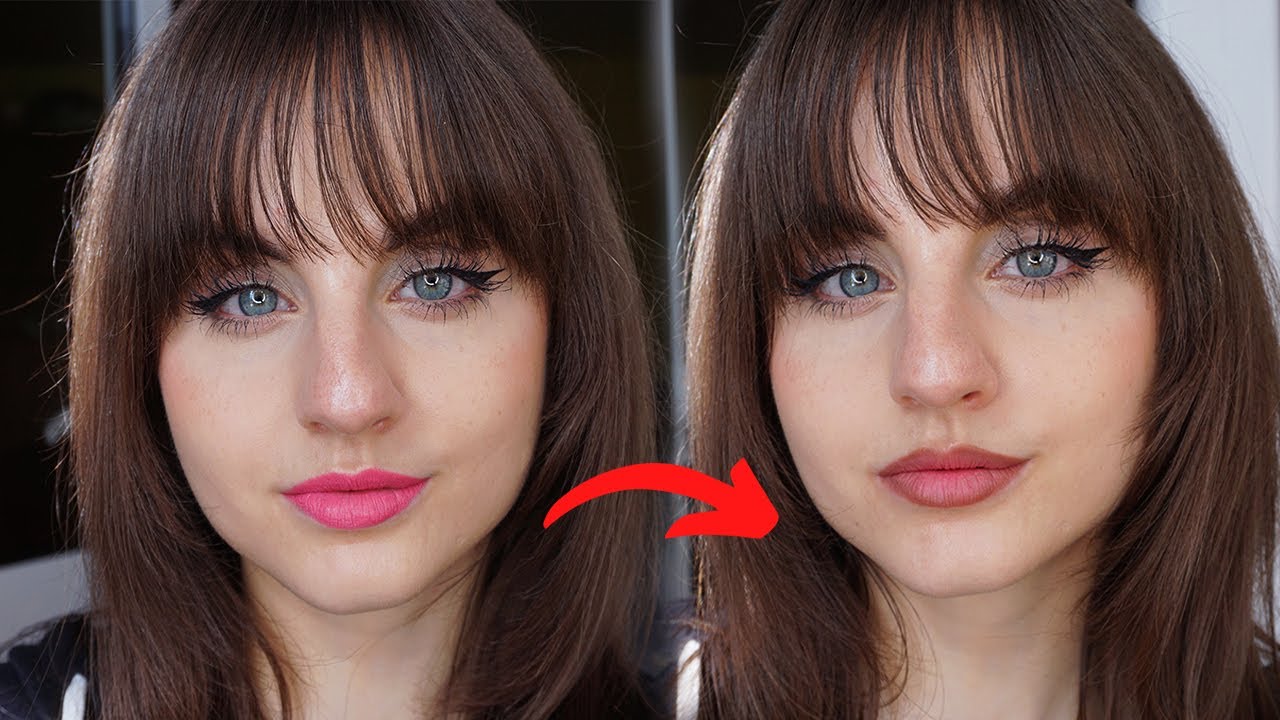
Most pink problems have a quick fix.
Pink that looks stark or sallow
Makeup artist Lisa Caldognetto told Marie Claire UK that a pink that looks stark usually clashes with the wearer’s undertone. The fix is moving to a different undertone family rather than giving up on pink.
Pink that makes teeth look yellow
Colgate says lipsticks with yellow, orange or gold undertones make teeth look yellower, while blue or purple undertones make them look whiter.
Dentist Dustin Cohen gave Who What Wear UK a quick way to check a shade. Rub it on the back of your hand or a white tissue and see whether it blends better with a true blue or a true yellow. Here is a full breakdown of which lipstick colors make teeth look whiter.
Artists disagree on nudes. Marie Claire UK, drawing on Max Factor’s Caroline Barnes, lists nudes and brown or orange-leaning shades as colors to avoid, while Charlotte Tilbury’s own guide says brown nudes work as long as they are not orange.
The common ground is orange. Colgate adds that if you have warm undertones and usually reach for a peachy blush, a bright pink blush can brighten teeth about as much as a bright red lipstick.
Pale pink on pigmented lips
Birchbox’s editor found that light pinks erase the natural lip line on deeper pigmentation. Tracing the lips with a liner a shade darker than the lipstick helps (Birchbox, 2015).
The Beauty Department suggests patting a little foundation over the lips with a sponge, then going back over with the lipstick. For more, see applying lipstick on dark lips.
Pink under office lighting
A 2010 Sowetan Live piece quotes etiquette coach Doris Msibi warning that a look that works in the bathroom mirror can turn harsh under fluorescent lights, so apply in natural light and check it before leaving.
The same piece says pink cheeks look muddy in an office, which contradicts Bloomberg’s 2013 advice to wear them. Check your own face under office light and decide.
Too much pink at once
SheerLuxe’s expert says pink works across the whole face if you decide where the main focus goes. Glamour South Africa’s Tom Pechuex adds that pink can read pretty or strong depending on how it is used.
A clown look is usually two or three focal points competing. Cut the extras until one is left.
FAQ about makeup looks with pink lipstick
Can I use pink lipstick as blush?
A creamy pink lipstick works as a cream blush, yes. Glamour South Africa advises dabbing it on the apples of the cheeks and blending, and W Magazine notes that a satin-finish lipstick can stand in for blush in a pinch.
Using the same shade on lips and cheeks makes the look read as one color.
How do I stop pink lipstick from feathering and fading?
Fill the whole lip with a same-shade liner before the lipstick. As the top layer wears off, a full liner base leaves an even tone instead of a bare center, per Superdrug.
For more fixes, see this guide to stopping lipstick from feathering.
How can I tone down a pink that is too bright?
Pat it on instead of swiping. Glamour South Africa suggests applying pink to the center of the lips and pressing it down for a soft finish, and a tissue blot lifts more, as Sowetan Live notes.
To soften the edges further, here is how to approach blending lipstick.
Why does the same pink look different on my lips than in the tube?
Your natural lip pigment shows through the lipstick, so one pink reads deeper, lighter or warmer from person to person. Birchbox’s editor found that a highly pigmented formula keeps her own lip color from showing, while a sheer one lets it mix.
Which Pink Lip Look to Try First

Start with the pink already in the makeup bag. Makeup looks with pink lipstick come together fastest when the shade you own picks the look, not the other way around.
Swatch the lipstick and sort it as cool, warm or neutral. Then pair it with one look, either sheer and quiet or bold with neutral eyes, and change a single cheek or eye detail per wear. Changing one variable at a time shows which choice is doing the work.
The catch is that the quiet version of a bright pink, or the sheer version of a nude pink, is the most forgiving first look and also the least dramatic.
If none of the pinks you own flatter you, picking a lipstick color is the next decision.
Advice verified October 2026. Trend-led looks such as Barbiecore and Y2K date fastest, and a new pink trend changes the shade names, not this sequence.

She started writing on the site after fielding the same questions from clients and friends often enough to just write the answers down: which red won't turn orange on a warm undertone, how to keep lipstick from feathering into fine lines, why a "12-hour" formula rarely survives dinner.
Every review on the site follows the same rule she uses with paying clients: wear it first, then decide if it's worth recommending.
- How to Make Eyeliner Last Longer Without Smudging - August 31, 2026
- How to Make Eyeshadow Last Longer All Day - August 29, 2026
- How to Find Your Undertone in 5 Easy Steps - August 27, 2026