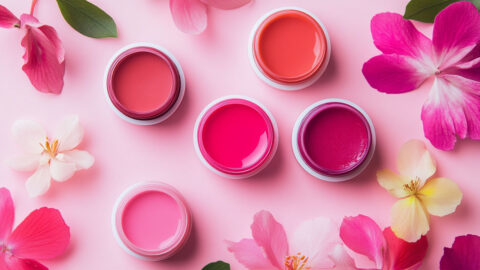
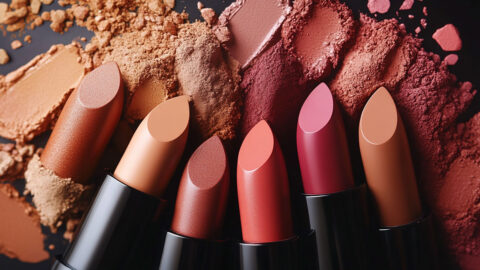
Nothing on the packaging will tell you much here. “Tint” and “lipstick” are marketing words, and what you actually get depends on what carries the color: wax and oil in a stick, water or gel in most tints.
A stick gives you a defined, opaque lip. A tint gives you a sheer flush that builds slowly and doesn’t ask for much aim.
The dye isn’t what separates them. A 1954 paper in the Journal of the Society of Cosmetic Chemists already lists D&C Red 27, now common on tint labels, among the staining colors added to lipstick. A long-wear stick and a tint can share a dye, and the formula around it sets how long the color lasts and how it feels.
What is the difference between lipstick and lip tint?
It mostly comes down to the base. Lipstick sits on the lips as an opaque, wax-based layer, while a tint is a thin liquid or gel that leaves a sheer wash you can build up.
Wear and feel change with that base, and so does removal.
| Attribute | Lipstick | Lip tint |
|---|---|---|
| Base | Waxes and oils in a solid bullet | Water, gel or emulsion, usually in a wand |
| Color payoff | Opaque, covers natural lip color | Sheer to medium, natural lip color shows through |
| Finish | Matte, cream, satin or glossy | Soft and skin-like, sometimes matte |
| Feel | More present on the lips | Light, often closer to a balm |
| Removal | Often needs a makeup remover | Usually wipes off clean |
The word “tint” has no fixed formula, and that trips people up. Tatcha and Jones Road Beauty both describe a sheer, hydrating, balm-like product, but Maybelline sells Super Stay Teddy Tint as a blurred matte tint, and The Creme Shop sells one water-based formula as both a tint and a stain.
Any comparison only holds up once you know which kind is in the tube. Some products labeled tint are closer to a tinted lip balm than to a stain.
What are lipstick and lip tint made of?

Open a lipstick and you’ll find wax and oil pressed into a bullet, with pigment mixed through. Tints are mostly water or gel carrying dissolved dye.
Lipstick base

Waxes hold the bullet’s shape and oils carry the pigment. Candelilla and carnauba add hardness and shine, though too much makes the stick brittle. Vegetable oils and esters work as emollients, wetting the pigment and softening the film. Castor oil is the one older formulas lean on (Cosmetics & Toiletries, 2015).
SpecialChem’s formulation guide (2007) puts total waxes at 15 to 25% of the formula, depending on melt points.
Color comes mostly from lake pigments such as D&C Red 7. Lakes do not dissolve in water, which is why formulators reach for them where color must not bleed, as in lipstick (FDA, as of October 2026).
For a closer look at individual stick components, this breakdown of what goes into lipstick formulas goes ingredient by ingredient.
Lip tint base

Water comes first on the tint labels from Essence, The Creme Shop and Zara.
Essence What a Tint is a water gel, with water, glycerin, propanediol and sodium hyaluronate near the top of the list. Their Hydra Kiss is an emulsion instead, adding jojoba and sunflower oils, squalane, iron oxides and titanium dioxide. Zara’s lip and cheek tint goes another way and pairs water and glycerin with alcohol and denatured alcohol.
The dye is usually CI 45410, sold as D&C Red 27 or 28. It appears on the Essence, The Creme Shop and Zara labels, while Dior’s Addict Lip Tint lists Red 7 and Red 33 instead (product labels, October 2026).
The more oils, iron oxides and titanium dioxide a tint carries, the closer it moves to lipstick. Plain water and dye stays sheer.
How does each product color the lips?

A lipstick leaves a film of pigment on the surface, and that film covers whatever color your lips already are. Tint works through dye, and whether the dye stays in a thin layer or soaks into the outer skin depends on the formula.
Sources don’t agree on this. Maybelline Australia describes a tint as sitting over the lip like lipstick, with stain being the product that sinks in, while The Creme Shop sells the same kind of water-based product as both a tint and a stain.
Both descriptions hold up, because the word isn’t standardized. A wax-free, watery product sinks in, and a thicker emulsion behaves more like a film.
Staining dyes aren’t exclusive to tints either. The Journal of the Society of Cosmetic Chemists (1954) lists D&C Red 27 among the halogenated fluorescein colors added to lipstick for a lasting stain. The carrier is what separates the two: a wax and oil film on one side, water or gel on the other.
On opacity, lipstick is the most opaque of the lip formats. Henne Organics puts stain in the middle, with more pigment than a tint and less than lipstick, and tint is a sheer wash that builds in layers.
Finish is mostly a lipstick variable. A matte formula gives a flat, high-pigment look with no shine.
A cream lipstick keeps the opacity but adds slip and a softer look.
Tints run sheer, matte or liquid (Jones Road Beauty, 2023), so the finish range is narrower and quieter.
Does lip tint last longer than lipstick?
Sometimes. It depends on whether the tint is a water-based stain or a balm-like gel, and whether the lipstick is a classic cream or a transfer-resistant formula.
Sources contradict each other here, and the contradiction follows the formula, not the category. IBA Cosmetics calls tint the low-maintenance color that lasts, while Tatcha says lipstick stays on longer than a tint, though not as long as a stain.
Wear claims also rest on small panels. Dior’s Addict Lip Tint claims 12 hours of transfer-proof wear from an instrumental test on 25 subjects (Dior product page, October 2026), and some retail reviewers report patchiness and transfer anyway.
Lipstick has its own test history. Revlon proved its Ultima II formula with a kiss test: apply, wait five minutes for the volatile oil to evaporate, then kiss the back of a hand, and 87% of panelists reported hardly a trace (Cosmetics & Toiletries, 2015).
Revlon then sold it as transfer resistant, not transfer proof, because the second phrase implies the color never comes off.
If a favorite stick fades by lunch, this guide to making lipstick last longer is a good next stop.
Which is better for dry or chapped lips?
Neither format wins by default. The ingredient list decides, because a cream stick or a gel tint with oils and humectants suits dry lips better than a matte film in either category.
Lips hold less water and lose more of it than cheeks and neck, according to a 2020 Applied Sciences study (Chirikhina et al.) that measured six facial areas.
Tints get oversold as the gentle option, and the marketing doesn’t agree with itself. Tatcha and Jones Road Beauty describe theirs as hydrating, but Henne Organics says most tints on the market do not moisturize. Alcohol-heavy formulas, like the denatured alcohol on Zara’s tint label, deserve a second look if your lips are chapped.
The label settles what the marketing copy cannot.
On the lipstick side the culprit is the film. A Cosmetics & Toiletries review (2015) notes that the long-wear polymers behind transfer-resistant sticks were not pliable and left a taut, mask-like feel with a matte finish.
If you love a matte finish anyway, there are ways of keeping lips moisturized under matte lipstick.
For chapped lips I’d skip matte and long-wear formulas entirely and pick a cream stick or gel tint with glycerin and oils near the top of the label.
Prep does more than formula here, so a steady lip care routine for dry lips comes before either product.
Is lip tint the same as lip stain or liquid lipstick?
No. They overlap on shelves and in marketing, but the color sits in different places and wears off in different ways.
| Format | Where the color sits | Best for |
|---|---|---|
| Liquid lipstick | On the surface, as a matte or high-shine film | Lipstick color with gloss-like comfort |
| Lip stain | Absorbed into the top layer of the lip | Color that survives cups and meals |
| Peel-off stain | Left behind as dye once the film is peeled away | Staying power when you have time to wait |
L’Oreal Paris and NYX Professional Makeup both describe this same split between a surface film and absorbed dye.
Liquid lipstick is the odd one out, since its color stays on top like a stick. This explainer on what liquid lipstick is covers the format in full.
L’Oreal Paris also says a stain gives the most color payoff of the three, because the dye is absorbed instead of layered on top. That sits awkwardly with the pigment ordering from Henne Organics cited earlier.
One reading is that the two measure different things, opacity at application versus color left after hours of wear. Neither source says so, so treat that as an explanation, not a finding.
Peel-off formats have their own failure mode. NYX Professional Makeup warns that the film must dry completely before peeling, or the finish turns patchy.
Comfort is the other catch. CVS notes that water-based stains tend to have a drying effect, which is why a hydrating balm pairs well with them.
Anyone still unsure what counts as a stain can start with this guide to what a lip stain is.
How do you apply and remove lipstick and lip tint?
Lipstick wants a steady hand. Tint is less fussy about aim, but you have to wait between thin layers.
Removal depends on how long-wearing the formula is, not on the category.
Applying lipstick
A loose hand shows. Maybelline Australia says lipstick needs more precision than a tint or a stain, and Thrive Causemetics ties the payoff to cleaner edges and a more defined lip.
- Outline first when the shade is dark
- Fill in from the center outward
Step-by-step detail lives in this guide to applying lipstick.
Applying lip tint
Exfoliate and hydrate first (Maybelline India). If lips are very dry, VE Cosmetics suggests applying balm earlier in the day and wiping off the residue before tinting.
Put a small amount in the center of the lips and blend outward with the applicator or a fingertip.
Keep layers thin and let each one dry fully before the next. Patchy color usually traces back to a layer that was still wet, according to VE Cosmetics.
Gel formulas set fast, and a MakeupAlley reviewer of theBalm’s Stainiac says the gel has to be blended in right away because it dries.
For the gradient look, keep the color in the center and diffuse it outward, as this guide to doing ombre lips shows.
Layering both
- Exfoliate gently and let a light balm absorb, then wipe off the excess
- Sweep on a thin tint layer and let it dry completely
- Blot once with a tissue
- Add lipstick on top, either all over or only along the edges for a gradient
- Finish with balm or gloss if the combination feels tight
The tint keeps the color even as the lipstick fades through the day, according to IBA Cosmetics.
Removal
Oil does most of the work. Jojoba, coconut or olive oil massaged over the lips will lift a lot of color, micellar water handles the stubborn long-wear stuff, and petroleum jelly left on for 2 to 3 minutes melts it.
MasterClass lists these removers for matte and liquid formulas and follows with an untinted balm.
Transfer-resistant sticks need more than a wipe. Procter & Gamble steered users to petrolatum or a dimethicone-based remover, and dedicated removers followed (Cosmetics & Toiletries, 2015).
Which color additives are allowed on lips?
Only colors listed for lip use. In the US, FDA lists each color additive by where it can go, and some colors cleared for external use are barred from lips.
FDA approves color additives, not finished lipsticks or tints (Cosmetics & Toiletries, 2015, quoting an FDA warning letter). So the lip-use listing of each color decides what is legal, whatever the product is called.
FDA’s cosmetics color table (current as of April 2022) caps D&C Red No. 33 and D&C Red No. 36 at 3% in lipstick products, and D&C Orange No. 5 at 5% in lipsticks. D&C Red No. 27 and Red No. 28, the dyes behind many tints, are cleared for lips but not for the eye area. Ferric ferrocyanide and ultramarines are the reverse, cleared for the eye area and not for lips.
Lime Crime learned that last rule the hard way. FDA’s July 29, 2015 warning letter said its Velvetines Liquid Matte Lipstick listed both colors, which 21 CFR 73.2299 and 73.2725 allow only in externally applied cosmetics, a term that excludes the lips (Cosmetics & Toiletries, 2015).
The brand called it a labeling error (Cosmetics Business, 2015). Either way, the ingredient list alone was enough to draw a warning.
The EU works from a positive list. Annex IV of Regulation (EC) No 1223/2009 names the permitted colourants with their areas of application and maximum concentrations, and some listed colourants are not for use near the lips or eyes (Cosmetics Europe, Cosmile database, retrieved October 2026).
A lip and cheek tint is fine on both, but keep it off the eyelids. Red 27 and 28 are not cleared for the eye area, so a tint built on them is not an eyeshadow.
What matters is the color listing, not the format.
Which should you choose, lipstick or lip tint?
Lipstick is the better choice when you want defined, opaque color that reads from across the room, and a tint covers the days when you’d rather have a soft flush with little effort.
Thrive Causemetics treats the two as roles in one routine, not rivals, and says a small mix on hand makes it easy to shift between polished and pared-back.
When lipstick is the better pick

Pick it when the lip is the focus of the look. Thrive Causemetics ties lipstick to a polished lip with cleaner edges.
The upside is opaque, defined color in the full range of finishes, and a clean outline if you apply it with care. Against that, it needs a steady hand and a mirror, and you’ll often need a remover at night. A wrong shade is obvious.
Shade is the main risk, so a guide to picking a lipstick color is worth a read first.
When lip tint is the better pick
Thrive Causemetics says tint suits days when comfort and flexibility come first.
| Pros | Cons |
|---|---|
| Goes on with little precision | Sheer, so deeper color takes layers |
| Light feel, often balm-like | Each layer must dry before the next |
| Easy to touch up | Formula quality varies widely by label |
Jones Road Beauty notes that a tint can be applied and touched up without a mirror.
When neither fits
If you want a sharp outline and all-day color, liquid lipstick sits between the two formats. And if you have no time to wait between layers, a gel tint or peel-off stain will go patchy, so a stick is the safer pick.
When the label lists colors without lip clearance, skip the product, whichever format it is.
Lipstick vs Lip Tint FAQ
Does lip tint stain lips permanently?
No. Stain-type dye sits in the outer layer of lip skin, which keeps renewing, so the color fades.
Oil-based removers lift leftover color sooner.
Why does a lip tint look different on the lips than in the bottle?
A sheer tint lets your natural lip color show through, so the two blend instead of one covering the other.
Swatch on bare lips, not the back of your hand.
Is Korean lip tint different from Western lip tint?
Partly, and mostly in style. Korean tints are best known as water-based stains for the gradient look, and Etude House’s Dear Darling Marker Tint lists water first and carries CI 17200 and CI 45410 dyes (Skinsort ingredient listing).
Western tints run from balm-like gels to matte formulas, so the label tells you more than the origin.
Can a lip and cheek tint double as blush?
Yes, when the label lists cheeks as an intended use. Use a very small amount and blend fast, since these formulas are highly pigmented (VE Cosmetics).
Keep it away from the eye area.
Which shades suit pale and deep skin tones?
Shade choice follows undertone, and the format changes the result. A lipstick shows as swatched, while a sheer tint shifts with your natural lip color.
For lighter complexions, start with these lipstick colors for fair skin.
Deeper tones have their own list of lipstick colors for dark skin.
How Long Lipstick and Lip Tint Stay Safe After Opening
The open-jar period printed on the label sets how long lipstick and lip tint stay safe after opening, not the product category. The EU requires that period once unopened durability exceeds 30 months (Regulation (EC) No 1223/2009, Article 19).
US law has no such rule. FDA states that nothing requires makers to print expiration dates on cosmetics.
Two Essence tints show the gap. The water-first What a Tint prints 6 months, and the Hydra Kiss emulsion prints 12 (product labels, October 2026).
Henne Organics notes that mostly-water stains need extra preservatives, which fits the shorter period.
Read the open-jar number, write the opening date on the base, and toss the product if the smell or texture changes.
The printed number leads because it is the only period the maker tested. Smell is the fallback when no number exists.
What happens past the limit is covered in this look at the side effects of expired lipstick.

She started writing on the site after fielding the same questions from clients and friends often enough to just write the answers down: which red won't turn orange on a warm undertone, how to keep lipstick from feathering into fine lines, why a "12-hour" formula rarely survives dinner.
Every review on the site follows the same rule she uses with paying clients: wear it first, then decide if it's worth recommending.
- How to Make Eyeliner Last Longer Without Smudging - August 31, 2026
- How to Make Eyeshadow Last Longer All Day - August 29, 2026
- How to Find Your Undertone in 5 Easy Steps - August 27, 2026