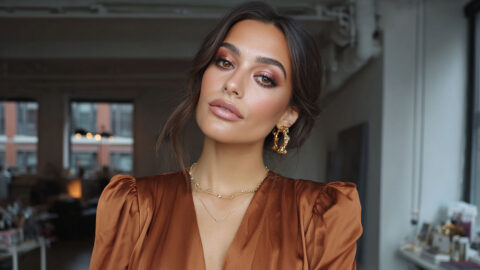
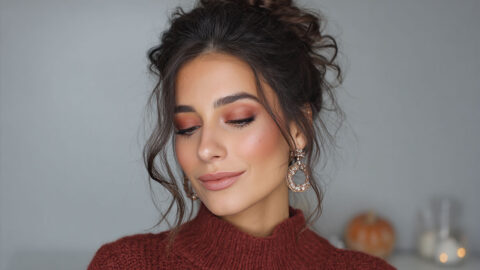
Natural makeup on brown skin usually goes wrong in the base. Too light or too cool, or just too much of it, and the face looks gray before the blush even goes on. A sheer base matched to undertone fixes most of that. Warm cream color and a little definition on the brows and lashes cover the rest, and nothing on the face should lighten the skin or hide it.
Brown skin runs from medium to deep and comes in warm, neutral, cool and olive undertones. The shade number follows depth, while the shade family follows undertone.
Sunscreen with iron oxide is hard to find. A Cureus catalog of 410 commercial sunscreens (2023) found only 1.7% of facial products paired iron oxides, which the American Academy of Dermatology ties to protection against dark spots, with broad-spectrum UV filters.
What makes a makeup look natural on brown skin?

Mostly restraint. A sheer base in the right shade and warm cream color on the cheeks and lips do the work, with only light definition on the brows and lashes. Nothing on the face lightens the skin or covers it.
“Brown skin” covers a lot of ground, from medium tan to deep espresso. Depth is how light or deep the skin is, and it sets the shade number on a base. Undertone is the color under the surface (golden, peach, red or olive). It sets the shade family and decides which blush and lip colors sit well.
At the deep end, makeup for dark skin follows the same sheer-and-matched logic. The color products just need enough pigment to register without turning bright.
Fitzpatrick or Monk: which scale helps with makeup?
Google released the Monk Skin Tone Scale on May 11, 2022, built with Harvard sociologist Ellis Monk. It has 10 shades, and Reuters reported that in a survey of around 3,000 people, a significant number said a 10-point scale matched their skin as well as a 40-shade palette.
Fitzpatrick’s scale is much older. Thomas B. Fitzpatrick created it in 1975 to dose UVA therapy, starting with four types and later extending it to six. It sorts skin by how it burns and tans, so it measures sun reactivity, not color (EyeWiki).
That blurs the differences inside brown skin, which is the gap Monk said his scale was designed to fix.
Foundation charts run on each brand’s own codes, so neither scale replaces a swatch. Monk is handy as a depth reference, and Google Images now lets users filter beauty searches by Monk shade to find tutorials on a similar skin depth.
How to find your undertone and match a base shade

Swatch the shade along the jawline and neck in daylight, then judge it after it dries down. A match disappears into the skin and reads no lighter, darker, yellower or pinker than the neck.
Undertone has to come first, because depth alone gives a shade that matches the number and misses the color. Matching makeup to your skin tone starts with deciding whether the skin reads golden, rosy or both, and that is worth settling before you open a single swatch. Here is the full walkthrough on Matching makeup to your skin tone if you want it.
How to read shade codes
On MAC’s chart, NC means golden undertone and NW means rosy, and the number gets higher as the shade gets deeper.
MAC’s own method for finding yours is simple. Take a bare-faced photo in natural light, blur it on your phone, and see which tone dominates. If both show up, that points to neutral.
Fenty Beauty launched its Pro Filt’r foundation in September 2017 with 40 shades and later grew the range to 50, according to Buro 247. Other brands widened their ranges after it.
When shade advice conflicts
A tip on a Sephora UK listing for MAC’s Studio Fix Powder Plus says to go for the lightest shade when in doubt. Maybelline India’s guide to flashback goes the other way and names a shade that is too light as a direct cause of it.
On brown skin the second advice holds. When torn between two shades, take the one that matches the neck and warm it up with color, rather than dropping a shade lighter.
Re-check the swatch after about 10 minutes, since a base that oxidizes darkens or turns orange.
Which sunscreen works under makeup on brown skin?
Go for a tinted, broad-spectrum sunscreen with iron oxide at SPF 30 or higher. On many days it can replace the base entirely. The AAD recommends tinted sunscreen with iron oxide for people with darker skin tones because iron oxide blocks visible light, a trigger for dark spots.
The AAD also notes that iron oxide is listed under inactive ingredients on the label, yet it adds protection against visible light and UVA.
A guide to tinted sunscreens summarized in the Journal of Clinical and Aesthetic Dermatology (May 2023) adds the spec. It wants UVA and UVB protection plus visible light coverage from 400 to 465 nm, with the shade chosen by tone and undertone.
Why mineral sunscreen leaves a white cast
Zinc oxide and titanium dioxide are white UV filters that sit on top of the skin (PLOS One, 2025). The same paper points out that no official method exists to quantify the cast.
Cast is only part of the problem. The Shyr abstract presented at the AAD found that discretionary face application left minimal whitening, which fits with people applying less product.
A June 2026 randomized trial in the Journal of Drugs in Dermatology reports that reduced application also cuts sunscreen efficacy. Johnson & Johnson Consumer sponsored the registered trial behind the earlier abstract (ClinicalTrials.gov), so both studies deserve that caveat.
Put together, the sunscreen that shows on brown skin is also the one that gets under-applied.
What each type gives up
Untinted mineral formulas leave a cast on deep skin and carry no iron oxide, and clear chemical gels avoid the cast but still give no visible light shield. Tinted sunscreen with iron oxide is the one that matches skin and blocks visible light. It costs more, though, and the shade range is small.
A few numbers from the research put that in perspective.
- Mineral sunscreens whitened dark skin 2.95-fold more than light skin across 96 participants (Shyr et al., AAD abstract, 2023).
- Only 6.0% of 385 sunscreens were tinted in a spring 2023 audit of six New York City stores, where 78.7% were traditional white and 15.3% were sheer (PubMed Central).
- Best-selling tinted sunscreens averaged an SPF of 38.8 vs 53.3 for non-tinted ones, at $15.4 versus $3.60 per ounce (Hamad et al., JAAD abstract, 2024).
- When brands were contacted about 37 tinted sunscreens, just 9.6% of those responding disclosed iron oxide concentration, with disclosed levels ranging from under 1.4% to 10.4% (Journal of Drugs in Dermatology, May 2026).
The last two figures are the real failure modes. Tinted formulas run lower in SPF on average, and most brands do not say how much iron oxide is inside. So read the ingredient list and pick the deepest shade that does not look ashy.
Skin prep before makeup then needs only a moisturizer and the sunscreen, rubbed in thoroughly so the tint does not streak.
Reapplication is the weak spot of any sunscreen worn under makeup. Topping up SPF over a finished face needs a formula that does not pill or lift the base.
Powder SPF can help with touch-ups and shine control, but it should not replace a properly applied sunscreen layer, since getting enough powder on the skin for the labeled protection is difficult.
Skin tint, tinted moisturizer or light foundation: which base looks most natural?
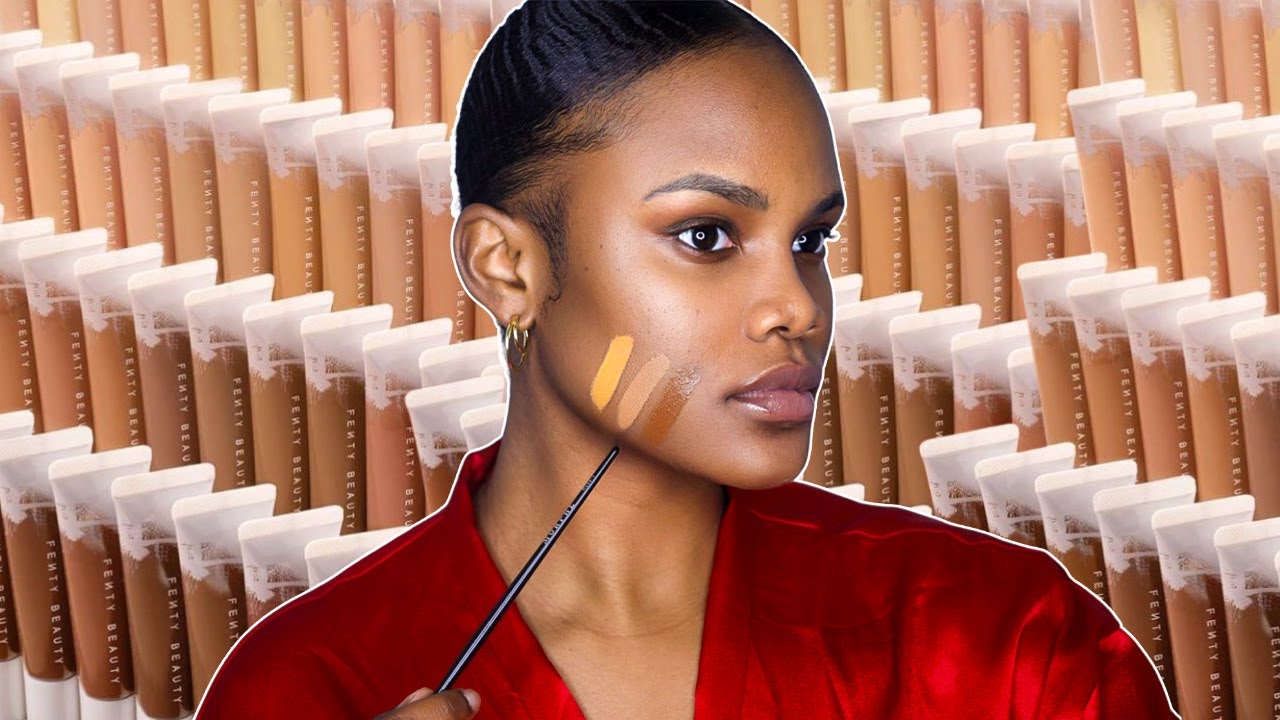
On even-toned skin a skin tint looks the most natural. Visible dark spots call for a light foundation, and tinted sunscreen covers the days when the only goal is to look rested. Tinted moisturizer sits between tint and foundation.
| Base | Coverage | Finish | Best for |
|---|---|---|---|
| Tinted sunscreen | Sheer | Skin-like | Even tone, daily wear |
| Skin tint | Sheer | Soft, dewy | Even tone, visible texture |
| Tinted moisturizer | Sheer to light | Hydrated | Dry or dull skin |
| Light foundation | Light to medium | Satin to matte | Dark spots, uneven tone |
If the category is new to you, here is a primer on what a skin tint actually is. Makeup.com by L’Oreal points to tints like the YSL Beauty NU Bare Look Tint as the lightweight alternative that leaves skin soft and dewy.
Texture should stay visible. The Fashion Spot’s guidance for darker skin is a sheer foundation or tinted moisturizer that lets natural texture show through while still evening the tone.
On deep skin, Bobbi Brown advises a foundation with warm, cinnamon tones and a shade check for any ashy or gray look.
Pros and cons by base type
Tinted sunscreen gives protection and base in a single step. Shades are few, and a mismatch is hard to hide. A skin tint keeps texture visible but does not hide dark spots.
Tinted moisturizer evens tone and hydrates, though sheer shades read ashy when the undertone is off. Light foundation covers spots and uneven tone, and it is also where a shade mismatch shows most.
Skipping the base is fine when tone is even and a tinted sunscreen is already doing the work. Dewy finishes raise flashback risk when paired with the wrong powder, according to Maybelline India.
Concealer: match the base, treat only spots
Concealer goes on only where tone needs help. Match it to the base on dark spots and blemishes, and keep it away from the rest of the face.
The test for a shade is whether it disappears next to the base. Choosing the right concealer for the under-eye is a separate decision, because that area needs a corrector first.
Cheek, eye and lip colors that look natural on brown skin
Warm cream color reads most natural. Peach, terracotta or deep berry on the cheeks, a lid shade close to the skin, and a lip somewhere in the nude-to-berry range all work. The goal is a flush that looks like it came from the skin.
Cheeks: blush, bronzer and highlighter

The Fashion Spot’s advice for a no-makeup look on darker skin is a cream blush that suits the undertone, applied with a very light hand, since bright colors look forced.
A tiny dot of Rare Beauty’s Soft Pinch Liquid Blush is enough for a natural flush, according to Refinery29. Joy (a muted peach) and Faith (a deep berry) are the kind of warm shades to start with.
Pressing cream blush into the skin with fingertips and tapping out the edges leaves no visible border.
Highlighter advice splits here. KIKO Milano’s brown-tones tutorial puts bronzer in the cheek hollows and highlighter on the cheekbones and the tip of the nose. The Fashion Spot says to skip highlighter on very deep skin because it looks forced, and otherwise to use it only on the tops of the cheeks.
The second advice gives the more natural result. A drop of highlighter mixed into the base gives the glow without a visible stripe.
Eyes and brows

- Many people with brown skin have lids darker than the rest of the face, so a lid primer evens them before any shadow (Brown Girl Magazine).
- In a Makeup.com tutorial, makeup artist Jonet Williamson sweeps a shimmering tan cream shadow across the lid and draws a V of deep brown at the outer corner, because brown defines without the drama of black.
- A dark liner pressed between the lashes defines the eye with no visible line (The Fashion Spot).
- Dark brown or clear brow gel tames strays without the hard edge of a pencil, and mascara finishes the eye.
Brown liner and shadow beat black for a natural look. Black stays on the tightline.
Lips
Most nude lipsticks fail brown lips by blending into them.
Mented Cosmetics co-founder KJ Miller described exactly that to Good Morning America, a shade “never tested” on brown lips. The brand launched in the spring of 2017, and co-founder Amanda Johnson said she had often mixed several colors to get a warm, non-ashy nude.
Picking a nude lipstick shade for brown skin starts at the warm end, anywhere from a pink with brown undertones to a deep chocolate brown. A liner one to two shades darker than the skin tone helps, and a gloss over the center softens the edge (Makeup.com).
Setting powder and spray: how to finish without flashback
Set only the T-zone and under-eyes with a powder close to the skin color, then add a film-forming spray if the look has to last. Powder is the step that most often breaks a natural look.
Powder: shade and ingredients
Maybelline India lists translucent powder among the causes of flashback, and Huda Beauty calls silica the worst offender, especially when baked.
L’Oreal Paris adds titanium dioxide and zinc oxide in concealer or foundation to that list.
Not every source agrees. Adore Beauty recommends RCMA No Colour Powder, a tint-free, two-ingredient powder of talc and silica, as a flashback-safe pick. Lab Muffin Beauty Science swatch tests found no obvious flashback from a silica-heavy powder, and little even from an SPF 50 CC cream with 9% titanium dioxide and 6.3% zinc oxide.
Flashback depends on the formula and the amount, not on one ingredient alone. Take a flash photo of any new powder before an event.
Choosing a setting powder comes down to shade first and the ingredient list second. For grey undertones, makeup artist Joni Lynne uses a yellow-toned powder (Ben Nye Banana Powder), per SAYS.
Spray: what it does and where it stops
Cosmetic chemist Ginger King describes setting spray as the face equivalent of a light-hold hairspray, a film-forming polymer that keeps makeup in place.
Too much spray backfires. Danh, quoted by House of Wellness, says an overdose leaves droplets that can start to remove the makeup underneath.
A light, even mist beats a soaked face, and misting setting spray correctly matters more than the bottle.
No independent wear-time data turned up. The hours printed on packaging are brand claims.
Natural makeup routine for brown skin, step by step

The order runs base, concealer, cream color, eyes, brows and lips, with powder and spray last. The short version skips most of that and goes base, blush, brows and lip.
Tools: fingers, sponge or brush
Makeup artist Barbara Daly told Beauty Bible that fingers work best for base because they warm it so it goes on smoothly.
A Beautyblender is used wet and squeezed out, then bounced on, and its pointed end reaches under the eyes and beside the nose. For a sheer base, applying makeup with a sponge in a bouncing motion deposits just enough pigment, according to retailer Dermstore’s description of the tool.
A fluffy brush is for powder only.
The steps
- Pat tinted sunscreen or skin tint over the face and neck.
- Conceal spots and under-eye darkness only.
- Tap cream blush onto the cheeks.
- Sweep bronzer outward from the cheek hollows, but only if the face looks flat.
- Prime the lids, then add one cream shadow shade.
- Tightline and apply mascara.
- Set brows with gel.
- Line the lips and add color or tint.
- Press powder on the T-zone and under-eyes, then mist lightly if needed.
Creams go before powders because powder over cream sets it, while cream over powder drags. Layering makeup in that order keeps each product where it was placed.
Add a step only when the skin asks for it. Even-toned skin can stop after the base, blush, brows and lip.
Fixing ashy cast, flashback, oxidation and under-eye darkness
Each of these has a different cause, so each takes a different fix.
| Problem | Cause | Fix |
|---|---|---|
| Ashy cast | Base lighter or cooler than the neck | Re-match the shade, add warmth with cream blush |
| Flashback | Silica, titanium dioxide or zinc oxide catching the flash | Dust off excess powder with a clean brush, mist lightly |
| Oxidation | Skin oils reacting with base pigments | Prime, then test the dry-down before buying |
| Under-eye darkness | Pigment, visible vessels or shadow | Corrector matched to the circle’s color |
Ashy cast is the grayish film from a base or powder that is lighter or cooler than the skin. White cast, covered under sunscreen, comes from the UV filters themselves.
Oxidation: why it happens and where sources disagree
Oxidation is a base darkening or turning orange after application. Maybelline India and Makeup.com blame skin oils reacting with the formula’s pigments, and Paula’s Choice Australia puts the shift at 1 to 3 hours after application.
Cosmetic chemists do not agree on the mechanism. Marie Claire reports one camp pointing to solvent evaporation and another to skin oils.
The practical fix is an oil barrier. Makeup artist Dominique Lerma recommends primer, and stopping foundation from oxidizing also means starting from cleansed skin, since residue and rich moisturizer speed it up.
This clashes a little with the shade advice above. Lerma tells shoppers to buy slightly lighter so the base lands on the right shade once it oxidizes, and Faces Canada suggests half a shade lighter for formulas that pull warm by midday.
That conflicts with the match-the-neck rule, and the dry-down test settles it. Drop a shade only for a formula you have watched darken, never as a default.
Lerma’s tip to avoid iron oxide applies to foundation. It does not cancel the AAD’s iron oxide guidance for tinted sunscreen.
Under-eye darkness: match the corrector to the color
Periorbital hyperpigmentation, the clinical term for dark circles, affects skin of color more than Caucasians worldwide, wrote Wendy Roberts in the Journal of Drugs in Dermatology (2014).
A Journal of Clinical and Aesthetic Dermatology review classes circles by color: pigmented (brown), vascular (blue, pink or purple), structural (skin-colored shadow) or mixed.
Brown, blue or purple circles need a peach to orange corrector, deeper for deeper skin. Shadow from a tear trough needs no corrector at all, only a concealer matched to the base.
A MAC artist told ASOS that warmer NW concealer tones help brighten dark circles.
When sheer coverage is not enough
Sheer coverage evens tone. It does not erase marks.
In a 2002 study cited by a 2010 Journal of Clinical and Aesthetic Dermatology review, acne left postinflammatory hyperpigmentation in 65.3% of African-American patients, 52.7% of Hispanic patients and 47.4% of Asian patients.
For many people a skin tint will not be enough, and the answer is spot concealer, not a thicker base across the whole face. The AAD adds that tinted sunscreen with iron oxide helps prevent new dark spots, which makeup alone cannot do.
Building coverage over marks is its own technique, and covering hyperpigmentation with makeup goes deeper on it.
Once the marks need more than spot concealer and a light foundation, the look stops being natural. Choose that coverage on purpose.
Common Questions About Natural Makeup Looks on Brown Skin
Do I need a primer for a natural look?
Not always. On oily skin a primer blocks oil from reaching the base, according to makeup artist Dominique Lerma at Makeup.com, while dry or even skin can often skip it.
If the base slides or turns orange by midday, using a primer is the first fix to try.
How should I adjust a natural look for oily or dry skin?
Oily skin needs an oil barrier under the base and powder only on the T-zone. Bobbi Brown’s guidance for combination skin is an oil-free formula with a light dusting of loose powder where shine shows.
Dry skin does better with tinted moisturizer and cream color, and the powder stays off the cheeks.
Which drugstore makeup works on brown skin?
SAYS shoppers with brown skin name Maybelline’s Fit Me foundation for shade match and wet n wild’s blush for a subtle flush. One of them calls Spicy Brown one of the few drugstore shades that matches her.
Deep shades are the weak point at the drugstore, so swatch in store before buying.
Can a natural look hold up for a wedding or flash photos?
Yes, with one check. Flash exposes flashback, so photograph the powder and any SPF base with a flash before the day.
A deeper lip and more eye definition move the look toward soft glam while the base stays sheer.
What is the clean girl look on brown skin?
It is the polished no-makeup style, with a sheer base, a cream flush, set brows and a glossy or tinted lip.
On brown skin the key is warmth. Brow gel stays dark brown or clear, and the blush leans peach or terracotta.
What to Buy First When Starting From Scratch
Start with a tinted sunscreen containing iron oxide in a matching shade, because it supplies sun protection and a sheer base for natural makeup looks on brown skin in one product.
After that, buy a cream blush in a warm shade, then a brow gel and a nude lip tint.
Sunscreen leads because it offers the fewest shades, so a wrong pick costs the most. Cream blush follows because one warm color changes the face more than any other product.
Brow gel and lip tint come last, since both are inexpensive and forgiving.
The sequence holds as of October 2026. It changes once brands widen tinted sunscreen ranges beyond a single tone and the base can be bought on shade match alone.

She started writing on the site after fielding the same questions from clients and friends often enough to just write the answers down: which red won't turn orange on a warm undertone, how to keep lipstick from feathering into fine lines, why a "12-hour" formula rarely survives dinner.
Every review on the site follows the same rule she uses with paying clients: wear it first, then decide if it's worth recommending.
- How to Make Eyeliner Last Longer Without Smudging - August 31, 2026
- How to Make Eyeshadow Last Longer All Day - August 29, 2026
- How to Find Your Undertone in 5 Easy Steps - August 27, 2026