Twiggy’s eyes get most of the credit for 60s makeup, though the decade started somewhere else entirely. Central Casting’s 2021 guide describes early 1960s looks as a continuation of late 50s styles, with red-pink lipstick, matte eyeshadow, winged eyeliner and heavy powder.
Mod and babydoll looks took over by the mid-1960s, and false lashes became one of the biggest style trends from that point.
What Defines 60s Makeup Looks?

The eye does the work, and the rest of the face stays quiet.
Eyes get dark crease lines, flicked or doubled liner and heavy lashes on top and bottom. Lips go nude, pale pink or peach, sometimes frosted. Skin is left mostly alone, with little to no contour, minimal blush and groomed brows.
The 50s ran the other way. Broadsheet’s 2026 decade guide lists sculpted brows and glossy red lips on porcelain skin for that era, then points to Twiggy’s black cut crease and pale pink lip as the break from it.
The 70s flipped the balance again. Graphic contrast gave way to glow and shimmer, which is its own story in these makeup looks from the 70s.
Youth drove the change. Mary Quant said she started her cosmetics line because the new clothes made the old makeup look wrong, according to Museum of London curator Beatrice Behlen’s essay for the V&A.
60s Makeup Looks by Period, From Early Glam to Hippie
Each look has its own window, and mixing them by accident gives a face that belongs to no year in particular.
| Look | Period | Eyes and lips | Reference faces |
|---|---|---|---|
| Early glam | Early 1960s | Flicked liner, matte shadow; red, coral or pink lips | Elizabeth Taylor, Sophia Loren, Audrey Hepburn |
| Mod and doll eyes | Early 1964 to mid-1967 | Dark crease over a pale lid, heavy lashes; nude or pale pink lips | Twiggy, Jean Shrimpton, Pattie Boyd |
| Smoky and sultry | Across the decade | Smudged, smoked liner; neutral lips | Brigitte Bardot, Edie Sedgwick |
| Hippie and psychedelic | Late 1960s | Vivid color, sheer base, sheen lips | Counterculture scene |
Early 60s glam
The decade opened by carrying the 50s forward. Upper liner got a flick, shadow was matte grey, green or blue, and heavy powder sat over the base. Lips ran from red through coral to pink.
Cleopatra changed the eye. Before the film, red lips with understated eyes were the trend, and Elizabeth Taylor’s heavy liner and bold shadow, along with her false lashes, pushed makeup toward the mod look, per the Elizabeth Taylor Archives (2024).
Revlon was already advertising Cleopatra-inspired color before the film opened in 1963. The Elizabeth Taylor Archives dates one such ad to 1961.
Mod and doll eyes

The mod eye was a dark line in the socket crease over a pale lid, with lashes on top and bottom. The lip stayed nude or very pale pink so the eye had the face to itself. Twiggy and Jean Shrimpton are the usual faces for it, with Pattie Boyd close behind.
The mod look peaked between early 1964 and mid-1967, according to Hair and Makeup Artist. Mary Quant Cosmetics landed inside that window, launching on 28 March 1966 after 18 months of development (V&A).
The first range had liquid eyeshadow and liquid eyeliner, plus a lip shaper pencil, Beauty Packaging reported in 2023.
Smoky Bardot-style eyes

Not every 60s eye was pale and graphic.
Brigitte Bardot wore smudged liner with a subtle nude lip. Edie Sedgwick went for a dark smoky eye, and black flicked liner became the Ronettes’ signature. The palette went darker still just after the decade, when Biba launched its cosmetics range in 1970 with sepia lipsticks and dark kohls, plus khaki eyeshadows, according to the V&A.
A modern version leans on a step-by-step smoky eye method, with the liner blended out and the lip kept neutral.
Late 60s hippie and psychedelic
Late in the decade, bases went sheer and lipsticks picked up sheen, per Central Casting. Heavy powder was out, and sheen lipstick sat next to matte ones.
Glamourdaze describes the counterculture palettes as vivid and psychedelic, which modern hippie makeup looks still borrow from. Pale lids gave way to color.
How to Create the 60s Eye: Winged Liner, Cut Crease and Pale Lids

A 60s eye needs a flicked or graphic liner and a hard-edged dark crease over a pale lid. Shadow color is up to you, pastel or vivid.
Winged and graphic liner
The single upswept wing carried over from the 50s. A double wing, two parallel lines, is one of the 60s graphic styles L’Oreal Paris lists. And then there’s the under-eye cat eye, drawn beneath the eye instead of above it.
The wing is the easy part to get wrong, and a winged eyeliner tutorial covers angle and line weight.
Where a hard edge looks wrong, kohl eyeliner gives a softer, smudged line. Twiggy’s eyes were kohl-rimmed, per i-D.
Cut crease and pale lids
Sources disagree on the crease color. Glamourdaze’s Twiggy breakdown draws a dark brown line with a brush, while Hair and Makeup Artist describes black.
Both agree on the edge. Hair and Makeup Artist shows hard-edged socket creases in early 1960s leaflets, such as a c.1963 Dorothy Gray piece, and Charlotte Tilbury describes a half-moon from inner corner to outer corner that creates the doll shape.
Put the pale lid down first so the line has something to contrast with, and keep the edge hard. Blended too softly, the line turns into ordinary shadow and the doll shape disappears.
Shadow colors
| Shade | Fits | Reference |
|---|---|---|
| Pale pastels, frosted | London mod lids | Glamourdaze |
| Matte grey, green, blue | Early 60s | Hair and Makeup Artist |
| Blue, purple, pink, green | Bright cut crease | Maybelline |
| Khaki | Biba’s darker palette (launched 1970, just after the decade) | V&A |
Brands of the era told women to match shadow color to eye color (Hair and Makeup Artist). Early kits also offered eye crayons and liquid eye makeup in a tube alongside powder shadow.
False Lashes, Mascara and Drawn Lower Lashes
Lashes were layered. The top ones were false, and the lower ones were mostly drawn on with liner.
Twiggy wore three layers of false lashes on top with the lower ones painted on, as CBS News described her look.
Strip lashes were cut to length, though individual sets existed too. Bottom lashes were drawn on in fine strokes or applied as false ones below. Materials included human hair and synthetics, along with animal hair such as sable, mink and seal (Hair and Makeup Artist).
A guide on how to apply false eyelashes covers placement along the lash line.
Max Factor’s Eye Talk adverts and Yardley’s lash range sold the look at the counter.
Mascara alone gets close. Makeup.com advises curling first and layering a thickening formula without combing through, because slight clumping looks more authentic. Several coats go on both lids.
Layering coats is where mascara application technique matters most.
Drawn lower lashes smear fast, so use a thin, waterproof liner.
How Did 60s Face Makeup Handle Base, Brows and Blush?
The face stayed out of the way. Skin was pale and powdered with thin rounded brows, and blush barely showed up, so the eyes had no competition.
Sources split on finish. Glamourdaze describes pale cream foundation under lashings of powder, and Maybelline’s guide rules out contour altogether, along with highlighter and bronzer, yet Charlotte Tilbury’s tutorial opens with a radiant complexion and adds lightly sculpted cheeks.
Central Casting gives the period aim: add glow to the face while the eyes pop. Tilbury’s radiant step reads as the modern version of that aim, not the period default.
For the base, think cream foundation and brightening concealer, with powder to set. The finish reads flat or chalky depending on setting powder technique.
Brows were thin and refined with a slight rounded arch toward the tail, per Makeup.com. Huda Beauty adds that the shape came from plucking more than penciling.
Weight varied by look. Hair and Makeup Artist puts Twiggy at the natural end and Elizabeth Taylor at the heavier end, and the heavier shape relied on a brow pencil.
Blush was sparing and soft, since blusher was not a main feature of the decade (Hair and Makeup Artist). Tilbury’s liquid babydoll blush step is an adaptation, not period practice.
Which Lip Colors Fit a 60s Look?
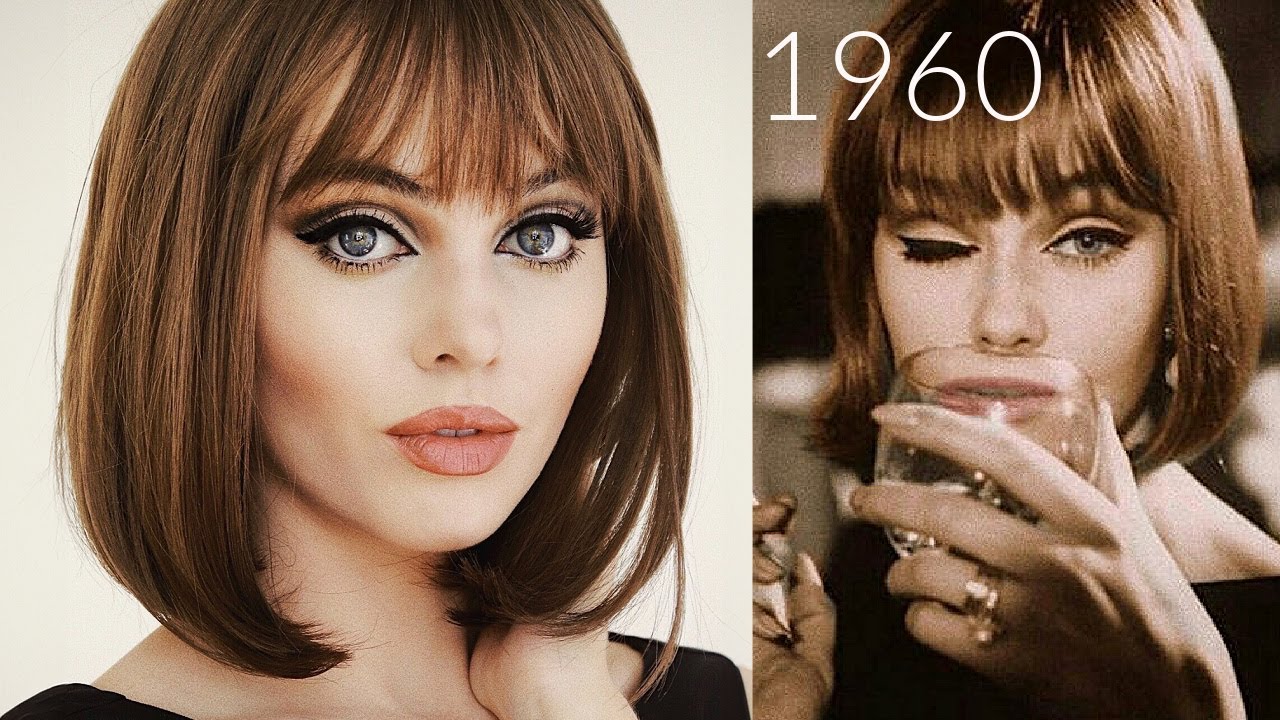
Matte pale pink or peach fits best, and nude works too, since the lip cannot compete with the eye.
Pale pink was the mod default beside heavy lashes. Peach ran warmer and was a Ronettes favorite per Woman & Home. Nude was the quietest option, built to disappear, and frosted or white sat at the stark end of the range.
Journalist Margaret Allen called the London look a “pale unmade-up look on the face and lips” in 1981, as quoted by the V&A. Matte was the default finish, according to Central Casting.
Frosted lips top L’Oreal Paris’s list of 60s looks, and it helps to know what frosted lipstick actually is before buying one.
Red is the contested shade. Maybelline says lips took a back seat to the eyes, while Glamourdaze notes that bold lips were popular too and that a nude or pale lip suits intense eyes.
The safe rule is one focal point. Heavy mod eyes get a soft lip, and a guide on how to pick a nude lipstick covers shade choice.
How to Do 60s Makeup Step by Step
Start with the base and work toward the eyes, then finish with lips and cheeks. This is the mod version.
Modern step order
- Even the skin with pale cream foundation and set it with powder.
- Shape the brows thin and softly rounded, with a small arch near the tail.
- Sweep a pale shadow across the whole lid.
- Draw a hard-edged line in the socket crease, in brown or black.
- Add a thin black line very close to the lashes, flicked or straight.
- Curl the lashes, then apply several coats of mascara, with a half-strip of false lashes at the outer corner for evening.
- Tip the lower lashes with mascara, and draw tiny lashes in for evening.
- Finish the lips in pale pink, peach or nude, matte.
- Add a touch of soft blush, nothing sculpted.
Sources order the eye differently. Charlotte Tilbury’s 11-step sequence starts with graphic liner and defines with shadow afterward, while Glamourdaze’s Twiggy breakdown builds the crease first and the thin black line second.
Either order works if the line stays steady, which comes down to basic eyeliner application.
Pale lids stay flat and even, and a refresher on how to apply eyeshadow covers the blending that keeps the crease line clean.
How a 1960 tutorial ordered the same steps
A 1960 educational film, “Makeup – Good Grooming for Girls” from the International Film Bureau, sequenced the routine as cleansing, powder, concealing blemishes, lips, brows, mascara and lash curling (Glamourdaze’s restored copy).
Lips came before brows and mascara, and no liner or shadow appears anywhere in the sequence.
That is a school-age day face, not the mod eye. Borrow its logic (skin first, lashes last) and leave its restraint behind.
Which 60s Look Suits You, and When Does It Fail?
What works depends on your eye shape and skin, and on where you’re wearing it. Hooded lids and pale lips on deeper skin are where it breaks most often, and heavy powder on dry skin causes trouble too.
By eye shape
Makeup artists disagree on hooded lids. Caroline Barnes tells Sheerluxe readers to forget the cut crease because contrast builds heavy intensity, while Makeup.com and L’Oreal Paris publish cut crease methods for the same eye shape.
Skipping it is the safer call, since hard contrast with little blending makes a hooded lid look heavy (Sheerluxe). Adapting works too. Draw the line slightly above the natural crease and wing the liner outward, not upward (Makeup.com, 2022).
Adapting keeps the look. A guide to makeup for hooded eyes covers placement beyond the cut crease.
By skin tone and skin type
Naomi Sims, who began modeling in 1966, founded a beauty business for Black women after stylists did not know what to do with dark skin and hair, according to theGrio (2013).
Pale creamy lipsticks can turn chalky on warmer, deeper complexions, so go a few shades darker, per Woman & Home.
Central Casting lists Diana Ross and Diahann Carroll among the decade’s trendsetters, along with Nancy Kwan. The look has reference points beyond Twiggy and Jean Shrimpton.
Dry skin does better with a light base than with the heavy powder of early 60s faces, and a guide to makeup on dry skin covers the prep.
By occasion
Purpose decides how far to push it.
Central Casting’s 2021 guide tells background actors that makeup varies by year, location and production, so the production’s own details override any general guide. It also advises adding more rather than removing, because adding is easier.
On a set or stage, follow the brief and match the year. For everyday wear, pale lips and graphic liner translate best, per Woman & Home.
FAQ About 60s Makeup Looks
Which 60s look is easiest to start with?
Early glam. It needs only a flicked upper liner, matte shadow, mascara and a pink or coral lip.
There is no crease line to steady and no drawn lower lashes to place.
What hair goes with 60s makeup?
Beehives and bouffants suit early and mid-decade glam, and the Ronettes paired black flicked liner with beehives.
The mod eye pairs with Twiggy’s cropped cut, shaped by Leonard of Mayfair in 1966.
How long does a full 60s look take?
No published standard time exists. The lashes are the slow part, since NPR (2017) noted that false lashes take effort for most people to apply.
Early glam runs faster than the full mod routine because it skips the crease line and drawn lower lashes.
Can you wear 60s makeup for Halloween?
Yes. Commit to one era and push the eye. A pale lid with a hard crease line and heavy lashes reads as mod at once.
Keep the lip pale so the eye stays the focal point.
How do you remove heavy liner and false lashes safely?
Soften the glue with warm water or eye makeup remover, then peel the strip off from the outer corner.
Drawn lower lashes in waterproof liner need a different approach, covered in a guide to removing waterproof makeup.
Wearing Just a Hint of the 60s

One hard-edged crease line over a pale lid signals 60s makeup looks when everything else stays plain. Add nothing until that line holds its edge.
After that, a pale pink, peach or nude lip and mascara on both lids are enough.
The order follows cost against payoff. The line takes the least effort and changes the face most, while false lashes take the longest to apply and the most practice.
The trade-off is proportion. Without lashes top and bottom, the face loses the doll shape and reads as modern graphic liner, not a period face.
Other decades offer their own single-element shortcuts, collected in these vintage makeup looks from other eras.

She started writing on the site after fielding the same questions from clients and friends often enough to just write the answers down: which red won't turn orange on a warm undertone, how to keep lipstick from feathering into fine lines, why a "12-hour" formula rarely survives dinner.
Every review on the site follows the same rule she uses with paying clients: wear it first, then decide if it's worth recommending.
- How to Make Eyeliner Last Longer Without Smudging - August 31, 2026
- How to Make Eyeshadow Last Longer All Day - August 29, 2026
- How to Find Your Undertone in 5 Easy Steps - August 27, 2026