Most people pick a lipstick for an outfit by holding the tube up to the dress and seeing whether the two get along. That settles the clothes. Your face is a separate matter, and it should get the first say.
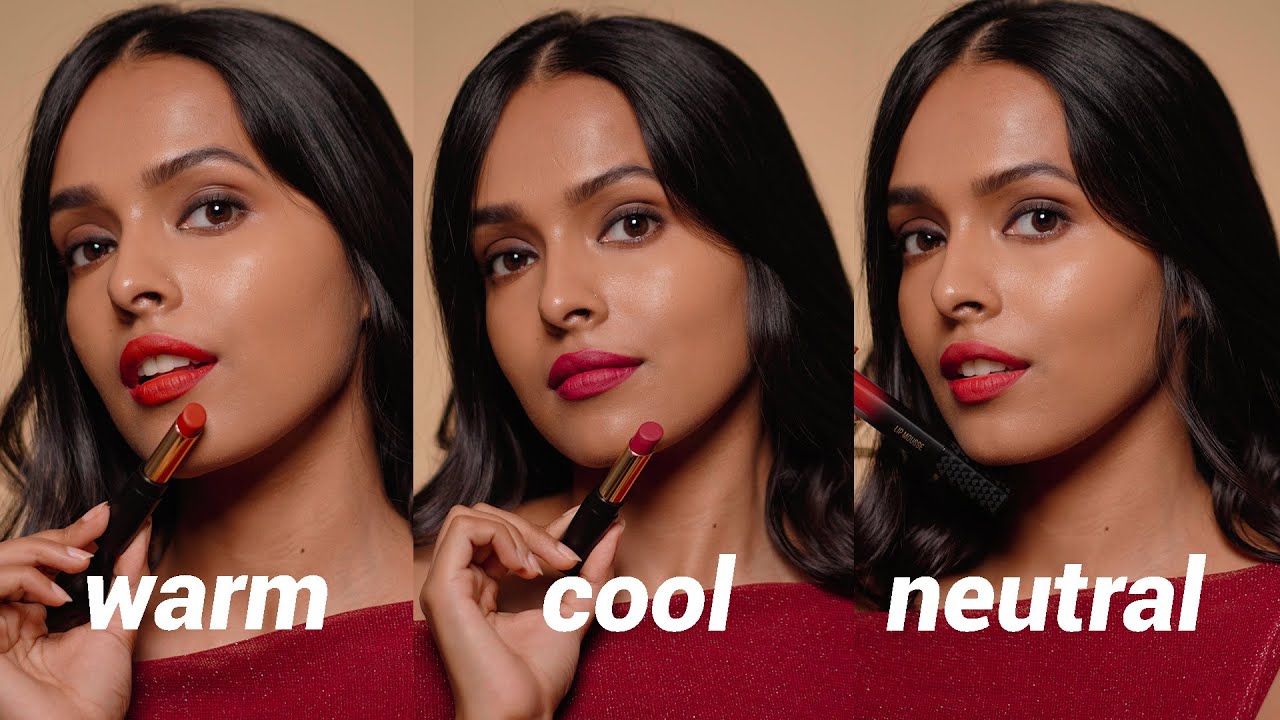
Undertone sets the shade family, and the garment’s color picks the shade inside it. Warm undertones suit coral, peach, terracotta and brick red, while cool undertones suit rose, mauve, berry and plum. From there you relate the shade to the clothes, either by contrast (complementary) or by staying close (analogous or tonal).
The lip changes the face it sits on, too. In the first experiment of a 2017 i-Perception study, redder lips made facial skin look lighter and darker lips made it look darker (Kobayashi, Matsushita and Morikawa, 2017). A shade chosen only for the dress shifts the complexion underneath it.
Should Your Skin Undertone or Your Outfit Decide the Lipstick Shade?

Start with skin. The outfit comes second, and all it does is choose among shades that already suit you.
Flip that order and the lipstick matches the dress while fighting your face.
Laura Mercier’s guide on pairing lipstick with outfits treats complexion as the filter, and says a shade that does not suit your natural coloring will not rescue any outfit. Red Apple Lipstick takes the faster route. Echo one color from the clothes or accessories and let the closet do the thinking.
Both hold up, just under different conditions. The outfit-first shortcut works because most people already buy clothes in colors that flatter their undertone, so a color pulled from the closet usually lands in a workable shade family.
It breaks when the outfit was not your pick. A bridesmaid dress, a uniform, a borrowed blazer. Those colors say nothing about what suits you.
Red Apple Lipstick adds one more test worth keeping. A clothing color you dislike on yourself will probably look wrong as a lipstick too.
Put together, the order I’d follow goes like this.
- Find your undertone and note two or three shade families that suit it.
- Read the outfit, which has either one dominant color or a print with several.
- Pick a pairing logic: complementary, analogous or tonal.
- Set the intensity from the occasion, softer for the office and fuller for the evening.
- Swatch the shade next to the outfit in daylight before you leave.
Choosing a lipstick with no outfit in mind is a separate skill, and a general guide on how to pick a lipstick color covers that groundwork.
How to Find Your Undertone and Shade Range

Do it in daylight. Look at the veins on your inner wrist, hold gold and silver jewelry against bare skin, and see how your face reads next to pure white fabric. When two of the three agree, that is your undertone.
| Undertone | Vein and jewelry result | Shade families that suit it |
|---|---|---|
| Warm | Greenish veins, gold flatters | Coral, peach, terracotta, brick red, warm brown |
| Cool | Blue or purple veins, silver flatters | Rose, mauve, berry, blue-based red, plum |
| Neutral | Mixed veins, both metals work | Nearly every shade, warm or cool |
| Olive | Warm or neutral base, green cast | Coral, rosy pink, brownish red, wine, nude |
Vein Test and Jewelry Test
On the inner wrist, blue or purple veins point cool, green veins point warm, and a mix points neutral.
With jewelry, whichever metal makes your skin look brighter and more even is your side.
The white cloth is the simplest. Hold it under your chin and see whether the skin turns golden or rosy next to it.
The vein test is the weakest of these, and I’d lean on it least. Sterling Style Academy explains that vein tint comes from how light travels through skin, so thin, translucent skin shows blue veins whatever the undertone, and it calls the test a preliminary step at best.
That same academy recommends the jewelry test instead, since it gives a result in real time across a range of skin tones.
Shade Families by Undertone
Warm undertones carry a golden base that leans yellow or orange. Coral, peach, terracotta and brick red sit in that range, and there is a longer list of lipstick colors for warm undertones if you want more options.
Cool undertones run pink and blue, sometimes violet. Rose, mauve, berry, plum and blue-based red belong there, and the same goes for the best lipstick colors for cool undertones.
Neutral undertones get the widest range. Red Apple Lipstick notes that either temperature works, so the outfit ends up doing most of the deciding.
Seasonal color analysis, popularized by Carole Jackson’s 1980 book Color Me Beautiful, treats undertone as one input of three. Each of its four seasons combines undertone, depth and intensity into one palette, according to the Color Me Beautiful brand.
How Skin Depth Changes the Shade
Undertone sets the hue, and depth decides how much of it your skin can carry.
On fair skin, soft pinks, peaches and rosy nudes read clearly, while deep wines can overpower. Medium skin gets the widest range, anything from nude to berry. Olive skin does well with corals, rosy pinks, wine and nude.
Deep skin carries saturated berry, plum and brown-red easily. Very pale nudes wash out.
How Color Wheel Pairing Works Between Lipstick and Clothes

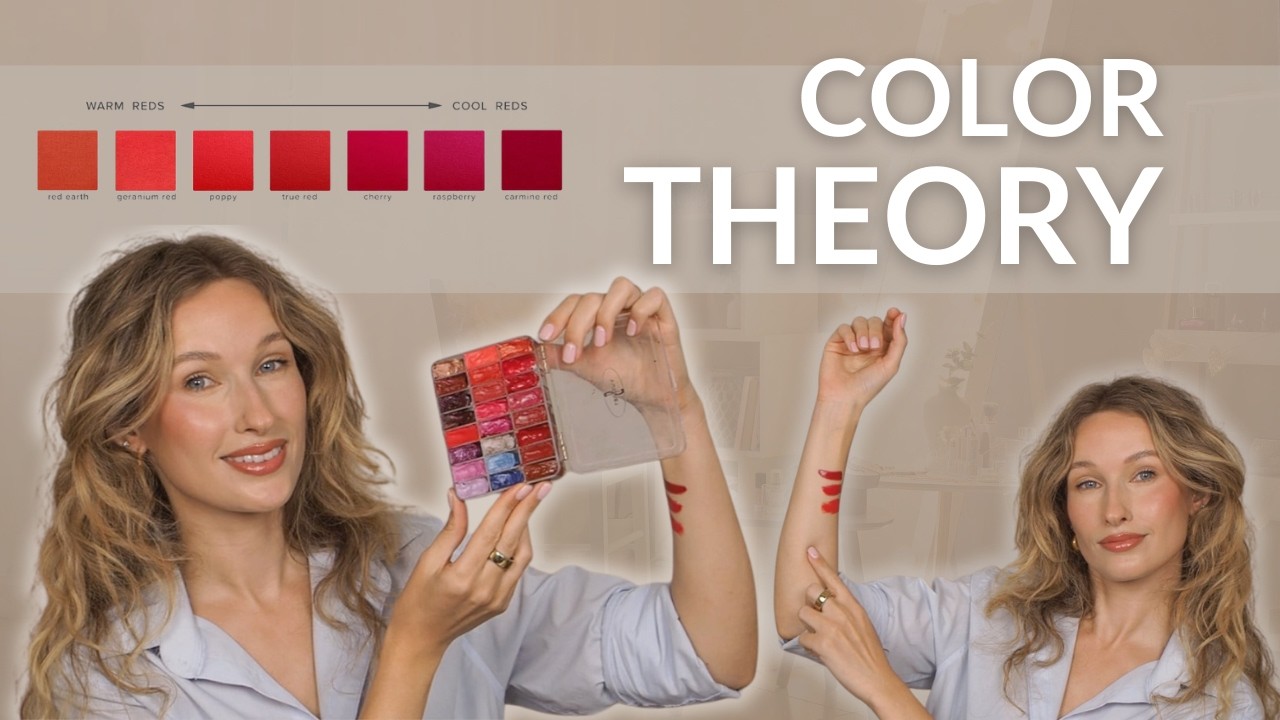
A complementary pairing puts opposite hues together for contrast. Analogous pairings use neighboring hues and tonal pairings stay in one hue at a different depth, and both of those read as harmony.
Colors also shift when they sit side by side. A 2020 paper in Scientific Reports describes simultaneous color contrast as a surround pushing the color of a central area toward the opposite hue.
WebExhibits notes the effect is strongest between adjacent complementary colors. In practice, the neckline, collar or scarf is the color to pair against, because it sits closest to the lips.
Complementary Pairing
The classic opposites are red and green, blue and orange, yellow and purple (WebExhibits). An orange or coral lip against a blue outfit is the textbook case, according to Current Boutique, though learning to wear orange lipstick well takes a little trial.
On the plus side, the lips become the clear focal point, the pairing looks deliberate, and it works best on solid-color outfits. The downside is that a complement in the wrong temperature clashes with the skin, and it overpowers a busy print.
Analogous and Tonal Pairing
Analogous pairing means neighboring hues, such as a coral lip with a peach or orange-red top. It is soft and low risk, but the lip can fade into the outfit.
Tonal is the polished one. Same hue family, different depth, like a wine lip with a burgundy dress. Land close but not quite right and it looks like a mistake.
Exact Match or Near Match
Practitioners split on this. Current Boutique reports that some makeup artists recommend a near-identical lipstick for red or pink outfits while others recommend a complement, and Red Apple Lipstick advises against matching exactly.
Makeup artist Veronica Chu frames it as a choice between complementary and exact, then adds a condition. If the lipstick runs slightly cooler or warmer than the garment, the match falls apart (Refinery29, 2015).
For most people a near match wins. A shade in the same family reads as intentional, while an exact match leaves no room for an undertone mismatch.
When an exact match is the goal, blending helps. For a burgundy lip to match a wine-colored dress, Chu suggested mixing CoverGirl LipPerfection Lipliner in Sophisticated with Colorlicious in Tempt Berry (Refinery29, 2015).
With a multicolor outfit, pick one color and echo it. Current Boutique suggests matching an accessory, since pairing a lip with a whole busy outfit rarely works.
What Lipstick Color Goes With Each Outfit Color?

Match temperature first, then hue. Warm outfit colors take warm lip shades, cool ones take cool, and black takes nearly anything.
Each table gives a warm-undertone and a cool-undertone option, because the same garment calls for a different shade on different skin.
Neutral Outfits
| Outfit | Warm undertone | Cool undertone | Safest pick |
|---|---|---|---|
| Black | Brick red, terracotta, coral | Blue-based red, berry, fuchsia | Any red |
| White | Peach nude, coral | Rosy nude, plum | Matte nude |
| Denim | Coral, warm brick | Raspberry, rose | Coral or rose |
| Brown and camel | Terracotta, cinnamon | Rosewood, mauve-brown | Tonal brown-red |
Faces Canada and Iba Cosmetics both treat black as the outfit that works with every lipstick shade.
White is a blank slate. Current Boutique suggests a matte nude or soft gloss for an elegant look and plum or purple for a playful one.
Bold and Saturated Outfits

Red on red is the pairing people ask about most. Laura Mercier’s guide advises against defaulting to it, partly because finding an exact match for the dress is tricky, and the lipstick options for a red dress run wider than red alone.
Blue splits by depth. A bright cobalt takes a matte beige lip with clear gloss or a creamy mauve (Laura Mercier), while navy and other dark, rich colors suit a deep wine (Swiss Beauty), and a separate guide covers what to wear on the lips with a blue dress.
| Outfit | Warm undertone | Cool undertone | Pairing logic |
|---|---|---|---|
| Red | Terracotta nude, warm coral | Rosy nude, soft berry | Neutral lip, or a red of the same temperature |
| Blue | Coral, peach | Mauve, wine | Coral as the complement, wine for navy |
| Green | Brick, terracotta | Berry, deep rose | Red family as the complement |
| Yellow | Coral, warm nude | Plum, soft mauve | Purple tones as the complement |
| Pink | Peach-pink, coral-pink | Rose, cool pink | Stay in the pink or nude family |
Earthy colors such as rust, olive and dull mustard are the hardest to pair. Faces Canada suggests dark lip shades for muted, earthy outfits and warm lip shades for warm-toned outfits.
Patterned Clothing
Echo one color from the print, an accent rather than the background.
With a loud print, keep the lip natural, which is how Current Boutique handles animal print. Pastel florals take pink-toned or nude lips, a pairing Iba Cosmetics and Faces Canada both recommend.
When the print has no clear accent color, a nude lip is the safe default.
Which Lipstick Finish Suits the Outfit?
Matte carries the most pigment and the longest wear. Satin and cream give up some of both for comfort, and gloss or sheer formulas carry the least color.
Pick the finish by the outfit’s formality, then the shade.
| Finish | Look | Suits | Trade-off |
|---|---|---|---|
| Matte | Flat, shine-free, high pigment | Long days, formal events | Can feel drying |
| Satin | Soft sheen, creamy | Everyday, office | Less opaque, builds in layers |
| Cream | Between gloss and matte | Dry lips, daytime | Wears off sooner than matte |
| Gloss or sheer | Shine, light color | Casual outfits | Little color payoff |
The differences come from the formula. Masterclass explains it this way: matte has low oil and high staying power, cream carries more wax, and sheer formulas carry more oil.
Brands disagree on what matte signals. Elizabeth Arden sells it as the statement finish, while Maybelline’s UK guide calls it the flatter, more low-key option and satin the eye-catching one.
Both descriptions hold once shine is taken out of the picture. The matte versus satin choice decides how much light the lip reflects, so a matte nude stays quiet and a matte red stays loud.
For a long event, matte gives the longest wear (Houston Life). Dry lips are more comfortable in satin or cream, and casual outfits can take a sheer finish.
A lip stain leaves a wash of color rather than a block of it. That suits an outfit that already has plenty going on.
Bold Lip or Soft Lip: How to Balance the Look
Let one element carry the look. A quiet outfit takes a bold lip, and a loud outfit takes a soft one.
That split comes from Swiss Beauty’s styling guide. A dense print counts as a statement too, so it gets the soft lip.
Eye makeup is where the balance usually breaks. Sandy Linter told AARP that a bold, dark or bright lip needs little eye makeup, and that a face loaded with strong eyes and strong lips looks overdone.
Rae Morris agrees that defining one feature looks more elegant, though she allows smoky eyes with a red lip on occasion. QC Makeup Academy’s guideline is looser, with a cap of two focal points.
The sources converge on the failure case, which is two features at full strength. Two focal points work when one is at full intensity and the other is diffused.
For a red lip, there is a separate guide to eye makeup for red lipstick. Flip the look and keep the lip neutral if the eyes lead, and the walkthrough for smoky eye makeup covers that side.
Before you leave the house, QC Makeup Academy’s Nathan Johnson cites the old Chanel rule of taking one thing off. If the look feels crowded in the mirror, remove the loudest element.
How the Occasion Changes the Lipstick Choice
Office looks do best with a muted rose or neutral in a semi-matte finish. Daytime and casual days suit sheer color, a tinted balm or a stain. Evenings go deeper and higher in pigment, with wine, berry or red. A wedding guest should lean neutral, with berry or rose.
For work, makeup artist Chantal Moore keeps a semi-matte neutral or rose-toned lipstick ready for last-minute meetings (Bustle). Julianne Kaye allows a brighter lip if the workplace suits it and the rest of the face stays balanced.
Etcoff and colleagues tested this kind of restraint in PLoS ONE in 2011, using 100 photos of 25 women. With unlimited viewing time, the natural, professional and glamorous looks all raised ratings of attractiveness and competence, while the effect on likability and trust varied by look. The natural look raised both, the professional look raised likability only, and the glamorous look lowered trust.
On a casual day, a tinted lip balm keeps the lip quiet next to a printed or colorful outfit.
Evening is where pigment goes up. Beauty entrepreneur Alison Jade likes a wine-stained lip for night-time, and the steps for makeup for a night out pair a deeper lip with a lighter eye.
Wedding Guest Outfits
Makeup artist Daniel Thompson wrote in 2014 that guests should never outshine the bride, which for him rules out red lipstick, glitter and dramatic effects. Oriflame’s guest guide goes the other way. It says a neutral base with bare eyes and a bold lipstick works, and it names the season’s bold reds.
The two camps also split on palette. Thompson says to echo the bride’s wedding colors, while David’s Bridal says guests do not need to match them exactly.
David’s Bridal’s own rule is to coordinate with the outfit’s undertones rather than match, and to keep lips neutral under a bold dress. A classic berry or rose is the middle path when the dress code and bridal palette are unknown.
When Matching Lipstick to an Outfit Does Not Work
Matching goes wrong when the garment’s color sits on the wrong side of your undertone, when nothing you own is near the garment’s color family, or when the shade reads differently under the light where you’ll wear it.
In the first two cases, follow the skin. Keep the lip in your undertone, drop to a nude or sheer finish, and let the outfit be a background.
The light problem is the one people miss. Sixty participants in a Frontiers in Neuroscience study (2023) judged 15 lipsticks worn by 3 models under 5 light sources spanning 2,500 K to 6,500 K.
Light source significantly shifted color preference and purchase intention. Ratings of the same lipstick on lips and on forearms showed no significant correlation, so swatch on the lips and check the shade near a window and under the venue’s indoor light.
| Problem | Fix | Source |
|---|---|---|
| Too dark for the outfit | Shimmery or nude gloss on top | Lynsey Buckelew, Red Apple Lipstick |
| Too pale, face looks washed out | Sheer reddish-brown in thin layers | Suzy Gerstein |
| Too warm | Cool pink gloss on top | Suzy Gerstein |
| Not enough punch | Liner over the lipstick | Suzy Gerstein |
Gerstein and Buckelew gave these fixes in a Refinery29 feature on rescuing the wrong shade. A gloss over lipstick is the quickest of them, and a nude gloss softens a dark shade without changing its undertone much, per Red Apple Lipstick.
Makeup artist Lexi Swain adds an order of operations for layering. Apply the matte shade first and the cream or gloss second, because matte adheres better and lasts longer (The Zoe Report).
When no single shade works, blending two lipsticks builds the missing one. Work in thin layers so you can stop before it gets too much.
Lipstick Color Matching FAQ
Does nude lipstick go with every outfit?
Yes, as long as the nude sits in your undertone. A peachy nude that suits warm skin looks flat on cool skin.
The right one works as a default with pastels, white and busy prints, and a guide on how to pick a nude lipstick covers the undertone check.
Which lipstick goes with a purple or orange outfit?
Orange takes a red in your undertone, according to Faces Canada. Purple takes a tonal plum or mauve, or a soft nude when the purple is bright.
There is a fuller breakdown of lipstick for a purple dress if you need more shades.
Does lipstick need to match nail polish?
No. Nails sit far from the face, so the outfit and your undertone carry more weight.
When both are bold, keep them in one color family and let one lead.
Do you need lip liner with a bold shade and a statement outfit?
Yes. Makeup artist Jemma Kidd recommends a waxy liner in the lipstick’s color for a bolder lip, since it holds the shade in place and sharpens the edge.
Match the liner to the lipstick, not to the dress.
Building a Small Lipstick Set That Covers Every Outfit
A nude, a berry or rose, and a red, each in your own undertone, cover most lipstick color matching.
Buy the nude first, since it works with the widest range of outfits. Berry or rose comes next for dark colors and evenings. Red goes last, for black and neutral outfits.
Red goes last because it demands the most precision. A red in the wrong temperature fights the skin and the garment alike, and a guide to choosing a red lipstick picks up from there.
The catch is exactness. A small set gives near matches rather than exact tonal ones or sharp complements, which take a fourth lipstick or a blend.
A shade that reads differently near a window and under indoor light stays out of the set.

She started writing on the site after fielding the same questions from clients and friends often enough to just write the answers down: which red won't turn orange on a warm undertone, how to keep lipstick from feathering into fine lines, why a "12-hour" formula rarely survives dinner.
Every review on the site follows the same rule she uses with paying clients: wear it first, then decide if it's worth recommending.
- How to Make Eyeliner Last Longer Without Smudging - August 31, 2026
- How to Make Eyeshadow Last Longer All Day - August 29, 2026
- How to Find Your Undertone in 5 Easy Steps - August 27, 2026