Your concealer is not the problem. The discoloration underneath it is.
A color corrector is the pre-foundation step that most people skip, and it is exactly why dark circles still show through, redness bleeds into foundation, and hyperpigmentation looks grayish no matter how much product goes on top.
Color correction uses basic color theory to neutralize unwanted skin tones before you apply anything else. Green cancels redness. Peach and orange cancel dark circles. Lavender cancels dullness.
This guide covers what color correctors are, how they work, which shades target which skin concerns, and how to use them in both everyday and professional routines.
What Is a Color Corrector

A color corrector is a tinted makeup product used to neutralize unwanted undertones in the skin before applying foundation. It does not match your skin tone. That is the whole point.
Unlike a skin-toned concealer, which adds coverage to mask discoloration, a color corrector cancels out the discoloration using opposing pigments. The two products serve entirely different purposes in your routine.
Key distinction: concealer covers, color corrector neutralizes.
Color correctors come in green, peach, orange, yellow, lavender, and red. Each shade targets a specific skin concern. The logic behind each shade comes from color theory, specifically from how complementary colors interact on the color wheel.
| Product | What It Does | Skin Tone Match? | Goes Under Foundation? |
| Color Corrector | Neutralizes discoloration | No | Yes, always |
| Concealer | Covers and matches skin | Yes | After foundation |
| Foundation | Evens overall skin tone | Yes | Applied over corrector |
Color correctors are applied to specific areas only, not all over the face. Think of them as a targeted, pre-foundation fix for dark circles, redness, hyperpigmentation, and similar concerns.
Available in cream, liquid, stick, and powder formulas, they work in both professional kits and everyday routines. Brands like Ben Nye and RCMA have included color correctors in their professional lines for decades. Mainstream options from Maybelline and NYX have brought the technique into everyday use.
How Color Correction Works

Color correction works because of one principle: opposing colors on the color wheel cancel each other out when layered. This is not a beauty trend. It is basic color theory applied to skin.
The color wheel groups hues into complementary pairs. Red and green sit opposite each other. Blue and orange are opposites. Purple and yellow are opposites. When you layer one over the other, the two tones neutralize into a more balanced, neutral shade.
Applied to skin: a green corrector layered over red acne cancels the red, leaving a neutral base for foundation to sit on top of.
The corrector sits between your skin and foundation, not on top of your makeup. Foundation then goes over it, with no visible tint from the corrector beneath. The goal is to use a thin enough layer that it neutralizes without building up.
Pigment concentration matters a lot here. Too much product causes the corrector to show through as a tint under foundation. This is the most common mistake. A little goes a long way, and that applies to every formula and shade.
Warm tones neutralize cool tones, and cool tones neutralize warm ones. Green is cool, red is warm. Orange is warm, blue is cool. Once you understand this, picking the right corrector becomes significantly easier.
Color Corrector Shades and What They Target

Each corrector shade has a specific job. Using the wrong one does nothing, or worse, makes the discoloration look different instead of better. Shade selection comes down to what color you are trying to cancel and your skin tone.
| Shade | Cancels | Best For | Skin Tone |
| Green | Red | Acne, rosacea, redness | All skin tones |
| Peach | Blue/purple | Dark circles | Fair to medium |
| Orange | Blue/purple | Dark circles, hyperpigmentation | Medium to deep |
| Yellow | Purple | Bruises, veins, mild dark circles | Fair to medium |
| Lavender | Yellow | Sallowness, dullness | Fair to medium |
| Red/brick | Deep blue-gray | Dark spots, post-acne marks | Deep skin tones |
A 2023 study published in the Pakistan Journal of Medical and Health Sciences found that around 80% of young adults showed signs of infraorbital hyperpigmentation. That is a lot of people who could actually benefit from a peach or orange corrector under their concealer.
Post-inflammatory hyperpigmentation (PIH) was reported as the most common past skin concern in a 2025 study, affecting 66.2% of respondents. This kind of discoloration, typically dark, brownish spots left behind by acne, often responds well to orange or red-toned correctors depending on the depth of the mark.
Choosing the Right Shade for Your Skin Tone
Fair skin: pink or light peach for dark circles, yellow for purple tones, lavender to brighten dullness. Green works for redness across all skin tones.
Medium skin: peach for dark circles, orange for deeper spots, yellow for bruising.
Deep skin tones: true orange or red correctors for dark circles and post-acne marks. Peach is too light and will look ashy or muddy.
The most frequent mistake here is using a green corrector on dark circles. Green cancels red, not blue or purple. Dark circles are almost always in the blue, purple, or gray family. Picking green for that job will not work.
Color Corrector vs. Concealer

These two products get mixed up constantly. They are not interchangeable, and they are not the same thing with different pigments.
Concealer is skin-toned. It is designed to match your complexion and add coverage on top of problem areas.
Color corrector is not skin-toned. It is intentionally an opposite hue, meant to cancel the discoloration before anything else touches the skin.
You can use a concealer without a color corrector. Plenty of people do. But if you have stubborn dark circles, visible rosacea, or post-acne hyperpigmentation, a concealer alone often leaves a grayish or ashy residue because the underlying tone was never properly addressed. Layering skin-toned coverage over a blue or purple tone often just creates a muted, chalky result.
The corrector solves the problem at its source. The concealer then has less work to do, meaning you need less product and the finish looks more natural.
Some products are marketed as “color-correcting concealers.” These are hybrid products that combine a subtle corrective pigment with skin-matching coverage. They can work for mild discoloration. For anything more pronounced, a dedicated corrector is the better choice.
When covering hyperpigmentation with makeup, using a separate corrector and concealer in two distinct steps usually gives a more controlled result than any hybrid formula can deliver on its own.
How to Apply Color Corrector

Application order matters. Color corrector always goes on after skincare and makeup primer, and always before foundation. Not after. Not mixed in with it. Under it.
Use a small, precise brush or your fingertip for targeted areas. Do not apply it with the same sponge you blend foundation with. The corrector needs to stay where you put it, not spread across the face.
Tap, do not rub. A tapping or patting motion prevents streaking and keeps the product sitting on the skin surface rather than spreading unevenly.
Apply the minimum amount needed. Build slowly. With color correctors, less product almost always looks better. Overapplication causes the corrector color to show through foundation as a visible tint.
Let it set for 30 to 60 seconds before going in with foundation. Some people lightly dust a translucent setting powder over it before foundation as well. This keeps the corrector in place and stops it from moving when you blend foundation on top. The step-by-step guide on applying color corrector covers this in more detail.
Layering Order in a Full Makeup Routine
The layering sequence is not optional. Get it wrong and the corrector either disappears entirely or shows through your base as a strange tint.
- Skincare (moisturizer, SPF)
- Primer
- Color corrector (targeted areas only)
- Foundation (applied over corrector)
- Concealer (for anything still showing)
- Setting powder
The full makeup layering process follows this same logic across every product category: prep first, correct second, cover third, set last.
When applying foundation over a color corrector, use a stippling or dabbing motion rather than dragging. Dragging a brush or sponge sideways can shift or remove the corrector underneath before it has fully done its job.
Color Corrector Formulas and Textures

Formula choice is not just about preference. It affects how much coverage you get, how easily the product blends, and whether it holds up under foundation without shifting.
Cream: highest pigment concentration, best for targeted and pronounced discoloration. The go-to choice in professional kits from brands like RCMA and Mehron. Needs a light hand.
Liquid: easier to blend, more forgiving with application. Better suited for everyday wear where you want a lighter touch on mild discoloration.
Powder: the lightest coverage of all three. More useful as a subtle color-balancing layer or setting product than as a corrector for visible concerns.
Stick: portable and precise. Good for spot application on the go. Formulas vary significantly between brands, so check the consistency before committing.
Palettes give you flexibility to mix shades. A single corrector in one shade is more precise and easier to control, which is why professionals often prefer individual products over palettes when working on specific concerns.
Formula matters more for certain concerns than others. Rosacea or widespread redness responds better to a cream formula that can be applied evenly across a larger area. Dark circles under the eyes, where the skin is thinner and more delicate, usually do better with a liquid or lightweight cream that does not crease or settle into fine lines.
The global concealer and color cosmetics market was valued at over USD 86 billion in 2024 (IMARC Group), reflecting how mainstream corrective base products have become across all skin care and makeup routines worldwide.
Color Corrector for Different Skin Concerns
Skin concerns are not interchangeable, and neither are the correctors for them. The same product that fixes rosacea redness will do nothing for a bruise, and the peach corrector that works on fair skin dark circles will look chalky and muddy on deeper skin tones.
Picking the right corrector starts with identifying the actual color of the discoloration, not just the concern category.
Redness from Rosacea and Acne
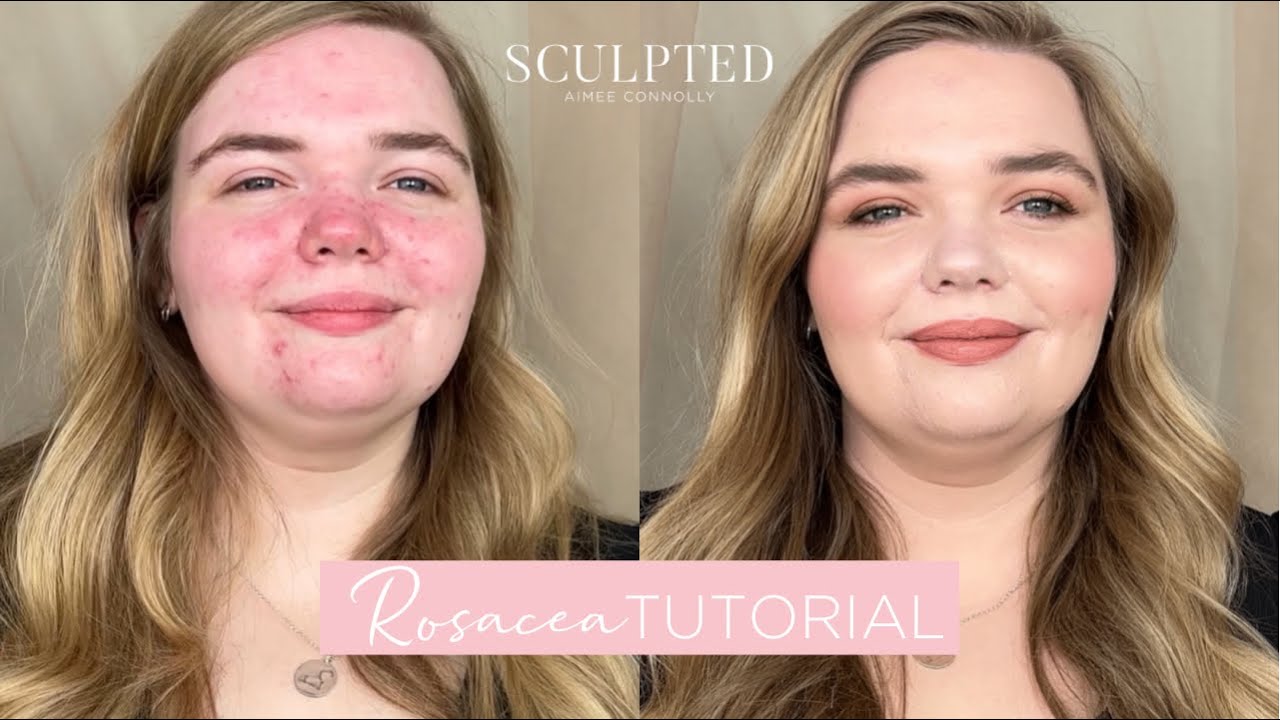
Green corrector is the standard fix for red discoloration, whether it comes from active blemishes, post-acne marks, or rosacea.
Rosacea affects an estimated 5.46% of the adult population globally, according to a meta-analysis published in the British Journal of Dermatology. A 2024 global study in the Journal of the American Academy of Dermatology found the highest prevalence in the 25-to-39 age group at 3.7%, which is also when most people establish serious makeup routines.
For widespread redness, a few drops of liquid green corrector mixed into moisturizer gives all-over balancing without visible color. For targeted spots, a cream formula with a precise brush is more controlled.
Smashbox’s Photo Finish Correct Anti-Redness Primer is a widely used option for rosacea coverage across large areas before foundation application.
Dark Circles
Dark circles vary by skin tone. This is where people get the corrector shade wrong most often.
- Fair skin: pink or light peach, targeting the blue-purple tone visible through thin under-eye skin
- Medium skin: peach, the classic corrector shade for this concern
- Deep skin tones: orange or red-brick, which cancel the gray-blue discoloration that reads more intensely against deeper pigmentation
A 2023 study published in the Pakistan Journal of Medical and Health Sciences found dark circles present in around 80% of young adults surveyed. That is a widespread concern with a straightforward corrective fix when the right shade is used.
Hyperpigmentation and Post-Acne Marks

Post-inflammatory hyperpigmentation (PIH) was the most frequently reported past skin concern across a 2025 study, affecting 66.2% of respondents.
Orange and red correctors address the deeper, brownish-gray discoloration that PIH leaves behind. Yellow works for lighter, more surface-level spots on fair to medium skin.
Important distinction: PIH is not the same concern as dark circles. Using a peach or orange corrector meant for under-eye circles on a flat dark spot from acne is not the same application. The spot needs full coverage over the discolored area, with edges blended out carefully.
Bruising and Sallowness
Yellow corrector cancels purple and blue-toned bruising. Apply directly over the bruise, tap rather than rub, and layer lightly.
Sallowness (that tired, yellowish dullness some skin develops) responds to lavender corrector. Lavender sits opposite yellow on the color wheel and instantly makes skin look more awake without adding warmth or color.
Kevyn Aucoin’s Face Forward Color Corrector uses peach, green, and red across three targeted shades, a format that covers the most common concerns without an overwhelming palette of options.
Common Color Corrector Mistakes
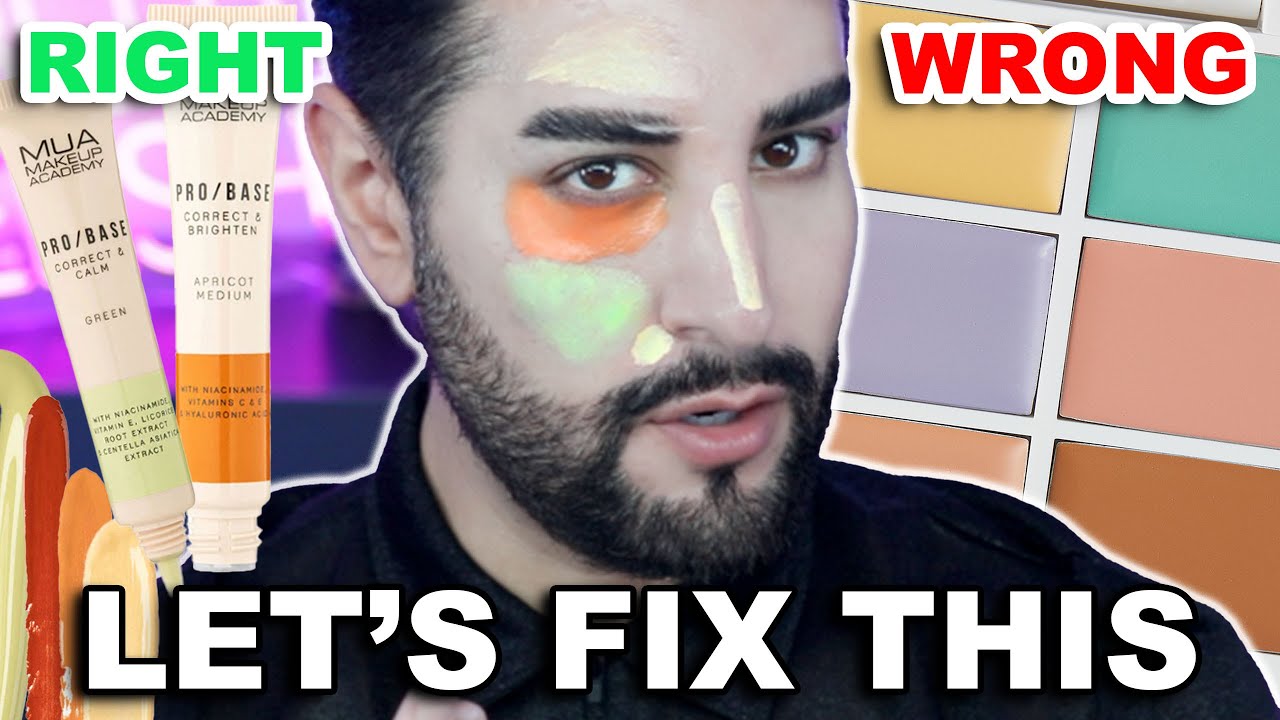
Most color correction failures come down to a handful of repeated errors. The technique is straightforward in theory. In practice, small missteps compound quickly.
| Mistake | What Happens | The Fix |
| Too much product | Color shows through foundation as a visible tint | Use a rice-grain amount, build slowly |
| Wrong shade for skin tone | Ashy, muddy, or no effect at all | Match corrector depth to skin tone depth |
| Green on dark circles | Does nothing, wrong color theory | Use peach, orange, or red instead |
| Skipping setting between steps | Corrector moves when foundation is applied | Dust translucent powder before foundation |
| Rubbing instead of tapping | Streaking, uneven distribution | Pat and press, never drag |
Kryolan, whose professional color correction guidance is used across film and stage makeup training, emphasizes that “less is more” is the core rule of correction. Too much corrector draws attention to the very area you are trying to fix.
Not setting each layer is equally common. When a cream corrector is applied and foundation is immediately blended over it, the two products mix. This creates the muddy, off-color result that makes people think color correctors do not work.
A study published in Herlan’s beauty research review found that 71% of makeup users do not blend properly, and skipping the setting step between corrector and foundation is a direct contributor to that issue.
Applying Over the Wrong Areas
Color correctors target specific zones. Spreading them across the full face is a waste of product and will shift the overall tone of your foundation.
Green corrector belongs only on red areas. Applying it across the entire face, hoping to pre-neutralize any redness, leaves a gray cast under foundation.
Targeted application only. Spot treat. Blend the edges carefully so there is no harsh line between the corrected area and the surrounding skin.
Not Blending Edges Properly
The corrector color should fade at the perimeter of the application zone, not stop abruptly.
When edges are not blended, foundation picks up the border between corrected and uncorrected skin and makes it visible. This is often mistaken for a product failure when it is actually a technique issue.
Blend the edges, not the center. The middle of the corrected area needs to stay put. The outer edges need to feather into surrounding skin with a clean brush or fingertip.
Color Corrector in Professional vs. Everyday Makeup
Color correction looks different depending on the context. What works for a film set will not translate to a 10-minute morning routine, and what works daily does not provide enough for high-resolution photography.
Professional Use: Film, Stage, and Photography
Professional kits rely on high-pigment cream correctors. Brands like Ben Nye, Mehron, and RCMA are standard across film and stage makeup setups because their pigment concentration is high enough to hold under lights, handle multiple takes, and stay stable across a full shoot day.
HD cameras and studio lighting pick up discoloration that is invisible to the naked eye. Kryolan’s professional guidance notes that color correction becomes particularly important for high-resolution photography because it allows a lighter overall foundation layer, reducing the flat, cakey look that heavy product buildup creates on camera.
For photography makeup, the general rule is that camera-facing work requires more correction than everyday life. A concern that blends into the background in a bathroom mirror can read clearly under a studio strobe.
One or two well-placed correctors, set properly, reduce the need for heavy foundation layering. That matters for both comfort and for how the final result photographs.
Everyday Wear: Keeping It Simple
For daily use, one or two corrector shades cover most people’s needs. Most people only have one or two consistent concerns, usually dark circles, redness, or general dullness.
Liquid formulas are easier to work with for everyday use. They blend faster and require less precision than cream correctors. NYX’s color-correcting products and Maybelline’s Instant Age Rewind line both offer liquid and stick formats at accessible price points.
Everyday corrector routine:
- One shade for your primary concern (dark circles, redness, or discoloration)
- Applied after primer, before foundation
- Set with a light translucent powder before moving on
When applying makeup daily, using a corrector in a stick format speeds up the process. Tap it on, blend the edges, and move forward without extra steps.
People who are covering acne with makeup regularly often find that a single green corrector stick replaces the need for two or three thick layers of concealer, which means less product, less weight on the skin, and a cleaner finish by end of day.
The face makeup segment accounts for 34.8% of the global color cosmetics market in 2025, according to Coherent Market Insights, with skin tone products, including correctors, primers, and foundations, driving that share alongside growing demand for skin-first formulations.
FAQ on What Is Color Corrector
What is a color corrector in makeup?
A color corrector is a tinted makeup product that neutralizes unwanted skin tones before foundation. It uses color theory, specifically complementary colors, to cancel discoloration like redness, dark circles, and hyperpigmentation at the base level.
What is the difference between a color corrector and concealer?
Concealer matches your skin tone and adds coverage. A color corrector uses an opposing hue to neutralize the discoloration first. They serve different functions and work best when used together, corrector underneath, concealer on top.
Which color corrector do I use for dark circles?
It depends on your skin tone. Fair skin responds to pink or light peach. Medium skin needs peach. Deep skin tones need orange or red, which cancel the gray-blue darkness that shows more intensely against deeper pigmentation.
Does green color corrector work for all redness?
Yes, for red and pink discoloration. Green cancels red across all skin tones. It works on acne marks, rosacea, and general skin irritation. Use it sparingly and only on red areas, not all over the face.
Do you apply color corrector before or after foundation?
Always before foundation. The correct order is skincare, primer, color corrector, foundation, concealer, then setting powder. Applying foundation first and corrector on top will not work. The corrector needs to sit directly against the skin concern.
Can I use color corrector without foundation?
Yes. Some people apply a corrector and go over it with a light skin tint or tinted moisturizer instead of full foundation. The corrector still neutralizes the discoloration. You just need something over it to blend the corrector color into the skin.
What color corrector is best for hyperpigmentation?
Orange or red correctors work best for post-inflammatory hyperpigmentation on medium to deep skin tones. Yellow handles lighter discoloration on fair to medium skin. The right choice depends on both the depth of the mark and your skin tone.
How much color corrector should I use?
Very little. A rice-grain amount is usually enough for one area. Too much product causes the corrector hue to show through foundation as a visible tint. Build slowly if needed. Less is almost always better with color correction technique.
What is the best color corrector formula for everyday wear?
Liquid and stick formulas are easier to blend and better suited to daily routines. Cream correctors offer more coverage but require a careful hand. Brands like NYX and Maybelline offer accessible everyday options in both formats.
Is color corrector the same as color-correcting primer?
Not exactly. A color-correcting primer applies across the full face and offers light, diffused correction. A dedicated color corrector is more pigmented and applied only to specific areas. Primers are better for mild, widespread tone concerns. Correctors handle targeted, pronounced discoloration.
Conclusion
This conclusion is for an article presenting what is color corrector, a technique built on color theory that most makeup routines genuinely benefit from once the basics are understood.
Skin pigmentation issues like rosacea, post-inflammatory hyperpigmentation, and dark circles are common. Concealer alone rarely solves them cleanly.
The right corrective makeup technique starts with identifying the actual color of the discoloration, matching it to the opposite shade on the color wheel, and applying a thin, targeted layer before foundation.
Formula choice matters too. Cream correctors for precision and coverage, liquid for everyday blending, stick for quick application on the go.
Used correctly, a single color corrector shade reduces the amount of foundation and concealer needed, leaving a more natural, even skin tone underneath everything else.

She started writing on the site after fielding the same questions from clients and friends often enough to just write the answers down: which red won't turn orange on a warm undertone, how to keep lipstick from feathering into fine lines, why a "12-hour" formula rarely survives dinner.
Every review on the site follows the same rule she uses with paying clients: wear it first, then decide if it's worth recommending.
- How to Make Eyeliner Last Longer Without Smudging - August 31, 2026
- How to Make Eyeshadow Last Longer All Day - August 29, 2026
- How to Find Your Undertone in 5 Easy Steps - August 27, 2026